- 256 pages
- English
- ePUB (mobile friendly)
- Available on iOS & Android
eBook - ePub
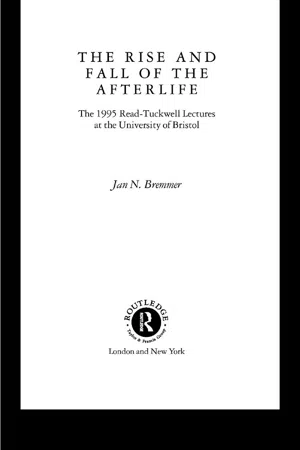
The Rise and Fall of the Afterlife
About this book
Belief in the afterlife is still very much alive in Western civilisation, even though the truth of its existence is no longer universally accepted. Surprisingly, however, heaven, hell and the immortal soul were all ideas which arrived relatively late in the ancient world. Originally Greece and Israel - the cultures that gave us Christianity - had only the vaguest ideas of an afterlife. So where did these concepts come from and why did they develop?
In this fascinating, learned, but highly readable book, Jan N. Bremmer - one of the foremost authorities on ancient religion - takes a fresh look at the major developments in the Western imagination of the afterlife, from the ancient Greeks to the modern near-death experience.
Information
1
INVENTING
THE AFTERLIFE
Even though their existence is no longer universally accepted, heaven and hell are still very much alive in Western civilisation. Priests and ministers often refer to them (if, admittedly, less to hell), literature uses them as metaphors, and the cinema even occasionally tries to represent them. Our ideas about the afterlife are part of the legacy of Christianity. As the first Christians were Jews, who lived in an area, Palestine, which at the time of Jesus was already heavily influenced by Greek culture,1 we might have expected that both Greece and Israel – or at least one of them – always had fully developed ideas about the soul and the afterlife. Yet nothing could be further from the truth. Heaven, hell and the immortal soul were all relative latecomers in the ancient world. Where, then, did these concepts come from and why did they develop? It is these questions which have stimulated me to write this study. Naturally, a book based on a series of lectures can only be selective. That is why I will start with a short, panoramic survey of the development of the soul (section 1) and afterlife (section 2) among the Greeks and Jews (section 3) of the pre-Christian era. This survey will provide the reader with the necessary background against which the succeeding chapters (section 4) have to be seen.
1. Greek concepts of the soul
In the twentieth century the Western world has seen a meteoric rise of the sciences of psychiatry and psychology: clearly, we all want to care for our psychê, ‘soul’, in this world.2 However, an early Greek would not have understood this usage of psychê, since in the poems of Homer, the Iliad and the Odyssey, there is not one seat of a person’s psychological attributes, but an enormously varied vocabulary.3 The most important word for the seat of emotions, such as friendship, anger, joy and grief, as well as emotion itself, is thymos,4 but there is also menos,5 ‘fury’, noos, ‘the act of the mind’,6 and the words for kidney, heart,7 lungs, liver and gallbladder, although all these words are often used in a semantically indistinguishable and redundant way.8
Unlike these terms, the psychê is never mentioned when its owner functions normally.9 This happens only at times of crisis. For instance, when the embassy of the Greek army beseeches Achilles to suppress his anger and resume fighting, he complains that he has been continually risking his psychê (IX.322). And when a spear was pulled from the thigh of Sarpedon, one of the allies of the Trojans, ‘his psychê left him and a mist came upon his eyes’ (V.696). In these, as in all other cases, the psychê is responsible for the maintenance of a person’s life, but its relative lack of importance is confirmed by the obscurity of its location. We only know for sure that it flew away from the limbs (XVI.856, XXII.362), through the mouth (IX.409), the chest (XVI.505) or through a wound in the flank (XIV.518).
It is the great merit of Scandinavian anthropologists in particular to have collected large amounts of data to show that most ‘primitive’ peoples have thought that man has two kinds of souls. On the one hand, there is what these scholars call the free-soul, a soul which represents the individual personality. This soul is inactive when the body is active; it manifests itself only during swoons, dreams or at death (the experiences of the ‘I’ during the swoons or dreams are ascribed to this soul), but it has no clear connections with the physical or psychological aspects of the body.10 On the other hand, there are a number of body-souls, which endow the body with life and consciousness, but of which none stands for the part of a person that survives after death.11
The Homeric concept of the soul of the living is clearly closely related to this ‘primitive’, dualistic concept of the soul. Here too we find on the one hand the psychê, a kind of free-soul, and on the other the body souls, thymos, noos and menos, as well as the more physical organs, such as phrenes, ‘lungs’, and êtor, ‘heart’. The free-soul was often associated with the breath, and this seems to have happened in Greece as well, since psychê is etymologically connected with psychein, ‘to blow or to breathe’.12 The connection was already made by Anaximenes (ca. 550–500 BC), who seems to have stated that the psychê held our body together and controlled it just as the wind controls the earth (B 2 DK). He was followed by other philosophers,13 and the same connection still occurs as a figura etymologica in an Orphic Gold Leaf (Ch. 2.2) found in 1974: ‘(the Underworld), where the psychai of the dead psychontai, “breathe.” ’14
In post-Homeric times the psychê no longer leaves the body of a living person, but otherwise its meaning gradually expands at the end of the Archaic Age.15 Hipponax now can say: ‘I will give my much-enduring psychê to evils’,16 a passage where psychê seems to come very close to our meaning of ‘self’. Somewhat differently, in a famous poem the more or less contemporaneous Anacreon says of a ‘boy with virgin glance’ that he is ‘the charioteer of my psychê’ (fr. 360 Page), where the psychê presumably is the seat of his emotional feelings.17 This development of the soul was taken up by Pythagoras when he ‘invented’ reincarnation and thus, by stressing the importance of the return of the soul, revalued the psychê in a remarkable way (Ch. 2.1). Pindar continued both these developments. On the one hand, he brings psychê in a sense close to ‘character’, when he describes men as having ‘psychai superior to possessions’ (Nem. 9.32) and, on the other, he made the soul even more important by calling it now ‘from the gods’ (fr. 129 Maehler).18
In the later tragedians the psychê has become the seat of all kinds of emotions and seems completely to have incorporated the thymos. The psychê now sighs, suffers pangs of emotion and melts in despair. It can even become ‘tied to bed’ (Eur. Hipp. 160) or ‘joined to a thiasos’ (Eur. Bacch. 75–6).19 This development of the psychê as the centre of man’s inner life culminated in Socrates’ view that a man’s most important task was ‘to care for his psychê’;20 at the same time, the incorporation of the thymos into the psychê probably led Plato to his theory of a tripartite soul.21 However, not all Greeks accepted the soul–body dualism, as Plato and Aristotle now articulated it in their varying ways. Important philosophical schools, such as the Epicureans and Stoics, or influential physicians, such as Herophilus and Erasistratus, continued to believe that the psychê does not exist independently from its body.22
Through the Septuagint, which was gradually composed in Alexandria in the third century BC (Appendix 2.4), psychê entered the vocabulary of the Greek-speaking Jewish community and subsequently that of the early Christians.23 As the Old Testament did not yet know the Greek opposition of soul and body (section 3), it would take a while before the early Christians started to use psychê in such a way. For example, in the apostle Paul we rarely find psychê and never in respect to the afterlife. He sometimes uses Jewish-sounding combinations like ‘every psychê’ (Romans 13.1); more ‘normally’, he uses psychê as the seat of emotions in his Letter to Philippians (1.27). It is only after the growing influence of philosophically trained Greek theologians, such as Clement of Alexandria and Origen, that the Platonic opposition was gradually taken over by the Christian community (Ch. 5.2). And in due time, the Greek concept of the soul would influence the ancient Germanic world via the Latin translations of the Bible and thus, eventually, be responsible for the content of our modern term ‘soul’, which derives from Germanic *saiwalo.24
Unlike the soul of the living, ideas about the soul of the dead have received much less systematic attention from scholars.25 Not surprisingly, anthropological studies have looked at those elements of the soul of the living that survive as a soul of the dead. To give one example, the word for the free-soul among the Siberian Mordvins is ört. Since the soul of the dead is also called ört, the conclusion can be drawn that among the Mordvins the idea of the soul of the dead was derived from the free-soul of the living, and this is indeed the case among most peoples. In Greece we would therefore expect that it was the psychê that survived, and that is exactly what we find. The dead Patroclus is represented by his psychê, who ‘resembles him in every respect’ (XXIII.65). Sometimes psychê is connected with eidôlon, ‘image’, as in the case of Patroclus, whose psychê ‘was wondrous like him’ (XXIII.104–7). The psychê of the Homeric dead has even kept some emotional faculties, since Ajax’s psychê stands ‘angrily’ aside and others are ‘grieving’ (Od. 11.541–3).26
Yet, such psychai are exceptions to the rule and typical of literature where individual dead have to have some mental faculties in order to come on stage.27 In other passages we hear that the psychê of the dead cannot be touched (XXIII.100), that it lacks the phrenes (XXIII.104) and that only the seer Teiresias possesses a noos: the others are mere ‘shadows’ (11.493–5). The dead are ‘the worn-out’ (11.476) or ‘the feeble heads of the dead’ (10.521, 11.29). What is striking here is the plural: the dead were clearly considered to be an enormous, undifferentiated group, as is also illustrated by a fragment of Sophocles, where the dead are compared to a swarm of bees: ‘Up [from the underworld] comes the swarm of the souls, loudly humming.’28 With so many visitors, it is not hard to understand that Aeschylus calls the Lord of the Underworld ‘the most hospitable Zeus of the dead’.29
This meaning of psychê as ‘soul of the dead’ will remain present all through antiquity, although it is relatively rare in lyric and elegiac poets and in tragedy. Yet the revaluation of the psychê of the living also affected the ways the dead were seen,30 and in the fifth century the dead are said to be apsychoi, ‘without a psychê’; dead Achilles can be called a ‘corpse without a psychê’, and, in a parody of this usage, Aristophanes even speaks of a psychê apsychos, ‘a soul-less soul’!31 The usage of psychê as soul of the dead was also taken over by the Jews and Christians.32 The best early example is undoubtedly in Revelations (20.4), where in one of his visions the author sees ‘the psychai of those who were beheaded’ in heaven.
2. Greek ideas of the afterlife
Now if the psychê changed in character over the ages, can we observe the same regarding life after death? In the Iliad a soul of the dead goes straight to the underworld,33 whose gates are guarded by canine Cerberus (Il. V.646).34 It is situated under the world, but also in the west – perhaps a sign of a conflation of different ideas about the underworld.35 The soul can reach this ‘mirthless place’ (11.94; Hes. Op. 152–5) only by crossing a river, the Styx, a crossing for which no help is required (XXIII.70–101; 11.51–4), but which cannot be done without a proper burial.36 The picture of the underworld is bleak and sombre, and dead Achilles understandably says: ‘do not try to make light of death to me; I would sooner be bound to the soil in the hire of anot...
Table of contents
- COVER PAGE
- TITLE PAGE
- COPYRIGHT PAGE
- PREFACE
- ABBREVIATIONS
- 1. INVENTING THE AFTERLIFE
- 2. ORPHISM, PYTHAGORAS AND THE RISE OF THE IMMORTAL SOUL
- 3. TRAVELLING SOULS?: GREEK SHAMANISM RECONSIDERED
- 4. THE RESURRECTION FROM ZOROASTER TO LATE ANTIQUITY
- 5. THE DEVELOPMENT OF THE EARLY CHRISTIAN AFTERLIFE: FROM THE PASSION OF PERPETUA TO PURGATORY
- 6. ANCIENT NECROMANCY AND MODERN SPIRITUALISM
- 7. NEAR-DEATH EXPERIENCES: ANCIENT, MEDIEVAL AND MODERN
- APPENDIX 1: WHY DID JESUS’ FOLLOWERS CALL THEMSELVES ‘CHRISTIANS’?
- APPENDIX 2: THE BIRTH OF THE TERM ‘PARADISE’
- APPENDIX 3: GOD’S HEAVENLY PALACE AS A MILITARY COURT: THE VISION OF DOROTHEUS
- NOTES
- BIBLIOGRAPHY
Trusted by 375,005 students
Access to over 1.5 million titles for a fair monthly price.
Study more efficiently using our study tools.
Frequently asked questions
Yes, you can cancel anytime from the Subscription tab in your account settings on the Perlego website. Your subscription will stay active until the end of your current billing period. Learn how to cancel your subscription
No, books cannot be downloaded as external files, such as PDFs, for use outside of Perlego. However, you can download books within the Perlego app for offline reading on mobile or tablet. Learn how to download books offline
Perlego offers two plans: Essential and Complete
- Essential is ideal for learners and professionals who enjoy exploring a wide range of subjects. Access the Essential Library with 800,000+ trusted titles and best-sellers across business, personal growth, and the humanities. Includes unlimited reading time and Standard Read Aloud voice.
- Complete: Perfect for advanced learners and researchers needing full, unrestricted access. Unlock 1.5M+ books across hundreds of subjects, including academic and specialized titles. The Complete Plan also includes advanced features like Premium Read Aloud and Research Assistant.
We are an online textbook subscription service, where you can get access to an entire online library for less than the price of a single book per month. With over 1.5 million books across 990+ topics, we’ve got you covered! Learn about our mission
Look out for the read-aloud symbol on your next book to see if you can listen to it. The read-aloud tool reads text aloud for you, highlighting the text as it is being read. You can pause it, speed it up and slow it down. Learn more about Read Aloud
Yes! You can use the Perlego app on both iOS and Android devices to read anytime, anywhere — even offline. Perfect for commutes or when you’re on the go.
Please note we cannot support devices running on iOS 13 and Android 7 or earlier. Learn more about using the app
Please note we cannot support devices running on iOS 13 and Android 7 or earlier. Learn more about using the app
Yes, you can access The Rise and Fall of the Afterlife by Jan N. Bremmer in PDF and/or ePUB format, as well as other popular books in Theology & Religion & Comparative Religion. We have over 1.5 million books available in our catalogue for you to explore.