This book presents a novel and systematic social theory of soil, and is representative of the rising interest in 'the material' in social sciences. Bringing together new modes of 'critical description' with speculative practices and methods of inquiry, it contributes to the exploration of current transformations in socioecologies, as well as in political and artistic practices, in order to address global ecological change.
The chapters in this edited volume challenge scholars to attend more carefully to the ways in which they think about soil, both materially and theoretically. Contributors address a range of topics, including new ways of thinking about the politics of caring for soils; the ecological and symbiotic relations between soils; how the productive capacities and contested governance of soils are deployed as matters of political concern; and indigenous ways of knowing and being with soil.
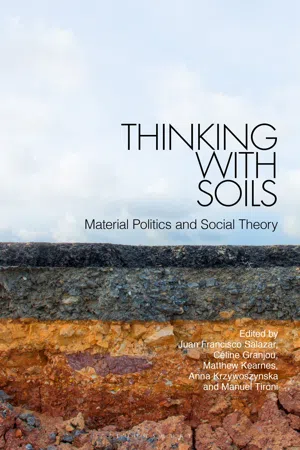
eBook - ePub
Thinking with Soils
Material Politics and Social Theory
- 256 pages
- English
- ePUB (mobile friendly)
- Available on iOS & Android
eBook - ePub
Thinking with Soils
Material Politics and Social Theory
About this book
Information
1
Thinking-with Soils: An Introduction
Juan Francisco Salazar, Céline Granjou, Anna Krzywoszynska, Manuel Tironi, and Matthew Kearnes
Origins
The geneses of this book go back to two parallel encounters. First, the international workshop “Going to Ground,” convened in October 2016 in Sydney by Matthew Kearnes, with Céline Granjou and Juan Francisco Salazar, which was designed as an opportunity to think both creatively and earnestly about the dirt we live on and off. The workshop brought together many of the contributors in this book to discuss how soil conservation and improvement practices are being marshaled in response to concerns over climate change, food security, and rural livelihoods, and how these might be indicative of the deep connections between soil and social processes. Second, the book also has its beginnings in a series of panels at the Knowledge/Culture/Ecologies International Conference held in Santiago, Chile, in November 2017, convened by Juan Francisco Salazar and Céline Granjou, where all five co-editors outlined the initial analytical coordinates for this book. These panels also served as a catalyst to start a broader interdisciplinary discussion that had been brewing, and which we see as having been largely initiated by Maria Puig de la Bellacasa through her pioneering work in recent years. This discussion aimed to engage scholars from not only the humanities and social sciences but also the ecological and soil sciences, as well as soil practitioners, particularly those proponents of integrative science frameworks and social-ecological systems thinking. A premise of these conference panels was that, despite notable contemporary reconceptualizations of soil as a matter of care and concern, it is striking to observe how soil, and its manifold entanglements with plants, fungi, bacteria, and other forms of life, remains largely undertheorized or ignored in contemporary social theory. Despite soil’s vital ecological importance, its significance as a belowground three-dimensional living world remains elusive in social and cultural research. This book is about developing work that is attuned and attentive to generating more ethical relations with nonhumans who both pervade and create livable environments, such as soil biota (Krzywoszynska 2019).

Figure 1.1 Coonawarra, Australia. Image: Charles G [https://unsplash.com/photos/WO7rUJFaJwQ ].
Crisis in the Critical Zone
Historically, critical attention from the social sciences to soils had been predominantly limited to understanding and explaining their role as resources underpinning food production under systems of intensive agriculture in contexts of ongoing capitalist expansion and colonialism. As the vast majority of human food is still derived directly from soils, it is arresting to think that as much as several tons of topsoil are lost for every ton of grain produced. The scale and severity of soil degradation has been highlighted by the natural science community for decades and is indicative of a much broader breakdown of soils as “bioinfrastructures” (Puig de la Bellacasa 2014). Soils are that vital layer, the so-called “critical zone” (Ashley 1998) that involves all the complex interactions connecting rock, soil, water, air, and living organisms that regulate life-sustaining resources. The critical zone enables all the processes that make the terrestrial surface of the globe habitable for humans, plants, animals, fungi and their millions of diverse life forms. That soils are a non-renewable resource in human timescales makes the degradation of this “life support system” even more alarming. Pedogenesis (soil creation) usually occurs at timescales well beyond many human generations.
With this new integrative critical zone paradigm, the natural sciences are positioning soils on the front line of global environmental change and a final frontier of environmental research. Scientists insist on a very critical matter of concern: soil security during what is considered to be a global soil crisis (Koch et al. 2013). As Koch et al. put it, “soil security is a new concept that has arisen during a time of emerging international response to the increasingly urgent problems that face the global soil stock” (2013: 434).
Nearly all terrestrial life, including humans, depends on this critical zone underpinned by geosocial formations linking the Earth’s surface processes and geosystems with human practices both ancient and contemporary. Changes in the planet’s biogeochemical flows (phosphorus and nitrogen cycles) point to the important role played by soils as a key planetary boundary and for thinking-with about what Will Steffen and others have termed “safe operating zones for humanity” (Steffen et al. 2015). The natural science community has in many ways taken the lead in and set the tone for the urgency of what is frequently referred to as the “global soil crisis.” Natural scientists have been leading the charge in raising the alarm about the degradation of soils worldwide and in attempting to address this problem, primarily by seeking to influence policymakers. Their efforts have in recent years led to the publishing of influential reports, the most cited of which is the United Nations’ Food and Agricultural Organization’s (FAO) 2015 Status of the World’s Soil Resources Report (SWSR), prepared by the Intergovernmental Technical Panel on Soils (ITPS). The report, which included the assessment of more than 200 environmental scientists of the state of knowledge on soil resources and soil change, was launched in December 2015, simultaneously with the opening for signatures of the Paris Agreement, which entered into force on November 4, 2016. The report’s overwhelming conclusion was that most of the world’s soil resources are in only fair, poor, or very poor condition. Since then, a series of new reports have shown that since the 1970s nearly two billion hectares of soil—equivalent to 15% of the Earth’s land area (an area almost twice the size of Australia)—have been degraded through human activities (FAO 2015).
In this increasingly heard narrative, the running out of topsoil is one of the most serious global threats facing humanity this century, with some scientists estimating that at current rates of soil degradation there could be no more than 60 years of topsoil left (Crawford 2012). Global soil degradation is being linked to “human pressures” on soils, which are said to have reached a pace and intensity that is unprecedented, particularly since the “Great Acceleration” in the 1950s (Steffen et al. 2015). The specter of soil collapse becomes a haunting narrative that “raises concerns marked by fears of gloomy environmental futures, prompting scientists and soil practitioners urgently to develop better ways of taking care of soils” (Puig de la Bellacasa 2015: 691). As Puig de la Bellacasa notes, “in contrast with visions of exhausted soils prey to a voracious humanity eating its nest, transformative involvements with soil’s aliveness assert the ecological significance of human–soil interdependency and disrupt persistent binaries between living and inert, species and belonging, the earthly and the spiritual, endurance and breakdown, the cosmic and the domestic, knowledge and mystery” (2017: 63). This is important to point out. In conversations with farmers, for example, Anna Krzywoszynska explains how this “alarmist” narrative about soils is seen very much as “a scientific thing,” not connected with the lived experience of farm managers.
While the symptoms are being increasingly better described, diagnosing the causes of the crisis, and imagining ways forward, is proving challenging. The aforementioned FAO report identifies increases in human population, urbanization, education, and social equity, changes in cultural values, as well as “land market failure,” unsustainable consumption, war and civil strife, and climate change as some of the key human drivers of soil degradation. Policies, research, and education are seen in the report as the primary mechanisms for acting on these drivers. Existing policy approaches to the management of soils are proving to be inadequate in dealing with the double “nature” of soils as both public goods and private property (Bartkowski et al. 2018). This is leading increasingly to arguments for a greater valuation of soils as natural capital (Davies 2017) and/or environmental services (Bouma 2014), in line with the predominant market-led and technocratic logics of environmental governance in the Global North.
On the other hand, the rise of soil ecology has been relying on the development of soil DNA analysis techniques since the mid 2000s—leading to rising hopes for deciphering soil’s genetic “text” (as for instance through the TerraGenome consortium implemented in 2009, modeled on the Human Genome Project), as well as for post-Pasteurian perspectives of prospecting and enhancing underground microbial activities, including using microbes as new lively models for understanding, controlling, and improving global environmental resilience in an era of climate change (Granjou and Phillips 2018; Cavicchioli et al. 2019). Soil biota are not only reimagined as a new site of promissory bio-economical hopes; they are also enrolled in emergent technoscientific expectations of reforming society through fostering “bio-literacy”—i.e., the awareness of the critical and multifarious roles played by microbes, including soil microbes, in the environment—including through a recent call by a panel of microbial ecologists to introduce microbiology fundamentals at preschool (Timmis et al. 2019).
The Dithering: Soils, Humanities, the Anthropocene
Characterizations of the Anthropocene as a human-inflicted distinct geological epoch proliferate: the Anthropocene as aftermath (of capitalism and late liberalism); the Anthropocene as the disaster to end all disasters; the Anthropocene as transition. As these multiple interpretations suggest, it is difficult to theorize an epoch of this magnitude while it is still unfolding. As “the crease of time” (Dibley 2012) and an instance of transition, the Anthropocene has also been described in an original way. In the novel 2312 (2012), US science fiction writer and cultural theorist Kim Stanley Robinson develops a fictional character, Charlotte, a historian who establishes a periodization from the early twenty-first to the early twenty-fourth centuries. She terms the period from 2005 to 2060 “the Dithering.” To dither is to be unable to decide about doing something. Robinson mobilizes this concept as a way of accounting for our current epoch as “a state of indecisive agitation” over climate change, and the failure to preempt what came next: the 2060 to 2130 period known as the Crisis (Robinson 2012: 144–45; see also Haraway 2015).
We invoke Robinson’s term here to qualify these times of perplexity, where humanity—or rather, its political leaders and economic elites—find themselves dithering, but also to illustrate what Bruno Latour (2018: 40) terms a “reorientation of the site of politics” toward the terrestrial. In part, Latour’s argument in Down to Earth: Politics in the New Climatic Regime (2018) is that we need a new term for this new “attractor” that might be able to encompass “the stupefying originality (the stupefying longevity) of this agent.” For Latour, “the Terrestrial, with a capital T” is emphasized “as a new political actor” (2018: 40).
Soils are a perfect companion to recognize the complex blend of sociopolitical predicaments and physico-material negotiations of planetary “boundary conditions” and “safe operating spaces,” which are not only indicative of the need for new ethical engagements but also suggestive of a new kind of “geologic politics.”
This book is an attempt to shake up shared assumptions about what it may mean to be “grounded.” In it, we seek to burrow into the ground and get our ideas dirtied by soil’s multiplicity, complexity, and uncertainty. By contemplating down under our feet, we note the connectivities that exist and em...
Table of contents
- Cover
- Half-Title Page
- Series Page
- Title Page
- Contents
- List of Figures
- Notes on Contributors
- Acknowledgments
- Foreword
- 1 Thinking-with Soils: An Introduction
- 2 Soil Theories: Relational, Decolonial, Inhuman
- 3 Mapping Soil, Losing Ground? Politics of Soil Mapping
- 4 Soils and Commodification
- 5 Knowing Earth, Knowing Soil: Epistemological Work and the Political Aesthetics of Regenerative Agriculture
- 6 To Know, To Dwell, To Care: Towards an Actionable, Place-based Knowledge of Soils
- 7 Soiling Mars: “To Boldly Grow Where No Plant Has Grown Before”?
- 8 Geosocial Polar Futures and the Material Geopolitics of Frozen Soils
- 9 A Mend to the Metabolic Rift? The Promises (and Potential Pitfalls) of Biosolids Application on American Soils
- 10 Reclaiming Freak Soils: From Conquering to Journeying with Urban Soils
- 11 Soil Refusal: Thinking Earthly Matters as Radical Alterity
- 12 Geophagiac: Art, Food, Dirt
- Index
- Copyright
Trusted by 375,005 students
Access to over 1.5 million titles for a fair monthly price.
Study more efficiently using our study tools.
Frequently asked questions
Yes, you can cancel anytime from the Subscription tab in your account settings on the Perlego website. Your subscription will stay active until the end of your current billing period. Learn how to cancel your subscription
No, books cannot be downloaded as external files, such as PDFs, for use outside of Perlego. However, you can download books within the Perlego app for offline reading on mobile or tablet. Learn how to download books offline
Perlego offers two plans: Essential and Complete
- Essential is ideal for learners and professionals who enjoy exploring a wide range of subjects. Access the Essential Library with 800,000+ trusted titles and best-sellers across business, personal growth, and the humanities. Includes unlimited reading time and Standard Read Aloud voice.
- Complete: Perfect for advanced learners and researchers needing full, unrestricted access. Unlock 1.5M+ books across hundreds of subjects, including academic and specialized titles. The Complete Plan also includes advanced features like Premium Read Aloud and Research Assistant.
We are an online textbook subscription service, where you can get access to an entire online library for less than the price of a single book per month. With over 1.5 million books across 990+ topics, we’ve got you covered! Learn about our mission
Look out for the read-aloud symbol on your next book to see if you can listen to it. The read-aloud tool reads text aloud for you, highlighting the text as it is being read. You can pause it, speed it up and slow it down. Learn more about Read Aloud
Yes! You can use the Perlego app on both iOS and Android devices to read anytime, anywhere — even offline. Perfect for commutes or when you’re on the go.
Please note we cannot support devices running on iOS 13 and Android 7 or earlier. Learn more about using the app
Please note we cannot support devices running on iOS 13 and Android 7 or earlier. Learn more about using the app
Yes, you can access Thinking with Soils by Juan Francisco Salazar, Céline Granjou, Matthew Kearnes, Anna Krzywoszynska, Manuel Tironi, Juan Francisco Salazar,Céline Granjou,Matthew Kearnes,Anna Krzywoszynska,Manuel Tironi in PDF and/or ePUB format, as well as other popular books in Politics & International Relations & Agricultural Public Policy. We have over 1.5 million books available in our catalogue for you to explore.