eBook - ePub
Advertising Cultures
- 236 pages
- English
- ePUB (mobile friendly)
- Available on iOS & Android
eBook - ePub
Advertising Cultures
About this book
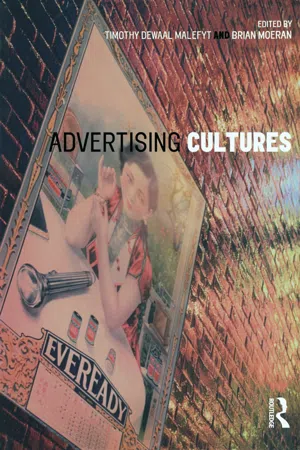
Through its artful engagement with consumers, advertising subtly shapes our everyday worlds. It plays upon powerful emotions -- envy, fear, lust and ambition. But the industry itself is far more subtle and complex than many people might assume. Through an innovative mix of business strategy and cultural theory, this pioneering book provides a behind-the-scenes analysis of the link between advertising and larger cultural forces, as well as a rare look into the workings of agencies themselves. How do advertisements endeavour to capture real life? How do advertising agencies think of their audience: the consumer and their corporate client? What issues do agencies have to consider when using an advertisement in a range of different countries? What specific methods are used to persuade us not only to buy but to remain loyal to a product? How do advertisers fan consumer desire? An incisive understanding of human behaviour is at the core of all these questions and is what unites advertisers and anthropologists in their work. While this link may come as a surprise to those who consider the former to be firmly rooted in commerce and the latter in culture, this book clearly shows that these two fields share a remarkable number of convergences. From constructing a Japaneseness that appeals to two very different Western audiences, to tracking advertising changes in the post World War II period, to considering how people can be influenced by language and symbols, Advertising Cultures is an indispensable guide to the production of images and to consumer behaviour for practitioners and students alike.
Information
1
How Advertising Makes its Object
Ask anyone to reflect on his or her own society, and they will produce a folk ethnography. To this extent, everyone is an ethnographer, not because human beings routinely stand back and reflect on the nature of their society but because every person has tacit knowledge and the ready-to-hand skills that allow him, let’s say, to rise on certain occasions and remain seated on others. It is this knowledge or skill that the ethnographer seeks to understand and, when he does, what he produces is simply a worked-up version of what the actor entertained more naturally. While there is more to ethnographic analysis than gaining access to the mental states of one’s informants, the equivalence of actors’ understandings and ethnographic ones is a defining mark of anthropology as a discipline.
If every human being is a folk ethnographer by default, anthropologists and advertising executives are ethnographers in the strict sense of the word. In different ways both are trained as such, and both get paid for making claims about how the natives think.1 In the case of advertising, agencies compete with one another by claiming better knowledge of how that thinking will affect a particular product or service. Addressing a prospective client, an executive musters the equivalent of ethnographic authority, that hard-to-define sense that the person speaking knows. Logical similarities aside, the two professions are becoming interdependent in everyday practice. As Mazzarella points out (this volume), where agencies once hired psychologists, they now advertise for anthropologists and insert them into agencies as ‘future planners.’2
Anthropologists have encountered a crisis of confidence over the last two decades or so, questioning whether the idea of meaning, much less the concept of culture, can allow anthropologists to make claims about other kinds of people. At roughly the same time, the culture idea has drifted into popular discourse, and advertising executives nowadays speak of culture as a way to talk about consumption as a social phenomenon (as opposed to a purely psychological one). Business constraints steer advertising executives away from the worst excesses implied by the idea. To make a plausible pitch, executives need to stay current in a way most ethnographers, who eventually have to leave their fieldwork sites, cannot. Concentrating on demographic complexities provides a second advantage. Having to attend to markets within markets militates against the temptation to understand a society as a single entity. Advertising executives might in principle have knowledge of the natives that is not only sophisticated but also less prone to the essentialism and ahistoricism – ‘these people have an essence; they are irremediably and always one way and not another’ – of which ethnographic accounts have been accused.
My interest in the advertising business came from contemplating the analogy between anthropological and advertising practice, and it led me to think that here was a way to learn something new about Sri Lankan society. Why not ask people who have a professional interest in understanding that society just what they know about it? Anthropologists interested in Sri Lanka have understood it as a society shaped by local religious, kinship, caste, and land tenure systems. More recently, they have emphasized new expressions of Buddhism, ethnic violence, and the historical memory. These interests have created a picture of Sri Lanka that is admirable but incomplete. Advertising people are interested in the same society pictured in different terms. For them, Sri Lanka is a society of consumers. It fans out from Colombo and divides neatly into two groups – the middle class, typically English-speaking and living in Colombo, and those who live in provincial cities and villages.
Much has been made of ethnographic work as a task that produces texts.3 Instead of assuming that the intellectually-central parts of the endeavor are participant observation, interviewing, and their default value, ‘being there,’ anthropological theorists two decades ago began to focus on the way ethnography gets written. They insisted that the way anthropological knowledge is reduced to journal, lecture, and book form is a constitutive act and deserving of scrutiny. By this recent standard, ethnographers have another characteristic in common with account managers, copywriters, and other creative people in the advertising business. Nonetheless, while anthropologists produce ethnographic texts, the texts which advertising people produce – a thirty-second commercial qualifies as a ‘text’ just as much as a book – create another kind of knowledge.4
The ethnographic study of Sri Lanka begins with Seligmann’s early twentieth century account of the island’s only aboriginal people, the Väddas, and that focus on the primitive, the traditional, and the unspoilt set the course.5 By the 1950s and 60s – when Leach, Tambiah, and Obeyesekere began their work – ethnographic interest had settled on village life. Only recently, and then haltingly, has it looked to urban settings, modernity, and transnational processes in the island. In other words, anthropological research on Sri Lanka started out in a way that could be criticized as exoticizing or orientalizing. Advertising could be criticized for contrary sins. Its focus fell first on a small, Westernized elite living mainly in Colombo. Advertisements, framed in English, and often featuring line drawings of European faces and places, treated those consumers as ‘brown Englishmen’ given to the tastes and values – even through the 1960s and 70s – of Victorian England. For the first two-thirds of the twentieth century, advertising ignored the great majority of Sri Lankans. Over the last third, advertising and ethnography moved in opposite directions – ethnography spread from village to town; advertising from the capital city to the hinterlands.
If anthropology is understood as ‘writing’ culture, what advertising ‘writes’ ends up producing culture. When ethnographers construct a picture of the remote parts and peoples of Sri Lanka as exotic, they too create culture. But when advertising does so, the Sri Lankans who view advertisements start to inhabit the cultural forms pictured in those advertisements in a way that is direct and powerful. Although producing culture is an unintended result of motives that are commercial and not representational, this byproduct has great importance for people’s self-understandings. Newspapers and periodical literature link the members of a society in an ‘imagined community,’ their regularity, demotic focus, and world-making qualities joining people who have no face-to-face experience of fellow readers in a league of anonymous equals.6 Television pushes these effects much further, joining viewers in an electronic community made stronger by higher levels of both synchronicity and visual power. While newspapers, radio, and television entertain and inform, the advertisements that drive these media carry existential force that can overpower other forms of content. Advertisements create this force by converting commodities into ‘libidinal images of themselves,’ placing goods and services in ‘zones of display’ that motivate desire and fear.7
The proposition that advertising like ethnography ‘writes’ culture, like all metaphors, has its limits. Advertising executives play the role of ethnographer with real disadvantages. Unlike the solitary ethnographer’s work, advertising is produced by many hands, and, as Malefyt shows (this volume), competing interests influence that product in surprising ways.8 As part of an urban-dwelling middle class, executives have negligible contact with people who live in villages. Executives invariably speak English as their first language and transact business in English (most Sri Lankans do neither). Advertising executives have the Westernized tastes and interests that characterize ‘brown Englishmen’ all across South Asia.9 Disproportionate numbers of them come from minority communities. Many are Burghers, that is, the European or Eurasian descendants of Dutch colonists, and others are Sinhala or Tamil Christians. And whatever their ethnic origins, advertising executives are cosmopolitan people, keeping them at a remove from most Sri Lankans. The social distance that separates the people of the advertising profession from their public may be no greater in Sri Lanka than in many postcolonial countries, but that distance reinscribes in their everyday lives the distinctions between foreign and local, the modern and the traditional that figure prominently in advertising texts.
Moreover advertising does not simply ‘write’ culture because it does more than provide information about products and address consumers. When anthropologists advocate for the rights of, let’s say, indigenous people, those communities have a sense of their own identity. When advertising executives use the word ‘segment,’ they employ it not as a noun but a verb. To segment a market is to create a market segment, not merely respond to an existing one.10 As in the expression ‘young urban professionals,’ segmenting a market begins with an act of phrase-making. Something more is required to turn fictive communities into communities of consumption. Advertising cannot create that segment without inventing tropes of gender, ethnicity, class, and locality that cause consumers to identify with the people and practices depicted in advertisements.
In so doing, advertising executives create new and often startling images of the people who read advertisements and watch commercials. They are hardly the only source of images of Sri Lankan society people encounter, and those images are reinterpreted as they are read.11 But whatever individuals make of them, advertising representations of Sri Lankan society have become a way in which people acquire a sense of place or locality, and thus of themselves. If figures of the modern show Sri Lankans how to be less like themselves, figures of the local show them how to be more Sri Lankan. Given the social distance that separates the people who make advertisements from the people who consume them, figures of the local can be as alien as figures of the modern. Whether advertising deterritorializes the imagination or domesticates it, it follows the same trajectory. Exhorting, advising, and sometimes merely picturing, advertising has no reason to exist if it cannot move people towards something new.
Proposing an advertising campaign to prospective clients, advertising executives need to know more than the people who constitute their market. As Brian Moeran’s chapter makes clear, they also need to understand the predispositions of the clients seated across the room.12 For an advertising executive, closing the deal requires a set of symbolic interactional skills that allow her to win the confidence of clients who come to that encounter with the full range of human pecu...
Table of contents
- Cover
- Half Title
- Title Page
- Copyright Page
- Contents
- Preface
- Acknowledgements
- Foreword: A Word from our Sponsor – Anthropology
- Introduction: Advertising Cultures – Advertising, Ethnography and Anthropology
- 1 How Advertising Makes its Object
- 2 Critical Publicity/Public Criticism: Reflections on Fieldwork in the Bombay Ad World
- 3 Advertising, Production and Consumption as Cultural Economy
- 4 Imagining and Imaging the Other: Japanese Advertising International
- 5 The Revolution in Marketing Intimate Apparel: A Narrative Ethnography
- 6 Models, Metaphors and Client Relations: The Negotiated Meanings of Advertising
- 7 Fame and the Ordinary: ‘Authentic’ Constructions Of Convenience Foods
- 8 Psychology vs Anthropology: Where is Culture in Marketplace Ethnography?
- Afterword: Looking Forward, Looking Back
- List of Contributors
- Index
Trusted by 375,005 students
Access to over 1.5 million titles for a fair monthly price.
Study more efficiently using our study tools.
Frequently asked questions
Yes, you can cancel anytime from the Subscription tab in your account settings on the Perlego website. Your subscription will stay active until the end of your current billing period. Learn how to cancel your subscription
No, books cannot be downloaded as external files, such as PDFs, for use outside of Perlego. However, you can download books within the Perlego app for offline reading on mobile or tablet. Learn how to download books offline
We are an online textbook subscription service, where you can get access to an entire online library for less than the price of a single book per month. With over 1.5 million books across 990+ topics, we’ve got you covered! Learn about our mission
Look out for the read-aloud symbol on your next book to see if you can listen to it. The read-aloud tool reads text aloud for you, highlighting the text as it is being read. You can pause it, speed it up and slow it down. Learn more about Read Aloud
Yes! You can use the Perlego app on both iOS and Android devices to read anytime, anywhere — even offline. Perfect for commutes or when you’re on the go.
Please note we cannot support devices running on iOS 13 and Android 7 or earlier. Learn more about using the app
Please note we cannot support devices running on iOS 13 and Android 7 or earlier. Learn more about using the app
Yes, you can access Advertising Cultures by Timothy de Waal Malefyt, Brian Moeran, Timothy de Waal Malefyt,Brian Moeran in PDF and/or ePUB format, as well as other popular books in Social Sciences & Advertising. We have over 1.5 million books available in our catalogue for you to explore.