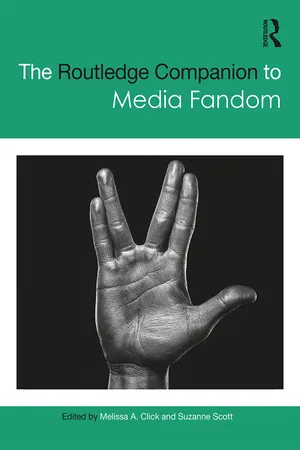
The field of fan studies has seen exponential growth in recent years and this companion brings together an internationally and interdisciplinarily diverse group of established scholars to reflect on the state of the field and to point to new research directions. Engaging an impressive array of media texts and formats and incorporating a variety of methodologies, this collection is organized into six main sections: methods and ethics, technologies and practices, identities, race and transcultural fandom, industry, and futures. Each section concludes with a conversation among some of the field's leading scholars and industry insiders to address a wealth of questions relevant to each section topic.
eBook - ePub
The Routledge Companion to Media Fandom
- 462 pages
- English
- ePUB (mobile friendly)
- Available on iOS & Android
eBook - ePub
The Routledge Companion to Media Fandom
About this book
Information
Part I
METHODS AND ETHICS
Introduction
Throughout its history, fan studies has been more focused on the analysis of fan communities and practices than on a discussion of the methods and ethics involved in the process of engaging fans and fandom. While fan studies scholars’ protectivist orientation toward fan communities has made research ethics a more prominent topic in conversations about scholarly practices (the September 2016 special issue of The Journal of Fan Studies is a notable example), the relative dearth of information about the methods of fan studies has made teaching challenging and learning to produce fan studies scholarship daunting. While we believe there is no true method or one clear ethical stance one should adopt when studying fan cultures, the collection of chapters in this section raise important ethical considerations and discuss the kinds of information that can be gleaned about fandom when using particular methods. Our hope is that these chapters will prove useful in the classroom as well as in the field.
Kristina Busse opens this section with an examination of the ethics of studying fandom online; and through case studies and discussion of her own experience, she demonstrates the difficulties of crafting a universal list of best practices and underscores the need to continually evaluate the wealth of issues raised when studying fan cultures online. The utility of psychoanalysis for fan studies is the focus of Matt Hills’ chapter; in it he argues that fandom bridges fans’ internal and external worlds, and exhibits the psychosocial processes revealed when taking a psychoanalytic approach to affective relations like antagonism and to fan practices like waiting and binge-watching. Kathy Fuller-Seeley’s discussion of historical fan practices reminds us that our knowledge of contemporary fans’ relationships with media and celebrities are rooted in longstanding practices and orientations; through case studies and suggestions for finding historical evidence of fan practices, Fuller-Seeley argues that while the histories uncovered of previous fandoms will necessarily be partial, they are unquestionably valuable. Online surveys are the focus of Lucy Bennett’s chapter, in which she considers the ethics, design and distribution of this research tool through her own experiences; Bennett also offers suggestions to help improve representativeness and guide analysis of the data collected. Hemphill, Kocurek, and Rao demonstrate the utility of cross-pollinating discussions of method between game studies and fan studies, especially where both areas of study examine the everyday practices of gamers and fans. They specifically explore three approaches to examining community norms and standards using the large volumes of texts produced inside and outside of game forums: conversation analysis, text mining, and social network analysis. Classroom ethics take center stage in Katherine E. Morrissey’s discussion of the issues raised by her use of fan remix practices, specifically vidding, with her students; through an exploration of vidding’s history, vidding as media criticism, and the challenges she has faced using vids in the classroom, Morrissey highlights the pedagological issues teachers should consider before incorporating fan works into one’s syllabus. Will Brooker, Mark Duffett, and Karen Hellekson conclude this section with an engaging conversation about Aca-fandom (an identity adopted by fan scholars who embrace their investments and participation in both academia and fan communities), ethics, and methodology, debating important recurring questions in fan studies.
Further Reading
Abel, R. (2015) Menus for Movieland: Newspapers and the Emergence of American Film Culture, 1913–1916. Berkeley: University of California Press.
AoIR (2012) “Ethical Decision-Making and Internet Research 2.0: Recommendations from the AoIR Ethics Working Committee,” http://aoir.org/ethics/.
Barker, M. and Mathijs, E. (2012) “Researching World Audiences: The Experience of a Complex Methodology,” Participations, 9(2): 664–698.
Bennett, L., Chin, B. and Jones, B. (2016) “Between Privacy, Ethics, Fandom and Social Media: New Trajectories that Challenge Media Producer/Fan Relations,” in A. Davisson and P. Booth (eds.) Controversies in Digital Ethics. London: Bloomsbury Press, pp. 107–122.
Busse, K. and Hellekson, K. (2012) “Identity, Ethics, and Fan Privacy,” in K. Larsen and L. Zubernis (eds.) Fan Culture: Theory/Practice. Newcastle: Cambridge Scholars Publishing, pp. 38–56.
Butsch, R. (2000) The Making of American Audiences: From Stage to Television, 1750–1990. Cambridge: Cambridge University Press.
Cavicchi, D. (2014) “Fandom before ‘Fan’”: Shaping the History of Enthusiastic Audiences,” Reception: Texts, Readers, Audiences, History 6, pp. 52–72.
Coppa, F. (2008) “Women, Star Trek, and the Early Development of Fannish Vidding,” Transformative Works and Cultures, (1).
Fuller-Seeley, K. (ed.) (2008) Hollywood in the Neighborhood: Historical Case Studies of Local Moviegoing. Berkeley, CA: University of California Press.
Garfinkel, H. (1967) Studies in Ethnomethodology. Cambridge: Polity Press.
Gray, J., Cornel Sandvoss and Lee Harrington C. (eds.) (2007) Fandom: Identities and
Communities in a Mediated World. New York: NYU Press.
Harrington, C. L. and Bielby, D. D. (1995) Soap Fans: Pursuing Pleasure and Making Meaning in Everyday Life. Philadelphia, PA: Temple University Press.
Hills, M. (2005) “Patterns of Surprise: The ‘Aleatory Object’ in Psychoanalytic Ethnography and Cyclical Fandom,” American Behavioral Scientist, 48(7): 801–821.
Hills, M. (2012) ‘’’Proper Distance’ in the Ethical Positioning of Scholar-Fandoms: Between
Academics’ and Fans’ Moral Economies?” In Fan Culture: Theory/Practice, K. Larsen and L. Zubernis (eds.). Newcastle-upon-Tyne, UK: Cambridge Scholars, pp. 14–37.
Hine, C. (2000) Virtual Ethnography. London: Sage.
Jenkins, H. (1992). Textual Poachers: Television Fans and Participatory Culture. New York: Routledge.
Kuhn, V. (2012) “The Rhetoric of ’Remix’,” Transformative Works and Cultures, (9).
Lessig, L. (2008) Remix: Making Art and Commerce Thrive in the Hybrid Economy. New York: Penguin.
Shaw, A. (2014) Gaming at the Edge: Sexuality and Gender at the Margins of Gamer Culture. Minneapolis: University of Minnesota Press.
Whitehouse-Hart, J. (2014) Psychosocial Explorations in Film and Television Viewing: Ordinary Audience. London: Palgrave Macmillan.
Whiteman, N. (2012) Undoing Ethics: Rethinking Practice in Online Research. New York: Springer.
1
THE ETHICS OF STUDYING ONLINE FANDOM
Kristina Busse
Introduction: Fans First
Like many acafans of my generation, I came to fandom studies by being a fan first, and that model has remained my central ethical guideline. I engage with fandom as a participant–observer, who reveals her academic and fan status, and I share my academic writing in stages with not only my fannish friends but also anyone I reference or cite. If there is any conflict between the academic and the fannish self, the simple plan goes — the academic has to give way. In fact, when Karen Hellekson and I founded the first fan studies journal, Transformative Works and Cultures (TWC) in 2007, we established an editorial attribution policy that emphasized fannish community standards over traditional humanities conventions. In the submission policies, we “strongly recommend … that permission be obtained from the creator for any fan work or blog post cited in a submitted article” and encourage authors not to use direct URLs for fan blog sites. Two years later, we expanded and explained our decision in “Fan Privacy and TWC’s Editorial Philosophy” (Hellekson and Busse 2009), which laid the groundwork for our “Identity, Ethics, and Fan Privacy” (Busse and Hellekson 2012). The reasons for this were manifold, but foremost it was TWC’s affiliation with the fan advocacy nonprofit Organization for Transformative Works and our own identification as fans.
And yet there have been times when my clear moral imperative of “fans first” did not fully cover the intricacies of a given situation. After all, even with underlying guidelines of always placing other fans and fandom spaces first, our roles as fans, academics, teachers, and political and social beings, may interfere with and affect one another in ways that might not be immediately obvious. So, while the perceived objective neutrality of outside observers has clearly been shown to be erroneous (Clifford and Marcus 1986; Gertz 1988), being an academic insider creates its own difficulties — from our access and the way fans may engage with us, to specific text choices and the frameworks we chose to analyze them. We may use pseudonyms and attempt to fully occupy different subject positions, but it behooves us as scholar fans and fan scholars to remain aware of all our various identities and how they may affect our fan engagement. Likewise, a decade later, I am not certain any more that our policy of encouraging, if not mandating, permission should be upheld, or whether an even more flexible set of recommendations might be needed.
In the following, I look at the ethical dilemmas ethnographic researchers face and how these debates translate into online fan studies research. My brief overview and discussion of human subject research illustrates how utilitarian approaches often harm the already most vulnerable, which indicates the superiority of clear rules like the ones endeavored by Internal Review Boards (IRBs). Nevertheless, such strict rules ultimately fail to fully account for the complexities of online interactions and the long-term involved role of participant observers that fan studies researchers occupy. Using case studies and personal experiences, I suggest that even personal imperatives can become detrimental when a strict set of rules fails in specific situations. The Association of Internet Researchers’ (AoIR) ongoing concern about online ethical engagements offers a framework in which fan researchers can and should negotiate their own positions with their subjects, friends, and fellow fans. Shifting focus from universal rules to the particular situations of fan scholars and their interactions and relationships, this nod toward virtue ethics thus acknowledges the complexities and expanse that compound contemporary online fan studies research.
Overview: Ethical concerns in online fan studies
Whereas most earlier ethics guidelines remained restricted to anthropology and sociology, the Internet and its textual quality of social interactions and communications forced humanities scholars to confront ethical concerns (Thomas 1996; Ess 2002; Lotz and Ross 2004; McKee and Porter 2009; Whiteman 2012). AoIR’s 2012 ethical guidelines point out how researchers have to take into account their own particular research situations and establish their own guidelines. Many of the rules governing IRBs do not apply to the online environment, which makes it all the more important to adapt the rules accordingly. Valuing flexibility over universality, the AoIR describes how “ethical decision-making interweaves one’s fundamental world view (ontology, epistemology, values, etc.), one’s academic and political environment (purposes), one’s defining disciplinary assumptions, and one’s methodological stances” (2012: 3). Fan studies scholars likewise draw from various disciplines, occupy a range of research positions, and employ diverse methodologies, all of which affect how they can successfully yet conscientiously study and engage fandom.
Potential Harm
Any discussion of ethical research must address the most infamous failures: medical research, such as the Nazi atrocities that initiated the Nuremberg Code and the Tuskegee syphilis experiments; social research, such as Stanley Milgram’s 1963 obedience study (Herrera 2013), Laud Humphreys’s 1970 tearoom trade research (Babbie 2004) and Philip Zimbardo’s 1971 Stanford prison experiment (Zimbardo, Maslach, and Haney 2000); and, online research, such as Marty Rimm’s 1995 cyberporn findings (Lee 2000) and the 2014 Facebook emotional contagion experiment (Hunter and Evans 2016). All these experiments caused bodily or emotional harm through the researchers’ deceptive and manipulative behavior and the human subjects’ lack of autonomy and consent.
While anything less than these notorious failures may feel safe, fan studies research bears its own potential exposure and jeopardy; like many other anthropological inquiries into subcultures and online communities, it must negotiate specific relationships, community norms, and disciplinary expectations. Fans have long feared legal and moral persecution: they often operate in a legal grey zone when they manipulate and transform copyrighted material owned mostly by big studios, and they often push the boundaries of local morality that frowns upon explicit sexuality, especially its non-normative versions. As a result, drawing attention to a vidding community in an academic essay may expose all its members to greater risk. Meanwhile, citing a fan story and directly linking to its author’s site may expose that fan to unwanted scrutiny — th...
Table of contents
- Cover
- Half-Title
- Title
- Copyright
- Contents
- List of Figures
- Notes on Contributors
- Introduction
- PART I Methods and Ethics: Introduction
- PART II Technologies and Practices: Introduction
- PART III Identities: Introduction
- PART IV Race and Transcultural Fandom: Introduction
- PART V Industry: Introduction
- PART VI Futures: Introduction
- Index
Trusted by 375,005 students
Access to over 1.5 million titles for a fair monthly price.
Study more efficiently using our study tools.
Frequently asked questions
Yes, you can cancel anytime from the Subscription tab in your account settings on the Perlego website. Your subscription will stay active until the end of your current billing period. Learn how to cancel your subscription
No, books cannot be downloaded as external files, such as PDFs, for use outside of Perlego. However, you can download books within the Perlego app for offline reading on mobile or tablet. Learn how to download books offline
We are an online textbook subscription service, where you can get access to an entire online library for less than the price of a single book per month. With over 1.5 million books across 990+ topics, we’ve got you covered! Learn about our mission
Look out for the read-aloud symbol on your next book to see if you can listen to it. The read-aloud tool reads text aloud for you, highlighting the text as it is being read. You can pause it, speed it up and slow it down. Learn more about Read Aloud
Yes! You can use the Perlego app on both iOS and Android devices to read anytime, anywhere — even offline. Perfect for commutes or when you’re on the go.
Please note we cannot support devices running on iOS 13 and Android 7 or earlier. Learn more about using the app
Please note we cannot support devices running on iOS 13 and Android 7 or earlier. Learn more about using the app
Yes, you can access The Routledge Companion to Media Fandom by Melissa A. Click, Suzanne Scott, Melissa A. Click,Suzanne Scott in PDF and/or ePUB format, as well as other popular books in Social Sciences & Media Studies. We have over 1.5 million books available in our catalogue for you to explore.