- 298 pages
- English
- ePUB (mobile friendly)
- Available on iOS & Android
eBook - ePub
Gender and Power in Families
About this book
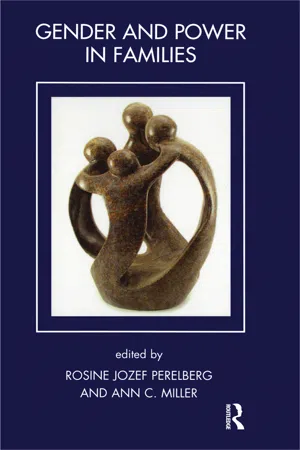
The systems approach to the family is based on the assumptions that there is equality between men and women in the family, and that women and men are treated equally in clinical practice. The contributors to this book challenge these hidden assumptions, discussing the issues from both a conceptual and clinical viewpoint. They argue strongly that questions of gender and power should be central to family therapy training and practice.
Information
Part one
Conceptual Frameworks
Chapter one
A feminist perspective in family therapy
Marianne Walters
There is no therapy, including family therapy, that can adequately reflect the range of human experience and conditions without including a feminist perspective. Yet a feminist perspective can never be monolithic or homogeneous as it will reflect the diversity of the complex social relations it addresses. A feminist perspective in family therapy is not limited to any particular methodology or technique, but rather is committed to exploring and elaborating the context and the process in the formation and transformation of any human experience.
Any feminist perspective in therapy has, I believe, four major components, each of which will be elaborated within a variety of theoretical and methodological frameworks. These components are (1) the conscious inclusion, in both theory and practice, of the experience of women growing up; developing; relating to each other, to men, and to social institutions; raising families; working; and growing old in a culture largely shaped and defined by male experience; (2) a critique of therapy practices, and the theoretical constructs on which they are based, that lend themselves to a devaluing of women, and of the particular social and familial roles of women - in other words, a critique of those practices and ideas commonly identified as sexist; (3) the integration of feminist theory, and the information derived from women's studies, into the knowledge base of psychological theory, as well as of methodological - and even pedagogical framework; and (4) the use of female modes and models in the continuing expansion and development of theory and practice in the field.
What do women want?
This plaintive question has haunted such profound thinkers as Freud, to such mundane pundits as David Stockman. I would imagine Socrates himself pondering this dilemma as he framed yet another deductive question; or Nero dreaming of some answer to be found in the flickering flames of a burning Rome. Yet despite the best efforts of men to answer this question, it has remained largely a source of confusion, and perhaps concern, but certainly not resolution - partly, of course, because different women want different things, much as men do. But the answer is ultimately to be found in the construction of a society that equally represents the interests and aspirations and values of both sexes. To accomplish this task would mean rearranging power and privilege in our society - a difficult, if not for many an unwelcome, task. Yet, as a relatively enlightened microcosm of our society, it would seem that attempts at some rearrangement of that tiny piece of turf on which we therapists cavort would be welcome. Or so I thought when I first became interested in exploring with my family-therapy colleagues the relevance of feminism to family therapy, and my own experiences as a woman therapist. What I learned (or perhaps already knew but chose to deny in order to get up the nerve to forge ahead) was that even in a field committed to change, and to representing the interest of the family and its members - both female and male - the subordination and devaluing of women were so strongly ingrained that even the wisest in the field had trouble broadening their vision.
Family therapists who have pioneered a feminist critique of the field have encountered all of the usual responses, everything from 'We're all human, aren't we?' to 'I've always loved women', to 'But, I've always thought women were better than men!' Some therapists thought feminist family therapists should not be allowed to do family therapy because they would lecture and harangue their clients; others argued that a feminist theory was the antithesis of the 'neutrality' and 'objectivity' of systems theory. And there were those whose understanding of the issues could encompass nothing deeper than the tired notions of the 'battle between the sexes'. Some of our movers and shakers embraced the new ideas with benign neglect; others trivialized it by exploring the 'complementary' plight of men. But perhaps more disappointing than the querulousness, or the opposition, was the tendency of the field to engage with the new ideas that feminist thinkers espoused, and then quickly assign them the significance of one, among many, issues in the field - which is precisely the problem. Although feminism raises issues for and about women, such as equal pay, child care, and maternity leave, its significance rests on its conceptual departure from a traditional, male-dominated perspective. Feminism, particularly in the field of family systems and family relations, suggests a fundamental rethinking of beliefs, principles, and practices. It suggests a search for new information, a conceptual dialogue, self-criticism. It is not about an issue, a symptom, or a segment of our society, it is about that society and the relationship of the two genders that compose it. As such, the feminist perspective challenges the field to restructure some of its practice and reconsider some of its assumptions. Such change is no easier for us than it is for our clients.
As a social worker, I learned a lot about human growth and development, about social systems and conditions, and some about the helping process. As my profession was mostly peopled by women (and never showed a profit), it was not highly valued by our society and was low in the hierarchical pecking order of the service delivery systems within which we worked, particularly those dominated by the medical profession, such as mental health. In this context, I often felt helpless and unclear about how to create change most effectively. And as the profession was often derivative - that is, flowing from and defined by professions higher in the hierarchy and with more power - social work did not evolve a distinct methodology of its own, separate from the roles and functions assigned by the prevailing power structures. Even within our profession, we tended to devalue much of what we know and many of our tenets of practice - such as the ways in which process is used to inform and to convey a message; or that behaviour is contextual and interactional; or that much of one's emotional development occurs within the family. Being devalued, women lacking power, and thus devaluing ourselves, we internalized the negative social and professional attitudes that surrounded our work lives. We did not lay claim to a distinct methodology, and we shied away from explicit and direct techniques of intervention. Like many social workers, when I encountered family therapy, I embraced it eagerly and lovingly - and pretty uncritically. Here were methods, explicit and direct techniques for change, ways to work, ways to think. It had a conceptual framework - systems theory - a structure from which to view behaviour and to tackle symptoms. And it did not take for ever to see change occur. For the first time I felt truly instrumental in my professional functioning. Now I was not 'merely" a social worker - I was a family therapist. It had a more authoritative ring to it.
When one feels instrumental and powerful, it is difficult to question some of the assumptions on which that instrumentality is based, or to understand that my own process of professional evolution mirrors the experience of women at every level in society and, of course, within families. Being in a woman's profession that was devalued and derivative, I was defined by others and began to devalue my own expertise. My roles and functions were prescribed within a male hierarchy. Unsureness, fed by a lack of power, undermined my effectiveness and self-esteem. Given the opportunity for Instrumental functioning, I embraced that end without questioning the means by which it was achieved. I had forgotten that the ends seldom justify the means, that change without 'due process' can indeed diminish the human endeavour.
What do women want? Perhaps the question can best be addressed through the process of asking them and listening to their answers.
Women's experience
At this stage in the development of the women's movement and of feminist consciousness, and considering the changes that have already improved the status of women, it seems almost redundant to discuss the continuing need to include the experience of women in our understanding of family dynamics and in the practices of family therapy. Yet perhaps in our field, more than any other of the social sciences and helping professions, it is necessary to emphasize this point. Systems theory and systemic modalities unfortunately have functioned to discount gender socialization and to blur gender differences. Systemic equations treat the parts as interchangeable, depending only on their configuration within the system for definition and explanation of their motivation and behaviour. The fact that such configurations must have origins in larger contexts is acknowledged but goes largely unattended and unexplored. Systemic equations and formulations conjure up the illusion of an objectivity that obscures the value-laden reality that they are meant to represent. It goes without saying that representations of reality will reflect the prevailing order of things, the accepted hierarchy, the socially approved values - unless these are challenged and uncovered to reveal the subtext. And so our systemic formulations and interventions will represent - indeed, will reproduce - patriarchal social, relational, and attitudinal structures unless the different, and often hidden, experience and reality of women in society, and in our families, are entered into the equation.
What is this experience? It is the everyday fall-out - subliminal, explicit, and covert; direct and indirect; conscious and unconscious; accidental and purposeful; humorous and serious - of life for women in a male-dominated culture.
She attends a wedding and hears jokes about entrapment and how now he will have to get rid of his sexy secretary. She leaves the wedding and goes to a bar where one of the drinks offered, along with the Singapore Sling and White Russian, is 'the dreaded mother-in-law'. She returns home and opens a magazine and learns that the best gift a woman can receive is a new Electrolux vacuum that will allow her to reach into the corners of the house she will clean. She reads an advertisement that tells her how easily she can be deceived if she gets something she wants in the end: 'Promise her anything, but give her Arpege'. She watches television and discovers that the only way a woman can get on the crew of a love boat' is as cruise director, attending to the pleasures of the 'family' of passengers - or failing that, as the daughter of the captain. She reads a popular novel and learns that success in the world of business is achieved by women who are bitchy. She turns to a history book where humans are referred to as mankind, work is described in terms of manpower, and the products of labour as man-made. Leaders are called chairmen and a skilled craftsman is called master (even when said expert is a woman). She calls a friend who describes a 'cat fight' in the office, evoking images of people clawing at each other rather than landing a direct punch.
She goes to a synagogue and sees that the most sacred, holiest of rituals there requires the services of ten men. She enters a church and hears the words of the prophet Martin Luther: 'If a woman dies in childbirth it matters not, because it was for this that she was created by God.' She attends a dinner party with her husband where the women talk of children and schools and the men exchange information about their enterprises. As a girl, she is told the boys won't like her if she is too smart ('Men won't make passes at girls who wear glasses'). As a young woman, she is told she won't attract a man if she is too fat. As a wife, she is told she won't keep her man if she doesn't defer to his needs. She will be an old maid if she does not marry; but if she graduates from college, she will get a bachelor's degree as her reward. When her children marry, she becomes the stuff from which a whole genre of jokes are fashioned. Paintings will depict her goddess-like qualities when she is coupled with her infant child; journal articles will describe her as smothering and hanging on when coupled with her adolescent child. She speaks of 'a rule of thumb' only to discover that this expression derives from an old English law that denied men the right to beat their wives with a stick larger than the circumference of their thumb!
Does the cumulative effect of such messages constitute a kind of psychological onslaught that shapes the way women experience themselves and each other? Do such messages affect the emotional and intellectual well-being of women? Of course they do; how could it be otherwise? These are the questions a feminist perspective will seek to address. Feminist family therapists have enlarged the theory of family functioning to include gender as a significant, if not fundamental, ingredient in the construction of family structures and interpersonal transactions. This challenges the idea that the family as a system is governed by its own internal regulatory mechanism within which all interpersonal transactions can be understood.
Women's experience is to be found not only in their encounter with the messages of a male culture and language, but within familial social institutions and structures. The institution of marriage, for instance, dramatically exemplifies the ways in which patriarchy, both implicitly and explicitly, organizes our lives. Marriage begins with the tradition of father handing his daughter over to another man whose name she will take, forsaking her own. (Of course, in a historical context, this quaint tradition would seem quite benign as it does not include purchasing a bride, a dowry, or some other form of economic barter, and the consent of the bride is almost always required!) The rituals of the marriage ceremony reflect the expected structure of the liaison to follow. The daughter is brought to her husband-to-be on the arm of her father while her mother quite literally stands to the side. The bride's face is often covered by a veil, suggesting humility. She wears white, symbolizing chastity. (And how does the groom demonstrate his humility and virginity?) In today's world, the bride may choose to keep her surname, but her formal social classification will change from Miss to Mrs (his remains Mr) and her person becomes, at least publicly, identified with her mate. Her new career as a wife will be organized by roles and functions primarily identified with the internal life of the family.
Early life decisions for the newly married couple, such as where and under what circumstances they will live, will largely depend on the man's work or career. This begins to construct the context and rules for later decision making between them. A process is set in motion that will identify this wife, and later their family, by association with the work or career, the choice, the social and economic conditions of the husband, the man, the head of the household. (Women have head-of-household status only when there is no husband present.) This process, in which the life of one adult person is largely organized by, and identified with, the life and person of another, is at the very core of the institution of marriage and the structure of family life. In the life cycle of women, power is, for the most part, derivative: as daughter, father entitles; as wife, husband bestows.
How is It possible to conduct therapy with families, with couples in and out of marriage, with women, without understanding how this process constructs many of the problems, relationships, and conflicts that we encounter in our offices? How can we make therapeutic interventions - interventions that will create change without damaging self-esteem - and not be sensitive to the profoundly different meanings our words, tasks, and metaphors will have for men and for women as a result of their gender experiences? And how can we not but be aware that in a patriarchal culture life experience will be defined largely within a male frame of reference? These questions are not merely rhetorical. In fact, such questions, and the concerns that provoke them, surround the experience of women both as family members and as care givers within institutionalized frameworks.
Women and service delivery systems
Women are at both ends of service delivery systems, as consumers and as providers. As gatekeepers of the family, it is women who are largely responsible for seeking the services attendant to the general welfare of the family. Yet when seeking these services, women become both dependent on other women and in opposition...
Table of contents
- Cover
- Half Title
- Title
- Copyright
- Dedication
- Contents
- Contributors
- Acknowledgements
- Introduction I
- Introduction II
- Part one Conceptual Frameworks
- Part two Strategies of Intervention
- Part three Applications: Specific Clinical Issues
- Part four What About Men?
- Part five Applications: Wider Systems
- Name index
- Subject index
Trusted by 375,005 students
Access to over 1.5 million titles for a fair monthly price.
Study more efficiently using our study tools.
Frequently asked questions
Yes, you can cancel anytime from the Subscription tab in your account settings on the Perlego website. Your subscription will stay active until the end of your current billing period. Learn how to cancel your subscription
No, books cannot be downloaded as external files, such as PDFs, for use outside of Perlego. However, you can download books within the Perlego app for offline reading on mobile or tablet. Learn how to download books offline
Perlego offers two plans: Essential and Complete
- Essential is ideal for learners and professionals who enjoy exploring a wide range of subjects. Access the Essential Library with 800,000+ trusted titles and best-sellers across business, personal growth, and the humanities. Includes unlimited reading time and Standard Read Aloud voice.
- Complete: Perfect for advanced learners and researchers needing full, unrestricted access. Unlock 1.5M+ books across hundreds of subjects, including academic and specialized titles. The Complete Plan also includes advanced features like Premium Read Aloud and Research Assistant.
We are an online textbook subscription service, where you can get access to an entire online library for less than the price of a single book per month. With over 1.5 million books across 990+ topics, we’ve got you covered! Learn about our mission
Look out for the read-aloud symbol on your next book to see if you can listen to it. The read-aloud tool reads text aloud for you, highlighting the text as it is being read. You can pause it, speed it up and slow it down. Learn more about Read Aloud
Yes! You can use the Perlego app on both iOS and Android devices to read anytime, anywhere — even offline. Perfect for commutes or when you’re on the go.
Please note we cannot support devices running on iOS 13 and Android 7 or earlier. Learn more about using the app
Please note we cannot support devices running on iOS 13 and Android 7 or earlier. Learn more about using the app
Yes, you can access Gender and Power in Families by Ann C. Miller,Rosine Jozef Perelberg in PDF and/or ePUB format, as well as other popular books in Psychology & History & Theory in Psychology. We have over 1.5 million books available in our catalogue for you to explore.