
- 292 pages
- English
- ePUB (mobile friendly)
- Available on iOS & Android
eBook - ePub
Jacques Lacan
About this book
The work of Jaques Lacan, eminent French psychoanalyst and influential thinker (1901-1981), is recognized as being of vital importance to psychoanalysts, philosophers, and all those concerned with the the study of man and language. Its value is not limited to the field of psychoanalysis alone, but provides the basis for a new philosophy of man and a new theory of discourse. It is, however, notoriously difficult for the non-specialist reader to come to terms with Lacan's reading of Freud and his investigations of the unconscious. Until now, there has been no satisfactory general introduction to Lacan, and this first general exposition of his work, translated and revised from the French edition, is designed to provide the conceptual tools which will enable the reader to study Lacan using the original texts.
Information
PART ONE
Debates as to the nature of the linguistic sign and their methodological consequences
Linguistics has produced an extremely rich and varied amount of material. Tendencies and schools are numerous and, even within the same school, notions and terminology are not always the same.
There exist many works dealing with problems limited to certain languages or to certain categories of the facts of language, as well as more general works which frequently deal with problems of methodology.
I limited myself to some of these more general works and, while reading them, I was surprised at the immaturity of linguistic science. Authors do not agree as to the content of basic concepts, as to methods of study or as to the emphasis to be accorded to one or another notion.
A general uncertainty remains as to whether the categories of thought, meaning and concepts should be introduced into linguistic analysis, whereas, practically, it is admitted everywhere that the linguistic sign has two facets: phonic material and concepts.
Various linguists have criticized the use made of linguistics by Lacan on the grounds that he stresses certain aspects of language which they do not consider specific.
For the benefit of readers who are not linguists, I should like to point out that the Lacanian interpretation of linguistics finds, in every point, its verification by at least some linguists. The problem of the validity of certain linguistic conceptions adopted by Lacan is consequently a problem for the linguists themselves.
I will attempt here to bring out from within the heart of the controversy some constant principles of general linguistics. It must be emphasized that our task is not to resolve the problem of the validity of the theories expounded, but to show the theoretical struggles from within which Dr Jacques Lacan has derived the linguistic points he advances.
ONE
Debates as to the nature of the linguistic sign and their methodological consequences
The nature of the linguistie sign in F. De Saussure
In his Course in General Linguistics (58), Saussure, the pioneer of linguistics, designates the sign or linguistic unit as a double-sided entity. The sign unites, not a name and a thing, but a concept and an acoustic image, the representation of the word, that is, outside any actual use of it in speaking. The acoustic image is not the sound, but the psychical imprint of the sound.
The linguistic sign is, therefore, a relationship which may be represented as shown by Figure 1.1.
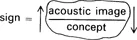
FIGURE 1.1
Saussure proposes that the acoustic image be termed the ‘signifier’ and the concept the ‘signified’. Figure 1.2 shows the result of the substitution of these terms in Figure 1.1.
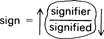
FIGURE 1.2
In its globality, the sign is the act of the unification of a signifier and a meaning, an act which engenders signification.
The discussions between linguists as to the arbitrary or non-arbitrary nature of the linguistic sign, as to the necessity of introducing the concept into linguistic analysis, and as to the pre-eminence to be accorded to thought or to language as a formal system which is closed in upon itself, may all be considered as having their origin in the Saussurian definition of the sign.
Saussure himself greatly modifies this definition with the introduction of the notion of value, one of the most productive notions in linguistics, and one which can be considered to be universally recognized, although it is at the origin of various controversies. In this new perspective, the sign is no longer a relationship between two things: a concept and an acoustic image. The sign also has a value which is not limited to its strict significance. The sign is no longer a union of a concept and an acoustic image in the sense that it could be isolated from the system of which it is part.
Only the entire system of the language gives it its specificity as opposed to the other signs.
Each element of the total sign, the signifier and the signified, is a value, a term in a system of interdependence, as is the total sign itself.
Thus, on the conceptual plane, value is an element of signification, but that is not all, otherwise language would be a mere nomenclature. Value results from the fact that language is a system whose terms are interdependent. The value of a word is the signification conferred upon it by the presence of all the words in the code, but also by the presence of all the elements of the sentence.
The value of a word thus results from the simultaneous presence of all the words in the sentence, as shown by Figure 1.3.
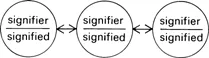
FIGURE 1.3
Here Saussure draws a comparison with the semiological system of money.
In order to determine the value of a five franc piece, one must first of all know what things of a different nature (such as bread) it can be exchanged for. But one must also know the relationship between a five franc piece and a one franc or a ten franc piece in the same system, or between the five franc piece and the elements of a comparable system, such as dollars.
Similarly, in order to determine the value of a word, one must know that it can be exchanged for an idea, as value always makes reference to the dissimilar, but one should also take into account its relationships with other words in the code and in the sentence. The French words redouter (to dread), craindre (to fear) and avoir peur (to be afraid) have value only because they can be opposed to one another.
We can now see how value differs from signification, which refers only to the local correspondence of the signifier to the concept. When we speak of concepts, we imply that they are differential, that they are defined not simply by their content, but also, and primarily, by their oppositional relations with other concepts.
Ideas are nothing outside the system within which they derive their identity from their opposition to other ideas.
Similarly, on the material plane of the linguistic sign, what matters in the word for example is not the sound as such, but the phonic differences which allow that word to be distinguished from others. That signifiers are efficient is due, not to their external characteristics, but to their relative positions within the system. This is in the nature of all conventional signs. Thus, in itself a coin is simply a piece of metal and draws its value only from its correlates within the system.
Phonemes are above all ‘oppositional’, relative and negative entities.
Finally, the play of interaction is the same at the level of the total sign. In English, for example, the sign ‘mutton’ takes on its real value only because of the co-existence within the same system of the term ‘sheep’.
It seems useful at this point to draw the reader’s attention to the fact that by introducing the notion of value, Saussure is merely modifying his interpretation of the linguistic sign. He does not in fact deny the close correspondence of the signifier to its concept, a correspondence which is adequately stressed by the vertical arrows and the circles drawn around the terms of the sign in Figure 1.1.
In the second schema (Figure 1.3), which is meant to illustrate the notion of value on the conceptual plane, the interrelation between the signs of the sentence is represented by the bipolar horizontal arrows, but the signifier’s relation to the signified is retained by the circles drawn around the terms of the sign.
In this schema Saussure clearly indicates that the local signification of an element in the sentence is determined by its correlations with the other elements, but he does not say that that signification does not exist as such, once the terms of the sentence have been related to one another.
This precision will be useful in the debate which follows. In it we shall see linguists in full polemic as to which of two conceptions should be given priority: that which stresses the relations between the signs in the ‘process’ of signification, and which sometimes leads to the signifier being considered as an order which is closed in upon itself and from which it is possible to exclude the signified, or that conception which recognizes an intrinsic designatory power in the sign.
The notion of value in general linguistics is one of the most widely recognized of notions.
It was established by Saussure, but his predecessor, the linguist Peirce, had already foreseen its importance.
For the sign to be understood, he says, there must be a speaker and a listener, but there must also be an interpretant, another sign or body of signs which is either concurrent with the sign in question or present in memory, and which may be substituted for it. For Peirce, the meaning of a sign is another sign by which it can be translated.
If, however, one blocks the notion of value by privileging relations between terms within one category (the signifier) or the other (the signified) to the detriment of the local correlation of signifier to signified, then one starts down a path which leads to extremist considerations.
Certain of Saussure’s own expressions, which are correct, if debatable, open a crack in which error can take root. For example, the idea that:
the final law of language is that nothing can reside in one term precisely because linguistic symbols are not related to the things they designate. ‘A’ cannot designate anything without the help of ‘B’, which is itself powerless without ‘A’. They have value only because of their reciprocal difference. Things do not signify because of their concrete nature, but by virtue of the formal features which distinguish them from other things of the same class. To consider a term as simply the union of a certain sound with a certain concept is grossly misleading.
(58, p. 113.)
Such phrases, which are, I repeat, correct in themselves, may lead to the conception of there being two radically different orders which are closed in upon themselves. What is more, they may give rise to linguistic studies from which meaning is partially or radically excluded.
Thus, in Elements of Semiology (56), Barthes will say that the notion of value leads to the conception of the production of meaning as no longer being the mere correlation of a signifier and a signified, but as an act of vertically cutting out two amorphous masses, two parallel floating kingdoms. Meaning intervenes when one cuts simultaneously into these two masses. The signs produced in this way are articuli, divisions. For my part, I would rather say that signification is born progressively from a permanent dialectic between grouped signifiers and grouped signifieds, rather like spiral loops uniting, at each discrete point of the spoken chain, a uni...
Table of contents
- Cover
- Half Title
- Title Page
- Copyright Page
- Table of Contents
- Preface by Jacques Lacan
- Foreword by Antoine Vergote
- Acknowledgments
- Introduction
- Synthesis of Lacanian thought
- Part One Some elements and some problems of general linguistics
- Part Two Lacan's use of the general data of linguistics
- Part Three The constitution of the subject by accession to the symbolic – the Spaltung – the role of the Oedipus in this transition
- Part Four The engendering of the unconscious by primal repression (or accession to language) in accordance with the process of metaphor
- Part Five The elementary signifiers constituting the unconscious
- Part Six The transition from lack to desire and to demand
- Part Seven The mechanisms of the formations of the unconscious: structure and organization of the unconscious signifying network
- Part Eight The general conception of the cure in Lacan
- Part Nine The Lacanian conception of neurosis and psychosis
- Conclusion
- Appendix: general purport of a conversation with Lacan in December 1969
- Bibliography
- Index
Trusted by 375,005 students
Access to over 1.5 million titles for a fair monthly price.
Study more efficiently using our study tools.
Frequently asked questions
Yes, you can cancel anytime from the Subscription tab in your account settings on the Perlego website. Your subscription will stay active until the end of your current billing period. Learn how to cancel your subscription
No, books cannot be downloaded as external files, such as PDFs, for use outside of Perlego. However, you can download books within the Perlego app for offline reading on mobile or tablet. Learn how to download books offline
Perlego offers two plans: Essential and Complete
- Essential is ideal for learners and professionals who enjoy exploring a wide range of subjects. Access the Essential Library with 800,000+ trusted titles and best-sellers across business, personal growth, and the humanities. Includes unlimited reading time and Standard Read Aloud voice.
- Complete: Perfect for advanced learners and researchers needing full, unrestricted access. Unlock 1.5M+ books across hundreds of subjects, including academic and specialized titles. The Complete Plan also includes advanced features like Premium Read Aloud and Research Assistant.
We are an online textbook subscription service, where you can get access to an entire online library for less than the price of a single book per month. With over 1.5 million books across 990+ topics, we’ve got you covered! Learn about our mission
Look out for the read-aloud symbol on your next book to see if you can listen to it. The read-aloud tool reads text aloud for you, highlighting the text as it is being read. You can pause it, speed it up and slow it down. Learn more about Read Aloud
Yes! You can use the Perlego app on both iOS and Android devices to read anytime, anywhere — even offline. Perfect for commutes or when you’re on the go.
Please note we cannot support devices running on iOS 13 and Android 7 or earlier. Learn more about using the app
Please note we cannot support devices running on iOS 13 and Android 7 or earlier. Learn more about using the app
Yes, you can access Jacques Lacan by Anika Lemaire in PDF and/or ePUB format, as well as other popular books in Psychology & Linguistics. We have over 1.5 million books available in our catalogue for you to explore.