The goal of this book is to help business managers and academic researchers understand the means-end perspective and the methods by which it is used, and to demonstrate how to use the means-end approach to develop better marketing and advertising strategy. The authors discuss methodological issues regarding interviewing and coding, present applications of the means-end approach to marketing and advertising problems, and describe the conceptual foundations of the means-end approach.
This book is of interest to academic researchers in marketing and related fields, graduate students in business, marketing research professionals, and business managers. It is intended as a reference book containing ideas about the means-end approach and its applications.
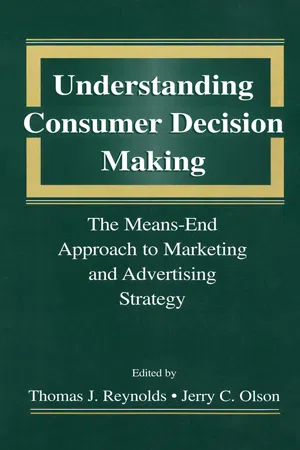
eBook - ePub
Understanding Consumer Decision Making
The Means-end Approach To Marketing and Advertising Strategy
- 466 pages
- English
- ePUB (mobile friendly)
- Available on iOS & Android
eBook - ePub
Understanding Consumer Decision Making
The Means-end Approach To Marketing and Advertising Strategy
About this book
Information
Publisher
Psychology PressYear
2001Print ISBN
9780805817317
9780805817300
Edition
1eBook ISBN
9781135693152
V
THEORETICAL
PERSPECTIVES FOR
MEANS-END RESEARCH
SECTION OVERVIEW
To a large extent, the means-end approach has evolved in an informal, somewhat haphazard manner. Many of the conceptual developments and methodological improvements were based on researcher intuition about solving a particular problem posed by a business application. With few exceptions, the theoretical underpinnings of the means-end approach remain implicit and only partially understood by its advocates.
As a result, the means-end approach lacks a clearly specified theoretical foundation. As yet, no one has developed a coherent and concise statement of the theory underlying the means-end approach. This lack of a conceptual foundation has disturbed many academic scholars and probably has limited its appeal. To many academic scholars, the means-end approach is a method used in business practice, with little theoretical interest or scholarly value. In fact, several chapters in this book reflect concerns about the “looseness” of the theoretical foundations of the means-end approach, and other chapters point out needed areas for theoretical development. Despite the general neglect of the theoretical basis for the means-end approach, we believe it is possible to position the means-end approach within a rich theoretical framework. The means-end approach has ties to several influential theories in psychology, including the work on personal construct theory (Kelley, 1957), human values (Rokeach, 1973), attribution theory, cognitive structure (Scott, 1969), among others. Future work could and should develop these theoretical threads into an articulate conceptualization of means-end chains.
The final section of this book contains original chapters that deal with important conceptual issues regarding the means-end approach. These chapters point out directions for future research and theorizing. Although these chapters take steps toward a fully explicated theory of the means-end approach, none of them accomplish that task. Apparently, more thinking must be done. We hope future researchers will be inspired to further develop the theoretical foundations of the means-end approach.
- Claeys and Vanden Abeele (chap. 16, this volume) address the important concept of product involvement from a means-end perspective. The core of involvement is the personal relevance a consumer feels for a product (or brand, or company, or activity). Means-end chains can be used to model how a product is seen to be personally relevant and, therefore, is involving to a consumer. The authors present a study of involvement for so-called think and feel products. Consumers supposedly use cognitive or rational choice criteria to make decisions about think products; whereas affective or emotional choice criteria are used to decide about feel products.
- Cohen and Warlop (chap. 17, this volume) address the motivational orientation of the means-end approach from a somewhat critical perspective. They review some of the apparent assumptions of the means-end, and they point out where current formulations of means-end approach go wrong. Their chapter offers many ideas for further theoretical development of the means-end approach.
- Pieters, Allen, and Baumgartner (chap. 18, this volume) continue the motivational focus by showing how means-end chains relate to the important idea of goal hierarchy. They show how the means-end approach can help researchers understand the sets of interrelated goals consumers are pursuing through their decisions and actions. The entire question of goals is a rich conceptual area of great relevance for means-end theory. This chapter lays out many of the issues and offers suggestions for further research and thinking.
REFERENCES
Kelley, G.A. (1955). The psychology of personal constructs. New York: Norton.
Rokeach, M. (1973). The nature of human values. New York: Free Press.
Scott, W.A. (1969). Structure of natural cognitions. Journal of Personality and Social Psychology, 12, 261–278.
16
Means-End Chain Theory and Involvement: Potential Research Directions
Christel Claeys
Catholic University of Leuven, Belgium
Piet Vanden Abeele
Catholic Univerity of Leuven, Belgium
ABSTRACT
This chapter focuses on the utility of the means-end chain theory for the analysis of involvement. At the conceptual level, a number of ideas on how the paradigm can provide academics with a new alternative to operationalize involvement are developed. We suggest that it is necessary to extend the conceptualization of involvement from the means-end chain perspective beyond value attainment. Several characteristics of the hierarchical value map (HVM) are introduced as potential indices of involvement. We discuss their nature, their interdependencies, and their contribution to the assessment of involvement.
INTRODUCTION
Since the 1970s, involvement has been introduced as an explanatory or moderating variable in a wide variety of consumer-related research. The construct has shown to mediate such consumer behavior topics as attitudes, decision making, information processing, advertising effectiveness, cognitive structures, and brand loyalty, to name but a few. The influence of involvement on major aspects of consumer behavior justifies its central status in contemporary consumer research. Therefore, it is a reasonable research strategy to study the interactions between involvement and concepts newly introduced to the field.
In this chapter, attention is paid to the relation of involvement with the concept of means-end chains and with the laddering methodology, an area that increasingly is attracting the interest of academic researchers. In this way, this chapter contributes to an increased understanding of both involvement and of means-end chains and laddering. In addition, we hope that this approach revives consumer researchers’ interest in involvement.
Despite the fact that the concept has profoundly altered the state of the art in our understanding of consumer behavior, research on involvement apparently has lost some of its attractiveness, at least in academic circles. One reason for this may be that the plurality of proposed definitions, typologies, and operationalizations have made the concept rather elusive, thereby discouraging academics from undertaking further research. Another, perhaps even more influential reason, may simply be that involvement is no longer a fashionable publishing topic. Whatever the reasons for the current lack of interest in involvement, important research topics should not be determined by fashion, nor should a body of knowledge acquired through 20 years of research accumulate dust in a dark academic corner. Such neglect is counterproductive for the consumer research discipline.
The goals of this chapter are threefold. First, we seek to establish a relation between involvement and means-end chains, primarily through the intervening construct of cognitive structures. Second, we use this relation as a starting point for a series of critical comments and thoughts on the causal implications of involvement on the content and structure of means-end chains. Third, we hope this discussion stimulates hypothesis formulation and research on the concepts of involvement, cognitive structures, means-end chains, and on the interrelations between them.
MEANS-END CHAIN THEORY
Means-End Chain (MEC) theory proposes a conceptual model for the cognitive organization, structure, and content of product knowledge in memory. The MEC model is consistent with the associative network type of memory structures but some characteristics are specific to means-end chains.
The MEC model distinguishes between three basic components: attributes, consequences, and values. A finer-grained version of the model is obtained by dichotomizing each of the basic levels into two sublevels. Product knowledge can thus be represented at six different levels of abstraction, ranging from the very concrete to the very abstract—concrete and abstract attributes, functional and psychosocial consequences, instrumental and terminal or end values. The different levels are related by causal asymmetric linkages. Thus, attributes may be perceived as producing desired consequences that in turn lead to the achievement of values. Attributes or product characteristics are the means by which the consumers search to materialize desired goals, values, or ends.
A means-end chain is a directed, hierarchically organize...
Table of contents
- COVER PAGE
- TITLE PAGE
- COPYRIGHT PAGE
- FOREWORD
- PREFACE
- I: INTRODUCTION
- II: USING LADDERING METHODS TO IDENTIFY MEANS-END CHAINS
- III: DEVELOPING AND ASSESSING ADVERTISING STRATEGY
- IV: THE MEANS-END APPOACH TO DEVELOPING MARKETING STRATEGY
- V: THEORETICAL PERSPECTIVES FOR MEANS-END RESEARCH
Trusted by 375,005 students
Access to over 1.5 million titles for a fair monthly price.
Study more efficiently using our study tools.
Frequently asked questions
Yes, you can cancel anytime from the Subscription tab in your account settings on the Perlego website. Your subscription will stay active until the end of your current billing period. Learn how to cancel your subscription
No, books cannot be downloaded as external files, such as PDFs, for use outside of Perlego. However, you can download books within the Perlego app for offline reading on mobile or tablet. Learn how to download books offline
Perlego offers two plans: Essential and Complete
- Essential is ideal for learners and professionals who enjoy exploring a wide range of subjects. Access the Essential Library with 800,000+ trusted titles and best-sellers across business, personal growth, and the humanities. Includes unlimited reading time and Standard Read Aloud voice.
- Complete: Perfect for advanced learners and researchers needing full, unrestricted access. Unlock 1.5M+ books across hundreds of subjects, including academic and specialized titles. The Complete Plan also includes advanced features like Premium Read Aloud and Research Assistant.
We are an online textbook subscription service, where you can get access to an entire online library for less than the price of a single book per month. With over 1.5 million books across 990+ topics, we’ve got you covered! Learn about our mission
Look out for the read-aloud symbol on your next book to see if you can listen to it. The read-aloud tool reads text aloud for you, highlighting the text as it is being read. You can pause it, speed it up and slow it down. Learn more about Read Aloud
Yes! You can use the Perlego app on both iOS and Android devices to read anytime, anywhere — even offline. Perfect for commutes or when you’re on the go.
Please note we cannot support devices running on iOS 13 and Android 7 or earlier. Learn more about using the app
Please note we cannot support devices running on iOS 13 and Android 7 or earlier. Learn more about using the app
Yes, you can access Understanding Consumer Decision Making by Thomas J. Reynolds,Jerry C. Olson in PDF and/or ePUB format, as well as other popular books in Business & Consumer Behaviour. We have over 1.5 million books available in our catalogue for you to explore.