This book provides an overview of issues associated primarily with food safety, shelf-life assessment and preservation of foods. Food safety and protection is a multidisciplinary topic that focuses on the safety, quality, and security aspects of food. Food safety issues involve microbial risks in food products, foodborne infections, and intoxications and food allergenicity. Food protection deals with trends and risks associated with food packaging, advanced food packaging systems for enhancing product safety, the development and application of predictive models for food microbiology, food fraud prevention, and food laws and regulations with the aim to provide safe foods for consumers. Food Safety and Protection covers various aspects of food safety, security, and protection. It discusses the challenges involved in the prevention and control of foodborne illnesses due to microbial spoilage, contamination, and toxins. It starts with documentation on the microbiological and chemical hazards, including allergens, and extends to the advancements in food preservation and food packaging. The book covers new and safe food intervention techniques, predictive food microbiology, and modeling approaches. It reviews the legal framework, regulatory agencies, and laws and regulations for food protection. The book has five sections dealing with the topics of predictive microbiology for safe foods; food allergens, contaminants, and toxins; preservation of foods; food packaging; and food safety laws.
eBook - ePub
Food Safety and Protection
- 700 pages
- English
- ePUB (mobile friendly)
- Available on iOS & Android
eBook - ePub
Food Safety and Protection
About this book
Information
Section II
Food Allergens,
Contaminants, and Toxins
Contaminants, and Toxins
3
Analytical Methods for the Detection of Mycotoxins in Milk Samples
Myra E. Flores-Flores and Elena González-Peñas
CONTENTS
3.1Introduction
3.2Aflatoxins
3.3Ochratoxins
3.4Trichothecenes
3.5Fumonisins
3.6Cyclopiazonic Acid
3.7Ergot Alkaloids
3.8Zearalenone and Its Derivatives
3.9Multimycotoxin Detection
3.10 Conclusions
Abbreviations
References
3.1Introduction
Food has been proven to be the major source of many toxicants today (Choi et al. 2015). The presence of naturally occurring contaminants that cause severe health effects to humans and animals after chronic exposure at low concentrations is a great concern in terms of food safety. Among these toxic compounds, the presence of mycotoxins is one of the most problematic (Zhang et al. 2014). Mycotoxins are secondary metabolites produced by filamentous fungi that can contaminate raw materials of vegetal origin (cereals and fruits) during their growth in the field or during storage and transport. The major toxin-producing fungal species belong to the genera Aspergillus, Penicillium, and Fusarium, and some of them can produce more than one type of toxin (Zhang et al. 2014). Mycotoxin contamination is hard to eliminate from agricultural crops, foods, and feeds. The mycotoxins are not easily detected by, for instance, a changed organoleptic characteristic in the contaminated products (Binder 2007). The Food and Agriculture Organization of the United Nations (FAO) estimates that approximately 25% of global food production is contaminated by, at least, one mycotoxin (Heussner et al. 2006). In addition, these fungal toxins generally have high resistance to heat, and can appear in a raw material even after the producing fungi have been destroyed. Mycotoxins reach animals and humans through diet, affecting their health and causing mycotoxicosis. In some cases, acute toxic effects have been observed after ingestion of a highly contaminated product, especially in farm animals; however, in terms of human and animal health, the greatest concern is the chronic toxic effects that are generated as a result of continuous long-term exposure to low levels of these toxins. Toxic effects vary due to the different toxicological characteristics of the more than 300 known mycotoxins, including carcinogenicity, genotoxicity, nephrotoxicity, immunotoxicity, and less resistance to infections (Binder 2007). Thus, human exposure to mycotoxins through diet is a significant concern to public health worldwide (Zhang et al. 2014).
Among all the different human foods, the study of the presence of mycotoxins in milk is of great interest, due to its key role in children’s diets and even in many adult diets. The well-documented presence of a broad spectrum of mycotoxins in raw materials and feeding stuffs is a subject of continuous monitoring programs (Zachariasova et al. 2014). It raises the possibility that these toxins reach animals through the diet and are carried over into tissues or biological fluids, such as milk. The number of studies related to the transfer of these compounds to milk (Fink-Gremmels 2008; Flores-Flores et al. 2015), or to the interactions between mycotoxins at absorption and biotransformation level, is very limited (Fink-Gremmels 2008).
It is known that rumen flora can transform mycotoxins such as ochratoxin A (OTA), zearalenone (ZEA), deoxynivalenol (DON), diacetoxyscirpenol (DAS), and T-2 toxin into their metabolites (Kalač 2011; Kiessling et al. 1984). However, this barrier can be altered by animal diseases, changes in the diet, or high mycotoxin contamination in feeding stuffs. For example, the studies of SCOOP (2002) and other authors (Pattono et al. 2011) warn about the possible presence of OTA in milk. In addition, other mycotoxins, such as patulin (PAT), may remain undisturbed by the rumen (Kalač 2011). Aflatoxin M1 (AFM1), the most studied mycotoxin in milk, is produced in the liver by hydroxylation of absorbed aflatoxin B1 (AFB1) (Kalač 2011). Its maximum permissible level in milk has been established at 0.05 µg/kg in the European Union (EU) (European Commission 2010) and 0.5 µg/kg in the United States (FDA 2005). In our recent review of the presence of mycotoxins in animal milk (Flores-Flores et al. 2015), it can be observed that approximately 10% of the 22 189 milk samples analyzed for AFM1 contamination worldwide presented concentration levels higher than those established in the EU. Moreover, even when feeding stuffs of ruminants comply with current EU regulations for aflatoxin content, AFM1 can reach milk in levels exceeding the actual permitted maximum level in the EU (Battacone et al. 2009; Han et al. 2013).
With regard to other mycotoxins in milk, although few samples have been analyzed worldwide, the presence of fumonisin B1 (FB1), cyclopiazonic acid (CPA), ZEA, zearalanone (ZAN), α-zearalanol (α-ZAL), α-zearalenol (α-ZEL), deepoxydeoxynivalenol (DOM-1), OTA, fumonisin B2 (FB2), aflatoxin G1 (AFG1), aflatoxin G2 (AFG2), AFB1, aflatoxin B2 (AFB2), and aflatoxin M2 (AFM2) has been encountered (Flores-Flores et al. 2015).
In order to increase milk safety, our knowledge in this field must increase. Studies are needed regarding the presence of mycotoxins, their most frequent combinations, and their concentration levels in milk. These studies will help lead to better risk assessment, evaluating compliance with regulatory policies and taking other actions to protect public health (Zhang et al. 2014). The choice of the analytical method, with adequate sensitivity, is of utmost importance in carrying out these studies (Rubert et al. 2012). In addition, due to the presence of fat, proteins, salts, and high water content, milk is a very complex matrix that requires extensive and selective sample cleanup procedures that not only enable the removal of the interference of coextracted compounds, but also preconcentrate the analytes in order to reach the required low detection limits. Figure 3.1 shows the different steps that are usually taken for milk sample preparation before chromatographic analysis of mycotoxins. Some of them are optional (dotted square), depending on the analyzed products and the analytical method.
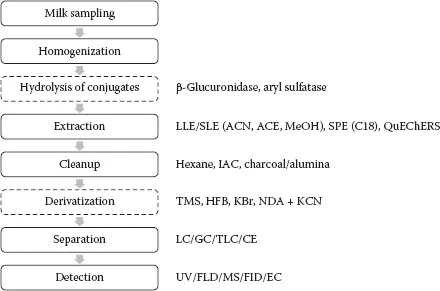
FIGURE 3.1
General workflow for analysis of mycotoxins in milk by chromatographic-based methods. Dotted square indicates optional steps. Also, the most frequently used reagents or techniques are shown.
This chapter is devoted to the review of the analytical methods published for mycotoxin detection and quantification in animal milk, including those developed for analysis of a single mycotoxin, as well as those that allow the simultaneous determination of these compounds in milk. Different technologies have been applied for this purpose, and they can be classified into two groups: chromatographic and nonchromatographic methods. Among the chromatographic methods, gas chromatography (GC) and especially liquid chromatography (LC), using different detector systems, have been used for the study of the different mycotoxins. Currently, the introduction of LC coupled to mass spectrometry (LC-MS) has improved the performance of the methods, allowing simultaneous detection and quantification of several mycotoxins from different families and with different physicochemical characteristics, with adequate sensitivity, and also allowing structural elucidation of unknown compounds. However, LC-MS requires high-cost equipment and specifically trained staff to operate the equipment and interpret the results.
On the other hand, among the nonchromatographic methods, immunoassays are usually used for initial screenings due to their simplicity, low cost, and the fact that it is easy to process a large number of samples. Nonetheless, positive results need to be confirmed (i.e., using chromatographic methods) due to cross-reactivity with related molecules that can give overestimated values (El Khoury and Atoui 2010). The enzyme-linked immunosorbent assay (ELISA) is the most popular format in this category. A wide offer of ELISA-based kits is commercially available for all regulated mycotoxins in different matrixes. Among immunochemical-based methods, lateral flow immunoassay (LFIA), also called immunochromatographic assay or immune-gold colloid (IGC) immunoassay, is relatively new in the field of food safety (Dzantiev et al. 2014), although it is widely used in the field of medical diagnostics (i.e., detection of pregnancy, drug screening, identification of disease biomarkers, etc.). In the case of milk, there are commercially available supplies in both LISA and LFIA formats, although only for AFM1 and OTA detection.
Recently, there has been a research trend toward the construction of biosensors for mycotoxin detection, but very few available methods have been published in the case of milk.
3.2Aflatoxins
Aflatoxins are mainly produced by three species of Aspergillus: A. flavus, A. parasiticus, and A. nomius (Prandini e...
Table of contents
- Cover
- Half-Title
- Title
- Copyright
- Contents
- Preface
- Editor
- Contributors
- Section I Predictive Microbiology for Safe Foods
- Section II Food Allergens, Contaminants, and Toxins
- Section III Preservation of Foods
- Section IV Food Packaging
- Section V Food Safety Laws
- Index
Trusted by 375,005 students
Access to over 1.5 million titles for a fair monthly price.
Study more efficiently using our study tools.
Frequently asked questions
Yes, you can cancel anytime from the Subscription tab in your account settings on the Perlego website. Your subscription will stay active until the end of your current billing period. Learn how to cancel your subscription
No, books cannot be downloaded as external files, such as PDFs, for use outside of Perlego. However, you can download books within the Perlego app for offline reading on mobile or tablet. Learn how to download books offline
Perlego offers two plans: Essential and Complete
- Essential is ideal for learners and professionals who enjoy exploring a wide range of subjects. Access the Essential Library with 800,000+ trusted titles and best-sellers across business, personal growth, and the humanities. Includes unlimited reading time and Standard Read Aloud voice.
- Complete: Perfect for advanced learners and researchers needing full, unrestricted access. Unlock 1.5M+ books across hundreds of subjects, including academic and specialized titles. The Complete Plan also includes advanced features like Premium Read Aloud and Research Assistant.
We are an online textbook subscription service, where you can get access to an entire online library for less than the price of a single book per month. With over 1.5 million books across 990+ topics, we’ve got you covered! Learn about our mission
Look out for the read-aloud symbol on your next book to see if you can listen to it. The read-aloud tool reads text aloud for you, highlighting the text as it is being read. You can pause it, speed it up and slow it down. Learn more about Read Aloud
Yes! You can use the Perlego app on both iOS and Android devices to read anytime, anywhere — even offline. Perfect for commutes or when you’re on the go.
Please note we cannot support devices running on iOS 13 and Android 7 or earlier. Learn more about using the app
Please note we cannot support devices running on iOS 13 and Android 7 or earlier. Learn more about using the app
Yes, you can access Food Safety and Protection by V Ravishankar Rai, Jamuna A Bai, V Ravishankar Rai,Jamuna A Bai in PDF and/or ePUB format, as well as other popular books in Technology & Engineering & Food Science. We have over 1.5 million books available in our catalogue for you to explore.