eBook - ePub
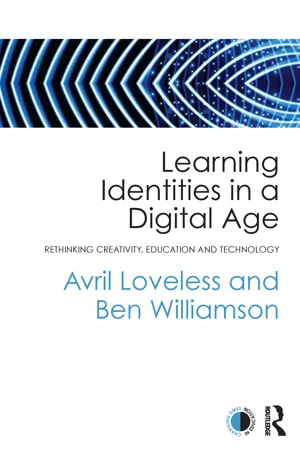
Learning Identities in a Digital Age
Rethinking creativity, education and technology
- 208 pages
- English
- ePUB (mobile friendly)
- Available on iOS & Android
eBook - ePub
Learning Identities in a Digital Age
Rethinking creativity, education and technology
About this book
Digital media are increasingly interwoven into how we understand society and ourselves today. From lines of code to evolving forms of online conduct, they have become an ever-present layer of our age. The rethinking of education has now become the subject of intense global policy debates and academic research, paralleled by the invention and promot
Information
1
SHAPING SOCIETY, TECHNOLOGY AND LEARNING IDENTITY
Re-wiring and re-mixing education
Since the 1980s the educational uses of new information and communication technologies and digital media have been expanding. Whether in the form of computers in the classroom, as ‘educational technologies’ designed for explicit pedagogic purposes, or in the form of everyday new media being aligned with educational intentions, practices and activities, new technologies and media have become, it seems, almost naturalized as a common-sense feature of educational life. Schools are now seemingly built around a complex apparatus of electronic screens and surfaces, technical infrastructure, computing hardware, software and code, all hardwired to electronic communication networks.
Yet this has been no simple process of importing technological devices into classrooms and wiring them up to informational and communication networks. It has signalled the emergence of new ways of thinking about education, and about the future of education in an era that seems bound to become incessantly more digitalized. As a consequence of this massive rewiring of education itself, the ways in which many aspects of learning, the curriculum and pedagogy are thought, understood and practised have been gradually amalgamated with emerging ways of conceiving, understanding and practising with new technologies and media. In the process, new ways of imagining the future of education, schools, learning, pedagogy and curriculum have been generated. The future of education itself has been made thinkable, intelligible, and amenable to intervention in terms translated from the domain of new technologies and media. The outcome is the emergence of a new style of thinking that remixes and amalgamates educational concepts and ideals with technological concepts and ideals, along with wider social connections to political imaginaries like the ‘knowledge economy’ and intellectual constructs such as the ‘network society.’ In the chapters that follow, we explore education and technology as objects of thought, understood and shaped by different types of questions, problems and forms of analysis. And we suggest that education and technology are now being re-thought, re-imagined and reshaped according to a complex and heterogeneous mixture of social and material elements and conflicts and contests over their future.
As this book will show, education and technology are constituted by societal (economic, political and cultural) and technical components, and completed by the biological components of their embodied human users. That is, technology and education consist of a ‘socio-technical’ system. The term ‘socio-technical’ recognizes that technologies and society are mutually constitutive; technology influences social relations, while social relations influence the development and take-up of technologies. Technology and society are constantly interacting. Conceived as a socio-technical system, education and technology are therefore made up of interacting elements of educational practice and technical systems, as well as aspects of social policy, digital media culture, and economics, among other things. Education in the digital age is now becoming an increasingly hybrid domain comprising technological artefacts, physically embodied human action, social relations and institutions, and a range of new and emerging theories and practices of learning, curriculum and pedagogy all being assembled together. The future of education involves attempts to radically ‘remix’ these socio-technical elements, though the result, as we shall see, is to produce an inchoate, messy and sometimes incoherent vision of the future.
Such messy processes of socio-technical amalgamation have taken place over an extended historical duration often given the short-hand periodization of ‘the digital age’, which has given rise to all sorts of breathless techno-utopian claims that we are now on the cusp of new breakthroughs in learning, curriculum and pedagogy for the digital age. Grand historical claims about a digital age — or any of its temporal equivalents, the ‘information age’, the ‘knowledge age’, and so forth — as an epochal break with the past need to be treated extremely cautiously. The effects of new technology and media on education, for example, are highly (and often rightly) contested. Yet it is clear that new technologies and media are now a significant element of our age, as shown by high-profile events including the Wikileaks scandal, and the use of social media in the Middle East conflicts, uprisings and revolutions. In everyday life, millions of people sign in to their social networks in order to access social groups, and they take their social worlds and their preferred media with them in their pockets, contained in mobile, portable and pocketable devices. For some, work in the ‘knowledge-based economy’ is dominated by computing; wages are increasingly earned through informational labour. Moreover, our cities, towns and buildings are today extensively wired up to technical infrastructures and communication networks, their surfaces animated with pixellated informational displays and moving imagery. Less visibly or spectacularly, our finances and our personal data flow constantly as transactional traces through complex databases … We could go on, but the point is clear. Today, new technologies appear to be everywhere. They are both spectacular and also invisible, sometimes appearing as a major force on the world's stage, but much more often working behind the scenes of society, shaping it in subtle ways through mundane everyday things like office software, web searches, templates, text messaging, GPS, email, photo manipulation, and databases. For that reason new technologies do need to be taken seriously as a component (albeit amongst other social, intellectual and material components) now exerting influence over the future of education. The key question is how such changes, collected under the periodization the ‘digital age,’ are being interpreted, thought, and translated into visions and prescriptions for the future of education.
Learning, curriculum and pedagogy have, in this period, been subject to a series of attempted reconfigurations. Beyond the mundane importation of computers into classrooms, new models of learning with digital tools have been put forward, curriculum reforms and other experiments in developing a curriculum for the digital age have been tried out, and diverse pedagogical innovations have been put into practice. Some enthusiasts see such developments as the breakers of great waves of educational transformation. We are far more circumspect, cautious and critical, motivated by a desire to begin to understand, interpret and explain the merger of new technology and media with education as a complex set of social processes with human consequences and effects. This is a highly messy merger, an ongoing process rather than a state of completion, and it is embedded in socio-economic, political, and cultural issues and problems in contemporary society. Ultimately, what is at stake here is the way in which young people are being sculpted and moulded in order to deal with social change. The future of education is being reimagined and young people's personal and social futures are being reimagined along with it.
This book is an attempt to untangle some of the consequences of the hybridization of new technology and media with education for young people's sense of identity. Who do young people today think they are? What futures do they imagine before them? What place does education have in shaping these identities? The book addresses three main questions.
- How is the future of education being thought and re-thought in relation to new technology and media?
- What kinds of learning identities are presupposed and promoted by the merger of new technologies and media with education?
- How are these learning identities to be organized in emerging models of learning, curriculum and pedagogy?
We therefore stress ‘learning identities’ in order to emphasize how young people's identities are intricately connected to their ongoing learning, but also to indicate how identities themselves increasingly need to be learned through active, ongoing pedagogic opportunities both within the formal institutions of education and in the informal pedagogies accessed via new technology and media. Identities are not fixed forever, but are the subjects of constant lifelong learning.
Our central claim is that new technology and media are increasingly being articulated and constituted in various forms of knowledge, practical techniques, forms of expertise and authority within the educational domain, and organized in emerging models of learning, curriculum and pedagogy, in a variety of ways that are beginning to make it possible for children and young people to think and act in new ways. We are witnessing a rethinking of the future of education itself; a future already being anticipated, represented and ‘made up’ in our present. In the terms ‘made up’ and ‘making up’ we are indexing ideas about assembling, constructing, composing, creating and constituting the future of education, but we also recognize that ‘make up’ implies a cosmetics of appearance, as well as indicating an imaginative act, perhaps with the intent to deceive. What we take to be the archetypal institutions of education, schools, colleges and universities, are themselves under threat in educational futures where learning is now being ‘made up’ and imagined as being distributed via networked media into the textures of everyday life, aligned with and woven into the experiential worlds and personal aspirations of young people. In the background of our analysis, we have tried to remain alert to how such futures are now being constructed and ‘made up’ by a variety of new kinds of actors, organizations and influencers, not just from government education departments but from all manner of public and commercial sector positions. How are such actors working to reimagine and reassemble the future of education, according to what objectives and aspirations, on what authority and expertise, and how are these efforts intended to shape the actions, thoughts and identities of learners?
In addressing these questions it is important to remain cognizant of the fact that many of the claims made for new technology and media in education should not be viewed as statements of empirical fact or as straightforward accounts of an already-existing material reality in schools. Instead, what we are dealing with here are objects of thought, a complex entanglement of normative visions, ideals, imaginary futures, prototypical arrangements, objectives, aspirations, hopes and problematizations, all generated by particular social actors operating in the educational realm, that may or may not correspond with the material contexts in which educational processes take place. Rather than focusing on technical aspects of learning, curriculum and pedagogy with new technological devices and media platforms, here we are making a stronger argument that education and learner identities are being re-thought, reimagined and reshaped at a time when many aspects of socio-economic, political and cultural existence are themselves being influenced and reshaped in relation to technological change.
For those reasons, we are interested in how visions of the future of education are thought and ‘made up,’ and in how the identities of learners are ‘made up’ too. The reshaping of identities is no mere process of driving up educational standards, test scores, student motivation and so on. It involves the reshaping of the modes of living and the futures to which young people aspire. It reshapes and realigns their relations with socio-economic, political and cultural realities and makes certain futures seemingly plausible and thinkable. Certain presuppositions about learners' identities are built into emerging practices of learning, curriculum and pedagogy. The question of how learners' identities are being reimagined and reshaped is therefore embedded in social structures and power relations and in economic, political and cultural contingencies. Learners are being thought and shaped as certain kinds of persons who can think of themselves and feel and act in certain sorts of ways — as kinds of learners who, in a very real sense, did not exist before, equipped for futures still to come.
We concentrate on learning, curriculum and pedagogy because these constitute three ‘master discourses’ of education through which young people are offered specific positions of identity and agency from which to think, feel and act. We want to query, for example, how theories and approaches to learning are being reshaped according to new technological framings and new models of ‘competence’; how the curriculum is being reimagined for the future; and how pedagogy is increasingly imagined to be taking place beyond the formal institutional boundaries of school, in informal and everyday contexts, especially those made available through new technologies and digital media.
These shifts in thinking about the future of learning, curriculum and pedagogy will affect the shaping of learner identities. Rather than operate from the pretext that learners possess particular fixed identities, we query how learners have been encouraged to think of themselves and their aspirations anew, and what the future repositioning of learning identities might mean for education. The amalgamation of new technologies and media with education has been made possible through a variety of discourses, institutions, materials and practices that, over time, have deposited and sedimented new possible forms of learning, curriculum and pedagogy in schools in order to inculcate particular new learner identities. Consequently, young people have been encouraged to identify themselves in relation to new technologies and media, to think in terms of new technologies and media, to act in terms of new technologies and media, and to aspire to the future in terms of new technologies and media.
A corresponding array of technological reconfigurations of ‘learning identity’ have been promoted in different places, by different institutions and actors, through different approaches to new technology and learning. Young people themselves have increasingly been understood and encouraged to understand themselves in terms of their supposed ‘digital learning identities’ and even through collective identification with a ‘digital generation’. The mixing of new technologies and media with learning, curriculum and pedagogy in much recent thought on the future of education, then, holds enormous significance for the shaping of who learners think they are and where they think they would like to be in the future, and this in turn has great potential consequences upon their socio-economic, political and cultural alignments and aspirations.
Technology in society/society in technology
What do we mean by ‘technology’? When we talk of new technology we are usually referring to tools, hardware, devices and an assortment of material items, along with the operating systems, software, graphic interfaces and other sensorial displays which mediate the user's encounter with information and content. But this is a very innocent caricature of technology. It represents new technologies as simplified asocial containers of information, as artefacts without histories, as products without politics, and as objects seemingly without origins. But this is to neglect the complex social processes involved in the creation, design and development of any technological device, system, product or artefact. It locates technology as a separable and independent factor outside of society. Likewise it proposes a naïve technological determinism which holds that technological change is driven by its own internal dynamism and then that these technologies will have effects on society and the material, physical and biological conditions of our lives.
The opposite view, which we advocate, is that technology is inextricably a part of society. These arguments have been developed in the field of Science, Technology and Society (STS) studies (e.g. Bijker and Law 1992; Latour 1987). What STS research tells us is that all technological devices and systems are both socially shaped and socially shaping. As the products of intentional design processes, they are socially constructed and historically contingent, the outcomes of conflicts and compromises amongst designers, developers, programmers, funders and all kinds of other actors. One way of phrasing this is that technologies have ‘social lives’, as STS researcher Law (2010) puts it: they come into being with a purpose, through the efforts of sponsors, and through drawing upon previous resources. And just like most social lives, a lot of factors make them up. There is no single dominant shaping force which socially constructs technology but a multiplicity of heterogeneous shaping factors. There is plenty of mess, conflict, alliance, breaking up, making up and compromise between all the different social actors and groups involved in the development of a technology.
Reciprocally, however, technologies have a ‘double social life’ (Law 2010) because they also help to influence and shape human thought and action, even to influence the form and structure of society itself. This is no simple, causal and technologically deterministic process of technology imprinting itself upon human will and agency. Instead, STS claims that all technologies are ‘interpretively flexible’ (Woolgar 2002) at the point of use: whatever the intended purposes and objectives of their design, they can be interpreted and put to use in myriad other ways. This is why STS researchers talk of ‘social shaping’ and ‘influencing’ rather than either technological determinism, which privileges the supposed ‘laws’ of technology over human agency and social relations, or social constructionism, which can tend to over-privilege the dominance of human agency and social relations over technology. Rather, technology and society are in a reciprocal relationship. The emphasis on the social shaping of technology looks at ‘the influence of social relations upon technologies’, and also at ‘the influence of technology upon social relations’, so that it is ‘mistaken to think of technology and society as separate spheres influencing each other: technology and society are mutually constitutive’ — they are ‘symmetrical’ and ‘made of the same “stuf”’ (Mackenzie and Wajcman 1999: 23–4). Societal values are embedded in technologies and reciprocally ‘our technologies mirror our societies. They reproduce and embody the complex interplay of professional, technical, economic, and political factors,’ and ‘the processes that shape our technologies go right to the heart of the way in which we live and organize our societies’ (Bijker and Law 1992: 3–4). Technologies, understood in this way, are things that humans have made which are then involved symmetrically in many of the ways that humans think and act — they help create society. This reciprocal relationship between the social and the technological is captured in the term ‘socio-technical’.
In a powerful study taking up these socio-technical conceptual orientations to new technology and education in a sustained critical fashion, Monahan (2005: 9) deploys the concept ‘built pedagogy’ to refer to the ‘lessons taught by technological systems’. Built pedagogy articulates how all technologies are inherently political, engendering power relations that are embedded in the same values and ideologies which catalyzed their invention. The implication is that the scripting of built pedagogies reshapes not only the practices and activities of pedagogy but learners' internalized sense of self and identity. In Monahan's detailed ethnography of new technology implementation in high schools in Los Angeles, technology includes more than just technical infrastructure, computers on desks, wiring and cabling, software and programmes — although it certainly does require those things too. It additionally requires the shaping and privileging of certain modes of human action, social activity, and states of being; new techniques for the body, new practices of the self, and new mental capacities; and the normalization of modes of conduct, behaviour and comportment that may be internalized in learners' identities and carried out of the c...
Table of contents
- Cover
- Half Title
- Full Title
- Copyright
- Dedication
- Contents
- List of illustrations
- Series Editors' foreword
- Preface
- 1 Shaping society, technology and learning identity
- PART I Reconfiguring education and technology
- PART II Thinking, curriculum and pedagogy
- Bibliography
- Index
Trusted by 375,005 students
Access to over 1.5 million titles for a fair monthly price.
Study more efficiently using our study tools.
Frequently asked questions
Yes, you can cancel anytime from the Subscription tab in your account settings on the Perlego website. Your subscription will stay active until the end of your current billing period. Learn how to cancel your subscription
No, books cannot be downloaded as external files, such as PDFs, for use outside of Perlego. However, you can download books within the Perlego app for offline reading on mobile or tablet. Learn how to download books offline
Perlego offers two plans: Essential and Complete
- Essential is ideal for learners and professionals who enjoy exploring a wide range of subjects. Access the Essential Library with 800,000+ trusted titles and best-sellers across business, personal growth, and the humanities. Includes unlimited reading time and Standard Read Aloud voice.
- Complete: Perfect for advanced learners and researchers needing full, unrestricted access. Unlock 1.5M+ books across hundreds of subjects, including academic and specialized titles. The Complete Plan also includes advanced features like Premium Read Aloud and Research Assistant.
We are an online textbook subscription service, where you can get access to an entire online library for less than the price of a single book per month. With over 1.5 million books across 990+ topics, we’ve got you covered! Learn about our mission
Look out for the read-aloud symbol on your next book to see if you can listen to it. The read-aloud tool reads text aloud for you, highlighting the text as it is being read. You can pause it, speed it up and slow it down. Learn more about Read Aloud
Yes! You can use the Perlego app on both iOS and Android devices to read anytime, anywhere — even offline. Perfect for commutes or when you’re on the go.
Please note we cannot support devices running on iOS 13 and Android 7 or earlier. Learn more about using the app
Please note we cannot support devices running on iOS 13 and Android 7 or earlier. Learn more about using the app
Yes, you can access Learning Identities in a Digital Age by Avril Loveless,Ben Williamson in PDF and/or ePUB format, as well as other popular books in Education & Education General. We have over 1.5 million books available in our catalogue for you to explore.