Professional Behaviors and Dispositions teaches counselors in training (CITs) how to cultivate counselor competencies and critical thinking skills in support of lifelong professional development. CITs will first gain a detailed understanding of the professional behaviors and dispositions expected of all counselors. They will then learn how to evaluate themselves for these factors using a universal growth model that promotes holistic, ongoing assessment of oneself and one's relationships. Next, CITs will be presented with concrete tools and activities that they can use to cultivate and retain counselor competencies. Finally, CITs are given a step-by-step guide for creating a professional growth plan they can use throughout their program and their clinical practice. Accompanying this text is a helpful online faculty guide for supervisors to use while working with CITs. Aligned with CACREP, ACA, and ACES standards, this textbook will be useful for all graduate students training to become counselors.
eBook - ePub
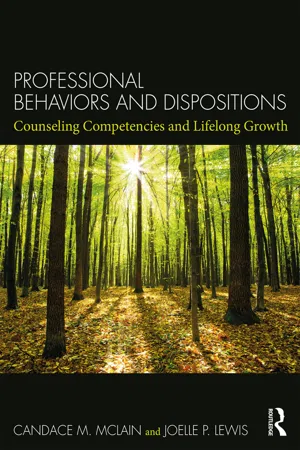
Professional Behaviors and Dispositions
Counseling Competencies and Lifelong Growth
- 202 pages
- English
- ePUB (mobile friendly)
- Available on iOS & Android
eBook - ePub
Professional Behaviors and Dispositions
Counseling Competencies and Lifelong Growth
About this book
Information
Topic
PsychologieSubtopic
Bildungsberatung1 Professional Behaviors and Dispositions
What Is PB&D?
This chapter covers a range of experiences Counselors in Training (CITs) face upon entering the clinical mental health field, including the experience of ongoing CIT growth and development and the requirement to continually engage in development and growth. Some CITs may be given a formal growth plan, while others are referred to work on a few areas, and still others choose to do immense growth on their own. Either way, we believe it is ultimately your choice to do the work and growth. In this chapter we also evaluate why many CITs are placed on a growth plan and how this is directly related to CACREP (2015) 2016 Standards of competency in knowledge, skills, and dispositions. Research is shared regarding the most commonly noted areas for CITs requiring a growth plan and we provide a detailed look at how dispositions fit into the research. We believe this data can indeed help those required to do a growth plan, and those who have a desire to learn and grow independently, to understand the expectations of competency.
Furthermore, this chapter offers normalization to CITs, with a developmental perspective and a focus on growth over your entire career. You are all Counselors in Training; by being in your training process you are indeed already professionals, training towards ongoing professionalism in knowledge, skills, and dispositions. PB&D is not a Peanut Butter and Donut sandwich despite that sounding quite interesting. Rather, PB&D stands for Professional Behaviors and Dispositions. “What is professionalism?” “What does it mean for me?” “Why is this so important?” “I can be a professional when I’m at work, but when I am off the clock I can do what I want, right?”
These may be questions or thoughts that many students have had about their career choice. If they are not questions yet, they should be questions pondered and processed as one goes through a clinical mental health program. Professional careers are held to a higher standard than other careers, often with both ethical and legal requirements as well as standards of practice. Counselors have an obligation to do no harm and thus have a higher standard of expectations about how to interact with others and what to do 24/7. The scrutiny is higher because of the level of trust in professionals to do what is best when interacting with clients and other professionals.
By nature, a counselor has a power differential with clients; ethical and legal standards of practice take this into consideration for the client’s and the public’s welfare. Standards are meant to protect others from harm by the counselor, and, therefore, the counselor has a greater responsibility to be aware of the influence they have on clients and supervisees.
These obligations are not only required by programs that are approved by the Council for Accreditation of Counseling and Related Educational Programs (CACREP) (2015), but also for the American Counseling Association (ACA) Code of Ethics (2014). In turn, all elements of competency in skills and dispositions are part of Professional Identity in Counseling. Counselors in Training will review their roles and responsibilities of learning and development, while also considering the relationship of the Counselor Educator and Supervisor (CES) within counselor education, who accompanies the CIT and encourages them to be able to change, grow, and develop. This chapter operationally defines the many CACREP and ACA codes that are required for both supervisor and students.
Professional identity development within the counselor is often seen as both an intrapersonal and interpersonal process.
The intrapersonal process is an internalization of knowledge and skills shared by faculty members and supervisors (e.g., recognizing personal strengths; areas of growth in academic roles). The interpersonal process develops during immersion into the norms of the professional community (e.g., submitting manuscripts for publication, presenting papers at conferences, teaching courses). These two developmental processes co-occur while counselor education trainees are conceptualizing their specific roles and tasks within academia. (Limburg et al., 2013, p. 42)
Within the intrapersonal and interpersonal integration lies the area of not only skills and knowledge, but dispositional competencies as well. There is a deep need for dispositional competency training and ongoing CIT developmental support to achieve professional identity. Professional identity development is imperative from the beginning of your training as a CIT, and throughout your entire professional career. We recognize you are required to have competencies in knowledge, skills, and dispositions. There are multiple resources to assist CITs in developing knowledge and skills. However, the dispositional opportunities to grow and become competent are not as prevalent. Therefore, the focus of this book is on dispositions, considering how much they also impact knowledge and skills as well. It can be argued that we can all learn the knowledge required of the field, and even practice the skills, but how do we gain personal and professional counselor dispositions? In mental health, considering the responsibility of caring for others, with the utmost ethical standards comes intense pressure and a dire need for ongoing self-reflection, desire for growth, acceptance of feedback, and use of critical thinking. Consider the ramifications if this is not taken into consideration within your training.
So, what does all this mean on a practical level?
I (Dr. Lewis) quite often worked with an attorney some years ago regarding my clients. He was my “go to” lawyer. My sons played soccer with his son. At one of the games, he didn’t like a call the referee made against his son, and confronted the referee, yelling obscenities, and actually “belly bucked” the ref! That was the last time I used him as an attorney. My trust in his abilities to maintain control and to act with integrity and respect was severely compromised by that display. Although he wasn’t in a courtroom exhibiting these behaviors, to me, it still told a lot about his character and professional dispositions. Too harsh you say? Maybe. But my obligation was to “do no harm” to my clients, and what if I referred a client to him who set him off? His behavior was unprofessional and public. Understanding that we all require ongoing growth is the first step towards becoming competent as a CIT; however, before we dig deeper into the developmental process, let’s operationally define terms towards universal understanding.
Operationally defining terms
• Counseling as a profession: “Professional counseling is a professional relationship that empowers diverse individuals, families, and groups to accomplish mental health, wellness, education, and career goals” (ACA, 2017).
• Counselor Educator Supervisor: Those who train and enter the counseling field are professionals who are educated in the art of teaching others to be counselors and supervising both at the student and professional level. The education includes a doctoral degree in Counselor Education and Supervision from an accredited university. A CES can have various licensure but also adheres to the ACES Best Practices in Clinical Supervision (2011) and ACA Code of Ethics (2014) as well as following CACREP 2016 Standards (2015). In addition, they may shift from roles including therapist, teacher, and consultant (Bernard & Goodyear, 2004). However, the CES is not in the role of giving therapy to the CIT.
• Student Remediation: Supporting a student to gain professional competency in all areas, while also maintaining a gatekeeping function for the field of counseling. This may include but is not limited to: retaining the CIT in the program, dismissing them from the program, recommending a leave of absence, transfer to a non-counseling program if warranted, or continued guidance, support, and teaching to reach competence (Foster & McAdams, 2009; Homrich, DeLorenzi, Bloom, & Godbee, 2014).
• Student Recidivism: Students who repeat remediation processes more than one time. The changes that were gained may not have been effective enough for long-term changes; thus, the CIT either continues with the same unprofessional interactions, or when they reach one area in competence and another issue arises in a different area.
• Student Support: Support that can be done in a variety of ways to assist CITs in their growth process, through remediation, short-term support for life-events, and mentoring or training. Support can include helping with skills, knowledge, or dispositions. Professional development, comportment or remediation is considered a form of student professional support as well.
• Personal Counseling for Supervisees: Counseling for Supervisees: If supervisees request counseling, the supervisor assists the supervisee in identifying appropriate services. Supervisors do not provide counseling services to supervisees. Supervisors address interpersonal competencies in terms of the impact of these issues on clients, the supervisory relationship, and professional functioning. (F. 6. c., ACA Code of Ethics, 2014.)
• Evaluation: Per the CACREP 2016 Standards (2015), formative evaluation examines the development of professional competencies, with a focus on identifying strengths and deficiencies and corresponding learning interventions. Summative evaluation focuses on outcomes and is used to assess whether desired learning goals are achieved consistent with a professional standard (p. 45).

Table of contents
- Cover Page
- Professional Behaviors and Dispositions
- Title
- Copyright
- Dedication
- Contents
- Foreword
- Preface
- Acknowledgments
- Introduction
- 1 Professional Behaviors and Dispositions: What Is PB&D?
- 2 Self-Evaluation and Personal Growth: How Do I Know I Have “IT”?
- 3 How to Exhibit Key Counselor Dispositions: How Do I Get “IT”?
- 4 Lifelong Standards: How to Measure and Keep “IT”
- 5 Application to Challenging Work: The Lifelong Growth Plan
- Appendix 1: Worksheets
- Appendix 2: Resources
- Glossary
- Index
Trusted by 375,005 students
Access to over 1.5 million titles for a fair monthly price.
Study more efficiently using our study tools.
Frequently asked questions
Yes, you can cancel anytime from the Subscription tab in your account settings on the Perlego website. Your subscription will stay active until the end of your current billing period. Learn how to cancel your subscription
No, books cannot be downloaded as external files, such as PDFs, for use outside of Perlego. However, you can download books within the Perlego app for offline reading on mobile or tablet. Learn how to download books offline
Perlego offers two plans: Essential and Complete
- Essential is ideal for learners and professionals who enjoy exploring a wide range of subjects. Access the Essential Library with 800,000+ trusted titles and best-sellers across business, personal growth, and the humanities. Includes unlimited reading time and Standard Read Aloud voice.
- Complete: Perfect for advanced learners and researchers needing full, unrestricted access. Unlock 1.5M+ books across hundreds of subjects, including academic and specialized titles. The Complete Plan also includes advanced features like Premium Read Aloud and Research Assistant.
We are an online textbook subscription service, where you can get access to an entire online library for less than the price of a single book per month. With over 1.5 million books across 990+ topics, we’ve got you covered! Learn about our mission
Look out for the read-aloud symbol on your next book to see if you can listen to it. The read-aloud tool reads text aloud for you, highlighting the text as it is being read. You can pause it, speed it up and slow it down. Learn more about Read Aloud
Yes! You can use the Perlego app on both iOS and Android devices to read anytime, anywhere — even offline. Perfect for commutes or when you’re on the go.
Please note we cannot support devices running on iOS 13 and Android 7 or earlier. Learn more about using the app
Please note we cannot support devices running on iOS 13 and Android 7 or earlier. Learn more about using the app
Yes, you can access Professional Behaviors and Dispositions by Candace M. McLain,Joelle P. Lewis in PDF and/or ePUB format, as well as other popular books in Psychologie & Bildungsberatung. We have over 1.5 million books available in our catalogue for you to explore.