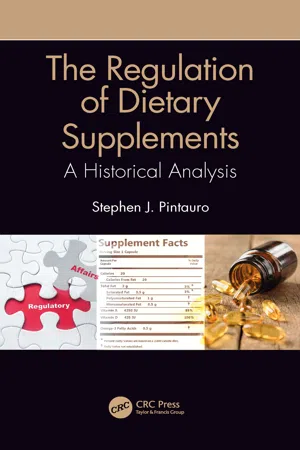
This book documents the long, still ongoing battle between the US Food and Drug Administration and the dietary supplement industry. It presents the complex, often subtle, and sometimes overlooked series of events that had a major impact on how dietary supplements are manufactured, marketed, sold, and used today. While the first few chapters focus on some background topics, the remaining chapters walk the reader through timeline of events, legislative actions, FDA proposed and final rules, and judicial decisions that led to our current dietary supplement regulatory framework. Interwoven in narrative are examples of the roles of science, social and public policy, politics, and popular media.
- 222 pages
- English
- ePUB (mobile friendly)
- Available on iOS & Android
eBook - ePub
About this book
Information
Subtopic
Ciencia de los alimentoschapter one
Introduction
Any regular viewer of evening news programs on television (TV) is certainly aware of the pharmaceutical theme that pervades the commercial breaks of these shows. Clearly, the manufacturers of many health-related products and services consider viewers of these programs to be prime targets for their advertising dollars. On just a recent 30-minute evening news broadcast, I noted commercials for the following:
- Phillips Colon Health (probiotic capsules)
- Prevnar13 (pneumococcal pneumonia vaccine)
- Humira (rheumatoid arthritis)
- One-A-Day Men’s (multivitamin)
- Zantac (for heartburn)
- Aleve (pain reliever)
- Prevagen (for brain health and memory)
- Linzess (for chronic idiopathic constipation)
It seems that our daily dose of evening news includes a virtual tour of your local pharmacy. I suppose this shouldn’t be surprising. After all, older Americans represent the largest proportion of network news viewers. A fairly recent Pew Research Center survey1 reported that approximately 40% of individuals aged 65 and above are regular viewers of evening news, compared with only 11% of those between the ages of 18 and 29 and 26% of those between the ages of 30 and 49. It does not take a Madison Avenue genius to recognize that these older viewers are also the folks most likely to purchase these products. But a closer look at this list of TV ads reveals some additional interesting information. Of the eight ads, three are for prescription drugs (Prevnar13, Humira, Linzess), two are for over-the-counter (OTC) drugs (Zantac and Aleve), and three are for dietary supplements (Philips Colon Health, Prevagen, and One-a-Day Men’s multivitamin). So, these ads represent three different categories of products: prescription drugs, OTC drugs, and dietary supplements.
The federal laws and regulations that oversee the manufacture, labeling, and advertising of these three categories of products differ in many important ways. One of the most significant differences among these three categories of substances is that, for both prescription and OTC drugs, the laws and regulations require that the manufacturers provide the U.S. Food and Drug Administration (FDA) with scientific data, establishing both the safety and effectiveness of these products before they are permitted for sale. As we shall see in subsequent chapters of this book, no such premarket safety and effectiveness testing is required for dietary supplements. Yet, while the principal focus of this book is on the regulation of dietary supplements, we will necessarily find ourselves also dealing with issues related to drug regulation. This is because the distinction between what is a “drug” and what is a “dietary supplement” is not always easy for the consuming public to discern. Let us start by simply taking a closer look at the narratives in the three dietary supplement TV ads mentioned earlier. The first is the commercial for Phillips Colon Health probiotic supplement.
[Female spokesperson wearing a Philips T-shirt that reads “Regular and proud of it” climbs onto the upper deck of a bus, holding a package of Philips Colon Health Probiotic Capsule supplement, and asks the passengers on the bus:]
“Anyone have occasional constipation, diarrhea, gas, bloating?”
One husband points shyly at his wife.
Another passenger says, “Yes.”
[Female Philips spokeswoman]: “One Philips Colon Health Probiotic capsule each day helps defend against these digestive issues—with three strains of good bacteria.”
[Female Philips spokeswoman then begins to pass out boxes of the Philips Probiotic supplement to the passengers.]
[Spokeswoman voiceover]: “Live the regular life. Philips.”
The second commercial is for One-A-Day Men’s 50+ multivitamin.
[Male voiceover. Video of men and boys camping and cooking outdoors.] “Americans. 83% try to eat healthy. Yet up to 90% fall short in getting key nutrients from food alone.”
[Video of man holding bottle of vitamins, Male voiceover.] “Let’s do more. Add One-A-Day Men’s. Complete with key nutrients we may need.”
[Man looking at bottle of vitamins. Male voiceover.] “Plus heart health support with B vitamins. One-A-Day Men’s. In gummies and tablets.”
And the third commercial is for Prevagen brain and memory supplement.
[Male voiceover, with animations of brain and nerve activity]: “Your brain is an amazing thing. But as you get older it naturally begins to change, causing a lack of sharpness, or even trouble with recall. Thankfully, the breakthrough in Prevagen helps your brain, and actually improves memory. The secret is an ingredient originally discovered in jellyfish. In clinical trials, Prevagen has been shown to improve short-term memory. Prevagen. The name to remember.”
As you read these transcripts of the TV ads, you may have noticed that there is something very different between these ads and those for the prescription or OTC drugs. Unlike the drug commercial advertisements, there is no mention of a specific disease or medical condition in the advertisements of these dietary supplements. This is not unintentional. According to federal law, any product label that makes a claim related to its “intended—use in the diagnosis, cure, mitigation, treatment, or prevention of disease in man or other animals” is, by legal definition, considered to be a drug (with a few notable exceptions that we will discuss later in this book). And no drug, whether it be prescription or OTC, can be sold in the United States until the manufacturer provides sufficient scientific evidence to the FDA that it is both safe and effective. Establishing safety and effectiveness of any drug can typically cost the manufacturer many millions of dollars in animal testing and human clinical testing and often takes many years to complete. Can the manufacturer of Phillips Colon Health capsule afford to do the necessary testing to prove that the product is safe? Well, the parent company of this product is Bayer AG, a very large multinational pharmaceutical company. So they certainly have the resources to do the necessary safety testing. But that would likely greatly increase the cost of the product to the consumer. Besides, there is the additional requirement of establishing the effectiveness of the product. Does Phillips Colon Health really improve issues related to constipation, bloating, and gas? Again, if this product met the legal definition of a drug, Bayer would need to provide the FDA with reliable and convincing scientific data to substantiate the product’s labeling and advertising claims for these gastrointestinal issues. Even if a company such as Bayer could afford this type of scientific testing, for many—if not most—dietary supplements, proving effectiveness may be a difficult task. Some of the reasons for this will be addressed later in this book.
Yet, dietary supplement manufacturers need to communicate what they believe are the health—and even disease—preventing or treating benefits of their products to the consumer. How can they do this and still avoid their products being legally classified as drugs? Let’s consider this by taking another look at the Prevagen ad transcript. Notice the line, “Researchers have discovered a protein that actually supports healthier brain function.” And the line, “For support of healthier brain function, a sharper mind, and clearer thinking.”
And notice similar claims in the Phillips Colon Health and One-A-Day Men’s Multivitamin ads. For Phillips Colon Health the ad states, “Help defend against those digestive issues.” In the One-A-Day ad, notice the line, “Plus heart health support with B vitamins.” These types of statements are permitted because they do not make a specific disease claim. Rather, they make claims related to the structure or function of the body. The manufacturers intend and hope that consumers will make the link between these “structure and function” claims and the possible benefits to specific diseases. So, the One-A-Day ad states that the product offers “…heart health support with B vitamins.” But it does not state that it helps in the treatment or prevention of heart disease. And the Prevagen ad states, “For support of healthier brain function…” But it does not state that it helps prevent dementia or related brain diseases such as Alzheimer’s disease.
And there is one other important legal requirement in the advertising and labeling of these dietary supplements. If you watch the actual TV ads closely, you may notice a small font disclaimer that appears briefly at the bottom of the screen. This disclaimer states
These statements have not been evaluated by the FDA.
This product is not intended to treat, cure, or prevent any disease.
But why aren’t dietary supplements held to the same standards of safety and effectiveness that the FDA requires of all drugs? This is because in 1994 the U.S. Congress passed and President Clinton signed into law the Dietary Supplement Health and Education Act. Throughout this book, we will simply refer to this law as the DSHEA. This law radically altered the way dietary supplements are regulated in the United States. Among the law’s provisions is one that permits the manufacturers of dietary supplements to make “structure or function” claims, such as the ones for the products described earlier.
There are many other important provisions to this law, and we will explore these in detail in this book. However, this book is not intended to simply review the major provisions of the DSHEA. Rather, it is intended to explore the roles that many different factors and issues played in the nearly 100-year history of dietary supplement regulation, culminating in the passage of the DSHEA in 1994, and some important changes that have occurred since. Some of the issues to be explored include
How big is the dietary supplement industry in the United States? We all know that many Americans take dietary supplements. But how is that reflected in the growth and size of the industry? How much are Americans spending on dietary supplements, and how much money are manufacturers making in the sale of these products?
Why do people take dietary supplements? This may seem like a simple question, but research has shown that the reasons will vary based on many factors, such as gender, age, health status, education, socioeconomic status, and more. An understanding of the role that these factors play in driving consumer demand for dietary supplements is important to understanding the interaction between science and the enactment of public policy.
Are dietary supplements effective? Of course, there is no simple yes or no answer to this question. Although the DSHEA does not require that manufacturers of dietary supplements prove their “structure or function” claims, there is nevertheless considerable interest among consumers regarding the effectiveness of the products they are purchasing. However, there are literally thousands of different dietary supplement products on the market, making it virtually impossible to scientifically evaluate the effectiveness of each. And how do we define “effective”? If 5 out of 100 users of a probiotic dietary supplement experience a slight improvement in, for example, “gastrointestinal discomfort,” is that a sufficient indication of effectiveness? There is no absolute threshold at which a substance can officially be considered “effective.” But we can apply some basic scientific principles to help us make determinations about the relative effectiveness and the strength of the scientific evidence related to effectiveness. Consideration of these scientific principles and the role that they should play in the regulation of dietary supplements have driven much of the debate between federal regulators (such as the FDA), legislators, manufacturers, and the consuming public.
Are dietary supplements safe? As with the “effectiveness” issue, the DSHEA does not require premarket safety testing of dietary supplements. Yet, the safety of dietary supplements has been a major consideration in the long history of dietary supplement laws and regulations. Evaluating the safety of dietary supplements presents some unique scientific and regulatory challenges. All dietary supplements are different and present different levels of risk with regard to toxicity. As with any substance, whether it be a dietary supplement, a drug, or any food item, its toxicity is fundamentally related to the amount consumed, or more precisely, the dose. If y...
Table of contents
- Cover
- Half Title
- Title Page
- Copyright Page
- Dedication Page
- Table of Contents
- Preface
- About the Author
- Chapter 1 Introduction
- Chapter 2 Dietary supplement use in the United States
- Chapter 3 Our federal food regulatory structure
- Chapter 4 The early history of dietary supplement regulation
- Chapter 5 Dietary supplements: Foods or drugs?
- Chapter 6 Food labeling versus food advertising
- Chapter 7 The battle over health claims
- Chapter 8 Congress takes action
- Chapter 9 The congressional hearings
- Chapter 10 DSHEA: Defining dietary supplements
- Chapter 11 DSHEA: A new safety standard for dietary supplements
- Chapter 12 DSHEA: Structure–function claims versus health claims
- Chapter 13 DSHEA: Other important provisions
- Chapter 14 The health claims debate continues
- Chapter 15 Where does dietary supplement regulation stand today?
- Index
Trusted by 375,005 students
Access to over 1.5 million titles for a fair monthly price.
Study more efficiently using our study tools.
Frequently asked questions
Yes, you can cancel anytime from the Subscription tab in your account settings on the Perlego website. Your subscription will stay active until the end of your current billing period. Learn how to cancel your subscription
No, books cannot be downloaded as external files, such as PDFs, for use outside of Perlego. However, you can download books within the Perlego app for offline reading on mobile or tablet. Learn how to download books offline
Perlego offers two plans: Essential and Complete
- Essential is ideal for learners and professionals who enjoy exploring a wide range of subjects. Access the Essential Library with 800,000+ trusted titles and best-sellers across business, personal growth, and the humanities. Includes unlimited reading time and Standard Read Aloud voice.
- Complete: Perfect for advanced learners and researchers needing full, unrestricted access. Unlock 1.5M+ books across hundreds of subjects, including academic and specialized titles. The Complete Plan also includes advanced features like Premium Read Aloud and Research Assistant.
We are an online textbook subscription service, where you can get access to an entire online library for less than the price of a single book per month. With over 1.5 million books across 990+ topics, we’ve got you covered! Learn about our mission
Look out for the read-aloud symbol on your next book to see if you can listen to it. The read-aloud tool reads text aloud for you, highlighting the text as it is being read. You can pause it, speed it up and slow it down. Learn more about Read Aloud
Yes! You can use the Perlego app on both iOS and Android devices to read anytime, anywhere — even offline. Perfect for commutes or when you’re on the go.
Please note we cannot support devices running on iOS 13 and Android 7 or earlier. Learn more about using the app
Please note we cannot support devices running on iOS 13 and Android 7 or earlier. Learn more about using the app
Yes, you can access The Regulation of Dietary Supplements by Stephen J. Pintauro in PDF and/or ePUB format, as well as other popular books in Tecnología e ingeniería & Ciencia de los alimentos. We have over 1.5 million books available in our catalogue for you to explore.