The second book of the Food Biotechnology series, Functional Foods and Biotechnology: Biotransformation and Analysis of Functional Foods and Ingredients highlights two important and interrelated themes: biotransformation innovations and novel bio-based analytical tools for understanding and advancing functional foods and food ingredients for health-focused food and nutritional security solutions. The first section of this book provides novel examples of innovative biotransformation strategies based on ecological, biochemical, and metabolic rationale to target the improvement of human health relevant benefits of functional foods and food ingredients. The second section of the book focuses on novel host response based analytical tools and screening strategies to investigate and validate the human health and food safety relevant benefits of functional foods and food ingredients.
Food biotechnology experts from around the world have contributed to this book to advance knowledge on bio-based innovations to improve wider health-focused applications of functional food and food ingredients, especially targeting non-communicable chronic disease (NCD) and food safety relevant solution strategies.
Key Features:
Provides system science-based food biotechnology innovations to design and advance functional foods and food ingredients for solutions to emerging global food and nutritional insecurity coupled public health challenges.
Discusses biotransformation innovations to improve human health relevant nutritional qualities of functional foods and food ingredients.
Includes novel host response-based food analytical models to optimize and improve wider health-focused application of functional foods and food ingredients.
The overarching theme of this second book is to advance the knowledge on metabolically-driven food system innovations that can be targeted to enhance human health and food safety relevant nutritional qualities and antimicrobial properties of functional food and food ingredients. The examples of biotransformation innovations and food analytical models provide critical insights on current advances in food biotechnology to target, design and improve functional food and food ingredients with specific human health benefits. Such improved understanding will help to design more ecologically and metabolically relevant functional food and food ingredients across diverse global communities.
The thematic structure of this second book is built from the related initial book, which is also available in the Food Biotechnology Series
Functional Foods and Biotechnology: Sources of Functional Food and Ingredients, edited by Kalidas Shetty and Dipayan Sarkar (ISBN: 9780367435226)
For a complete list of books in this series, please visit our website at:
BIOTRANSFORMATION OF FUNCTIONAL FOODS AND INGREDIENTS
Chapter 1
Metabolic Modulation of Abiotic Stress Response for Improvement of Functional Ingredients in Food Plants
Dipayan Sarkar and Kalidas Shetty
1.1 Introduction
1.2 Evolution of Food Plants and Abiotic Stress Response
1.3 Biosynthesis of Secondary Metabolites under Abiotic Stresses
1.4 Role of Proline-Associated Pentose Phosphate Pathway (PAPPP) to Stimulate Biosynthesis of Phenolic Bioactives in Food Plants
1.5 Dual Biological Functions and Human Health Benefits of Phenolic Bioactives of Food Plants
1.6 Metabolic Modulation of Abiotic Stress Responses for Bioactive Enrichment of Food Plants: Novel Strategies
1.6.1 Chemical Elicitation Strategy
1.6.1.1 Chitosan and Chitosan Derivatives
1.6.1.2 Seaweed and Marine Protein Hydrolysate
1.6.1.3 Organic Acids and Other Natural Compounds
1.6.1.4 Elicitors of Microbial Origin
1.6.1.5 Other Chemical Elicitors
1.6.2 Wounding
1.6.3 Heat, Cold, and Salt Stress
1.6.4 Ozone, Ultrasound, UV-Radiation, and Other Stress Induction Methods
1.7 Future Directions and Summary
References
1.1 Introduction
Building abiotic stress-resilient and nutritionally enriched food plant systems is essential to advancing global food security and public health solutions as rapid climate change increases the challenges. Overall, increases in global mean temperature, flooding associated with intense precipitation, prolonged drought, increasing salinization of topsoil, higher frequency of extreme climate events, and gradual loss of fresh water resources as a result of rapidly emerging climate change are imposing significant burdens on agricultural production and profitability (Campbell et al. 2016). Furthermore, the impact of climate change-associated food security challenges are not only restricted to production and availability of foods, but also affect the nutritional quality of plant-based foods that are relevant to combatting emerging non-communicable chronic disease (NCD) challenges worldwide (Dawson et al. 2016; Hartel 2015). Public health challenges linked to NCDs are affecting all age groups and economic classes and are responsible for 71% of all deaths in each year worldwide (World Health Organization 2018). Plant-based foods with balanced nutritional composition (in terms of macronutrients, micronutrients, minerals, and fiber) and health- protective bioactive compounds are critical for building dietary solutions against the diet-linked NCD epidemic globally (Pearce et al. 2015). Therefore, ensuring greater availability and accessibility of such nutritionally balanced and bioactive-enriched plant-based foods to meet the needs of the increasing global population (which will reach 9–10 billion by 2050) is an enormous challenge for growers, traders, and scientists, particularly in developing countries, where the projected global population will rise more rapidly in numbers and overall density per unit area than elsewhere (Bullock et al. 2017; Godfray et al. 2010). In this context, advancing ecologically and metabolically responsive innovations to build resilience to counter abiotic stress challenges facing food plants, and improving human health-relevant nutritional qualities of plant-based foods are essential to advancing sustainable agricultural solutions against climate change-linked food and nutritional security challenges. Modulation of abiotic stress responses through mild stress induction or by mimicking biotic stress responses using natural elicitors at pre- and post-harvest stages is an effective sustainable strategy to stimulate stress-inducible and human health-protective bioactive enrichment in food plants. Such metabolically linked and robust strategies to improve resilience to climate change, and increase nutritional qualities of food plants can be advanced and implemented in diverse agricultural ecosystems, including field, greenhouse, and high tunnel production systems. However, it will be important to understand the metabolic and biochemical regulations of food plants growing under abiotic stresses to achieve its maximum use in wider agricultural production systems, especially to address food- and nutritional security-linked public health challenges worldwide.
1.2 Evolution of Food Plants and Abiotic Stress Response
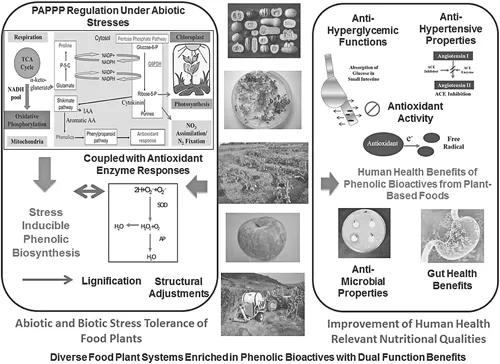
Terrestrial higher plants, including food plants, are sessile organisms and throughout their lifespan, they are constantly exposed to a range of abiotic and biotic stresses such as salinity, waterlogging, heat, cold, drought, heavy metal toxicity, ultraviolet (UV)-radiation, insects, pathogens, and weeds (Prasch and Sonnewald 2015). As part of the overall evolutionary process linked to adaptive responses, higher plants have developed unique and intricate endogenous defense systems to cope with such constantly varying and diverse environmental stresses (Amtmann et al. 2005). Without possessing locomotion, plants depend mostly on seed dispersal, vegetative reproduction and growth, allelopathy, and physiological, structural and metabolic adjustments to escape or mitigate the impacts of biotic and abiotic stresses (Rodriguez and Redman 2008). Both natural evolution and selection through domestication of food plants by humans have shaped such diverse defense mechanisms as part of overall adaptation towards different environmental stresses (Shao et al. 2008). Integration of diverse transduced events into a dynamic network of signaling pathways and the diversion and allocation of carbon flux towards several metabolic and structural adjustments are critical physiological and molecular responses of plants under abiotic and biotic stresses (Knight and Knight 2001; Shao et al. 2008; Shetty and Wahlqvist 2004). Though there are significant cross-talk among different abiotic stress signaling pathways, specific inducible and appropriate responses associated with a particular stress condition are also evident in many food plants and in wider plant systems (Knight and Knight 2001). Such specific stress-inducible responses are particularly important for tailoring food plants toward greater resilience against climate change and also to improve the nutritional properties of plant-based foods derived from such resilient and robust food plants (Figure 1.1) (Schijlen et al. 2006; Shetty and Wahlqvist 2004). In this context, pathway regulation associated with the diversion of carbon flux toward secondary metabolism to stimulate the biosynthesis of human health- relevant secondary metabolites as part of overall abiotic stress responses of food plants is gaining increasing interests from breeders, agronomists, and molecular biologists to build nutritionally enriched food plant systems which are more resilient to abiotic stresses (Roy et al. 2011). Therefore, improved understanding of such specific secondary metabolite biosynthesis-associated responses of food plants towards abiotic stresses has significant relevance toward the design of new agronomic tools for enhancing abiotic stress tolerance, and for improving human health-relevant bioactive profiles in food plants. In this chapter, specific attention has been paid to phenolic metabolites, due to their dual biological functions in terms of abiotic stress tolerance of food plants and human health-protective roles in plant-based foods.
Figure 1.1 Dual function benefits of stress-inducible phenolic bioactives in food plants for enhancing climate change resilience and for improving human health-protective nutritional qualities in plant-based foods.
1.3 Biosynthesis of Secondary Metabolites under Abiotic Stresses
In response to different biotic and abiotic stresses, biosynthesis of secondary metabolites, such as phenolic bioactives, occurs through stimulation of plant secondary metabolic pathways (Akula and Ravishankar 2011). Current scientific evidence strongly indicates that most phenylpropanoid compounds, such as flavonoids, isoflavonoids, anthocyanins, and phenolic acids, are induced in response to wounding, nutritionaldeficiency, cold, salinity, UV-B, drought, and flooding (Akula and Ravishankar 2011; Miller et al. 2008). In the evolutionary process of land plants, development of phenolic polymer biosynthesis was partly induced by UV-B coupled with other abiotic stresses and has played a major role in the transition of early plants from an aquatic environment to terrestrial ecosystems (Rozema et al. 2002). Recent studies further strengthens the hypothesis that flavonoids are the main UV absorbents in plant tissues, with most conifers being capable of epidermal attenuation of incident UV by absorbing UV radiation via high levels of flavonoids and other phenolic pigments in their needle leaves (Bornman et al. 2019; Day and Vogelmann 1995). Additionally, most herbaceous plants also up-regulate the biosynthesis of flavonoids and phenolic acids after exposure to UV-radiation and other abiotic stresses ...
Table of contents
Cover
Half-Title
Series
Title
Copyright
Contents
PREFACE
EDITORS
LIST OF CONTRIBUTORS
SECTION 1 BIOTRANSFORMATION OF FUNCTIONAL FOODS AND INGREDIENTS
SECTION 2 ANALYSIS OF FUNCTIONAL FOODS AND INGREDIENTS
INDEX
Trusted by 375,005 students
Access to over 1.5 million titles for a fair monthly price.
Study more efficiently using our study tools.
Frequently asked questions
Yes, you can cancel anytime from the Subscription tab in your account settings on the Perlego website. Your subscription will stay active until the end of your current billing period. Learn how to cancel your subscription
No, books cannot be downloaded as external files, such as PDFs, for use outside of Perlego. However, you can download books within the Perlego app for offline reading on mobile or tablet. Learn how to download books offline
Perlego offers two plans: Essential and Complete
Essential is ideal for learners and professionals who enjoy exploring a wide range of subjects. Access the Essential Library with 800,000+ trusted titles and best-sellers across business, personal growth, and the humanities. Includes unlimited reading time and Standard Read Aloud voice.
Complete: Perfect for advanced learners and researchers needing full, unrestricted access. Unlock 1.5M+ books across hundreds of subjects, including academic and specialized titles. The Complete Plan also includes advanced features like Premium Read Aloud and Research Assistant.
Both plans are available with monthly, semester, or annual billing cycles.
We are an online textbook subscription service, where you can get access to an entire online library for less than the price of a single book per month. With over 1.5 million books across 990+ topics, we’ve got you covered! Learn about our mission
Look out for the read-aloud symbol on your next book to see if you can listen to it. The read-aloud tool reads text aloud for you, highlighting the text as it is being read. You can pause it, speed it up and slow it down. Learn more about Read Aloud
Yes! You can use the Perlego app on both iOS and Android devices to read anytime, anywhere — even offline. Perfect for commutes or when you’re on the go. Please note we cannot support devices running on iOS 13 and Android 7 or earlier. Learn more about using the app
Yes, you can access Functional Foods and Biotechnology by Kalidas Shetty, Dipayan Sarkar, Kalidas Shetty,Dipayan Sarkar in PDF and/or ePUB format, as well as other popular books in Business & Food Science. We have over 1.5 million books available in our catalogue for you to explore.