Through the author's experiences, investigations and discussions with artists, art therapists and inmates from around the world, Art and Art Therapy with the Imprisoned: Re-Creating Identity comprehensively explores the efficacy, methods, and outcomes of art and art therapy within correctional settings.
The text begins with a theoretical and historical overview of art in prisons as a precursor to exploring the benefits of art therapy, followed by a deeper exploration of art therapy as a primary focus for wellness and mental health inside penitentiaries. Relying on several theoretical perspectives, results of empirical research studies, and case vignettes and illustrations gleaned from over 25 years of clinical and programmatic experience, this book argues why art therapy is so beneficial within prisons.
This comprehensive guide is essential reading for professionals in the field, as well as students of sociology, criminology, art theory, art therapy, and psychology who wish to explore the benefits of art therapy with inmate populations.
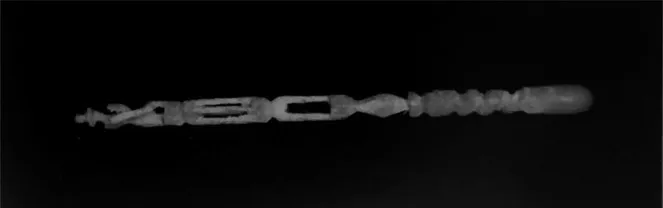
Long before art therapists worked in prisons providing clinical services, the arts in corrections flourished. Ursprung (1997) recognized that “prison art is probably as old as the institution of prison itself” (p. 18). The writings of Plato and Socrates were inspired by their respective incarcerations (Rojcewicz, 1997), and gladiators enslaved in the Pompeii arena in the first century scratched graffiti into the walls of their imprisoning barracks (Kornfeld, 1997). Many artistic victims of Nazi Germany imprisoned in various concentration camps created drawings and paintings of what they saw, as an escape and as a way to bear witness—never mind that if they were caught doing so would have resulted in their immediate death (Gussak, 2004 a). The excavation of a Pennsylvania prison built in 1829 yielded inmate handicrafts, specifically wooden toys, figurines, and gaming pieces (Ursprung, 1997). Figure 1.1 was by an unknown artist, discovered during that excavation; on the end of a matchstick he carved a replica of the sculpture of William Penn that sits atop Philadelphia’s City Hall.
Many famous artists and writers completed great works of art while imprisoned in asylums and early forms of penitentiaries (Rojcewicz, 1997). In the 1780s, well-known painter Jacques-Louis David painted some of his celebrated works, including his self-portrait, while imprisoned for his political views. Oscar Wilde and François Villon wrote and composed poems about their respective prison experiences. Johnny Cash reminded us of just how important and prevalent music is within the walls, Lil Wayne, Tupac Shakur, and Prodigy all composed some of their music while locked up—some of which was about their experiences—while Merle Haggard played in a country band while in San Quentin.
Figure 1.1
This has developed into more systematic arts in corrections programming. What has naturally emerged is the clear understanding that not only is art making recreationally beneficial for the prison population, but that it would lead to one of the most advantageous and therapeutic interventions inside.
Overcoming Limitations
Clearly, there is a natural tendency for artistic and creative expression in prison settings (Brown, 2002; Kornfeld, 1997; Ursprung, 1997). Correctional institutions are filled with energy needing an outlet—certainly a creative outlet is much preferred over other forms of cathartic expression. As Ursprung further stressed:
The incarceration experience, one of sensory deprivation, is a world of imposed controls, rigid regulations, tedium, minimum allowable risk, and consistent inconsistencies. It appears that the creative process [art making] is an apt coping mechanism in order to survive such an oppressive dys-functional milieu, especially to derive some sense of order out of chaos.
(1997, p. 17)
Inmates find unique methods to create in order to overcome the limitations they experience. While some institutions have supported some variations of arts programming, oftentimes inmates rely on their own talents to create: envelopes are decorated and then bartered by talented inmates to send letters home, handkerchiefs are covered with intricate designs and portraits sold to other inmates to give to their loved ones as mementos, and of course many inmates sport intricate tattoos designed by those inside (Gussak & Ploumis-Devick, 2004). The prison system comprises several hierarchical layers, not the least of which is the artist whose abilities are much esteemed; inmates who create “good” art earn respect and friendship from others (Kornfeld, 1997). Even when limitations seemingly make it almost impossible to create, those inside still find ways to make something out of nothing, oftentimes rising above the ugliness inside.
Strings Are Attached
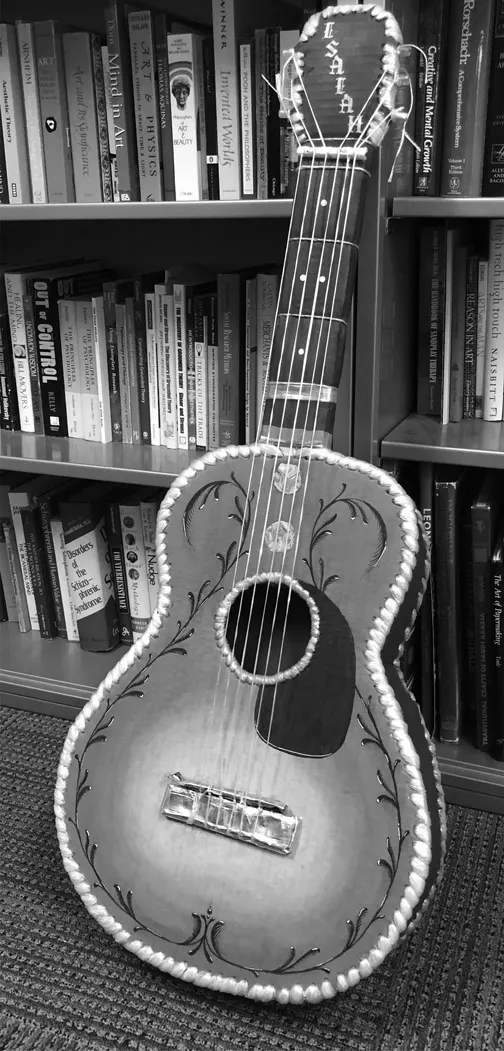
Several years ago, I received an email from a long-time friend and colleague, Laura Bedard, formerly professor of criminology at Florida State University, deputy secretary of Florida’s Department of Corrections, and warden for several institutions. Known for her forward thinking and strong support for programming and education, she has been a strong advocate for the arts in prisons. She told me that one of her officers confiscated an art piece completed by an inmate. Considered contraband, the officer was set to destroy it. She rescued the piece and sent it to me for safekeeping [Figure 1.2].
The guitar stands around three feet tall and is constructed from discarded cardboard, artfully folded and painted, sewn together with stretched white plastic garbage bags. Its strings are also made from the same trash bags, stretched and then connected tautly to tuning pegs made from broken disposable ink pens. The bridge and frets are made from candy bar foils. While there was no information provided on how it was painted, the brown looks like shoe polish, the yellow and orange appear to be colored pencil, and the black seems to be pen ink.
Dr. Bedard does not know who the artist was; the only clue we have is the common name on the guitar head, done in stylized white graffiti-like lettering, which could either represent the artist or the artist’s loved one. Unfortunately, there was no way to tell who it was or what happened to him.
There was no art programming in this facility. This piece was constructed in the inmate’s free time, likely in secret. As a resident of this system, he likely knew it was contraband. He did not make the piece for notoriety, as he kept it hidden, likely not showing it to many people.
This piece, in all its tangible form, emphasizes this drive to create “insider art.”
Outsider/Insider Art
Art Brut [Raw Art], commonly known as Outsider Art, refers to work created by those on the fringes of society, outside the mainstream art world. Dubuffet (1949) first conceived of this form as its own genre, focusing on the art completed by psychiatric patients, vagabonds and those he considered eccentric. Cardinal, an expert of Outsider Art (1972), considered the works of these untutored artists as honest yet naïve, while Dubuffet recognized their output as pure yet crude (Macgregor, 1989). Some outside artists are driven to create even despite their lack of ability or talent. For similar work created in prison, Ursprung coined the term Insider Art (1997).
Figure 1.2
Many inmates inside are driven to create, despite knowing that the pieces they make outside of a sanctioned program might be confiscated and destroyed. Using the creative process to escape from their surroundings, many inmates will create regardless of their limitations.
As I was writing this, it conjured up a memory from long ago. In the mid-1990s, when I was a young art therapist, I was walking down the mainline of a California prison with a colleague when we saw an inmate carrying a rather large sailing ship, heavy enough for it to be a visible struggle to transport. It was made out of hundreds of tongue depressors, with its sails made from fragile toilet paper. We stopped him so we could take a closer look. It was one of the most intricate sculptures we had ever seen. He was justifiably proud of it; he had spent many weeks building it from these discarded pieces of wood. When talking to him, he revealed he had no artistic training, and simply felt compelled to make it. His sense of accomplishment was palpable.
About a week later we saw him again. We asked him about the sculpture. He told us, in a matter-of-fact tone, that a correctional officer confiscated and destroyed it, as it was deemed a misuse of state property and was therefore contraband (Fox, 1997). He was fairly philosophical about it, shrugging in a matter that conveyed “What can you do? It’s prison.” Personally, I was furious for him; I felt impotent and frustrated. It was not until much later that I realized that he must have known that it was only a matter of time before the piece would be confiscated. What became clear was that it was the act of making it that was important to him. What happened to the piece after was simply an epilogue.
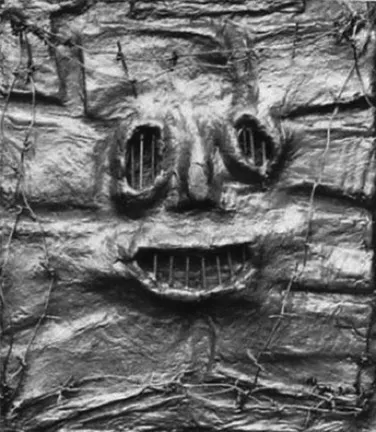
Despite the lack of materials in many of the institutions—or perhaps in defiance of this—inside artists construct pieces from whatever materials they can find. Something as banal as toilet paper and toothpaste can be the basis of a rather complicated image. The “mask” [Figure 1.3], featured in the book Drawing Time, is constructed from toilet paper, toothpaste, soft soap, jute, and shoe polish, a combination from which emerges a rather sophisticated relief.
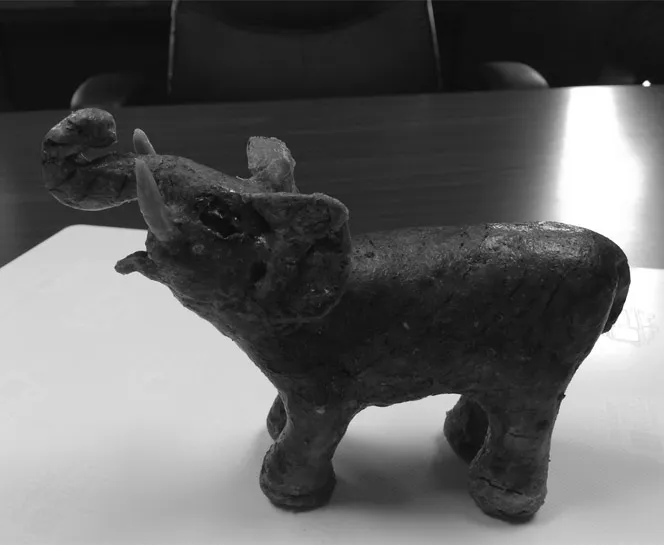
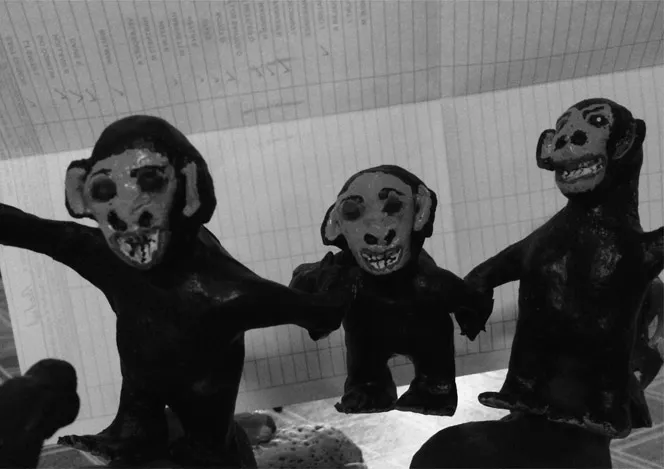
The guitar was not the only piece rescued by my colleague. I have had numerous soap and wooden sculptures delivered to me over the past few years. Figures 1.4 to 1.7 were made of soap—a popular media, as it was readily available. It could either be carved with sharpened toothbrushes and sticks, or softened with water and reshaped. Some were quite primitive, as shown by this elephant [Figure 1.4] removed from a women’s facility in North Florida, and these three monkeys from a men’s prison, painted with shoe polish and stolen ink [Figure 1.5].
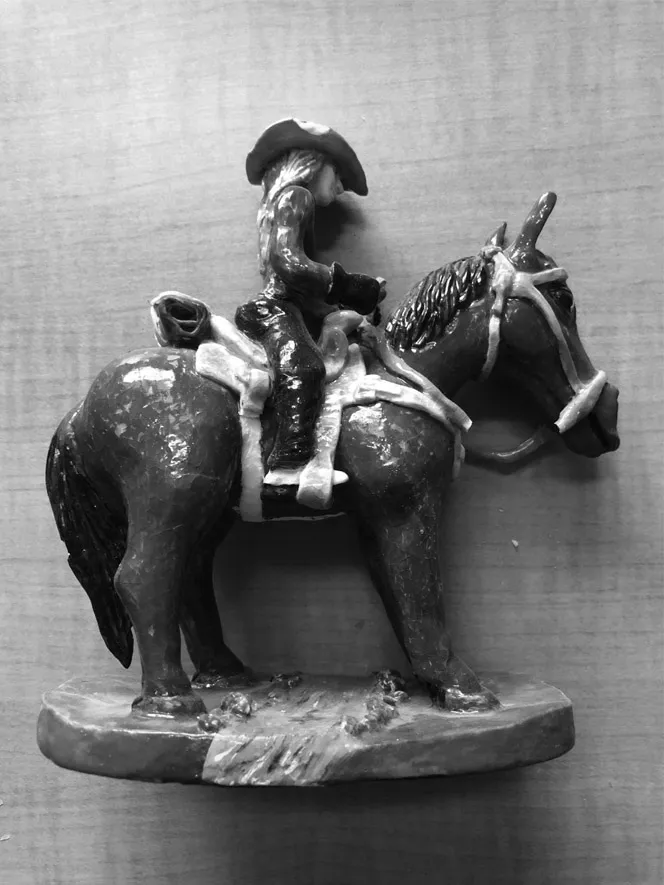
Others were more complicated, like this cowboy on a horse rescued from a facility in Texas [Figure 1.6], and an intricate sailing vessel with other found objects to fashion the sail and cabin [Figure 1.7]. Both of these were painted and sealed with flooring wax to protect them.
Figure 1.3
Figure 1.4
Figure 1.5
Other objects were often used. Figure 1.8 was recently rescued from a men’s prison in north Florida. The artist meticulously collected stones, scrap pieces of wood, corrugated cardboard, and thick plastic wrap found in the prison yard. He glued this debris together using non-dairy creamer mixed with water as mortar, constructing this very complicated cabin. A peek inside the door and windows reveal an amazing attention to detail—various pieces of furniture and a spiral staircase leading to the upstairs and outside balcony.
Candy Man
In 2014, I received a handwritten letter from a prison inmate from central Florida. It began “my name is John Blasi, I am an extraordinary artist and love to paint.”
He explained that while incarcerated for over three decades, he began painting. His work had been well received by heads of state, government agencies and through private commissions. He wanted to know if I would be interested in seeing his work. Unfortunately, he was limited in the materials he was provided, so he made his own materials: “The paints I use I make from the colored dye of M&M candy and my brushes are handmade from locks of my own hair.”
Along with his handwritten letters, he included a number of his pieces, such as Figure 1.9, heavily varnished with floor polish—still faintly aromatic of the candy they were made from—an artist statement, and several press releases. The press releases detailed how his works had been obtained by high-profile politicians and government agencies.
Figure 1.6
So, who is John Blasi?
Although newspaper articles indicate that John Blasi is a convicted murderer, robbing and killing two shopkeepers in 1981, he continues to profess his innocence, even after 30 years: “I’m not the monster they made me out to be. My prison record and conduct on a daily basis speaks for itself.” Despite his position, and the ongoing struggles he has with the courts and the system as his case continues to progress through appeals, he remains somewhat philosophical:
I’ve reached a place in my life where I can look back without panicking. I have regrets, but I’m willing to mention them if they might ...
Table of contents
Cover
Half Title
Title
Copyright
CONTENTS
Prologue: “Now That’s Sexy”
Introduction: Identity in Isolation: A Beginning
1 Art in Prison: A Natural By-Product
2 Rehumanizing Through Art
3 Drawing Time Revisited: The Benefits of Art Therapy in Prison
4 Making Something Out of Nothing: Materials and Directives for the Correctional Milieu
5 Deepening the Exploration Through Research
6 Nurturing Identity: Art Therapy in Women’s Correctional Settings
7 Reversing the Delinquent Label: Art Therapy With Juvenile Justice Populations
8 The Realities of Professional Dissonance: Maintaining Boundaries Within the Tensions of Ethics, Morals, and the Law
9 Negotiating a Continuously Fluctuating Identity
Epilogue: Art Therapy in Prison Is Social Justice: The Last [for Now] Rallying Cry
References
Appendix: Research Results
Index
Trusted by 375,005 students
Access to over 1.5 million titles for a fair monthly price.
Study more efficiently using our study tools.
Frequently asked questions
Yes, you can cancel anytime from the Subscription tab in your account settings on the Perlego website. Your subscription will stay active until the end of your current billing period. Learn how to cancel your subscription
No, books cannot be downloaded as external files, such as PDFs, for use outside of Perlego. However, you can download books within the Perlego app for offline reading on mobile or tablet. Learn how to download books offline
Perlego offers two plans: Essential and Complete
Essential is ideal for learners and professionals who enjoy exploring a wide range of subjects. Access the Essential Library with 800,000+ trusted titles and best-sellers across business, personal growth, and the humanities. Includes unlimited reading time and Standard Read Aloud voice.
Complete: Perfect for advanced learners and researchers needing full, unrestricted access. Unlock 1.5M+ books across hundreds of subjects, including academic and specialized titles. The Complete Plan also includes advanced features like Premium Read Aloud and Research Assistant.
Both plans are available with monthly, semester, or annual billing cycles.
We are an online textbook subscription service, where you can get access to an entire online library for less than the price of a single book per month. With over 1.5 million books across 990+ topics, we’ve got you covered! Learn about our mission
Look out for the read-aloud symbol on your next book to see if you can listen to it. The read-aloud tool reads text aloud for you, highlighting the text as it is being read. You can pause it, speed it up and slow it down. Learn more about Read Aloud
Yes! You can use the Perlego app on both iOS and Android devices to read anytime, anywhere — even offline. Perfect for commutes or when you’re on the go. Please note we cannot support devices running on iOS 13 and Android 7 or earlier. Learn more about using the app
Yes, you can access Art and Art Therapy with the Imprisoned by David Gussak in PDF and/or ePUB format, as well as other popular books in Psychology & History & Theory in Psychology. We have over 1.5 million books available in our catalogue for you to explore.