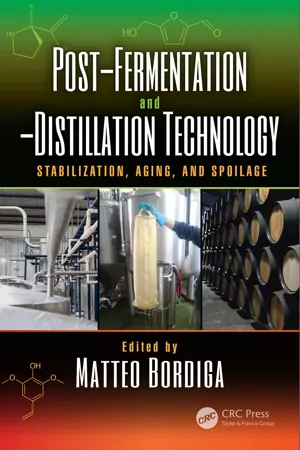
Post-Fermentation and -Distillation Technology
eBook - ePub

Post-Fermentation and -Distillation Technology

Stabilization, Aging, and Spoilage

  1. 282 pages
  2. English
  3. ePUB (mobile friendly)
  4. Available on iOS & Android
eBook - ePub

Post-Fermentation and -Distillation Technology

Stabilization, Aging, and Spoilage

About this book

While most wine and spirits books focus on vineyard and crop management or fermentation and distillation processes, few address critical post process aspects of stabilization, aging, and spoilage. This book serves as a comprehensive source of information on post-fermentation and -distillation technology applied to wine, beer, vinegar and distillates in a broad spectrum.

Post-Fermentation and -Distillation Technology: Stabilization, Aging, and Spoilage thoroughly describes all of the operations related to these products after the fermentation or distillation steps, focusing on the complex issues related to their stabilization, aging, and spoilage. The final product must be stable against microbial activity as well as undesirable chemical and physical chemical reactions that occur in the bottle. For example, clarity, stability, compositional adjustment, style development and packaging represent the five goals of "finishing" a wine. Concerning the visual defects associated with spoilage, it is crucial that wine at the point of consumption not be cloudy or contain any haze or precipitate, especially white wines. Similarly, it is also important to prevent unwanted microbial growth from occurring in the wine after the primary fermentation is complete, affecting the flavor and aroma profile in unpredicted ways. The book addresses all of these issues and more.

Moreover, the discussion also involves beer, vinegar and distillates, giving this book a novel and interesting approach. The book combines referenced research with practical applications and case studies of novel technologies such as square barrels, synthetic closures, and Tetra Pak®.

Trusted by 375,005 students

Access to over 1.5 million titles for a fair monthly price.

Study more efficiently using our study tools.

Information

Publisher
CRC Press
Year
2017
Print ISBN
9781498778695
eBook ISBN
9781351651097

1Fermentation Process

Tiziana Nardi and Matteo Bordiga
1.1Wine
1.1.1Alcoholic Fermentation
1.1.2Malolactic Fermentation
1.1.2.1Lactic Acid Bacteria in Grapes and Wine
1.1.2.2The Chemistry of MLF
1.1.3Sensory Impacts of Malolactic Fermentation
1.1.3.1Acidity Reduction
1.1.3.2Production of Flavor-Active Compounds
1.1.3.3Risk of Organoleptic Defects
1.1.4Current Knowledge on Malolactic Fermentation: Managing the Process
1.1.4.1Physicochemical Parameters Affecting MLF Development
1.1.4.2Use of Starter Cultures
1.1.4.3Control of MLF to Avoid Further Microbial Spoilage
1.2Beer
1.2.1Microbial Aspect of Malting and Brewing
1.2.1.1Barley
1.2.1.2Malt
1.2.1.3Wort
1.2.1.4Beer
1.2.1.5Beer Maturation Lagering Tanks with Single Jacket (Air Cooled)
1.2.1.6Beer Maturation Lagering Tanks with Double Jacket (Liquid Cooled)
1.2.1.7Brewing Yeast
1.2.2Reaction Mechanisms of Aging Processes in Beer
1.2.2.1Reactive Oxygen Species in Stored Beer
1.2.3Aging Reactions Producing Carbonyl Compounds
1.2.3.1Oxidation of Higher Alcohols
1.2.3.2Strecker Degradation of Amino Acids
1.2.3.3Aldol Condensation
1.2.3.4Degradation of Hop Bitter Acids
1.2.3.5Oxidation of Unsaturated Fatty Acids
1.2.3.6Acetalization of Aldehydes
1.2.3.7Maillard Reactions
1.2.3.8Synthesis and Hydrolysis of Volatile Esters
1.2.3.9Degradation of Polyphenols
1.2.4Oxidative versus Nonoxidative Beer Aging
1.2.4.1Antioxidants and Reducing Agents versus Pro-Oxidants
1.3Vinegar
1.3.1Overview
1.3.1.1Wine Vinegar
1.3.1.2Beer Vinegar
1.3.1.3Fruit Vinegars
1.3.1.4Balsamic Vinegar
1.3.1.5Malt Vinegar
1.3.1.6Rice Vinegar
1.3.1.7Cane Vinegar Production
1.3.1.8Others
1.3.2Vinegar Production
1.3.2.1Bacterial Cultures
1.3.2.2Processing Methods
1.3.2.3The Orleans Method
1.3.2.4Generator Method
1.3.2.5Submerged Fermentation Method
1.3.3Quality Control
1.3.4Maturation and “Oaking” of Vinegar
References

1.1Wine

1.1.1Alcoholic Fermentation

Winemaking represents the process of wine production, from the selection of grapes to the bottling of finished wine. Grapes must be healthy, without defects due to bacterial and/or fungal infections. Winemaking must be performed as soon as possible to prevent wine defects. If grapes are damaged during harvest and/or transport to the winery, issues or defects may arise due to the activity of acetic and/or lactic bacteria. It is possible to obtain about 70 L of must from 100 kg of grapes. The stem, generally separated from the grapes and discarded, represents a lignified vegetable structure containing a high concentration of polyphenols. Polyphenols and aroma compounds are present in the skin of grapes. Acids (tartaric, malic, and citric—about 0.5%–1.5% w/v), sugars (fructose and glucose—about 15%–30% w/v), and small quantities of aromatic compounds and polyphenols are present in the pulp.
Grape crushing represents the first activity of winemaking. Usually, grapes are treated with a mechanical crusher/destemmer. Once crushed, berries are then transferred to the fermentation tank. For white wine production, grape must be treated very carefully because the compounds present in the skin and stem must not pass into the must. Usually, for this typology, crushing is generally obtained with a simple grape pressing. When the must has been prepared, selected yeasts, sulfur dioxide, and nutrient substances are added. Yeasts are generally already present on the grapes and in the winery environment but they can give detrimental results. For this reason, selected commercial strains of yeast are added to the must. Sulfur dioxide is used in winemaking (generally at 50–100 mg/L) due to its inhibitory activity against the natural microflora (bacteria and yeasts) in the juice, thus facilitating the action of the selected yeasts added to the must. Another activity related to this compound acts to inhibit oxidative enzymes responsible for wine browning. Ammonium salts and vitamins (biotin and thiamin) are often added as nutrients for the yeast. If the sugar concentration is low, sugar may be added. However, this addition is strictly subject to local regulations. For example, in Italy it is only possible to add concentrated and rectified must, not sucrose. After about 10 hours from inoculation with yeast, the primary, alcoholic fermentation (AF) starts. This fermentation generally lasts for about 8 days and, during this period, the yeast cells metabolize the sugars in the must, producing carbon dioxide gas and alcohol. The temperature during the fermentation affects the taste of the product. The proper temperature for red wines is typically from 25°C to 28°C, while for white wines it is from 20°C to 25°C. Other substances (minor products) are produced during alcoholic fermentation (e.g., glycerol, acetic acid, higher alcohols, and acetaldehyde). Wine quality is...

Table of contents

  1. Cover
  2. Half Title Page
  3. Title Page
  4. Copyright Page
  5. Dedication
  6. Contents
  7. Preface
  8. Editors
  9. Author
  10. Chapter 1 Fermentation Process
  11. Chapter 2 Distillation Processes and Distillates
  12. Chapter 3 Proteins and Bentonite in Winemaking: Chemical and Practical Aspects and Sensory Consequences
  13. Chapter 4 Wine Aging and Spoilage
  14. Chapter 5 The Stability and Stabilization of Beer
  15. Chapter 6 Beer Conditioning, Aging, and Spoilage
  16. Chapter 7 Vinegars: Process, Aging, and Spoilage
  17. Chapter 8 Stabilization of Distilled Spirits
  18. Chapter 9 Distillates Cask Aging
  19. Chapter 10 Marketing Beer, Wine, Spirits, and Vinegar: Who Are the Consumers? What Do They Want? How to Talk to Them so They Hear You
  20. Index

Frequently asked questions

Yes, you can cancel anytime from the Subscription tab in your account settings on the Perlego website. Your subscription will stay active until the end of your current billing period. Learn how to cancel your subscription
No, books cannot be downloaded as external files, such as PDFs, for use outside of Perlego. However, you can download books within the Perlego app for offline reading on mobile or tablet. Learn how to download books offline
Perlego offers two plans: Essential and Complete
  • Essential is ideal for learners and professionals who enjoy exploring a wide range of subjects. Access the Essential Library with 800,000+ trusted titles and best-sellers across business, personal growth, and the humanities. Includes unlimited reading time and Standard Read Aloud voice.
  • Complete: Perfect for advanced learners and researchers needing full, unrestricted access. Unlock 1.5M+ books across hundreds of subjects, including academic and specialized titles. The Complete Plan also includes advanced features like Premium Read Aloud and Research Assistant.
Both plans are available with monthly, semester, or annual billing cycles.
We are an online textbook subscription service, where you can get access to an entire online library for less than the price of a single book per month. With over 1.5 million books across 990+ topics, we’ve got you covered! Learn about our mission
Look out for the read-aloud symbol on your next book to see if you can listen to it. The read-aloud tool reads text aloud for you, highlighting the text as it is being read. You can pause it, speed it up and slow it down. Learn more about Read Aloud
Yes! You can use the Perlego app on both iOS and Android devices to read anytime, anywhere — even offline. Perfect for commutes or when you’re on the go.
Please note we cannot support devices running on iOS 13 and Android 7 or earlier. Learn more about using the app
Yes, you can access Post-Fermentation and -Distillation Technology by Matteo Bordiga in PDF and/or ePUB format, as well as other popular books in Technology & Engineering & Food Science. We have over 1.5 million books available in our catalogue for you to explore.