As teachers are required to integrate an increasing number of assessment practices into the classroom, it is crucial that they have effective routines for organizing and evaluating the generated data. Managing Classroom Assessment to Enhance Student Learning introduces pre- and in-service teachers to the major categories of assessment management and provides empirical and theoretical support for their effectiveness. In-depth chapters consider management in the context of assigning and collecting work, interpreting and organizing assessment results, and providing students with feedback.
- 154 pages
- English
- ePUB (mobile friendly)
- Available on iOS & Android
eBook - ePub
Managing Classroom Assessment to Enhance Student Learning
About this book
Information
1

What Is Meant by “Managing Classroom Assessment”?
The excerpt in Figure 1.1, posted to the website, A to Z: Teachers’ Stuff, by Miss Rookie, is not unique. In addition to planning, delivering, and assessing lessons, most teachers also collect lunch money, administer standardized tests, and manage the behavior and learning of 25+ students with diverse learning needs. In this particular example, Miss Rookie struggles with the ubiquitous task of collecting student work – a task that both new and experienced teachers do as part of their teaching practice. Yet, despite what could be a seemingly simple task, it turned into a management problem. Can Miss Rookie really be sure that she did not lose a student’s work? Has she established collection procedures to minimize the likelihood of misplacing student work? Has she effectively communicated and taught students the procedures they should follow to hand in an assignment? These questions should give Miss Rookie pause to evaluate her assessment management routines.
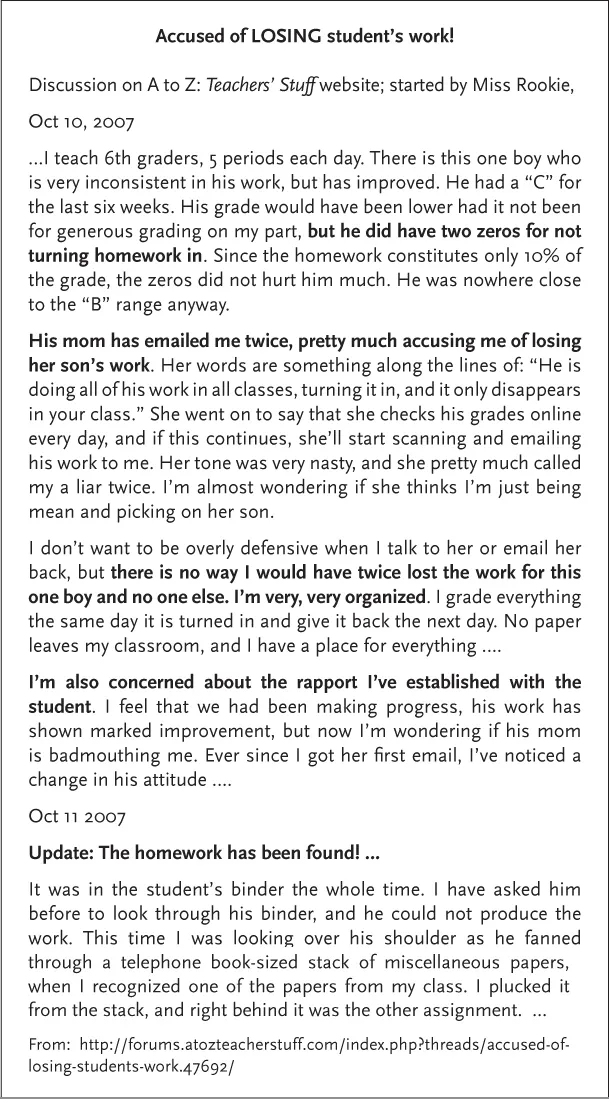
Figure 1.1 “Accused of Losing Student’s Work,” Miss Rookie’s Post.
We use this excerpt as an example of the complex work of teaching and systems teachers have to navigate. Many of the preservice teachers we work with are excited to share their content with students, develop relationships, and help their students experience the “aha moments” that are so important. Yet, a challenging area for most teachers involves classroom assessment, and, in particular, the management of classroom assessment activities. Classroom assessment refers to the processes teachers engage in to come to decisions about relatively fine-grained student learning. It involves the assigning, collecting, evaluating, and reporting of student performance. This may include everything from a simple formative observation in class, to a complex multistage project, to use of required district and/or state tests to improve instruction. Exacerbating the complexity of classroom assessment is the volume of assignments students complete, the need to structure the process for learners at various developmental levels (some of whom are just beginning to understand what a folder is), and the speed with which the process needs to unfold for assessment information to be useful to the teacher and learners. Routines that can help manage these complications are at the heart of this book. We offer explicit guidance on how to manage the overall assessment process. Our goal is to provide you with routines to facilitate the smooth management of assessment activities to support the overall goals of classroom assessment so that decisions informed by this process are well grounded in best evidence.
Definitions
Before examining the tasks of classroom assessment management in detail, we want to clarify our use of specific terms: assessment, classroom assessment, assignment, student work, routine, and manage(ing/ment). In Table 1.1 we overview these terms and provide examples of each. We conceive of assessment as a process, specifically “the process of obtaining information that is used to make educational decisions about students, to give feedback to students about their progress, strengths, and weaknesses, to judge instructional effectiveness and curricular adequacy, and to inform policy” (American Federation of Teachers, National Council of Measurement in Education, and National Association, 1990, p. 1). This definition indicates that the assessment process is directed at informing instruction (e.g., formative), evaluating achievement (e.g., summative), or discerning students’ needs (e.g., diagnostic). Further, we also align with the assessment triangle model. This model asserts that assessment involves three interrelated components: cognition, observation, and interpretation (Pellegrino, Chudowsky, & Glaser, 2001). In this model cognition refers to processes involved in students’ thinking and knowledge representation, observations are the activities that allow teachers (and others) to observe students’ thinking and learning, and interpretation “refers to the reasoning one makes from students’ evidence of learning” (Lyon, 2011, p. 421). We focus on classroom assessment, which situates the assessment process (and elements of the assessment triangle) within classrooms, where most often individual teachers organize, implement, and oversee this process.
Table 1.1 Definitions
| Term | Definition |
|---|---|
| Assessment | “[T]he process of obtaining information that is used to make educational decisions about students; to give feedback to students about their progress, strengths, and weaknesses; to judge instructional effectiveness and curricular adequacy; and to inform policy” (American Federation of Teachers, National Council of Measurement in Education, and National Association, 1990, p. 1). |
| Classroom Assessment | Assessment processes that occur within classrooms where individual teachers organize, implement, and oversee these processes. |
| Assignment | Tasks students are asked to complete in order to access their knowledge, skills, or abilities. |
| Student Work | Tasks students have completed as a result of requests to complete an assignment. |
| Interpretation | The procedural knowledge used to understand the performance demonstrated on student work. Interpretation involves both appraisal (determining the value or quality of student work or validity of the assessment task in context) and monitoring (consideration of the ongoing process of individual students and the class as a whole; Barnes, Fives, SaizdeLaMora, & Mabrouk-Hattab 2019). |
| Marking+ | A subroutine of interpretation during which teachers determine if students’ responses are correct or incorrect and indicate this with some type of mark. Marking may lead to a grade or not. |
| Grades | “[T]he symbols assigned to individual pieces of student work or to composite measures of student performance on student report cards” (Brookhart et al., 2016, p. 804). |
| Evaluation | The process of making judgements or decisions based on information gathered through assessment processes (Stiggins, 1999; Hanna & Dettmer, 2004). |
| Manage | To organize, control, and implement a process, routine, or other system. |
| Routines | “[E]stablished procedure(s) [in which the main] function is to control and coordinate specific sequences of behavior” (Yinger, 1979, p. 165). |
+ The term scoring can also be used to describe the marking process. We prefer marking, as the term “score” connotes a numerical outcome. Marking can include such an outcome, but does not always end in one.
While assessment is an extensive process, an assignment refers to a request from teachers to elicit an observation of students’ cognitive or skill performance, either prior to or following instruction. Teachers select or generate assignments to gather evidence about students in order to make informed educational decisions. In our use of this term, assignments include but are not limited to homework, projects, essays, performances, classwork, or exit slips. That is, any task teachers ask students to complete in order to conduct an observation of students’ thinking and skills is considered an assignment. We use the term student work to refer to demonstrations of students’ cognition or skill that are provided in response to assignments. This includes specific documented products that students complete, create, or perform as part of a learning experience or in response to a given assignment (see Figure 1.1). Assignments differ from student work in that the assignment is given to the student by the teacher with the expectation that the student perform the assigned task. Student work is the completed task. Teachers sometimes document student work when they observe students engaged in a performance activity (e.g., classroom discussion, read aloud, presentation) and generate a record of that observation. In these cases, the records are documentation of student work.
Following the assessment triangle we use the term interpretation to describe the procedural knowledge and processes teachers enact to make sense of student work. Interpretation involves both appraisal and monitoring routines (Barnes et al., 2019). Appraisal deals with making determinations about the quality of student work in context, as well as the quality of the assigned task for accessing students’ cognitions. Monitoring is the process of keeping track of ongoing progress for both individual students and the class as a whole. We use the term marking to describe a subroutine of interpretation. Marking is the process by which teachers “mark” or “write on” student work to indicate the results of their interpretation processes. For example, while reviewing a student essay an English teacher may determine that a new paragraph should start and could indicate this with a paragraph symbol or “new paragraph” comment in the margin. Likewise, Marleigh Rose’s teacher in Figure 1.2 might place a small “x” next to numbers 2 and 3 to indicate that the responses are incorrect. In these instances the marking process may or may not lead to a grade. In fact we use the term marking rather than scoring as the latter suggests a numerical or leveled outcome.
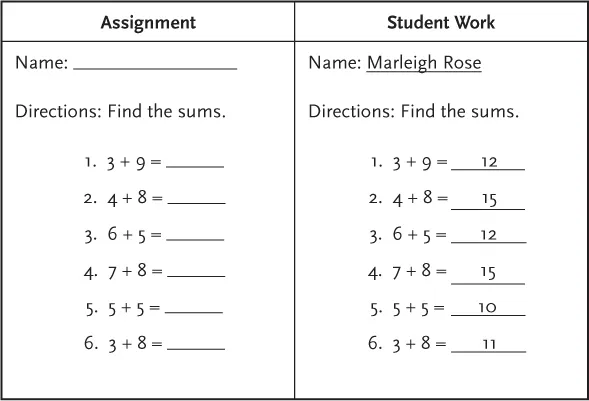
Figure 1.2 Distinction between Assignments and Student Work.
A possible outcome of the interpretation process can be to indicate the quality of students’ performance with a grade. Grades are “the symbols assigned to individual pieces of student work or to composite measures of student performance on student report cards” (Brookhart et al., 2016, p. 804). Grades reflect teachers’ evaluation, the process of making judgements or decisions based on information gathered through assessment processes (Hanna & Dettmer, 2004; Stiggins, 1999). Thus, as teachers engage in interpretation they attempt to make sense of the student work in terms of quality and this sensemaking process may be supported through various marking procedures. Following marking, if a teacher steps back and makes an overall decision based on this process, that decision is an evaluation. Evaluations may, and typically do, take the form of a grade. But they can also be reflected in decisions about instruction for the class or individual students.
Teachers need to manage the overall process of assessment (i.e., organize, control, and implement). This means that they need to use procedures to gather evidence of student learning (i.e., assign and collect), evaluate such evidence (i.e., analyze and make decisions), and report those decisions back to students (e.g., feedback) and other stakeholders (e.g., parents). In order to manage the range of tasks involved in this overall process, teachers frequently develop or adopt routines. We use Yinger’s (1979) definition for routines: “established procedures whose main function is to control and coordinate specific sequences of behavior” (p. 165). Procedures are different from rules. Procedures refer to tasks (Wong & Wong, 2018), while rules establish general expectations. We focus on the routines for managing classroom assessment that are supported by research and practice. The goal of these routines is to support the meaningful work of teaching by suggesting systematic processes to deal with some of the more perfunctory tasks that can lead to unexpected issues.
Why Assessment Management Matters
Students are considered to be engaged in learning activities when they demonstrate both behaviors and emotions that reflect active involvement, such as focusing on the task and enjoy...
Table of contents
- Cover
- Half Title
- Series Page
- Title Page
- Copyright Page
- Table of Contents
- Dedication
- Preface
- 1 What Is Meant by “Managing Classroom Assessment”?
- 2 Assigning
- 3 Collecting
- 4 Interpreting
- 5 Recording and Returning
- Index
Trusted by 375,005 students
Access to over 1.5 million titles for a fair monthly price.
Study more efficiently using our study tools.
Frequently asked questions
Yes, you can cancel anytime from the Subscription tab in your account settings on the Perlego website. Your subscription will stay active until the end of your current billing period. Learn how to cancel your subscription
No, books cannot be downloaded as external files, such as PDFs, for use outside of Perlego. However, you can download books within the Perlego app for offline reading on mobile or tablet. Learn how to download books offline
We are an online textbook subscription service, where you can get access to an entire online library for less than the price of a single book per month. With over 1.5 million books across 990+ topics, we’ve got you covered! Learn about our mission
Look out for the read-aloud symbol on your next book to see if you can listen to it. The read-aloud tool reads text aloud for you, highlighting the text as it is being read. You can pause it, speed it up and slow it down. Learn more about Read Aloud
Yes! You can use the Perlego app on both iOS and Android devices to read anytime, anywhere — even offline. Perfect for commutes or when you’re on the go.
Please note we cannot support devices running on iOS 13 and Android 7 or earlier. Learn more about using the app
Please note we cannot support devices running on iOS 13 and Android 7 or earlier. Learn more about using the app
Yes, you can access Managing Classroom Assessment to Enhance Student Learning by Nicole Barnes,Helenrose Fives in PDF and/or ePUB format, as well as other popular books in Education & Classroom Management. We have over 1.5 million books available in our catalogue for you to explore.