This book assesses Joss Whedon's contribution to US television and popular culture. Examining everything from his earliest work to his most recent tweets and activist videos, it explores his complex and contradictory roles as both cult outsider and blockbuster filmmaker. Crucially, the book insists on the wider industrial, technological, political and economic contexts that have both influenced and been influenced by Whedon, rejecting the notion of Whedon as isolated television auteur.
Using key source material, with exclusive access to drafts of many of the episodes across Whedon's career, as well as unique correspondence with Whedon collaborator Jane Espenson, this book offers unparalleled access to the creative process that helped produce the series Buffy the Vampire Slayer, Angel, Dollhouse and Firefly. Energetic, engaging and informed by detailed scholarship and theoretical rigour, the book is not just an essential addition to the study of Whedon, but a timely and important re-invigoration of television studies in general.
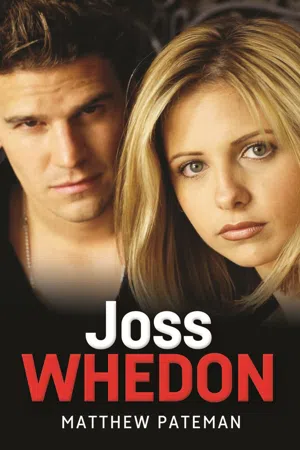
- 262 pages
- English
- ePUB (mobile friendly)
- Available on iOS & Android
eBook - ePub
Joss Whedon
About this book
Information
Publisher
Manchester University PressYear
2018Print ISBN
9780719077814
9780719077807
eBook ISBN
9781526122193
Histories of Whedon's works: Politics, industry, art
1
‘Buffy is the slayer. Don’t tell anyone’: Creating a cultural phenomenon
This chapter will look at the first three seasons of Buffy, and the ways in which Whedon was able to make the show, the character and himself a ‘cultural phenomenon’. This was an explicit desire for Whedon in relation to his first show, ‘I wanted her to be a cultural phenomenon. I wanted there to be dolls, Barbie with kung-fu grip’ (Lavery and Burkhead, 2011: 28). The mention of Barbie speaks to the heart of one of the difficulties of talking about Whedon. The popular, genre-based mass appeal of his shows and the demand for secondary markets suggests a market-driven profit-based compulsion that obviates, if it does not destroy, the claims to art and progressive politics that this book is proposing. In response to this, it is important to recognise that television is a commercially driven medium and that artistic success can only be achieved if there is also commercial success. Equally, the creation of a television show (unlike a novel, for example) requires enormous investment from a wide range of people who will seek to recoup their investments and make a profit (economic or reputational) from them. To assert that this occludes the possibility of a televisual art is a common but stupid position. There have been recent efforts to recast notions of the aesthetic by insisting that art can never be entirely autonomous but yet still exists as something more than merely ideological symptom or blinker, and in the introduction to the most sustained engagement with this ‘new aesthetics’ we are told, ‘it is impossible now to argue that aesthetics is anything other than thoroughly imbricated with politics and culture. And this without doubt is an entirely good thing’ (Joughin and Malpas, 2003: 3). Additionally, art (or form as a function of art) is ‘linked to new technologies, economic structures of exchange, social relations of production as well as intrinsic artistic formings of the always already historically shaped material’ (Ziarek, 2003: 53).
Whedon's ‘cultural phenomenon’ is part of these technologies, structures of exchange and relations of production in very clear and explicit ways. His art is industrial, commercial (as indeed all art has always been) and, as such, political. Equally, its intrinsic artistic formings (the aspects mistaken for, or desired as being, autonomous) provide the aesthetic qualities that intersect with the ‘political, cultural and industrial’ to produce his version of television art. And his art is imbued with a democratic politics that attempts to offer progressive social liberal views while also being attentive to the dangers of the globalised economy that in some ways allows his vision to be seen at all: ‘We are now in such a homogenized, globalized monopolized entertainment system … Eventually there will just be Gap Films and McDonald's films. And that will be it’ (Lavery and Burkhead, 2011: 178). His promotion of a feminist politics in a mass entertainment context, which arguably threatens that very politics, is one of the many contradictions and difficulties that his work has to engage with. But he does promote it, and the politics is not ancillary to the art, it is what the art is, formally textually, texturally.
Art and feminism, the two things in the world of which Whedon is most proud, are at the forefront of the opening of Buffy. The show's premise, derived from the original movie, is that the person who is routinely the victim in horror films – the blonde girl – becomes the hero. Whedon says, ‘I want to see the movie where she walks into a dark alley, a monster attacks her, and she just wails on him’ (Lavery and Burkhead, 2011: 53). Here, it is the artistic choices that are seen as irreducibly political: the casual murder of the young woman is both a generic trope and a political expression; it is lazy storytelling and misogyny. Whedon, in Buffy, refuses at every turn lazy storytelling, and insists on the inter-penetrating relationships between art and politics. However, the politics is presented as much as an affective aspect of the art as an intellectual one. The audience feels the politics as well as thinks it. In part, this is because of Whedon's commitment to the emotional realism of his shows, which shall be discussed presently, but also because he invests his characters (even those seemingly unlike him) with a sense of himself, his own frailties and needs. The blonde girl in the movies is a boring trope; the blonde girl Buffy is a character with whom, in part, Whedon ‘identifies’. This identification derives in part from a sense of physical vulnerability (‘I have been mugged a lot of times’) but also because the pretty blonde frivolous girl that Buffy could appear to be was never expected to be able to ‘take care of herself’ in much the same way Whedon suggests he was not (Lavery and Burkhead, 2011: 53, 53, 53).
So, Whedon strives to create televisual art that is intrinsically political, but also seeks to ensure that the politics is usually a function of the characters’ experience and/or a supposed audience's ability to identify with those characters. Allied with this, is a belief in the knowledge and intelligence of the audience and this is manifested in the opening scene of the pilot of Buffy. This scene is vital in establishing many of the moods and tones of the show, but what it also does is assert at the very beginning of the show that it is not only being attentive to horror conventions but also that it recognises and expects the audience to recognise the political challenge that generic rewriting poses. The initial set-up firmly locates the action within a horror context: night-time, low lighting, eerie music and sounds; we are in a high school science lab (the connections and conflicts between the claims for knowledge made by and on behalf of science – a version of Enlightenment rationalism – and the supernatural will be a key feature of the show as it progresses), and the camera provides partial, awkward views. As a window smashes and two characters appear, the audience can reasonably assume that the young man and the blonde girl are up to no good. The girl seems innocent and nervous, scared by sounds, worried about being there. The boy is confident, taking the lead. Horror conventions dictate that possibly both, but certainly she, will die (he might be the aggressor). Given the title of the show, we might as an audience assume that the girl will be Buffy, which would undermine the generic conventions but also be narratively simple. Instead, the girl morphs into a vampire and kills the boy. The usual victim is not the victim, nor is she the hero: she is a monster, able and willing to kill the boy. Generic convention has been held up, played with, subverted and undermined. The refusal to trade on tropes is both an artistic choice (the storytelling is more interesting, more textured, richer, more exciting) and a political one (the narrative laziness that sees the blonde girl die is also misogyny, refusing to be lazy is equivalent to challenging misogyny). We have not yet met Buffy, but Buffy has already set out its stall, and in the next three seasons will offer ever more subtle, complex, emotionally resonant stories using all the resources of myth fantasy and legend to offer a ‘very real, emotional’ (Lavery and Burkhead, 2011: 58) show that will propel televisual art forward. And it will do that, initially, in high school.
By discussing the first three (high school) seasons on Buffy in this chapter, I am not asserting any form of qualitative or thematic division between these seasons and the four later ones. But the high school years of Buffy and her friends, before their graduation and increasingly variegated trajectories, do provide a critical unity that does not occur again in the analysis of Whedon. The nature of Whedon's storytelling desires, especially his determination to have stories and characters grow, develop, have memory and exist as an organic whole across seasons, means that some aspect of this chapter will have to discuss episodes from the later seasons, but I will keep these excursions as brief as possible in order to focus on this period.
An obvious point about the first three seasons is that never again will there be the very first Whedon-created and executively produced show to confront. Allied to this is that for these three seasons, Whedon is in sole charge of his sole show. The oeuvre-to-come has not yet ar...
Table of contents
- Cover
- Series page
- Title page
- Copyright page
- Dedication
- Contents
- Figures and tables
- General editors’ preface
- Acknowledgements
- Introduction
- Part I Histories of Whedon's works: Politics, industry, art
- Part II Readings of Whedon's works: Narratives, formats, characters
- Coda: ‘I'm not done baking’
- Appendix 1: Jane Espenson correspondence
- Appendix 2: Definitive guide to Whedon output week-by-week
- References
- Index
Trusted by 375,005 students
Access to over 1.5 million titles for a fair monthly price.
Study more efficiently using our study tools.
Frequently asked questions
Yes, you can cancel anytime from the Subscription tab in your account settings on the Perlego website. Your subscription will stay active until the end of your current billing period. Learn how to cancel your subscription
No, books cannot be downloaded as external files, such as PDFs, for use outside of Perlego. However, you can download books within the Perlego app for offline reading on mobile or tablet. Learn how to download books offline
Perlego offers two plans: Essential and Complete
- Essential is ideal for learners and professionals who enjoy exploring a wide range of subjects. Access the Essential Library with 800,000+ trusted titles and best-sellers across business, personal growth, and the humanities. Includes unlimited reading time and Standard Read Aloud voice.
- Complete: Perfect for advanced learners and researchers needing full, unrestricted access. Unlock 1.5M+ books across hundreds of subjects, including academic and specialized titles. The Complete Plan also includes advanced features like Premium Read Aloud and Research Assistant.
We are an online textbook subscription service, where you can get access to an entire online library for less than the price of a single book per month. With over 1.5 million books across 990+ topics, we’ve got you covered! Learn about our mission
Look out for the read-aloud symbol on your next book to see if you can listen to it. The read-aloud tool reads text aloud for you, highlighting the text as it is being read. You can pause it, speed it up and slow it down. Learn more about Read Aloud
Yes! You can use the Perlego app on both iOS and Android devices to read anytime, anywhere — even offline. Perfect for commutes or when you’re on the go.
Please note we cannot support devices running on iOS 13 and Android 7 or earlier. Learn more about using the app
Please note we cannot support devices running on iOS 13 and Android 7 or earlier. Learn more about using the app
Yes, you can access Joss Whedon by Matthew Pateman in PDF and/or ePUB format, as well as other popular books in Media & Performing Arts & Television History & Criticism. We have over 1.5 million books available in our catalogue for you to explore.