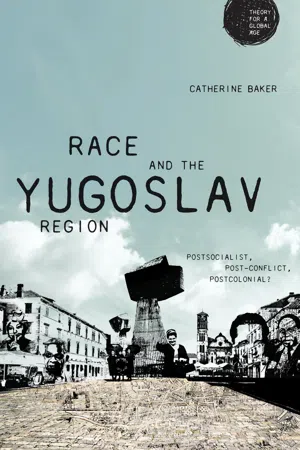
This is the first book to situate the territories and collective identities of former Yugoslavia within the politics of race – not just ethnicity – and the history of how ideas of racialised difference have been translated globally. The book connects critical race scholarship, global historical sociologies of 'race in translation' and south-east European cultural critique to show that the Yugoslav region is deeply embedded in global formations of race. In doing this, it considers the everyday geopolitical imagination of popular culture; the history of ethnicity, nationhood and migration; transnational formations of race before and during state socialism, including the Non-Aligned Movement; and post-Yugoslav discourses of security, migration, terrorism and international intervention, including the War on Terror and the present refugee crisis.
- 256 pages
- English
- ePUB (mobile friendly)
- Available on iOS & Android
eBook - ePub
About this book
Information
1
Popular music and the ‘cultural archive’
This book began its Introduction, and begins its chapter structure, not in the mainstream of international affairs (the politics of state socialist Non-Alignment, or postsocialist European border control) but with what might seem a more distant topic: popular music. It does so because the everyday structures of feeling perceptible through popular music are a readily observable sign that ideas of race are part of identity-making in the Yugoslav region; proving this point opens the way to revisiting other open questions in the study of the region through the lens of ‘race’. Both the transnational histories of popular music's globalised production and circulation, and the narratives and fantasies of identity revealed in its audiovisual and embodied dimensions, are encounters with and often reconstructions of global formations of race, where musicians, media workers and listeners–viewers respond to music from outside the region and participate in musical cultures grounded inside it. It is integral within what Gloria Wekker (2016: 2), showing how to study race and whiteness in societies where prevailing identity narratives position the nation ‘outside’ race, calls the ‘cultural archive’: the often everyday and ephemeral, but no less significant, sites that make explicit how deeply race has permeated constructions of individual and collective identity.
The cultural archive, alongside ‘innocence’ (neither knowing nor wanting to know about racism) and ‘white Dutch self-representation’ (in which the national self belongs to Europe while national Others do not and cannot), is one of Wekker's three central concepts in White Innocence, which builds on Said's reference to imperial fiction and poetry as a cultural archive via Ann Stoler's sense of the archive as a ‘repository of memory’ (Stoler 2009: 49 in Wekker 2016: 19) for everyday legacies of imperial rule in postcolonial metropoles. It is
located in many things, in the way we think, do things, and look at the world, in what we find (sexually) attractive, in how our affective and rational economies are organized and intertwined. Most important, it is between our ears and in our hearts and souls. (Wekker 2016: 19)
Popular music is just such a repository; moreover, across south-east Europe ideas of ‘popular music’ are very often given meaning by relating them (by claims of continuity or performative distance) to folk traditions. South-east European folk music, in turn, has long been a symbolic resource in constructing collective cultural identities by ascribing or denying ‘modernity’ and ‘Europeanness’ to certain territorial–demographic spaces but not others (those ‘non-European’ ones are ascribed to ‘the Balkans’). This characteristic of ethnonational and socio-economic identity-making in south-east Europe reveals both the music and the discourses as part of a common post-Ottoman space (Buchanan (ed.) 2007). The break-up of Yugoslavia, meanwhile, enmeshed popular music in the same political processes of ethnic separation and marginalisation of social alternatives that operated throughout post-Yugoslav public spheres (Čolović 1994; Pettan (ed.) 1998b; Gordy 1999). The powerful interventions in everyday public consciousness necessary to normalise the primacy of ethnic identity and polarisation against national Others placed popular entertainment, including music, in a continuum with phenomena more conventionally thought of as ‘political’ (Baker 2010), where one might often look for evidence about nationalism and race.
Wekker's search for the affective legacies of racialised colonial imagination in the ‘cultural archive’ reinforces Anikó Imre's argument that scholars of European media ought to apply the lens of east European postcoloniality to everyday popular culture as well as highbrow literature and cinema (Imre 2014). Indeed, south-east European studies uses the critique of balkanism to discern a common politics of representation and exotification – with many incentives for creators to internalise exoticising Western gazes on their region – affecting music, cinema and literature alike (Iordanova 2001; Baker 2008; Volčič 2013).1 More than just a parallel to what Stuart Hall termed the ‘spectacle of the “Other” ’ (Hall 1997) driving the construction of racial difference since imperial consumer and visual cultures were born, gazes that partition the globe into national cultures and expect essentialised representations of identity from each (but the most tradition-bound zones most of all) originate from the same fin-de-siècle international expositions (Bolin 2006) at which white Europeans as gazing audiences could form first-hand stereotypes of Africans and indigenous peoples (Pieterse 1992: 94–7; Blanchard, Boëtsch and Jacomijn Snoep 2011; Novikova 2013). The conclusion is more complex than saying the stereotypes the West projects on to eastern Europe racialise eastern Europeans as non-white, though in certain contexts they may (Longinović 2011; Fox, Moroşanu and Szilassy 2012); it also raises the uncomfortable, silenced, necessary question of what else eastern Europeans, identifying with ‘Europe’ and modernity, might be identifying with.
Popular music itself, meanwhile, belongs to a history of globalisation structured by the routes and legacies of colonialism and Atlantic slavery (Gilroy 1993; Erlmann 1999; Radano and Bohlman (eds) 2000; Weheliye 2005; Lipsitz 2007; Denning 2015). Gilroy's ‘black Atlantic’ as a transnational cultural space of struggle, communication, memory-work, history-making and political critique is constituted by soul, reggae, Afrobeat and hip-hop musicians as well as the poets, novelists and scholars who have expressed written black thought (Gilroy 1993). Their music takes its sonic and embodied forms because of the movements of people, capital, technologies and sounds that resulted from European colonialism, Africans' enslavement and what this violence left behind (Weheliye 2005). Simultaneously, it is part of a global consumer culture that commercialises racialised gazes and desires into exotica (Gilroy 2000) and of the complex global imagination of ‘America’: indeed, African-American music and musicians were important for US cultural diplomacy during the Cold War (Von Eschen 2006), towards Non-Aligned Yugoslavia (Vučetić 2012) as well as the USSR. Sounds, songs, stars and genres deeply embedded in US racial politics, from jazz to Michael Jackson through Motown, were also cultural artefacts that entered Yugoslavia as symbols of Americanness, coolness and hipness, feeding into how vocalists, musicians and producers thought performers should sound and move; while black diasporic musics from Jamaica and Nigeria, from Britain and France and Germany, were also part of Yugoslav popular music cultures for at least some listeners, via multilateral and Non-Aligned routes of musical circulation as well as historic western European cultural entrepots.
Anglo-American popular music's influence on the Yugoslav region or anywhere else is not – as studies of global hip-hop, especially, emphasise (Mitchell (ed.) 2001; Alim, Ibrahim and Pennycook (eds) 2008) – one-way cultural homogenisation or ‘Americanisation’. Rather, it is an active vernacularisation or ‘cultural translation’ (Stokes 2003: 298) interpreting the sound, style and content of foreign popular music through the lenses of existing local identity narratives (such as the modernity–Europe–West/tradition–Balkan–East narrative) and combining foreign musical elements with musical practices understood as belonging to a collective (national, urban, regional, ethnic) self. Foreign frames of reference for popular music in this region have included Anglo-American music, Italian and German light-entertainment traditions (peaking in the 1950s–70s), northern European pop–dance–rap (late 1980s–present) and music from the wider post-Ottoman space (Rasmussen 2002). For instance, one pan-south-east European genre with different national inflections, ‘pop-folk’, combines post-Ottoman elements of musical meaning and practice (such as vocal styles; instruments; rhythms; melody; lyrical devices), which themselves bridge ethno-linguistic boundaries and the greater symbolic boundary between ‘Europe’ and ‘the Middle East’, with elements from the Anglosphere and larger European centres of musical production (electric guitars; synthesisers; drum machines; hip-hop beats; rap; electronic dance music), in resonance and tension with ideologies of national and ethnic cultural identity (Buchanan (ed.) 2007; Samson 2013).
While ethnomusicologists of south-east Europe pay important attention – more than many other disciplines – to the politics of Romani identity and representation (Imre 2008; Pettan 2010; Silverman 2012), even they still rarely consider the racial politics of popular music in a transnational sense, or how expressions and signifiers of those politics are translated, recognised and reappropriated (or not) as music circulates. Every musical genre connected to the Anglosphere, however, exists within the Black Atlantic's racial formations – whether inherently and symbolically connected to black struggle, like hip-hop and soul; whether implicitly defined through whiteness, like country, metal or rock; or whether they have been racialised in changing ways as they gained popularity, as occurred in the history of rhythm-and-blues or rock'n'roll. The transnational circulation of popular music and its translation into local musical cultures, therefore, inherently bring ‘a politics of race and power’ (Gilroy 1993: 103) – acknowledged or not – as part of what musicians and listeners hear, see, interpret and transform. Popular music does not just reflect ‘race in translation’ (Stam and Shohat 2012); it is race in translation. Some of these translations exemplify as racialised a European colonial imagination as anything from Britain, France, the Netherlands or Germany; yet others have situated the region's national identities in genuine solidarity with the subjects of colonial oppression and the marginalisation of blackness. The puzzle of how the same collective identities could len...
Table of contents
- Cover
- Series page
- Title page
- Copyright page
- Contents
- Series editor’s introduction
- Preface
- List of abbreviations
- Introduction: what does race have to do with the Yugoslav region?
- 1 Popular music and the ‘cultural archive’
- 2 Histories of ethnicity, nation and migration
- 3 Transnational formations of race before and during Yugoslav state socialism
- 4 Postsocialism, borders, security and race after Yugoslavia
- Conclusion
- Bibliography
- Index
Trusted by 375,005 students
Access to over 1.5 million titles for a fair monthly price.
Study more efficiently using our study tools.
Frequently asked questions
Yes, you can cancel anytime from the Subscription tab in your account settings on the Perlego website. Your subscription will stay active until the end of your current billing period. Learn how to cancel your subscription
No, books cannot be downloaded as external files, such as PDFs, for use outside of Perlego. However, you can download books within the Perlego app for offline reading on mobile or tablet. Learn how to download books offline
We are an online textbook subscription service, where you can get access to an entire online library for less than the price of a single book per month. With over 1.5 million books across 990+ topics, we’ve got you covered! Learn about our mission
Look out for the read-aloud symbol on your next book to see if you can listen to it. The read-aloud tool reads text aloud for you, highlighting the text as it is being read. You can pause it, speed it up and slow it down. Learn more about Read Aloud
Yes! You can use the Perlego app on both iOS and Android devices to read anytime, anywhere — even offline. Perfect for commutes or when you’re on the go.
Please note we cannot support devices running on iOS 13 and Android 7 or earlier. Learn more about using the app
Please note we cannot support devices running on iOS 13 and Android 7 or earlier. Learn more about using the app
Yes, you can access Race and the Yugoslav region by Catherine Baker in PDF and/or ePUB format, as well as other popular books in Politics & International Relations & Globalisation. We have over 1.5 million books available in our catalogue for you to explore.