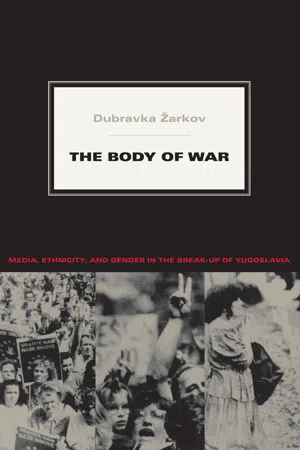
Tracing the links between the war and press representations of ethnicity, gender, and sexuality, Žarkov examines the media's coverage of two major protests by women who explicitly identified themselves as mothers, of sexual violence against women and men during the war, and of women as militants. She draws on contemporary feminist analyses of violence to scrutinize international and local feminist writings on the war in former Yugoslavia. Demonstrating that some of the same essentialist ideas of gender and sexuality used to produce and reinforce the significance of ethnic differences during the war often have been invoked by feminists, she points out the political and theoretical drawbacks to grounding feminist strategies against violence in ideas of female victimhood.
eBook - PDF
The Body of War
Media, Ethnicity, and Gender in the Break-up of Yugoslavia
- 299 pages
- English
- PDF
- Available on iOS & Android
eBook - PDF
The Body of War
Media, Ethnicity, and Gender in the Break-up of Yugoslavia
About this book
In The Body of War, Dubravka Žarkov analyzes representations of female and male bodies in the Croatian and Serbian press in the late 1980s and in the early 1990s, during the war in which Yugoslavia disintegrated. Žarkov proposes that the Balkan war was not a war between ethnic groups; rather, ethnicity was produced by the war itself. Žarkov explores the process through which ethnicity was generated, showing how lived and symbolic female and male bodies became central to it. She does not posit a direct causal relationship between hate speech published in the press during the mid-1980s and the acts of violence in the war. Instead, she argues that both the representational practices of the "media war" and the violent practices of the "ethnic war" depended on specific, shared notions of femininity and masculinity, norms of (hetero)sexuality, and definitions of ethnicity.
Information
Publisher
Duke University Press BooksYear
2007Print ISBN
9780822339663
9780822339557
eBook ISBN
9780822390183
Table of contents
- Contents
- Acknowledgments
- Introduction
- Part I: The Maternal Body
- Part II: The Victimized Body
- Part III: The Armed Body
- Notes
- Bibliography
- Index
Trusted by 375,005 students
Access to over 1.5 million titles for a fair monthly price.
Study more efficiently using our study tools.
Frequently asked questions
Yes, you can cancel anytime from the Subscription tab in your account settings on the Perlego website. Your subscription will stay active until the end of your current billing period. Learn how to cancel your subscription
No, books cannot be downloaded as external files, such as PDFs, for use outside of Perlego. However, you can download books within the Perlego app for offline reading on mobile or tablet. Learn how to download books offline
Perlego offers two plans: Essential and Complete
- Essential is ideal for learners and professionals who enjoy exploring a wide range of subjects. Access the Essential Library with 800,000+ trusted titles and best-sellers across business, personal growth, and the humanities. Includes unlimited reading time and Standard Read Aloud voice.
- Complete: Perfect for advanced learners and researchers needing full, unrestricted access. Unlock 1.5M+ books across hundreds of subjects, including academic and specialized titles. The Complete Plan also includes advanced features like Premium Read Aloud and Research Assistant.
We are an online textbook subscription service, where you can get access to an entire online library for less than the price of a single book per month. With over 1.5 million books across 990+ topics, we’ve got you covered! Learn about our mission
Look out for the read-aloud symbol on your next book to see if you can listen to it. The read-aloud tool reads text aloud for you, highlighting the text as it is being read. You can pause it, speed it up and slow it down. Learn more about Read Aloud
Yes! You can use the Perlego app on both iOS and Android devices to read anytime, anywhere — even offline. Perfect for commutes or when you’re on the go.
Please note we cannot support devices running on iOS 13 and Android 7 or earlier. Learn more about using the app
Please note we cannot support devices running on iOS 13 and Android 7 or earlier. Learn more about using the app
Yes, you can access The Body of War by Dubravka Žarkov, Caren Kaplan, Robyn Wiegman, Caren Kaplan,Robyn Wiegman in PDF and/or ePUB format, as well as other popular books in Social Sciences & Ethnic Studies. We have over 1.5 million books available in our catalogue for you to explore.