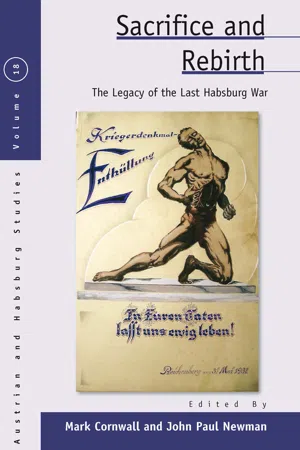
When Austria-Hungary broke up at the end of the First World War, the sacrifice of one million men who had died fighting for the Habsburg monarchy now seemed to be in vain. This book is the first of its kind to analyze how the Great War was interpreted, commemorated, or forgotten across all the ex-Habsburg territories. Each of the book's twelve chapters focuses on a separate region, studying how the transition to peacetime was managed either by the state, by war veterans, or by national minorities. This "splintered war memory," where some posed as victors and some as losers, does much to explain the fractious character of interwar Eastern Europe.
eBook - ePub
Sacrifice and Rebirth
The Legacy of the Last Habsburg War
- 306 pages
- English
- ePUB (mobile friendly)
- Available on iOS & Android
eBook - ePub
Sacrifice and Rebirth
The Legacy of the Last Habsburg War
About this book
Trusted by 375,005 students
Access to over 1.5 million titles for a fair monthly price.
Study more efficiently using our study tools.
Information
PART I

SACRIFICE AND THE VANQUISHED
Chapter 1

COMPETING INTERPRETATIONS OF SACRIFICE IN THE POSTWAR AUSTRIAN REPUBLIC
In September 1934, a war memorial was unveiled in Vienna. Christened the “Heldendenkmal”, the heroes’ memorial, it was built into the existing Burgtor, a structure completed in 1824 under the patronage of Franz I. The Burgtor trumpeted on one side the Habsburg motto in Latin, “Justice, the foundation of rule,” and on the other side, an inscription added in 1916, “Laurel, for soldiers worthy of the laurel.”1 Presiding over the ceremony was Chancellor Kurt von Schuschnigg, leader of the authoritarian Fatherland Front, a movement founded in 1933 to unite “loyal Austrians” under one banner. The monument’s planners had envisioned “not an unknown soldier following the western model” but something specifically Austrian.2 The unveiling was coordinated with a three-day “Comrades’ Convention” for which tens of thousands of veterans came to Vienna from the provinces, subsidized by discounted train tickets and sightseeing packages. The socialists had been defeated in a brief civil war seven months earlier, and Schuschnigg noted with apparent relief that “finally” the Austrian capital could boast “a worthy commemoration” of the Great War.3
As will become clear, however, Schuschnigg’s “finally” did not mean “at last”; rather, his emphasis lay on “worthy.” During the First Austrian Republic, a dizzying number of smaller war-related memorials had been erected, and several more unrealized projects existed on paper. The Heldendenkmal ceremony was just one of many moments when citizens in interwar Austria tried publicly to ascribe meaning to the experiences of the Great War. In the planning of these memorials and in the inscriptions they bore, we find a cacophony of claims, disclaimers, accusations, and denials about sacrifice: who had sacrificed during the war? What had they sacrificed? And for what higher cause? Opfer, an ambiguous term meaning both “sacrifice” and “victim,” had lent itself to flexible interpretation during the war.4 It is genuinely difficult to identify individuals in interwar Austria who did not conceive of themselves as war victims, as having sacrificed in some way, or to find electoral constituencies that did not include victimhood as a part of their collective raison d’être.
For understanding the discourse of sacrifice after 1918, in which victimhood and loss loomed large, the following definition is a useful starting point. Sacrifice is the destruction of something valued or desired for the sake of something having a higher or more pressing claim. It is the loss entailed by devotion to some other interest.5 During the First Republic no compelling, universally accepted narrative emerged on the “higher cause” for which these sacrifices had been made. Elsewhere, as essays in this volume demonstrate, Czech legionaries and South Slav volunteers could claim the cause of victory. But in Austria no group could make such a straightforward claim.6 Instead, Austrians interpreted wartime sacrifice in five discernible ways: for the fatherland, for God, for the Emperor, for the Republic, and for the spirit of comradeship. Paradoxically, despite extensive public commemoration of one or another of these variants of sacrifice, many felt that the returning soldiers were not receiving adequate gratitude for their wartime deeds. Further, a process of erasing and forgetting accompanied the ostensible remembering of the war conflict. The wartime sacrifices of certain groups, notably Jews and women, were muted or missing in most public commemorations. With so many conflicting claims in circulation, the Austro-Fascist government that came to power in 1934 aimed to bring “order” to the messy story of Austrian sacrifice. It attempted at the Heldendenkmal ceremonies to clean up apocryphal versions of who had sacrificed what for whom. That multiple stories (and omissions) are evident in the great memorial itself attests to the impossibility of weaving from particular and competing claims a universal narrative of Austrian wartime sacrifice.
Commemorative Flurry
Historian Ernst Hanisch writes of “the heroicizing of the fallen soldiers: the dead returned in the monuments and ceremonies for heroes. In every village all over the country war memorials were erected in the early 1920s.”7 By 1929, in the Neunkirchen region of Lower Austria, memorials had been constructed in the vast majority of communities. They were built by returning soldiers’ or veterans’ organizations, by parochial authorities, or by local committees representing these groups. As “symbolic foci of bereavement,” such memorials offered the local community tangible sites at which to gather, remember, and commemorate the war and, in some cases, view the names of the fallen of that locality.8 The memorials took the form of columns, crosses, or plaques on church walls. They were ordered from stonemasons or architects and unveiled by local dignitaries at small-scale, quiet ceremonies. However, while such memorials served important functions within local communities, not all of this commemorative activity was welcome. The federal memorial office (Bundesdenkmalamt), an imperial office given powers in the Republic in December 1918 and formally recognized by law in 1923, had not standardized the aesthetics of local memorials. Letters to the Bundesdenkmalamt and articles in the press raised concerns that many of these memorials lacked the artistic merit and the quality of construction to properly convey messages about the war to future generations.9
The shortcomings of local memorials perceived by some commentators were undoubtedly linked to the practical problems faced by those seeking to construct memorials. The sapper regimental memorial in Krems is one such memorial. Construction began during the war, but the bronze needed for its completion was requisitioned at the end of hostilities so the memorial was not finished. In 1920, the Sapper Memorial Association was founded to complete it and, at a ceremony to raise funds and awareness that year, the still unfinished memorial was unveiled by the town authorities.10 After various modifications and renewed fundraising efforts, the temporary plaques were replaced by permanent bronze ones.11 In 1930, after undergoing further improvements, the completed memorial was unveiled. By then many compromises in design and construction materials had been made.12 This long process was a feature of much memorial construction in interwar Austria. Finished memorials were often the result of protracted negotiations between changing committee members and interested groups. Building was limited by financial resources and fundraising attempts were undermined by inflation.
Memorials were constructed not only by veterans’ organizations and local communities but also by academic institutions, employers, and other civilian groups. A typical example of this was a 1930 memorial that was unveiled at the seventieth anniversary of the founding of the Higher Federal Academy for Winegrowing, Fruit Growing, and Horticulture for the fallen soldiers of that institution. This memorial was funded by a professional association and it commemorated the fallen along with their prewar colleagues rather than their co-combatants.13 Similarly, in 1923 the Austrian Bicycle Riders’ Association held the first annual “Heroes’ Bike Races” to commemorate fallen members of the Bike Sport Association.14 Fallen Austrian soldiers were commemorated as residents of a town, village, region, or state; as members of a regiment; as former colleagues or members of a profession; as students; or as members of leisure associations.
Although many memorials were rooted in local communities or organizations, some commemorative activity aspired to grander scale. Plans were made to construct a memorial on the Grossglöckner, the highest point in Austria. The Austrian Minister of Defense Carl Vaugoin argued that the question of accessibility was not important in this case. The primary aim of the memorial was “to put a sign of thanks for the sacrifices of soldiers as close to the heavens as possible,” an aim, he argued, that would have been undermined by building the memorial anywhere else.15 A member of the socialist Volkswehr proposed that the most appropriate memorial would not be in bronze and stone at all. He wrote, “[t]he most beautiful, ideal monument that could be erected for the victims of the World War is the League of Nations.”16 One of the most controversial memorials, unveiled in 1925 in the Viennese central cemetery and funded by the Social Democrat municipal government, depicted a woman in mourning and bore the title Schmerzensmutter or grieving mother. The leading Social Democrat newspaper, the Arbeiter-Zeitung, argued that the new memorial was a monument to sadness and reconciliation, rather than a traditional war memorial.17 As we shall see, many in Austria did not count a female figure in stone as a legitimate tribute to wartime sacrifice, and did not consider it a war memorial at all.
A perceived lack of a “worthy” monument of national scale in the capital city sparked initiatives that eventually culminated in the Heldendenkmal celebrations of 1934. Groups from outside Vienna petitioned for its creation. In 1933, the Amstetten branch of the Comradeship Association of Former Warriors sent a petition to the Defense Ministry calling for the introduction of a specific “Austrian” day of national mourning on 30 August and the construction of an Austrian War memorial in Vienna.18
Thus, as this brief review suggests, no single memorial was universally accepted as the Austrian memorial. The range of activities and proposals illustrates the extent of attempts to commemorate and come to terms with the experience of the Great War. But they also present us with a paradox. Why, in spite of the commemorative flurry described above, did some Austrians still feel that wartime sacrifice was not being properly acknowledged? Why, at the unveiling of the Heldendenkmal, did speakers from the Fatherland Front claim that it had heretofore been “impossible” during the Republic to erect a suitable monument in the capital to honor wartime sacrifice?19 Building monuments per se had not been impossible; rather, reaching consensus on the underlying meaning of sacrifice had. Austrians were divided along partisan lines over questions about who had sacrificed during the war, for what higher purpose, whose sacrifices warranted remembering, and whose would be erased. The answers were complex, sometimes contradictory, and sometimes overlapping, especially in light of the defeat of the Habsburg armies, the end of the dynasty, the dismemberment of the empire, and the lack of faith in the new state. German nationalists, Catholics, and socialists in Austria interpreted sacrifice in starkly different terms. So too did some men and women.
“With God, for Emperor, and Fatherland”… and Republic and Comrades
The list of possible higher purposes for which the war had been fought grew after 1918. Of course, the war was begun and waged by the imperial Habsburg state. How Austrians remembered wartime sacrifice would be intimately tied to the ways they remembered three hundred years of Habsburg rule. For soldiers fighting for Austria-Hungary, the war’s higher purpose, in theory at least, was the multinational empire. Commemorative activity began during the war, and the official meaning of the sacrifice of the fallen and those still fighting was clear. They were fighting “With God, for Emperor, and Fatherland” for the ultimate victory of the Habsburg armies,...
Table of contents
- Cover Page
- Title Page
- Copyright Page
- CONTENTS
- List of Illustrations
- Acknowledgments
- Introduction. A Conflicted and Divided Habsburg Memory
- Part I. Sacrifice and the Vanquished
- Part II. Sacrifice and the Discourse of Victory
- Part III. Sacrifice in Silence
- Select Bibliography
- Index
Frequently asked questions
Yes, you can cancel anytime from the Subscription tab in your account settings on the Perlego website. Your subscription will stay active until the end of your current billing period. Learn how to cancel your subscription
No, books cannot be downloaded as external files, such as PDFs, for use outside of Perlego. However, you can download books within the Perlego app for offline reading on mobile or tablet. Learn how to download books offline
Perlego offers two plans: Essential and Complete
- Essential is ideal for learners and professionals who enjoy exploring a wide range of subjects. Access the Essential Library with 800,000+ trusted titles and best-sellers across business, personal growth, and the humanities. Includes unlimited reading time and Standard Read Aloud voice.
- Complete: Perfect for advanced learners and researchers needing full, unrestricted access. Unlock 1.5M+ books across hundreds of subjects, including academic and specialized titles. The Complete Plan also includes advanced features like Premium Read Aloud and Research Assistant.
We are an online textbook subscription service, where you can get access to an entire online library for less than the price of a single book per month. With over 1.5 million books across 990+ topics, we’ve got you covered! Learn about our mission
Look out for the read-aloud symbol on your next book to see if you can listen to it. The read-aloud tool reads text aloud for you, highlighting the text as it is being read. You can pause it, speed it up and slow it down. Learn more about Read Aloud
Yes! You can use the Perlego app on both iOS and Android devices to read anytime, anywhere — even offline. Perfect for commutes or when you’re on the go.
Please note we cannot support devices running on iOS 13 and Android 7 or earlier. Learn more about using the app
Please note we cannot support devices running on iOS 13 and Android 7 or earlier. Learn more about using the app
Yes, you can access Sacrifice and Rebirth by Mark Cornwall, John Paul Newman, Mark Cornwall,John Paul Newman in PDF and/or ePUB format, as well as other popular books in History & 20th Century History. We have over 1.5 million books available in our catalogue for you to explore.