This volume of spellbinding essays explores the tense relationship between Alfred Hitchcock and Bernard Herrmann, providing new perspectives on their collaboration. Featuring chapters by leading scholars of Hitchcock's work, including Richard Allen, Charles Barr, Murray Pomerance, Sidney Gottlieb and Jack Sullivan, the collection examines the working relationship between the pair and the contribution that Herrmann's work brings to Hitchcock's idiom.
Examining key works, including The Man Who Knew Too Much, Psycho, Marnie and Vertigo, the essays explore approaches to sound, music, collaborative authorship and the distinctive contribution that Herrmann's work with Hitchcock brought to this body of films, examining the significance, meanings, histories and enduring legacies of one of film history's most important partnerships. By engaging with the collaborative work of Hitchcock and Herrmann, the book explores the ways in which film directors and composers collaborate, how this collaboration is experienced in the film text, and the ways in which such partnerships inspire later work.
eBook - ePub
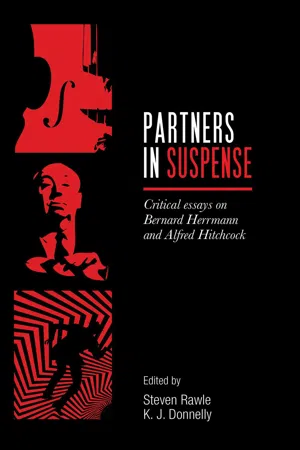
Partners in suspense
Critical essays on Bernard Herrmann and Alfred Hitchcock
- 226 pages
- English
- ePUB (mobile friendly)
- Available on iOS & Android
eBook - ePub
Partners in suspense
Critical essays on Bernard Herrmann and Alfred Hitchcock
About this book
Information
Publisher
Manchester University PressYear
2016Print ISBN
9781526139528
9780719095863
eBook ISBN
9781526107725
Topic
LiteraturaSubtopic
Crítica literaria europea1
Bernard Herrmann: Hitchcock’s secret sharer
Jack Sullivan
Partners in Suspense celebrates a great director–composer collaboration that fascinates even people who normally don’t think about film music. This chapter addresses that partnership both as a very special professional connection between a director and composer and also as an intense Conradian relationship that was as volatile as it was productive. Because he was so meticulously involved with the musical process, Hitchcock often had a close working relationship with his composers, but here the connection was stronger and deeper: Herrmann was a risky alter-ego, a ‘secret sharer’ who took his cinema into darker places than it had gone before, tying the two artists together in ways that enhanced their careers even as it threatened their sense of identity.
Before examining this collaboration, it is necessary to evaluate precisely how Bernard Herrmann fits into Alfred Hitchcock’s overall musical achievement. We tend to forget just how rich and varied that achievement was and how deeply Hitchcock had experimented with music long before he met Herrmann. When we consider Hitchcock’s music at all, we tend to think about Vertigo (1958) or Psycho (1960), but how often do we think about the music in Rebecca (1940) or Spellbound (1945) or Rear Window (1954), even though these changed the way film music was received and marketed? And how often do we think about the incredibly diverse genres Hitchcock explored, more than any director in history, not only dense symphonic scores, but popular songs, Strauss waltzes, jazz, cabaret, rock tracks, Cageian noise effects, and electronic experiments?
Herrmann is the gold standard for Hitchcock’s symphonic sound, but his predecessors are significant too, and the pop songs that were the occasion of Hitchcock–Herrmann imploding were already part of Hitchcock’s musical experimentation for some thirty years. Herrmann was openly resistant to producing popular songs, but there is evidence that Hitchcock was grumpy as well, precisely because he had already worked with dozens of vernacular tunes both successfully and unsuccessfully and had been fighting with studios over the issue of how to use them since Spellbound. As I wrote in Hitchcock’s Music (2006), even the quarrel over Herrmann’s alleged repeating of his own themes in Marnie wasn’t new, but a revisiting of the same controversy with Miklós Rózsa in Spellbound.
For Hitchcock, the very act of making movies was musical. He compared himself to conductor, composer, and orchestrator, making analogies between scoring and movie-making, storyboards and musical notation. Close-ups, he said, were like trumpet solos, long shots ‘an entire orchestra performing a muted accompaniment’ (Truffaut, 1983: 335). Twice he said that his relationship with his audience was that of an organist playing his instrument.
From the start of his career, Hitchcock depicts singers and songs, conspiracies and codes, musicians and ensembles, stages and dressing rooms. Often the quality of the singing or playing is as important as the music: the nervous performances of Marlene Dietrich and Farley Granger bring on guilt and catastrophe; the confident singing of Doris Day saves her son’s life.
Music could be traumatic and overpowering, like the poisoning scene in Roy Webb’s underrated score for Notorious (1946) or surpassingly delicate like the distant vocalise in I Confess (1953). It could be life-saving or death-dealing, sometimes both, as in The Lady Vanishes (1939). Either way, it is a vital force in the flawed humanity of Hitchcock’s characters. Miss Lonelyhearts could be speaking for Hitchcock when she tells the composer at the end of Rear Window, ‘You have no idea what this music means to me.’
Hitchcock’s music comprises the low-budget British films, full of popular ditties, marching bands, theatre orchestras, street singers, and other diegetic sounds; the great symphonic period from Rebecca to Marnie (1964), where Hollywood Golden Age money and composers allowed him to experiment with elaborate scores; and the final years of decline, where musical excellence was harder to achieve. These categories are not mutually exclusive: Waltzes from Vienna (1934, originally released in the USA as Strauss’ Great Waltz) and the original The Man Who Knew Too Much (1934) both feature a brilliant symphonic scene, though it is diegetic; Hitchcock’s Hollywood films sometimes eschew symphonic music altogether, notably Rope (1948), which has only seven cues, and The Birds (1963), which relies on electronic effects and haunted silence. The entirely diegetic Rear Window, Hitchcock’s most imaginative fantasia on popular song, is actually an American riff on British Hitchcock, an extension of the method in Waltzes from Vienna, The Lady Vanishes, and others where serenades and waltzes drift into the protagonist’s window, full of charm but also menace.
In a unique category is The Man Who Knew Too Much remake (1956), not only a radical expansion of the original British version but a culmination of Hitchcockian methods with both popular and classical. After Rear Window and The Man Who Knew Too Much, Hitchcock really had nowhere else to go with popular song and kicked out singers from The Wrong Man (1956), Vertigo and Topaz (1969), even though the studio put him under pressure to do the opposite and even though singers were already scheduled in these films (USC and Margaret Herrick archives).
Hitchcock forged a musical style very early. As with many of his themes and cinematic designs, he sounded important signatures at the beginning, then spent the rest of his career playing endlessly fascinating variations. The Pleasure Garden (1925), The Ring (1927) and Downhill (1927, released in the USA as When Boys Leave Home) depict dancers, cabarets, and stages as exuberant counterpoint to disaster. When sound became available in 1929, he quickly immersed himself in the new medium. In Blackmail (1929), Cyril Ritchard sings ‘Miss Up to Date’ to Anny Ondra in a seductive aria that ends with the singer stabbed to death by the heroine, linking music to a disturbingly ambiguous psychodrama. ‘Miss Up to Date’ moves with astonishing subtlety from source music to symphonic underscore, unveiling a music of the subconscious that establishes an interior point of view and blurs the distinction between diegetic and non-diegetic long before those terms were codified. Blackmail even experiments with noise music in the breakfast knife montage and with elaborate aural transferences. All this in 1929, and several score details – spectral harp and organ, barren timpani solos, abrupt silence following huge crescendos, spinning arpeggios linked to circular designs – became signatures as well.
The most important musical experiment from Hitchcock’s early period was Waltzes from Vienna, a behind-the-scenes look at the musical and sexual conquests of the Strauss family. This unique combination of musical and Oedipal drama depicts Johann Strauss Jr’s overthrow of his father as the Waltz King through the inspiration, composition and premiere of the ‘Blue Danube’ waltz, his muse energised by both his younger and older lovers. In its depiction of an onstage orchestra from multiple points of view and its revelation of how dramatically music can change lives, this Hitchcockian operetta anticipates numerous orchestral scenes in his later films. The young Strauss’s premiere of his new waltz is a personal triumph and a landmark in Viennese culture, but a betrayal of his father and younger lover. In a memorable scene depicting the premiere of the new waltz, Hitchcock takes out all non-musical sound, dialogue and street noise, as he does in Herrmann’s maestro cameo in The Man Who Knew Too Much, so the music becomes a force of its own; the dancers are moved as if by a magical power, much as Miss Lonelyhearts is transported in Rear Window.
Waltzes from Vienna is a striking predecessor of later Hitchcock films in its poetic depiction of music floating in windows and up staircases. Like Rear Window, it shows the composition of a song from conception through noodlings and rehearsals to full performance. In a poignant coda, the defeated father wanders among empty chairs in the bandstand following his son’s triumph. When a girl requests his autograph, he calls her back, and wistfully adds ‘senior’ under his name, proud of his son in spite of himself. As the lights go down on the bandstand, his silhouette moves off-camera on a bittersweet ‘Blue Danube’ cadence, ending the film with the exquisite ambiguity that Hitchcock strived for in music.
Hitchcock was as sour about Waltzes from Vienna as the critics, but it was a valuable musical laboratory, as revealed by an astonishing interview he did for Cinema Quarterly in 1933 when editing the film. He spoke about music as a new tempo in editing, as counterpoint rather than imitation, and as an ‘underlying idea’ that illuminates a film’s psychology, all principles he enacted through his career. Anticipating Erich Wolfgang Korngold, whose sumptuous orchestrations he used in Waltzes from Vienna, he tied cinema to opera, something he had hinted at in the Wagnerian shaving scene in Murder! (1930) (Hitchcock, 1933–34: 244).
Singers are everywhere in Hitchcock, momentarily turning films like The Lady Vanishes, The Man Who Knew Too Much and Stage Fright (1949) into musicals. Even non-singers have a way of suddenly bursting into song, as in 1Train (1950) or playing a significant motif on the piano, as in The Paradine Case (1947) and Stage Fright. In the latter, Blackmail, and The Man Who Knew Too Much, he hired popular singers for leading roles, mimicking the position of opera director.
One of Hitchcock’s favourite forms was the waltz, a staid form he invested with near-mystical properties. Again, Waltzes from Vienna is the template. The film’s coda brought the curtain down on the era of Johann Strauss senior, whose Radetzky March opens the film, and ushers in the new Viennese waltz. By the 1930s, however, the latter signified an old order nostalgia for an old order lost in the onslaught of modernism; Hitchcock used waltzes to embody crumbling worlds and treacherous charm in a number of films, including Rebecca, Suspicion (1941), Shadow of a Doubt (1942) and Strangers on a Train (1951).
Ballet was also a central design in Hitchcock, including the kinetic chases in The 39 Steps (1935), Foreign Correspondent (1940) and North by Northwest (1959); Miss Torso dances under Jeff’s gleefully voyeuristic gaze in Rear Window; Paul Newman and Julie Andrews escape from the Soviets during a ballet of Tchaikovsky’s Francesca Da Rimini, an extravagant music-suspense sequence that brings this wooden film to sudden life. Hitchcock also experimented with jazz, layering it with double meanings, a suave surface masking dread in Rich and Strange (1931, originally released in the US as East of Shanghai), Saboteur (1942) and The Wrong Man.
Hitchcock’s use of vernacular music was always strong and original, but his symphonic scores are even more celebrated. Often, the basic design of a film – crisscross in Strangers on a Train, obsessive spirals in Vertigo, slashing lines in Psycho – is established immediately by the music well before the story begins, and remains in our heads long afterward.
Hitchcock’s work with big symphonic scores began in 1939 with Rebecca. Spooked by a pair of novachords, Franz Waxman’s sensuous score envelops the film from beginning to end. Several long scenes, notably the mesmerizing tracking shot as Joan Fontaine approaches Manderley’s west wing, delete all dialogue and non-musical sounds, creating a huge space for Waxman’s haunted pedal point.
Working closely with Hitchcock through a meticulous set of music notes, Waxman wrote a triumphantly successful score (Selznick archive). It made such a powerful impression that the Standard Symphony Hour asked Waxman to compose a symphonic suite immediately after the premiere, transforming movie music into classical. Sensing a new way of promoting a movie over a long period, David Selznick, who had angrily denounced the music, suddenly became very happy about it, and renewed Standard’s request two years later (Selznick archive).
Miklós Rózsa’s score for Spellbound went a step further. It was programmed as a concert suite by Leopold Stokowski and broadcast on the radio before the film’s release, helping to sell the movie in advance. Like Rebecca, Spellbound became a popular Hitchcock concert piece, a ‘Spellbound Concerto’, unveiling another shivery electronic instrument, the theremin, which quickly became a Hollywood marker for spooks and breakdowns.
Spellbound is an example of what Hitchcock called the ‘psychological use’ of music, a revelation of the subconscious rather than just a mood setter or character marker. Ambivalence is built into the music’s structure: the love theme and the ‘paranoia’ theme are variants of each other, revealing the thin line between love and terror, one of Hitchcock’s favourite themes. In the lengthy, hypnotic razor-blade scene, Hitchcock moves music forcefully to the foreground, making it equal with his camera.
It was during his Selznick period that Hitchcock first tried to get Bernard Herrmann. Selznick remarked during the search for Spellbound’s composer that he could not ‘see anyone to compare with Herrmann’, but the latter was unavailable (Selznick archive). When Hitchcock finally landed him a decade later, the timing was ideal. By the mid-1950s, the lush, melodic style of Raksin, Steiner and Korngold had peaked, making Herrmann’s menacing chord patterns and incisive motifs all the more refreshing. (On Broadway, a similar pattern was unfolding, as Oscar Hammerstein was displaced by his most brilliant student, Stephen Sondheim, whose Sweeney Todd: The Demon Barber of Fleet Street (1979) is an homage to Hitchcock–Herrmann.)
Herrmann’s brooding intensity and harmonic asperity are indelibly linked with Hitchcock’s mature work. Their personalities were dramatically opposite – Hitchcock regal and controlling, Herrmann no...
Table of contents
- Cover
- Half Title
- Title Page
- Copyright Page
- Contents
- List of figures and tables
- List of contributors
- Acknowledgements
- Introduction
- 1 Bernard Herrmann: Hitchcock’s secret sharer
- 2 Hitchcock, music and the mathematics of editing
- 3 The anatomy of aural suspense in Rope and Vertigo
- 4 The therapeutic power of music in Hitchcock’s films
- 5 A Lacanian take on Herrmann/Hitchcock
- 6 Portentous arrangements: Bernard Herrmann and The Man Who Knew Too Much
- 7 On the road with Hitchcock and Herrmann: sound, music and the car journey in Vertigo (1958) and Psycho (1960)
- 8 A dance to the music of Herrmann: a figurative dance suite
- 9 The sound of The Birds
- 10 Musical romanticism v. the sexual aberrations of the criminal female: Marnie (1964)
- 11 The murder of Gromek: theme and variations
- 12 Mending the Torn Curtain: a rejected score’s place in a discography
- 13 The Herrmann–Hitchcock murder mysteries: post-mortem
- 14 How could you possibly be a Hitchcocko-Herrmannian?: Digitally re-narrativising collaborative authorship
- Selected bibliography
- Index
Trusted by 375,005 students
Access to over 1.5 million titles for a fair monthly price.
Study more efficiently using our study tools.
Frequently asked questions
Yes, you can cancel anytime from the Subscription tab in your account settings on the Perlego website. Your subscription will stay active until the end of your current billing period. Learn how to cancel your subscription
No, books cannot be downloaded as external files, such as PDFs, for use outside of Perlego. However, you can download books within the Perlego app for offline reading on mobile or tablet. Learn how to download books offline
Perlego offers two plans: Essential and Complete
- Essential is ideal for learners and professionals who enjoy exploring a wide range of subjects. Access the Essential Library with 800,000+ trusted titles and best-sellers across business, personal growth, and the humanities. Includes unlimited reading time and Standard Read Aloud voice.
- Complete: Perfect for advanced learners and researchers needing full, unrestricted access. Unlock 1.5M+ books across hundreds of subjects, including academic and specialized titles. The Complete Plan also includes advanced features like Premium Read Aloud and Research Assistant.
We are an online textbook subscription service, where you can get access to an entire online library for less than the price of a single book per month. With over 1.5 million books across 990+ topics, we’ve got you covered! Learn about our mission
Look out for the read-aloud symbol on your next book to see if you can listen to it. The read-aloud tool reads text aloud for you, highlighting the text as it is being read. You can pause it, speed it up and slow it down. Learn more about Read Aloud
Yes! You can use the Perlego app on both iOS and Android devices to read anytime, anywhere — even offline. Perfect for commutes or when you’re on the go.
Please note we cannot support devices running on iOS 13 and Android 7 or earlier. Learn more about using the app
Please note we cannot support devices running on iOS 13 and Android 7 or earlier. Learn more about using the app
Yes, you can access Partners in suspense by Steven Rawle,K. J. Donnelly,Kevin J. Donnelly, Steven Rawle, K.J. Donnelly in PDF and/or ePUB format, as well as other popular books in Literatura & Crítica literaria europea. We have over 1.5 million books available in our catalogue for you to explore.