By exploring the relationship between music and the moving image in film narrative, David Neumeyer shows that film music is not conceptually separate from sound or dialogue, but that all three are manipulated and continually interact in the larger acoustical world of the sound track. In a medium in which the image has traditionally trumped sound, Neumeyer turns our attention to the voice as the mechanism through which narrative (dialog, speech) and sound (sound effects, music) come together. Complemented by music examples, illustrations, and contributions by James Buhler, Meaning and Interpretation of Music in Cinema is the capstone of Neumeyer's 25-year project in the analysis and interpretation of music in film.
- 335 pages
- English
- ePUB (mobile friendly)
- Available on iOS & Android
eBook - ePub
Meaning and Interpretation of Music in Cinema
About this book
Information
Subtopic
Music History & CriticismPart I
Meaning and Interpretation
1Music in the Vococentric Cinema
A simple, typical example of sound practice in the Hollywood studio era (roughly 1930–60) may be found in a few moments from The Dark Corner (1946), an A-level film noir obviously meant as a stand-alone sequel to Laura (1944). An evening party at the lavish home of Hardy Cathcart (Clifton Webb) includes a dance sequence that begins with a straight-on view of members of Eddie Heywood’s band (figure 1.1a), followed by a pan across the dancing couples to Cathcart and his wife, Mari (Cathy Downs, figure 1.1b). The sound level of the band is maintained during the pan but drops a little as Webb’s voice enters at the original, higher sound level; the band is now offscreen and in the sonic background. The couple, in medium shot, are seen at a very modest angle (to emphasize the dance), but on the reverse to Mari (figure 1.1c), a standard shot / reverse shot with an eyeline match is used, confirming the priority (and, with the tighter framing, also the privacy) of their conversation.1 The backgrounding of the music serves narrative clarity and happens in collusion with the camera: the pan charts distance covered, but no attention is paid to a drop in volume for the physical circumstances of the room (in other words, the band actually should be louder as Cathcart and Mari talk). Music begins as performance, but it leads before long to the voice.2
The work presented in this book is grounded in two assertions: the integrated sound track is basic, and the cinema is vococentric. These are elaborated as three general principles, the first of which recognizes that the sound track is the film’s audio system and asserts that, as such, the sound track has priority over any of its individual elements. The second acknowledges that the sound track is constructed—the overriding priority in the classical system being narrative clarity, not acoustic fidelity—and it is hierarchical, with the voice (speech, dialogue) at the top, music and sound effects below.3 The third follows directly from the second: film music is stylistically plural. It is in fact any music used in a film; that is, no special status is given to symphonic underscore.4
The three principles will be familiar to those who know my published work over the past decade or more, including texts coauthored with James Buhler. In the present volume, however, I have radicalized my position through a claim that the narrative sound film is vococentric. In a sense, the claim of vococentrism is simply a restatement of the first two principles above: if the sound track as a whole is the proper object of study, then analysis and criticism must always take into account—begin from—the internal sound track hierarchy. I will seek to convince the reader—as I am myself convinced—that, reductive as this model may appear, it yields results that are truer to film as an art. Furthermore, it is both richer and more nuanced with respect to music than the all-too-common approach in which film is seen as a backdrop for interpretation of its music. Analysis and interpretation are also greatly enriched by the recognition that, although the sound track as a whole has priority, its internal hierarchy guarantees a dialectic among its elements. As we shall see, the fact that the sound cinema is vococentric does not mean the hierarchy is mechanically expressed in every filmic situation. The voice (as speech) is the benchmark, but other elements, and especially music, often compete with it. Beyond that, I will argue that two basic structures—of action (agency in the image) and of speech (agency in the sound track)—give rise to the basic formal units of spectacle and dialogue.
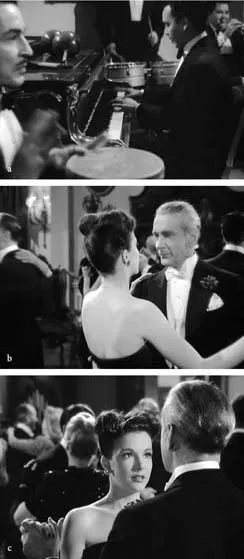
Figure 1.1, a–c. The Dark Corner (1946), dance (at about 21:20): (a) music played by Eddie Heywood’s band; (b) initial view of Hardy and Mari Cathcart; (c) second view. Screen stills.
This Book’s Title, Part 1: Meaning, Interpretation
In order to position the kind of work that arises from the three principles outlined above in relation to the critical practices of the music studies discipline, it will be useful to examine the four keywords in this book’s title.5 The first of them, “meaning,” may be defined as whatever arises from acts of interpretation as they operate on cinematic texts or, more specifically for my purpose here, on cinematic texts as read in terms of the musical component of their sound tracks. Making sense of that definition, however, requires a comparable definition of “interpretation,” preferably of course one that does not collapse into the circular by including the word “meaning.” I respect the distinction between meaning and interpretation implied by the title of this Indiana University Press book series—one would not need both of them if the two terms were really pretty much the same (as many of us came to assume for a while in the 1980s, when terms like “narrative,” “interpretation,” “criticism,” and the like were expanding dramatically, seeming to co-opt whole fields in a rush to the multidisciplinary). The paired words in the series title suggest that “meaning” is better defined as what arises from the effects generated by texts, which for most films (like most literature) very particularly means narrative effects. “Interpretation,” on the other hand, is a handy umbrella term for critical practices, that is to say, what it is we do with—or how it is that we respond to—the effects that texts generate.
The two terms as defined here align well with Robert Hatten’s “historical meanings” (or “stylistic knowledge”) and “hermeneutic inquiry” as they are expressed in the following passage from his book Interpreting Musical Gestures, Topics, and Tropes: “We maintain that the ‘aesthetic’ is no illusion, . . . that we still have access to relatively objective (by which I mean intersubjectively defensible) historical meanings—both at the general level of style (which can be reconstructed to a degree that the evidence will allow) and at the more detailed level of a work (which must be interpreted not only from stylistic knowledge but also through hermeneutic inquiry)” (2004, 6; emphasis in the original). David Bordwell makes a similar distinction based more directly on disciplinary practices and in a negative formulation that reflects his pessimistic view of the state of film studies in the 1980s: “Interpretation of individual films can be fruitfully renewed by a historical scholarship that seeks out the concrete and unfamiliar conditions under which all sorts of meaning are made. Further, interpretation should not overwhelm analysis of form and style; the critic should not strive to reduce every effect to the conventions of interpretive reason” (1989, 273).6
The distinction between meaning and interpretation is connected to a historical trajectory beginning with nineteenth-century critics, commentators, and historians who gave priority to the author, often radically in the notion of the genius and masterwork. This view began to be contested as early as the 1890s and was under siege by the 1930s, by which time priority was shifting to the text, specifically the text as system (whether construed as organic or mechanical). Early structuralist models and the interpretive practices exemplified in literary studies by the New Critics represent this phase well. By the late 1960s, the opposition closed system / infinite meaning began to shift criticism into its poststructuralist phase, and with that change attention swiftly moved away from the text to the reader (or viewer, audio-viewer [Chion 1994, xxv], critic), most directly through interpretive models of deconstruction in literary studies (eventually imported into music, as well) and reader-response theory, but also through cognitivist analytical models, most prominently for music studies through Lerdahl and Jackendoff’s (1983) generative theory of tonal music and for film studies through Bordwell’s (1985) narrative theory. Only in recent decades has the balance been righted somewhat because of attention given to empirical audience-response research (Bordwell 2008, 20).7
This author-text-reader tricolon is simply a historically mapped version of a model of communication dating to the 1920s and closely linked to information theory (Shannon and Weaver), to linguistics (Jakobson’s six communication functions), and through linguistics to literary theory and interpretation (cited in Cobley 2008, 15). The literature on these issues is very large indeed—almost all of literary theory over the past fifty years and a significant part of film theory from the 1960s through at least the mid-1990s is fundamentally concerned with it—and each of the positions has its strong, sometimes strident, advocates. I do not argue that any should be privileged; in practice, they obviously can, as Jakobson’s model already made clear (the “poetic” function, for example, simply gives priority to experience of the text, etc.).8 Instead, I assert that the interpreter must always be clear in locating the focus and—the harder part—be willing to acknowledge its limitations. Bias toward the author is always in danger of collapsing into the hagiographic (and becomes indistinguishable from promotion or marketing). Bias toward the text too readily turns formalistic (tending to praise complexity for its own sake). And, finally, bias toward the reader-critic can, paradoxically, be merely willful, even when it is plainly constrained by the conventionalized patterns of interpretive rhetoric, whether or not tied to a more or less fully articulated ideology.
Without making particular theoretical or ideological claims, then, I find that separating textual effects from interpretive practices—at least provisionally—has greater heuristic value for the study of films, and sound and music as integrated within them, than does insisting that they cannot or should not be separated. In any case, this separation results in selective emphases, not a brick wall, and it creates priorities for interpretation, not an unbridgeable ideological divide (unless the critic chooses to foreground one, of course). Bordwell helpfully separates what he calls “comprehension” from “interpretation”: under each heading he includes two types of meanings that the reader or viewer might construct. Under “comprehension” fall referential meanings and explicit meanings. Referential meanings are those that attempt to make sense of the diegetic world and character actions, whereas explicit meanings try to reconstruct the film’s (author’s) goals and intentions based on what is directly presented. Under “interpretation” are implicit meanings and symptomatic meanings. Implicit meanings go a step further than explicit meanings, to the abstract level of thematic statements, whereas symptomatic meanings assume a critical stance in the sense of “reading against the grain,” assuming a fissure between a film’s presentation and themes, and its underlying ideology (Bordwell 1989, 8–18).
Bordwell, however, also says one should not “assume that the four sorts of meanings constitute levels which the critic must traverse in a given sequence. . . . There is evidence [for example] that whereas beginning interpreters of poetry do read referentially and have trouble making the thematic leap, skilled interpreters try out implicit meanings from the start and often neglect the ‘literal’ level, or summon it up only to help the interpretation along” (1989, 11). Given that it can require some effort to pay specific attention to music and its effects, however, the literature has profited from careful descriptions, that is, attention to referential and explicit meanings that include music and sound. Robynn Stilwell uses such examples in the context of her theoretical construction of the diegetic/nondiegetic pair, the opposition that has come under criticism repeatedly since it was clearly formulated in relation to film music by Claudia Gorbman (1987).9 Stilwell argues against abandoning or radically reconceiving the opposition: “Because the border between diegetic and nondiegetic is crossed so often does not invalidate the separation. If anything, it calls attention to the act of crossing and therefore reinforces difference” (2007, 184). It should be noted that Stilwell’s argument is consistent with Gorbman’s original description: “Significantly, the only element of filmic discourse that appears extensively in nondiegetic as well as diegetic contexts, and often freely crosses the boundary line in between, is music. Once we understand the flexibility that music enjoys with respect to the film’s diegesis, we begin to recognize how many different kinds of functions it can have: temporal, spatial, dramatic, structural, denotative, connotative—both in the diachronic flow of a film and at various interpretive levels simultaneously” (1987, 22). What Stilwell calls the “fantastical gap” is a “border region,” “a transformative space, a superposition, a transition between stable states” (2007, 200). Presumably because her essay is concerned with filling out the definition of the “fantastical gap,” her examples tend to concern themselves with Bordwell’s level of “comprehension” rather than “interpretation.” We will look briefly at her discussion of the main-title sequence from the Jane and Anna Campion film Holy Smoke (1999).
Among the powers of the “fantastical gap” is the ability to ...
Table of contents
- Cover
- Half title
- Title
- Copyright
- Dedication
- Contents
- Preface
- Acknowledgments
- Part I: Meaning and Interpretation
- Part II: Music in the Mix: Casablanca David Neumeyer and James Buhler
- Part III: Topics and Tropes: Two Preludes by Bach
- Notes
- Bibliography
- Index
Trusted by 375,005 students
Access to over 1.5 million titles for a fair monthly price.
Study more efficiently using our study tools.
Frequently asked questions
Yes, you can cancel anytime from the Subscription tab in your account settings on the Perlego website. Your subscription will stay active until the end of your current billing period. Learn how to cancel your subscription
No, books cannot be downloaded as external files, such as PDFs, for use outside of Perlego. However, you can download books within the Perlego app for offline reading on mobile or tablet. Learn how to download books offline
Perlego offers two plans: Essential and Complete
- Essential is ideal for learners and professionals who enjoy exploring a wide range of subjects. Access the Essential Library with 800,000+ trusted titles and best-sellers across business, personal growth, and the humanities. Includes unlimited reading time and Standard Read Aloud voice.
- Complete: Perfect for advanced learners and researchers needing full, unrestricted access. Unlock 1.5M+ books across hundreds of subjects, including academic and specialized titles. The Complete Plan also includes advanced features like Premium Read Aloud and Research Assistant.
We are an online textbook subscription service, where you can get access to an entire online library for less than the price of a single book per month. With over 1.5 million books across 990+ topics, we’ve got you covered! Learn about our mission
Look out for the read-aloud symbol on your next book to see if you can listen to it. The read-aloud tool reads text aloud for you, highlighting the text as it is being read. You can pause it, speed it up and slow it down. Learn more about Read Aloud
Yes! You can use the Perlego app on both iOS and Android devices to read anytime, anywhere — even offline. Perfect for commutes or when you’re on the go.
Please note we cannot support devices running on iOS 13 and Android 7 or earlier. Learn more about using the app
Please note we cannot support devices running on iOS 13 and Android 7 or earlier. Learn more about using the app
Yes, you can access Meaning and Interpretation of Music in Cinema by David P. Neumeyer in PDF and/or ePUB format, as well as other popular books in Media & Performing Arts & Music History & Criticism. We have over 1.5 million books available in our catalogue for you to explore.