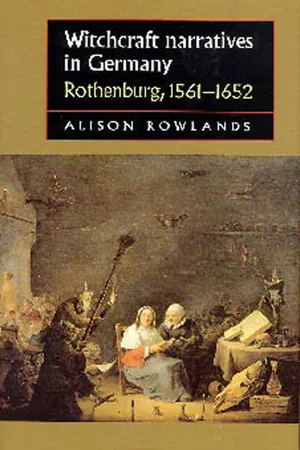
Looks at why witch-trials failed to gain momentum and escalate into 'witch-crazes' in certain parts of early modern Europe. Exames the rich legal records of the German city of Rothenburg ob der Tauber, a city which experienced a very restrained pattern of witch-trials and just one execution for witchcraft between 1561 and 1652. Explores the social and psychological conflicts that lay behind the making of accusations and confessions of witchcraft. Offers insights into other areas of early modern life, such as experiences of and beliefs about communal conflict, magic, motherhood, childhood and illness. Offers a critique of existing explanations for the gender bias of witch-trials, and a new explanation as to why most witches were women.
- 256 pages
- English
- ePUB (mobile friendly)
- Available on iOS & Android
eBook - ePub
About this book
Information
1
‘An honourable man should not talk about that which he cannot prove’: slander and speech about witchcraft
On 29 January 1561, Paulus and Barbara Brosam, a married couple from Wettringen, one of the largest villages in Rothenburg’s rural hinterland, brought a slander suit before the council in Rothenburg against two of their neighbours, brothers-in-law Hans Lautenbach and Leonhart Immell. The Brosams complained that Lautenbach and Immell had falsely claimed that Barbara was a witch and Paulus her accomplice, thereby threatening to rob the couple of their honour. Defendants Lautenbach and Immell refused to retract their claims, however, and because of this and the gravity of their allegations, the council gaoled both parties to the suit in order to examine the matter further. A few days later the case ended, in the Brosams’ favour. Paulus and Barbara were allowed to return home after paying the costs of their brief imprisonment and promising to present themselves before the council if allegations of witchcraft were made against them in future, while Lautenbach and Immell were eternally banished from Rothenburg and its hinterland for malicious defamation, with Lautenbach first enduring the additional ignominy of a spell in the city’s pillory.1
This was one of the earliest cases in which allegations of harmful or demonic witchcraft were brought to the attention of the post-reformation council in Rothenburg and one of eighteen such cases investigated by the council between c. 1561 and c. 1652. Of the forty-one individuals involved in these cases as alleged or self-confessed witches, nine were banished and only one was executed, in 1629.2 Chapters 1 and 2 of this book will explain why Rothenburg and its hinterland had this restrained pattern of formal prosecution for witchcraft during the early modern period, exploring the web of legal, social and cultural factors at popular and elite levels which operated and interacted to deter the inhabitants of the area from accusing their neighbours of witchcraft at law, and to ensure that the allegations of witchcraft that reached the courts rarely led to convictions for the crime and never triggered mass trials. Using the Wettringen case from 1561 as a starting point, this chapter will focus on two legal factors central to this web of restraints: the unwillingness of the Rothenburg council to abandon due legal procedure in its treatment of witchcraft, and the role that the legal treatment of slander in Rothenburg played in dissuading people from accusing others formally of witchcraft, and even from voicing suspicions of witchcraft publicly at all. The Wettringen case proved to be the forerunner of a case-type – in which allegations of witchcraft were treated as instances of slander and in which the slanderers rather than the alleged witches came off worst – which played an important part in shaping the council’s judicial engagement with witchcraft in the late sixteenth and early seventeenth century and remained of some, albeit lesser, significance thereafter.
Brosam v. Lautenbach and Immell
Hans Lautenbach’s story of alleged witchcraft, which precipitated the Brosams’ slander suit and which he repeated to Wendel Ferg and Erhardt Schleeried, the councillors deputised to question him after his arrest, ran as follows. On 18 January 1561 he had been travelling home with several barrels of wine from Heidenfels, a village situated several miles to the southwest of Wettringen, when heavy snowfalls had forced him to abandon his cart at a tavern in another village called Wallhausen. By sunset he had managed to return home to Wettringen on horseback and, tired and cold, had lain down on a bench in front of the stove to warm himself. He had dozed off and been pressed by a witch while asleep.3 On waking, Lautenbach had urinated into a glass container, stoppered it shut, and locked it in a chest. By this means Lautenbach hoped to identify the witch responsible for the pressing as – according to popular belief – she would thereafter be unable to pass water and would be forced to confront him in order to obtain and smash the container and thereby break its counter-magical power over her.4
A couple of days later Lautenbach’s plan for identifying the witch had apparently worked. He had been drinking with companions in a Wettringen tavern belonging to Hans Kapp when one of the daughters of Paulus and Barbara Brosam arrived with a message from her father, in which Paulus offered to accompany Lautenbach on his journey to Wallhausen to retrieve his abandoned cart. Instead of going to meet Paulus, however, Lautenbach had dallied in the tavern. A short while later Lautenbach’s own wife had turned up, to tell him that Paulus had just called at their house to repeat his offer personally. Again Lautenbach had stayed in the tavern, and it was at this point that he uttered the words that were to have such dire consequences for him. He told his companions of his recent pressing by the witch and of the method he had adopted to identify his tormenter, suggesting that Paulus Brosam’s desire for his company ‘was part of the same affair’.5 This indirect reference was understood by those listening to Lautenbach to imply that the witchcraft was the work of Barbara Brosam, on whose behalf Paulus was now acting to obtain the urine-filled container.
The account Lautenbach gave of his subsequent journey to Wallhausen to retrieve his cart underlined this conclusion. He had set off alone, but Paulus had followed the tracks of his horse in the snow to the tavern at Wallhausen. There he had insisted on speaking to Lautenbach and arranging that the two of them travel back to Wettringen together. On the return journey, Paulus had begged Lautenbach for the container, which was apparently causing great problems in the Brosam household. Lautenbach had initially made no promises, merely commenting that ‘he had not thought that Paulus and his family were such people’, meaning witches.6 Paulus had asked for the container on two further occasions, once when Lautenbach’s cart overturned in the snow – the idea being that he would help right the cart if Lautenbach promised to give him the container – and again when they reached Wettringen. At this point Lautenbach had relented to his increasingly desperate requests and given him the container, which he had smashed on the ground outside Lautenbach’s house.7 The allegation that Barbara Brosam was the witch who had pressed Lautenbach was subsequently repeated by his brother-in-law, Leonhart Immell, at another Wettringen tavern belonging to Georg Rigell.8 It was in reaction to the ever-widening publicity that Lautenbach’s story was gaining in Wettringen that the Brosams brought their slander suit.
In custody both Brosams refuted the allegations made by Lautenbach, although in different ways. Paulus told councillors Ferg and Schleeried a tale which accorded in many details with Lautenbach’s, but which put a different gloss on the motives for his actions. He suggested that his offer to accompany Lautenbach on his journey had not been unusual or overly insistent, explaining that he had needed to travel in the same direction anyway in order to collect some money he was owed for a barrel of wine from a man who lived near Wallhausen. As he had been concerned about the threat posed by itinerant mercenaries to lone travellers, it had made sense to him to secure the company of Lautenbach for the journey. The arrangement had worked to Lautenbach’s advantage as well, as he had been able to right his overturned cart on their return journey to Wettringen only with the assistance of Paulus. Paulus denied ever asking Lautenbach for the glass container. Instead, he gave his interrogators an everyday account of two men going about their business in the context of a neighbourly companionship which worked in both their interests, with no subtext of witchcraft to give sinister meaning to their exchanges.9
What Paulus implied – that Lautenbach’s story was a malicious fabrication – Barbara made explicit in custody using three interlinked strategies: an assertion of her innocence, an attempt to discredit the defendants, and an emphasis on her piety. She insisted that she was not a witch, pointing out – by way of a negative proof of this fact, and as evidence of the popular understanding of witchcraft as a mode of illicit material gain made by witches at the expense of their neighbours – that if she could work witchcraft she would not have suffered such poverty during her life. Her innocence was further shown by the fact that she and Paulus had come into Rothenburg voluntarily, leaving their six young children at home, to bring the case to the attention of the council in the first place. The implication was that these were not the actions of people who had anything to hide, but here Barbara was being disingenuous, glossing over the fact that the Brosams’ decision to bring the suit had doubtless been made after careful calculation of its risks and advantages. She accused Lautenbach and Immell of having plotted together to concoct lies about her out of envy and hatred and did all she could to undermine their credibility and the plausibility of their testimony. Immell had previously accused other women of being witches when drunk, she explained, while Lautenbach was a man tainted with vice, who lacked honour himself and therefore sought to deprive other people of their good names by defaming them. Barbara referred to a previous legal punishment that Lautenbach had received – for adultery in 1555, discussed below – and the fact that God had seen fit to inflict the serious illness of epilepsy upon him, as proof of his inherent sinfulness and dubious character. Barbara also called on God as a witness of her blamelessness and drew parallels between her own and Christ’s suffering as a way of emphasising her lack of guilt and of warning her interrogators against the unjust punishment of innocents by secular authorities.10 From their fervour and frequency, Barbara’s assertions of piety appear to have been heartfelt, but in voicing them she may also have been replicating narrative strategies she had already employed in response to the questions about her identity as a witch that had been put to her by the pastor of Wettringen, Johannes Zöllner, in the years before 1561.11
Leonhart Immell, Lautenbach’s brother-in-law and a baker by trade, was questioned next. He had lost his nerve since being gaoled and now sought to escape the council’s wrath by shifting the blame for the slander against the Brosams onto Lautenbach and by offering excuses for his own role in the affair. He admitted that he had mentioned Barbara’s act of witchcraft to his drinking companions in Georg Rigell’s tavern, but added that he had done so only after Lautenbach had first made the allegations against her public and that he otherwise knew nothing about her in connection with witchcraft. To excuse his repetition of the slander, Immell explained that he had been drunk at the time and provoked in his actions by the hostility which the Brosams had previously shown towards him. Barbara had once attacked him with a stick and Paulus with an axe and both Brosams had damaged his trade by criticising the quality of his bread. Immell expressed the wish that he lived far away from the couple, begged the councillors for merciful treatment, and implored them to ask his neighbours in Wettringen for testimony of his good character.12
The council did turn next to other Wettringen inhabitants for evidence, questioning pastor Zöllner and four men – Gilg Hoffman, Lorentz Herman, Steffan Haim and Gorg Kurtz – who were neighbours of the Brosams, on oath on 31 January. Such communal opinion was crucial to legal procedure in early modern Germany, as it could provide the circumstantial evidence on the basis of which a decision to question one or more of the protagonists under torture could be made by the judicial authorities. It was particularly important in cases such as those of alleged witchcraft or illicit sexual intercourse, where two parties maintained opposing versions of events which no-one else had witnessed and where the key issue for the authorities was that of which party was to be deemed most credible. The fact that the questioning of the Wettringen witnesses focused on the suspicions of witchcraft raised against Barbara Brosam showed that the council was still taking them seriously.
The statements given shed interesting light on other members of the Brosam family. Pastor Zöllner explained that, throughout the decade of his incumbency in Wettringen, rumours had circulated to the effect that the parents of Paulus, Veit and Elisabeth Brosam, were workers of sorcery who had taught their arts to Barbara. Zöllner stressed that he had done all he could to discover whether there was any truth in this talk, frequently exhorting Veit, Elisabeth and Barbara to admit their sin rather than take communion with it on their consciences. Here Zöllner had acted in accordance with the Rothenburg Church Ordinance of 1559, which decreed that village pastors were to summon and talk to any parishioners suspected of having heterodox beliefs or of working sorcery, in order to convince them of the errors of their ways.13 The Brosams, however, had always maintained their innocence and continued to take communion. Zöllner had also watched their behaviour closely, but had seen nothing to confirm the rumours against them.14 Hoffman, Herman, Haim and Kurtz state...
Table of contents
- Cover Page
- Title Page
- Copyright Page
- Contents
- Acknowledgements
- Map: place of origin of the sixty-five people involved in witch-trials in Rothenburg ob der Tauber, 1549–1709
- Introduction
- 1 ‘An honourable man should not talk about that which he cannot prove’: slander and speech about witchcraft
- 2 The devil’s power to delude: elite beliefs about witchcraft and magic
- 3 ‘One cannot … hope to obtain the slightest certainty from him’: the first child-witch in Rothenburg, 1587
- 4 ‘When will the burning start here?’: the Catholic challenge during the Thirty Years’ War
- 5 Seduction, poison and magical theft: gender and contemporary fantasies of witchcraft
- 6 ‘God will punish both poor and rich’: the idioms and risks of defiance in the trial of Margaretha Horn, 1652
- Conclusion
- Appendix: trials for witchcraft in Rothenburg ob der Tauber, 1549–1709
- Bibliography
- Index
Trusted by 375,005 students
Access to over 1.5 million titles for a fair monthly price.
Study more efficiently using our study tools.
Frequently asked questions
Yes, you can cancel anytime from the Subscription tab in your account settings on the Perlego website. Your subscription will stay active until the end of your current billing period. Learn how to cancel your subscription
No, books cannot be downloaded as external files, such as PDFs, for use outside of Perlego. However, you can download books within the Perlego app for offline reading on mobile or tablet. Learn how to download books offline
We are an online textbook subscription service, where you can get access to an entire online library for less than the price of a single book per month. With over 1.5 million books across 990+ topics, we’ve got you covered! Learn about our mission
Look out for the read-aloud symbol on your next book to see if you can listen to it. The read-aloud tool reads text aloud for you, highlighting the text as it is being read. You can pause it, speed it up and slow it down. Learn more about Read Aloud
Yes! You can use the Perlego app on both iOS and Android devices to read anytime, anywhere — even offline. Perfect for commutes or when you’re on the go.
Please note we cannot support devices running on iOS 13 and Android 7 or earlier. Learn more about using the app
Please note we cannot support devices running on iOS 13 and Android 7 or earlier. Learn more about using the app
Yes, you can access Witchcraft narratives in Germany by Alison Rowlands in PDF and/or ePUB format, as well as other popular books in History & Chinese History. We have over 1.5 million books available in our catalogue for you to explore.