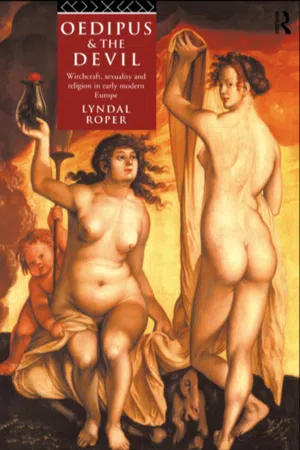
This bold and imaginative book marks out a different route towards understanding the body, and its relationship to culture and subjectivity. Amongst other subjects, Lyndal Roper deals with the nature of masculinity and feminity.
eBook - ePub
Oedipus and the Devil
Witchcraft, Religion and Sexuality in Early Modern Europe
- 258 pages
- English
- ePUB (mobile friendly)
- Available on iOS & Android
eBook - ePub
About this book
Information
1
Introduction
I
In 1686, Appolonia Mayr, a jilted servantwoman, confessed that she had murdered her newborn baby. The Devil had promised that if she killed her child, her lover would marry her. She had strangled the infant at a little hill beyond the Lech bridge, just before the small town of Friedberg. She still knew the place and could find it. There was a tree not far away and she had walked into the fields, and it was midday that it happened.1 Describing the birth and murder, she said ‘The Evil Spirit left her no peace. It was only a moment, the Devil touched it [the child] as if he were a midwife, it happened quite quickly that the child came out. She strangled it immediately with the hand, and she felt no pain in the delivery.’2 Then Appolonia walked on: ‘She left it lying quite naked, uncovered, and unburied…. The Devil did not go with her, but remained staying by the child, and she did not look back.’3
What do we make of such a cultural fragment? Here a woman is apparently committing infanticide as a kind of love magic, in a crazed and hopeless attempt to force her lover to marry her. Alone on the path between the fields and the village, she has walked beyond human habitation —the sole tree which marks the spot is the only distinguishing mark of the landscape. She bears the child without female assistance. The Devil acts as midwife, and it is he who remains standing over the child. Appolonia herself hardly acts at all—she barely strains to give birth, she leaves the child uncovered in the bushes and keeps on walking. All the more stark is her single deed: the strangling of her newborn child with her hand. Appolonia Mayr was burnt as a witch. She lived in a world in which the Devil was a character one might meet on any lonely pathway, who might whisper whom to kill, how to control others.
How does one understand such a world? There has been a long line of attempts to do so, from the judges who first interrogated such criminals, to the publishers of broadsheets who turned such horrible cases into entertainment, to the nineteenth-century practitioners of cultural history,4 to historians of our own day. Then as now, much of this interest is animated by fascination with a foreign, yet familiar world. Such cases pose puzzles about our own identity, teasing us to specify in what the historical consists. They present us with a time which was apparently innocent of our notion of the person, when moral categories had a different shape, when the relation between the natural and supernatural was differently conceived. To analyse such a world, we have borrowed many tools. We have learnt from anthropology and from literary criticism to read our texts with an eye for symbol and ritual, to decipher kinship structures and, above all, to stress the otherness of early modern society.5 Such an approach has enabled us to measure the distance which separates us from that other world, to make it ‘historical’ by reconstructing the collective nature of early modern society, viewing subjectivity itself as culturally constructed.
How will historical approaches based on these assumptions help us interpret Appolonia Mayr’s story? One might see her as an exemplar of mid-Counter-Reformation womanhood, tormented by the sexual guilt imposed on her through Catholic re-education and social discipline. Her story about the Devil might be read as the hackneyed script which Baroque culture required women guilty of any female sin to recite. Like a good seventeenth-century Catholic, conscious—as historians would lead us to expect—of her religious confessional identity, Appolonia describes how she searched for ‘Catholic people’ in Augsburg at whose inn she might give birth.
But there is something which is deeper and more disturbing in her behaviour. When Appolonia returned to the city of Augsburg some months later, it was her demand to the Franciscan friars that they give her the baptismal certificate for her dead baby which set the whole case in train. In her first interrogation, Appolonia hotly denied having killed her baby, telling how ‘nearly one hour after the birth she desired to see her child’, only to be informed that it was already dead after having been taken to the Franciscans for baptism. The lost record of the infant’s baptism—proof that it had eternal life—comes to stand for the loss of the child itself. As Appolonia put it, ‘she just wanted to see her child again; she could not live thus any more’.6 There is a suicidal desperation in her attempts to obtain the piece of paper: her search for it ensnared her in the web of bureaucracy which would inevitably uncover her crime and expose her tissue of lies about its death. This speaks not so much of confessional identity and sexual guilt—Appolonia made no secret of her pregnancy—as of the sheer agony of the loss of her baby, pain which is not the product of Counter- Reformation religiosity. The various, indeed inconsistent, accounts she offered of where and how she gave birth make the historian (and her interrogators) despair of ever uncovering the ‘truth’, but they may tell us other things.
to historians of our own day. Then as now, much of this interest is animated by fascination with a foreign, yet familiar world. Such cases pose puzzles about our own identity, teasing us to specify in what the historical consists. They present us with a time which was apparently innocent of our notion of the person, when moral categories had a different shape, when the relation between the natural and supernatural was differently conceived. To analyse such a world, we have borrowed many tools. We have learnt from anthropology and from literary criticism to read our texts with an eye for symbol and ritual, to decipher kinship structures and, above all, to stress the otherness of early modern society.5 Such an approach has enabled us to measure the distance which separates us from that other world, to make it ‘historical’ by reconstructing the collective nature of early modern society, viewing subjectivity itself as culturally constructed. How will historical approaches based on these assumptions help us interpret Appolonia Mayr’s story? One might see her as an exemplar of mid-Counter-Reformation womanhood, tormented by the sexual guilt imposed on her through Catholic re-education and social discipline. Her story about the Devil might be read as the hackneyed script which Baroque culture required women guilty of any female sin to recite. Like a good seventeenth-century Catholic, conscious—as historians would lead us to expect—of her religious confessional identity, Appolonia describes how she searched for ‘Catholic people’ in Augsburg at whose inn she might give birth.
But there is something which is deeper and more disturbing in her behaviour. When Appolonia returned to the city of Augsburg some months later, it was her demand to the Franciscan friars that they give her the baptismal certificate for her dead baby which set the whole case in train. In her first interrogation, Appolonia hotly denied having killed her baby, telling how ‘nearly one hour after the birth she desired to see her child’, only to be informed that it was already dead after having been taken to the Franciscans for baptism. The lost record of the infant’s baptism—proof that it had eternal life—comes to stand for the loss of the child itself. As Appolonia put it, ‘she just wanted to see her child again; she could not live thus any more’.6 There is a suicidal desperation in her attempts to obtain the piece of paper: her search for it ensnared her in the web of bureaucracy which would inevitably uncover her crime and expose her tissue of lies about its death. This speaks not so much of confessional identity and sexual guilt—Appolonia made no secret of her pregnancy—as of the sheer agony of the loss of her baby, pain which is not the product of Counter- Reformation religiosity. The various, indeed inconsistent, accounts she offered of where and how she gave birth make the historian (and her interrogators) despair of ever uncovering the ‘truth’, but they may tell us other things.
Appolonia’s fantasies about the Devil have little to do with ritual. They are so tangibly located and speak of such individual misery that it is inadequate to speak of collective beliefs and symbols. The process by which Appolonia came to describe her pain through talking about the Devil is far more complex than a mere recapitulation of cultural stereotypes. It is certainly true that the plausibility of her testimony to both her interrogators and herself depended on a shared belief in the powers of the Devil, but Appolonia created her own story about motherhood and guilt. And it was a story with its own sacrilegious, Marian inflection: as she told it first, she spoke of how, as a stranger, she asked to be taken in at an inn, and how she gave birth in a lonely room with a bed of straw.
It was stories such as that of Appolonia Mayr which first began to make me uneasy with the way I had been constructing the relationship between individual subjectivity and culture. In this book, I want to argue against an excessive emphasis on the cultural creation of subjectivity, and to argue that witchcraft and exorcism, those most alien of early modern social phenomena, or courtship and ritual, those seemingly irreducibly collective early modern social events, cannot be understood without reference to their psychic dimension. My claim is that early modern people had individual subjectivities, characterized by conflicts which are not entirely unfamiliar. I am not claiming that there is no historical gulf between our time and the early modern period: that would be absurd. But I want to suggest that the supposed gap between ourselves and the past, which we use to justify a particular way of dealing with that past world, is less complete than we sometimes suppose, and that the assumption of difference is not always a useful heuristic tool. Indeed, I think it has hampered our understanding of the complexity of early modern people as individuals.
This book has three implicit preoccupations: first, the importance of the irrational and the unconscious in history; second, the importance of the body; and third, the relation of these two to sexual difference. The subjects with which it deals are the nature of masculinity and femininity, the cultural impact of the Reformation and Counter-Reformation and the central role of magic and witchcraft in the psychic and emotional world of the early modern period and in what we take to be ‘rationality’. These chapters document a shift on my part away from the conviction that gender is a product of cultural and linguistic practice, towards the view that sexual difference has its own physiological and psychological reality, and that recognition of this must affect the way we write history. The task with which I have been engaged is how to write a cultural history of early modern Germany in which sexual difference will not just be added on as an afterthought, a further variable, but will be genuinely incorporated. This means that courtship, the history of motherhood, witchcraft, possession and masculinity—all fields in which gender is at issue, and where the relation of psyche and body are at stake—are central cultural areas. It means that, far from being an incidental matter, sexual difference, both as physiological and psychological fact and as social construction, is part of the very stuff of culture. This consequence is still only haltingly acknowledged in early modern cultural history, which largely continues to treat the issue of gender as if it were a question of women’s participation— or lack of it—in popular and élite culture.
Yet, central as I believe sexual difference is to conceiving of culture, I found I could no longer simply apply the tools which I had acquired from feminist history to the study of early modern Europe. As I shall go on to argue, along with other feminists writing now, I have come to think that feminist history, as I and others used to practise it, rested on a denial of the body. These chapters represent an attempt—often not fully articulated—to think out a different route towards understanding the body, culture and subjectivity
II
For historians, the problem of subjectivity in the past has primarily presented itself as a question of explaining how large movements of historical transformation (the rise of capitalism, the Reformation, the development of the state) altered individuals’ self-perceptions. Here, the work of the sociologists Max Weber and, later, Norbert Elias has been deeply influential, particularly among those who study Europe in the period 1500 to 1800. Weber’s The Protestant Ethic and the Spirit of Capitalism7 still shapes the way we see the early modern period, even as historians dispute its empirical detail. We owe to Weber the vision that the changes connected with the rise of Protestantism were linked with the origins of capitalism because these transformations valued new qualities in lay people, promoting the rational, calculating, disciplined individual, a kind of person who could cope with the regimen of the market. Luther’s doctrine of the ‘calling’ was new because of its ‘valuation of the fulfilment of duty in worldly affairs as the highest form which the moral activity of the individual could assume’, giving ‘everyday worldly activity a religious significance’.8 ‘Rational conduct on the basis of the idea of the calling’9 was thus born of Protestant asceticism. Norbert Elias’s work offers the prospect of linking psychoanalytic insight with historically informed sociology.10 As his ideas have been taken up by historians of the early modern period, they have tried to show how such abstract, general historical transitions as the Reformation and Counter-Reformation, or the growth of bureaucracy and the state, had effects not only on politics but on those much less tangible dimensions of human history, the constitution of human subjects themselves, their emotions, perceptions, behaviour and even their gestures. And recently, in a powerful philosophical synthesis, Charles Taylor has argued that the origins of the modern western sense of individualism and identity are to be located in the rise of what he terms ‘inwardness’ in the wake of the Protestant Reformation. This was accompanied by a move away from an older, magical world-view in which the boundaries between oneself and the natural world were essentially permeable. As he puts it, ‘Disenchantment was driven by and connected with a new moral/spiritual stance to the world…. It was connected to a new piety, and what we see emerging is a new notion of freedom and inwardness, which this piety fostered,’ By contrast:
The decline of the world-view underlying magic was the obverse of the rise of the new sense of freedom and self-possession. From the viewpoint of this new sense of self, the world of magic seems to entail a thraldom, an imprisoning of the self in uncanny external forces, even a ravishing or loss of self. It threatens a possession which is the very opposite of self-possession.11
Such syntheses have the merit of opening up new areas of human experience to historical investigation. However, illuminating as these accounts of the relation between historical change and psychology are, I want to argue that they are based on a problematic account of subjectivity, and that when historians draw upon Elias or Weber, we run the risk of schematizing the experience of historical subjects. Following Weber, the early modern period is often held to see the birth of the ideal of the rational, economic man, or, as Taylor might put it, of the rise of a new sense of ‘self-possession’, of individual identity. But, as the challenge of psychoanalysis to models of rational behaviour might suggest, human behaviour is not solely determined by conscious consideration, and identity is not a secure possession but a piecemeal process of identifications and separations. So far from ushering in the birth of the rational ascetic individual, the early modern period saw a renewed interest in magic and the irrational, and this is a central component of the subjectivity which we now like to view as ‘rational’ or ‘modern’. Magic and the irrational are integral to it, and not mere teething problems concomitant with a ‘crisis arising in the transition between identities’.12 Our own attachment to the story of the rise of individualism and rationality is, I think, part of the reason that we so often associate the witch-craze with the intolerance and so-called irrationality of the middle ages, even while we know that witchhunting was an early modern, not a medieval phenomenon.13 As such,...
Table of contents
- Cover
- Half Title
- Title Page
- Copyright Page
- Table of Contents
- List of plates
- Preface
- Acknowledgements
- 1 Introduction
- Part I
- Part II
- Part III
- Index
Trusted by 375,005 students
Access to over 1.5 million titles for a fair monthly price.
Study more efficiently using our study tools.
Frequently asked questions
Yes, you can cancel anytime from the Subscription tab in your account settings on the Perlego website. Your subscription will stay active until the end of your current billing period. Learn how to cancel your subscription
No, books cannot be downloaded as external files, such as PDFs, for use outside of Perlego. However, you can download books within the Perlego app for offline reading on mobile or tablet. Learn how to download books offline
Perlego offers two plans: Essential and Complete
- Essential is ideal for learners and professionals who enjoy exploring a wide range of subjects. Access the Essential Library with 800,000+ trusted titles and best-sellers across business, personal growth, and the humanities. Includes unlimited reading time and Standard Read Aloud voice.
- Complete: Perfect for advanced learners and researchers needing full, unrestricted access. Unlock 1.5M+ books across hundreds of subjects, including academic and specialized titles. The Complete Plan also includes advanced features like Premium Read Aloud and Research Assistant.
We are an online textbook subscription service, where you can get access to an entire online library for less than the price of a single book per month. With over 1.5 million books across 990+ topics, we’ve got you covered! Learn about our mission
Look out for the read-aloud symbol on your next book to see if you can listen to it. The read-aloud tool reads text aloud for you, highlighting the text as it is being read. You can pause it, speed it up and slow it down. Learn more about Read Aloud
Yes! You can use the Perlego app on both iOS and Android devices to read anytime, anywhere — even offline. Perfect for commutes or when you’re on the go.
Please note we cannot support devices running on iOS 13 and Android 7 or earlier. Learn more about using the app
Please note we cannot support devices running on iOS 13 and Android 7 or earlier. Learn more about using the app
Yes, you can access Oedipus and the Devil by Lyndal Roper in PDF and/or ePUB format, as well as other popular books in Histoire & Histoire de l'Allemagne. We have over 1.5 million books available in our catalogue for you to explore.