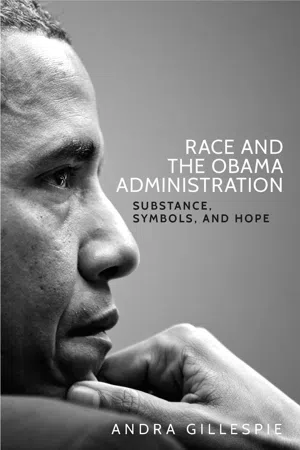
The election of Barack Obama marked a critical point in American political and social history. Did the historic election of a black president actually change the status of blacks in the United States? Did these changes (or lack thereof) inform blacks' perceptions of the President?This book explores these questions by comparing Obama's promotion of substantive and symbolic initiatives for blacks to efforts by the two previous presidential administrations. By employing a comparative analysis, the reader can judge whether Obama did more or less to promote black interests than his predecessors. Taking a more empirical approach to judging Barack Obama, this book hopes to contribute to current debates about the significance of the first African American presidency. It takes care to make distinctions between Obama's substantive and symbolic accomplishments and to explore the significance of both.
- 176 pages
- English
- ePUB (mobile friendly)
- Available on iOS & Android
eBook - ePub
About this book
Information
1
The triple bind
If human history is heard as well as seen, an audio-visual record of events and processes, then Obama’s election is, at this level, a revolutionary event, not merely in the quantity but the quality of what we can call his “visibility.” It is certainly a less than revolutionary event at the level of actual policies, and one of the central issues with Obama’s presidency will be measuring the distance between his audio-visual image – what he says and stages – and what he is able to do.
-W.J.T. Mitchell (2009, 125)
In a reflection piece for The Journal of Visual Culture, University of Chicago Professor (and Obama neighbor) W.J.T. Mitchell pondered the aesthetics of electing the first black president. He came to the conclusion that Barack Obama represented the hopes and dreams of those who voted for him, which put the new president in an interesting position. He writes, “When we analyze the effect of Obama as a ‘cultural icon,’ then, enumerating the innumerable commodifications of his image, it is important to recognize the extent to which his image is, before any positive content of, say, visible racial marking, a highly ambiguous blank slate on which popular fantasy could be projected” (Mitchell 2009, 126). Obama’s election, then, represented not only the shattering of one of the hardest, highest racial glass ceilings in the United States, then (to coopt Hillary Clinton’s phrasing); his electoral coalition was comprised of people who projected all of their hopes, fears, anxieties, and expectations onto him.
Because of Barack Obama’s status as the first African American president, he was likely an acute victim of voters projecting unrealistic expectations onto him. However, like all other presidents, he had to confront the constraints of his office and make tough decisions about which issues to address or not address (and how to frame those decisions for his many publics) over the course of his term in office. In this chapter, I advance a theory about three considerations that President Obama had to take into account as he crafted his agenda. Those insights will help to frame the discussion of the rest of the book and help to put the Obama record—and black voter reaction to that record—into context.
Simply put, while the election of Barack Obama symbolized the full incorporation of African Americans into American political life, the election of one black person cannot and should not connote the eradication of all forms of structural, social, political, and economic inequality along racial lines in this country. Moreover, it is unrealistic to assume that being president of the United States afforded Barack Obama the ability to end all inequality with the stroke of a pen, though it is not unreasonable for people to have expected him to make progress on these issues. Aside from the fact that it will take more than eight years to reverse nearly 400 years of racial inequality, Barack Obama had to confront the institutional constraints of his office as he pondered the nature of the racial advocacy he would choose to take while in office.
The office confines: presidents cannot do everything
It is easy for Americans to be lulled into thinking of their president as a singularly powerful figure. Anyone who has grown up since the Cold War has likely grown accustomed to hearing the president referred to as the “leader of the free (or Western) world,” and such phrasing connotes a certain type of singular power. That impression is not exactly accurate, though. Yes, the American president occupies a prominent leadership role on the global stage, but the Electoral College does not confer omnipotence on one winner every four years.
Instead, the Framers of the American Constitution, who feared despots and monarchies, placed real limits on what presidents can do. And as the country has evolved and put the ideas of the Constitution into practice, political actors have developed their own institutions—complete with their own constraints—to try to carry out their duties. Over time, these factors limit the leverage of even the most well-meaning presidents (even those who serve in times of unprecedented executive power) to address issues of racial inequality without cooperation from other political actors.
The first real constraint on the president is separation of powers. The president shares power with two other branches of federal government, whose different roles are intended to check and balance the power of the other branches. Take voting rights for example. By the 1960s, it was clear that Southern states were circumventing the 15th Amendment and denying blacks the right to vote through racially neutral, ingenious measures like literacy tests and more informal but explicit measures like intimidation. President Lyndon Johnson could not unilaterally instruct Southern states to let blacks vote. Instead, he had to work with Congress to pass legislation to empower the Executive Branch to oversee voting rights in the states. Despite the fact that presidents do have some capacity to govern via executive order (which we will discuss in Chapter 3), they still rely on Congress to make laws. If there is no law, then the president (and by extension, the rest of the Executive Branch) has nothing to enforce.
Executive Branch constraints came into full view when the Supreme Court overturned parts of the Voting Rights Act in 2013. In the ruling Shelby County, AL v. Holder (570 U.S. 2 (2013)), the high court declared the preclearance sections of the Voting Rights Act to be unconstitutional. Under preclearance, states and counties which had historically engaged in denying blacks and language minorities the right to vote in the 1960s and 1970s were required to submit any changes to their electoral processes to the Department of Justice (an arm of the Executive Branch) before those adjustments could be implemented. In 2013, the Supreme Court declared that the formula that the Voting Rights Act used to determine which areas of the country required preclearance was antiquated and therefore unconstitutional. According to the majority opinion, it was unfair to penalize states for egregious practices that happened two generations ago when those states may have stopped discriminating against minorities entirely. The Court’s opinion allowed Congress to rewrite the preclearance section of the Voting Rights Act and to redefine which jurisdictions were in need of oversight based on current patterns of discrimination. However, it would not allow the Department of Justice to force states and counties to clear election plans with them just because Congress had identified racial disparities in voter turnout in those areas in 1975.
The Shelby ruling had immediate consequences for electoral politics. Until that point, the Justice Department had used the power of preclearance to limit the ability of some Southern states to enact laws requiring photo identification in order to vote. Once the Court invalidated preclearance, states like North Carolina and Texas implemented voter identification laws that some critics charge were intended to make it difficult for poor, elderly, and black voters to participate in elections. The Justice Department can still sue states for voter discrimination if necessary, using Section 2 of the Voting Rights Act, but invalidating preclearance removed an important tool from the kit of remedies that the Justice Department uses to defend voting rights (see Fuller 2014; Lopez 2014).
Congress does have the right to revisit preclearance. In their ruling, the majority of the Supreme Court took issue with the idea of using 40-year-old criteria to define which states were more likely to discriminate. If Congress chooses, they can rewrite the Voting Rights Act and develop a more contemporary rubric to determine which states and counties are in need of supervision. As of this writing, though, they have not revised the Voting Rights Act (see Fuller 2014). As such, the Executive Branch has fewer tools at their disposal to help ensure equal access to the ballot than they had before June 2013.
In addition to the constitutional constraints of the office, the scope and magnitude of the Executive Branch (and bureaucracy) present its own challenges for governance and innovation. The federal government employs nearly three million civilian employees in over 500 departments, commissions, and independent agencies (Morone and Kersh 2013, 533). To put this into ...
Table of contents
- Cover
- Half Title
- Title Page
- Copyright Page
- Dedication
- Contents
- Figures
- Tables
- Acknowledgments
- Introduction: My president was black. So what?
- 1 The triple bind
- 2 How he did: The racial successes, failures, and impact of the Obama presidency
- 3 Was Obama a paddling duck?: Seven vignettes of substantive politics in the Obama Administration
- 4 The right person saying the right thing: Descriptive representation and rhetoric in the Obama Administration
- 5 The political power of symbolic representation: Artistic performances and commencement speeches from presidential couples
- 6 The substance of hope: Public opinion and black attitudes toward the Obama presidency
- Conclusion: Was it worth it?
- Epilogue: Considering the Obama legacy in the age of Trump
- Appendix: Black issue themed promises made by Barack Obama, by promise status
- Bibliography
- Index
Trusted by 375,005 students
Access to over 1.5 million titles for a fair monthly price.
Study more efficiently using our study tools.
Frequently asked questions
Yes, you can cancel anytime from the Subscription tab in your account settings on the Perlego website. Your subscription will stay active until the end of your current billing period. Learn how to cancel your subscription
No, books cannot be downloaded as external files, such as PDFs, for use outside of Perlego. However, you can download books within the Perlego app for offline reading on mobile or tablet. Learn how to download books offline
We are an online textbook subscription service, where you can get access to an entire online library for less than the price of a single book per month. With over 1.5 million books across 990+ topics, we’ve got you covered! Learn about our mission
Look out for the read-aloud symbol on your next book to see if you can listen to it. The read-aloud tool reads text aloud for you, highlighting the text as it is being read. You can pause it, speed it up and slow it down. Learn more about Read Aloud
Yes! You can use the Perlego app on both iOS and Android devices to read anytime, anywhere — even offline. Perfect for commutes or when you’re on the go.
Please note we cannot support devices running on iOS 13 and Android 7 or earlier. Learn more about using the app
Please note we cannot support devices running on iOS 13 and Android 7 or earlier. Learn more about using the app
Yes, you can access Race and the Obama Administration by Andra Gillespie in PDF and/or ePUB format, as well as other popular books in Historia & Historia social. We have over 1.5 million books available in our catalogue for you to explore.