Explores young black politicians' pursuit of diverse constituencies
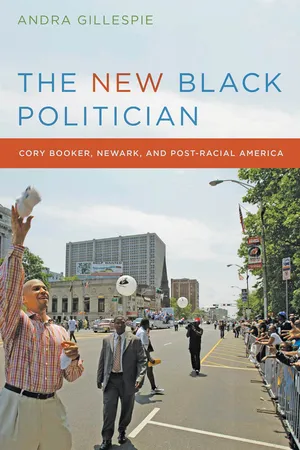
At the beginning of the 21st-century, a vanguard of young, affluent black leadership has emerged, often clashing with older generations of black leadership for power. The 2002 Newark mayoral race, which featured a contentious battle between the young black challenger Cory Booker and the more established black incumbent Sharpe James, was one of a series of contests in which young, well-educated, moderate black politicians challenged civil rights veterans for power. In The New Black Politician, Andra Gillespie uses Newark as a case study to explain the breakdown of racial unity in black politics, describing how black political entrepreneurs build the political alliances that allow them to be more diversely established with the electorate.
Based on rich ethnographic data from six years of intense and ongoing research, Gillespie shows that while both poor and affluent blacks pay lip service to racial cohesion and to continuing the goals of the Civil Rights Movement, the reality is that both groups harbor different visions of how to achieve those goals and what those goals will look like once achieved. This, she argues, leads to class conflict and a very public breakdown in black political unity, providing further evidence of the futility of identifying a single cadre of leadership for black communities. Full of provocative interviews with many of the key players in Newark, including Cory Booker himself, this book provides an on the ground understanding of contemporary Black and mayoral politics.
- 325 pages
- English
- ePUB (mobile friendly)
- Available on iOS & Android
eBook - ePub
About this book
Information
PART I
The Clash of Two Black Americas
1
Black Political Entrepreneurship, Twenty-First-Century Style
The Theory of Elite Displacement
That which has been is that which will be, And that which has been done is that which will be done. So there is nothing new under the sun.
— Ecclesiastes 1:9
IN THE OLD TESTAMENT, King Solomon reminded the faithful that the more things change, the more they stay the same. This is certainly true in politics. Times, techniques, and contexts may change, but certain aspects of politics stay the same. One of the longest-lasting continuities in American politics is the invocation of negative racial issues and imagery to help a political actor gain a comparative advantage over his or her opponents. For instance, journalist James Callender reported the allegations of Thomas Jefferson’s sexual relationship with Sally Hemings in an attempt to destroy his presidency. Lee Atwater produced the infamous Willie Horton ad to derail Michael Dukakis’s 1988 presidential candidacy. And the Republican National Committee primed voters’ fears of interracial romance when they developed the infamous “bimbo ad” featuring a winking, scantily clad blonde asking the Tennessee U.S. Senate candidate Harold Ford Jr. to “call me.”1
Another continuity in American politics is the struggle that black candidates face in projecting a strong, competent, and ethical image. Charlton McIlwain points out that one of the factors dooming Jesse Jackson’s 1988 presidential candidacy was white voters’ perception that Jackson was not a strong leader. Even Barack Obama struggled with this perception, scoring lower on the leadership dimension than Hillary Clinton during the 2008 Democratic primaries. (In 2008, voters wanted change, and Obama outscored Clinton on this dimension).2 Indeed, blacks aspiring for political office today encounter many of the same challenges that their predecessors faced in the 1870s and 1920s. They still face the reasonable expectation that they have to be twice as good as whites in order to be considered adequate, and they continually face the stereotype of being corrupt or not quite ready for prime time. For instance, in his 1935 preface to Harold Gosnell’s Negro Politicians, the University of Chicago sociologist Robert Park defended the black congressmen and senators from the Reconstruction era as neither “as ignorant or as incompetent as they have been represented to be.”3 He went on to highlight their elite educational pedigrees and—if he could be critical—contended that as a whole, the Reconstruction-era congressmen “were disposed to take themselves seriously and to be, if anything, a little too conscious of their responsibilities.”4 Thus, for as long as they have been holding office, black American politicians have had to contend with being perceived as too incompetent, too uppity, or too corrupt.
For black politicians, the history of racially polarized voting, glass ceilings, and intraracial voting consensus have distorted, even minimized, the impact of these stereotypes. Times are changing, though, as blacks have broken glass ceilings and sometimes run against one another for prominent offices. How will stereotypes affect black candidates’ strategic choices in this changing environment? Will historic stereotypes have a lesser or a greater impact on blacks’ ability to win elections, to legislate, or to govern?
I argue that—at least in the short term—the conditions that enable post-racial or “breakthrough” black candidates5 to emerge onto the national political stage actually help amplify and reify the negative stereotypes that have plagued black politicians (racially transcendent or otherwise) for more than a century.
It is important to consider the racial context in which we base this discussion. There has been tremendous change for blacks in the past half century. Some of these changes are positive. Since the civil rights movement, racial minority groups have gained greater access to America’s most elite educational, social, and professional institutions. Until the late 1960s and early 1970s, most of the nation’s most selective colleges and universities accepted only a few black students. By 2008, blacks made up at least 10% of the freshman classes at five elite universities (Columbia, the University of North Carolina at Chapel Hill, Stanford, Duke, and Yale).6 Although no Fortune 500 companies had black CEOs in 1995, five had black CEOs in 2008.7 Much progress is still to be made in these areas, as blacks make up more than 12% of the U.S. population and thus still are underrepresented. But arguably now, a critical mass of middle-aged black professionals have been able to spend their entire work lives in the same elite institutions as their white counterparts.
Nonetheless, other things remain the same. While it is not unheard of for blacks to win political office in majority-white jurisdictions,8 black officeholders usually serve constituencies in which the majority of the residents are minorities or in which blacks make up the critical swing vote. For instance, in 2001 (the year before the start of this study), of the forty-seven black mayors of cities with a population of 50,000 or more, twenty led cities in which 50% or more of the population was black, and twenty-eight led cities in which blacks made up 35% or more of the population. The results are even more dramatic at the congressional level. Of the thirty-seven full-voting black members serving in the 107th Congress, twenty-four were from districts whose population was more than 50% black. All but five black members were from districts that were at least 35% black.9 Even prominent younger black politicians—those born after the civil rights movement who have been the best positioned to benefit personally from integration—tend to start their careers in majority-black districts.10 Therefore, despite the progress the United States has made in racial integration—and even though we know that blacks can effectively represent white constituents11—black politicians still are likely to at least start their careers largely representing other black people.
Combining the increasing integration of our country’s most elite institutions with the constraint of blacks still beginning their political careers in black enclaves creates a dynamic, if sometimes volatile, electoral climate. Black candidates who might be naturally inclined to use deracialized political tactics to seek political office in more multiracial or majority-white districts end up using the strategy to seek office in majority-black jurisdictions, where they have to compete against a more racially conscious black political establishment and against black incumbents who, owing to previous constraints on black political mobility, cannot seek higher political office. As a result, black politicians who might be complementary allies find themselves embroiled in bitter battles over political style and generational succession.
I call this dynamic elite displacement. The ambitious political newcomers who use the strategy accentuate their sterling credentials and social assimilation in an attempt to unseat entrenched, racialized incumbents who are determined to retain power.
As theorized, elite displacement improves upon existing theories about candidate selection and strategy, which do a poor job explaining office seeking in the black community. To illustrate my point, I present two case studies which explain how and when black candidates use elite displacement. I then outline the positive and negative externalities of the strategy.
Political Succession and the Need for Elite Displacement
In his classic study of political succession in urban regimes, Robert Dahl tracks the transitions of power in New Haven, Connecticut, where he distinguishes four groups of people who controlled the city government from 1784 to 1960. The Puritan patricians who first dominated local politics were succeeded by white entrepreneurs who were succeeded by white ethnic politicians. The white ethnic politicians were then replaced by ethnically transcendent members of the same groups. Dahl used New Haven’s electoral history to develop his theory of pluralism, or “dispersed inequalities.”12 According to this theory, Puritan oligarchs gradually ceded political power to new groups as they increased in population and economic influence. As power spread throughout New Haven, different groups could leverage their resources to sway elected officials to support policies that would benefit them. Dahl noted that no one group won every political battle. For this reason, New Haven fundamentally embraced the norm of equality and distributed political resources with rough parity.13
Dahl’s theory has been criticized in the past fifty years, most notably by students of race and politics who believe that pluralism does not adequately explain the relationship between racial minorities and the majority-white political and economic system.14 For example, Lucius Barker, Mack Jones, and Katherine Tate note that historic racial discrimination and persistent economic inequality in black communities have made blacks less able to translate the resources that they do have (e.g., population density in key metropolitan areas) into proportional political power.15
For this study, the bigger criticism of pluralism is the tacit assertion that the transition from one regime to the next is smooth and organic. In describing the political demise of New Haven’s patrician class, for instance, Dahl writes, “Thereafter, the old Federalists whose memories carried them back to the days of unchallenged dominion grew feeble and died off one by one, leaving younger conservatives with different memories and traditions.”16 While he acknowledges that ethnic politics emerged in New Haven because its ethnic residents organized around the fact that they were victims of discrimination, he argues that ethnic politicians took over largely because of the sheer size of their communities. Thus, white ethnics outnumbered the white entrepreneurs, and white entrepreneurs stepped aside in a spirit of democratic fairness. Moreover, when he describes the transition from ethnic politics to transcendent politics, Dahl argues that the new politicians were a reflection of larger changes in the ethnic community. As members of ethnic communities assimilated into the mainstream, the need for ethnic politicians subsided. Dahl does recognize that ethnic politicians still held onto office in some areas but considers these politicians as mere relics of a bygone era.17
The literature on candidate recruitment and strategy seems to tacitly accept Dahl’s notion of organic transitions in elected leadership. Incumbents enjoy a high reelection rate. More than a quarter century ago, Gary Jacobsen and Samuel Kernell argued that potential challengers modified their behavior in response to their diminished odds of defeating an incumbent. Instead of engaging in what could be perceived as a quixotic, David- versus-Goliath run for office, challengers often wait for incumbents to retire (either for personal reasons or to run for higher office) before mounting a campaign. Moreover, vulnerable incumbents often see the handwriting on the wall and bow out of a race before engaging in a bloody electoral battle.18
Unfortunately, neither of these theories adequately explains the dynamics of electoral politics in black communities. In the United States, the elections of the first blacks to win elective office, particularly at the municipal level, were far from the velvet revolutions that Dahl described. Zoltan Hajnal studied major mayoral elections in the post–civil rights era and found that those first elections in which blacks were elected were marked by rancor and racially polarized voting. Although this subsided after the first election—black incumbents enjoyed far greater support from white voters in their reelection campaigns—the outcomes of those first elections were far from inevitable, and whites were not willing to give up power without a fight.19
Historically, blacks have had difficulty winning statewide or national office. To date, only five blacks have won election to statewide office (either U.S. Senate or governor) since Reconstruction (Edward Brooke, Douglas Wilder, Carol Moseley-Braun, Barack Obama, and Deval Patrick), and of course, only one black, Barack Obama, has been elected president. Thus, many blacks with progressive political ambitions may have chosen to remain in congressional or mayoral seats for exceptionally long periods of time because their chances of winning higher office were severely circumscribed. For instance, Alan Gerber found that blacks had some of the highest seniority rates of all members of the House of Representatives because they were less likely to risk their seats for dubious senatorial or gubernatorial bids.20
In addition, it is not uncommon for black elected officials at the municipal or congressional level to face only nominal competition. In a previous work, I discussed the competitiveness of congressional races featuring Congressional Black Caucus members from 1945 to 1994. Of the 239 races during this period, nearly two-thirds of those races (154) were won by at least a sixty percentage point margin. An additional sixth of the races were completely uncontested. Only fifteen races in this period were decided by margins of twenty or fewer percentage points.21 To be sure, all congressional incumbents enjoy a huge advantage. Incumbent U.S. House members have had reelection rates of 85% or greater since 1964, and incumbent U.S. senators have had reelection rates of 75% or higher since 1982, a rate that includes incumbents who retired or chose not to run for office.22
Black Political Entrepreneurship
Given the special inertia that black elected officials face (especially in the absence of term limits), it is not surprising that some would eschew traditional norms of strategy and take the foolhardy step of challenging incumbents who appear to be unbeatable. A person could spend an entire career waiting for a black incumbent to die, retire, or succumb to scandal. Accordingly, ambitious challengers may consider drastic measures in order to fulfill their political career goals. The people who take huge risks and run apparently ill-considered campaigns are known as black political entrepreneurs.
Some black political challengers appear more likely than others to attempt to jump the queue. In my work on young black elected officials (i.e., those born after 1960),23 I found that many viable candidates differed on an important dimension: their ties to the black political establishment. On the one hand, many prominent national figures (e.g., members of Congress or big-city mayors) are the children of prominent black politicians or activists. These officials either succeeded their parents in office (as in the case of former Congressmen Harold Ford Jr. or Kendrick Meek) or used their family name to run for open seats (as in the case of Congressman Jesse Jackson Jr.). They did not have to challenge incumbents for their seats. On the other hand, those without strong ties to the black establishment (because they lacked the familial connections or were not mentored by prominent older black elected...
Table of contents
- Cover page
- Title Page
- Copyright Page
- Dedication
- Contents
- Acknowledgments
- Introduction
- Part I: The Clash of Two Black Americas
- 1 Black Political Entrepreneurship, Twenty-First-Century Style: The Theory of Elite Displacement
- 2 Prelude: The Rise of Cory Booker
- 3 Losing: The 2002 Mayoral Election
- 4 Winning: The 2006 Election
- Part II: It’s Not Easy Being Elite: Governing Challenges in Post-Racial Black America
- 5 Policy Is Politics
- 6 Perception Is Reality: Judging Cory Booker
- 7 The Politics of Perception: Cory Booker in Local and State Affairs
- 8 2010: Electoral Politics Revisited
- 9 Uncle Julius’s Cabin: Black Political Entrepreneurs and the Future of Black Politics
- Epilogue
- Appendix A: Methodological Notes
- Appendix B: List of Interviewees
- Notes
- Index
- About the Author
Trusted by 375,005 students
Access to over 1.5 million titles for a fair monthly price.
Study more efficiently using our study tools.
Frequently asked questions
Yes, you can cancel anytime from the Subscription tab in your account settings on the Perlego website. Your subscription will stay active until the end of your current billing period. Learn how to cancel your subscription
No, books cannot be downloaded as external files, such as PDFs, for use outside of Perlego. However, you can download books within the Perlego app for offline reading on mobile or tablet. Learn how to download books offline
Perlego offers two plans: Essential and Complete
- Essential is ideal for learners and professionals who enjoy exploring a wide range of subjects. Access the Essential Library with 800,000+ trusted titles and best-sellers across business, personal growth, and the humanities. Includes unlimited reading time and Standard Read Aloud voice.
- Complete: Perfect for advanced learners and researchers needing full, unrestricted access. Unlock 1.5M+ books across hundreds of subjects, including academic and specialized titles. The Complete Plan also includes advanced features like Premium Read Aloud and Research Assistant.
We are an online textbook subscription service, where you can get access to an entire online library for less than the price of a single book per month. With over 1.5 million books across 990+ topics, we’ve got you covered! Learn about our mission
Look out for the read-aloud symbol on your next book to see if you can listen to it. The read-aloud tool reads text aloud for you, highlighting the text as it is being read. You can pause it, speed it up and slow it down. Learn more about Read Aloud
Yes! You can use the Perlego app on both iOS and Android devices to read anytime, anywhere — even offline. Perfect for commutes or when you’re on the go.
Please note we cannot support devices running on iOS 13 and Android 7 or earlier. Learn more about using the app
Please note we cannot support devices running on iOS 13 and Android 7 or earlier. Learn more about using the app
Yes, you can access The New Black Politician by Andra Gillespie in PDF and/or ePUB format, as well as other popular books in Politics & International Relations & Civil Rights in Politics. We have over 1.5 million books available in our catalogue for you to explore.