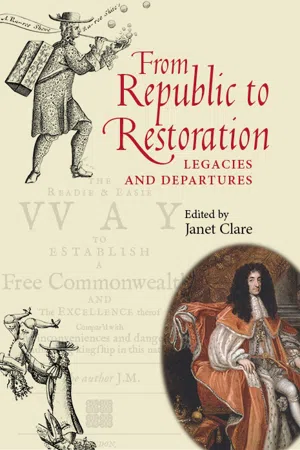
Republic to restoration cuts across artificial divides between periods and disciplines,often imposed for reasons of convenience rather than reality. Challenging the traditional period divide of 1660, essays in this volume explore continuities with the decades of civil war and the Republic, shedding new light on religious, political and cultural conditions before and after the restoration of church and king. Transdisciplinary in conception, it includes essays on political theory, poetry, pamphlets, drama, opera, art, scientific experiment and the Book of Common Prayer.
Essays in the volume variously show how unresolved issues at national and local level, including residual republicanism and religious dissent, were evident in many areas of Restoration life, and were recorded in memoirs, diaries, plays, historical writing, pamphlets and poems. An active promotion of forgetting, and the erasing of memories of the Republic and the reconstruction of the old order did not mend the political, religious and cultural divisions that had opened up during the Civil War. In examining such diverse genres as women's religious and prophetic writings, the publications of the Royal Society, the poetry and prose of Marvell and Milton, plays and opera, court portraiture, contemporary histories of the civil wars, and political cartoons, the volume substantiates its central claim that the Restoration was conditioned by continuity and adaptation of linguistic and artistic discourses.
Republic to restoration will be of significant interest to academic researchers in a wide range of related fields, and especially students and scholars of seventeenth-century literature and history.
- 392 pages
- English
- ePUB (mobile friendly)
- Available on iOS & Android
eBook - ePub
About this book
Information
CHAPTER 1
1660: restoration and revolution1
Blair Worden
On the face of it the restoration of the monarchy in 1660 is not hard to explain. An unforeseen and mostly unwanted civil war had had unforeseen and mostly unwanted consequences. The fracturing of the parliamentarian cause by the regicide; the inability of the regimes of the 1650s to root themselves in public feeling or establish coherent principles of government; their dependence on military rule and on the massive taxation that sustained the army and navy; the powers and intrusiveness of a swollen bureaucracy; the pastoral failures of Puritanism and the obstinacy of alternative social values and ecclesiastical allegiances; the fears and hatreds provoked by religious sectarianism: those liabilities may or may not have been insuperable, but at least we can say that they could not have been overcome without the basis of political stability which Puritan rule failed to secure. The two great works of political theory of the 1650s, Hobbes’s Leviathan and Harrington’s Oceana, offered contrasting answers to the same question: how could the nation escape from its convulsions?
The convulsions multiplied in the last year of the Interregnum, especially after the military coup of October 1659, when the Rump – the regime of 1649–53 which had been expelled by the army but restored by it in May 1659 – was deposed by it for a second time. A severe trading depression, acute problems of poverty, urban tumults and the disruption of the law courts – evils generally blamed on the political disorder – produced a chorus of demands for ‘peace’ and ‘quiet’ and a ‘real, settled, and regular government’.2 The image of tranquillity offered by Harrington appealed to readers who had learned the truth of his assertion that ‘for a nation to be upon the cast of a die, to be ever upon trepidation as to the main chance of government, is a dreadful state of things’.3 The political breakdown heightened two sentiments, anti-sectarianism and anti-militarism. Until its twilight the Cromwellian Protectorate of 1653–59 had curbed the clamour of religious radicalism. After its fall the clamour swelled again, as did the hostility to it and the demand for ecclesiastical regulation. Under the Protectorate military rule had at least kept order. In 1659–60, when the army fell apart, the soldiery became a source of disorder and was increasingly drawn into clashes with the civilian population, especially in those towns and cities which bore the heaviest burdens of military occupation or troop movements or free-quarter.4 Military interventions in politics provoked mounting vilification, particularly in the autumn of 1659, when the committee of safety, the army’s political instrument, ruled with not a vestige of constitutional sanction. Protests multiplied against what George Monck – who by a necessary paradox would use his own military dominance to end the military domination of politics – called ‘that intollerable slavery of a sword goverment’, which ‘I know England cannot, nay, will not indure.’5
Yet it was one thing to seek an exit from chaos and military rule, another to suppose that the Stuart monarchy could provide it. Harrington’s solution was republican, not monarchical. His determinist claim that changes in the balance of social and economic power had consigned the monarchy to the past became ‘very taking’ in the winter of 1659–60 ‘and the more because, as to humane foresight, there was no possibility of the kings returne’.6 In early 1660 Monck used Harrington’s language to explain that any attempt to restore the monarchy would reduce the nation to ruin.7 He also insisted that the proliferation of religious attachments over the past two decades, and the parliamentarian purchases of Crown and Church and royalist lands, had created new ‘interests’ incompatible with the return either of the monarchy or of the episcopal system of Church government that had fallen with it.8 There were other ‘interests’ in the way of a restoration too, among them the takeover of parishes by Puritan from Anglican clergy and, in Ireland, the acquisition of Catholic lands by English parliamentarians.
The last year of Puritan rule may seem to us to have been a helpless slide towards the Restoration. Yet events that in retrospect punctuate the collapse of that rule – the death of Oliver Cromwell, the two restorations of the Rump in 1659, and the brutal suppression of resistance to it in the city of London in February 1660 – seemed at the time, to royalists, to entrench it.9 In early 1660, the newly restored Rump surprised royalists by becoming, in the face of its towering difficulties, a ‘formidable’ body, ‘perfect sovereigns’, governing, at least to appearances, with ‘reputation and triumph’.10 How might the exiled Stuarts, against the might of the Puritan army and navy, hope to regain their throne, or anyway resume it without those dreaded prospects: renewed civil war, invasion by foreign troops, and the further deepening and further prolongation of disorder? It was a common perception that Charles II was attracted to ‘popery’ and that, like his father, he would find a Catholic wife. As the Restoration approached, publicity on his behalf scrambled to portray him, to a readership that knew little of him save through government propaganda against him, as a benign, trustworthy, Protestant figure. It no less urgently disowned the generally remarked and, on the parliamentarian side, widely feared ‘rage’ and taste for ‘revenge’ among the Crown’s followers. Royalism (by which I mean an overriding commitment to the cause of the exiled Stuarts) had become an increasingly conspicuous and restless force at least since the sitting of Richard Cromwell’s Parliament in the spring of 1659. Behind it lay a reaction not only against the Republic but against all Roundhead and Puritan rule. Yet the more assertive it became the greater and wider the anxiety it aroused.
The animating principle that created the impetus towards the Restoration was not royalism. It was the authority of Parliament. Many participants in the Puritan upheaval remarked on the reverence, even ‘idolatry’, commanded by the institution of Parliament, ‘a word’ which, to royalist dismay, ‘carried armies in it’. Royalists who hoped that the perversion of the institution by the rule of the Rump had discredited it were proved wrong.11 Instead the fund of devotion had been enlarged by anti-militarism. Victims of the coup of October 1659 spoke for a wider range of opinion than their own in alleging that it had been intended ‘to affright Englishmen out of their love to (and their very discourse of) a parliament’; to eliminate ‘their hereditary and birth-right privilege of making their own laws’; and to overrule the ‘many thousands’ who ‘know no help, under God, like that of a parliament’.12 Monck shared the outrage.13
In 1659–60 conflicting parties agreed in acknowledging Parliament to be, at least in a time of breakdown and emergency, the arbiter of the nation’s quarrels. The principle supplied a constitutional mechanism, the only one available, for the resolution of the nation’s crisis. If the principle had been unanimously held there would have been no civil war. Many of those who espoused it in 1660 did so solely for tactical reasons. Royalist leaders, having failed to beat parliamentarianism, joined it. Yet the tactic succeeded because of the breadth of public sentiment, wider than the range of party allegiances, to which it appealed. The Restoration was the restoration of Parliament before it was the restoration of the King. Though the first made the second possible, it should not be conflated with it. The first development began on 21 February 1660 with the readmission to the Commons of the ‘secluded members’, those MPs whose participation had been terminated, mostly by force though in many cases by choice, at Pride’s Purge, the military coup of December 1648 that had cleared the way for the regicide and the rule of the Rump. Next the newly reunited Parliament arranged fresh parliamentary elections, which followed its dissolution on 16 March. The result was the Convention which met on 25 April and in May welcomed the King’s return.
The Puritan upheaval could end peacefully only if the two sides that had gone to war in 1642 came together. The heart of the parliamentarian cause had been ‘presbyterian’. The label was applied in 1659–60, with a looseness which for shorthand we must replicate, to parliamentarians who had wanted to limit but also to preserve the monarchy, and whose political programme was allied – sometimes by conviction, sometimes by pragmatism – to an ecclesiastical one that sought the replacement of the episcopal Church by a Calvinist system. Before their eviction by Pride’s Purge in 1648 presbyterians had brought the defeated King to accept conditions that would have subjected him to parliamentary control. After the purge royalists and presbyterians had common enemies, in military, republican and sectarian rule. Neither side could afford to leave the opposition to the Republic, whether military or political, to the other, and so risk its own subjugation in the event of the Republic’s overthrow. Yet the differences between the parties, and the memories of the wars they h...
Table of contents
- Cover
- Half Title
- Title Page
- Copyright Page
- Contents
- List of figures
- List of tables
- List of Contributors
- Acknowledgements
- Introduction: from Republic to Restoration
- Chapter 1 1660: restoration and revolution
- Chapter 2 Monarchy and commonwealth: ‘republican’ defences of monarchy at the Restoration
- Chapter 3 Couplets, commonplaces and the creation of history in The Famous Tragedie of King Charles I (1649) and Cromwell’s Conspiracy (1660)
- Chapter 4 ‘Plots’ and dissent: the abortive Northern Rebellion of 1663
- Chapter 5 Visions of monarchy and magistracy in women’s political writing, 1640–80
- Chapter 6 The battle of the books: the Authorized Version and the Book of Common Prayer at the Restoration
- Chapter 7 Acts of oblivion: reframing drama, 1649–65
- Chapter 8 ‘Far off the public stage’: Marvell’s public and private writings, 1649–65
- Chapter 9 Projecting the Experiment: science and the Restoration
- Chapter 10 The view from the devil’s mountain: Clarendon, Cressy and Hobbes, and the past, present and future of the Church of England
- Chapter 11 ‘The Sport of Bishop-Hunting’: Marvell and the neo-Laudians
- Chapter 12 Choosing a captain back for Egypt: Milton and the Restoration
- Chapter 13 The French connection: luxury, portraiture and the court of Charles II
- Chapter 14 Restoration opera and the failure of patronage
- Chapter 15 ‘The Name of King will light upon a Tarquin’: republicanism, exclusion, and the name of king in Nathaniel Lee’s Lucius Junius Brutus
- Chapter 16 ‘A Child of Heathen Hobbs’: political prints of the Popish Plot and Exclusion Crisis – the revision of a republican mode
- Bibliography
- Index
Trusted by 375,005 students
Access to over 1.5 million titles for a fair monthly price.
Study more efficiently using our study tools.
Frequently asked questions
Yes, you can cancel anytime from the Subscription tab in your account settings on the Perlego website. Your subscription will stay active until the end of your current billing period. Learn how to cancel your subscription
No, books cannot be downloaded as external files, such as PDFs, for use outside of Perlego. However, you can download books within the Perlego app for offline reading on mobile or tablet. Learn how to download books offline
Perlego offers two plans: Essential and Complete
- Essential is ideal for learners and professionals who enjoy exploring a wide range of subjects. Access the Essential Library with 800,000+ trusted titles and best-sellers across business, personal growth, and the humanities. Includes unlimited reading time and Standard Read Aloud voice.
- Complete: Perfect for advanced learners and researchers needing full, unrestricted access. Unlock 1.5M+ books across hundreds of subjects, including academic and specialized titles. The Complete Plan also includes advanced features like Premium Read Aloud and Research Assistant.
We are an online textbook subscription service, where you can get access to an entire online library for less than the price of a single book per month. With over 1.5 million books across 990+ topics, we’ve got you covered! Learn about our mission
Look out for the read-aloud symbol on your next book to see if you can listen to it. The read-aloud tool reads text aloud for you, highlighting the text as it is being read. You can pause it, speed it up and slow it down. Learn more about Read Aloud
Yes! You can use the Perlego app on both iOS and Android devices to read anytime, anywhere — even offline. Perfect for commutes or when you’re on the go.
Please note we cannot support devices running on iOS 13 and Android 7 or earlier. Learn more about using the app
Please note we cannot support devices running on iOS 13 and Android 7 or earlier. Learn more about using the app
Yes, you can access From Republic to Restoration by Janet Clare in PDF and/or ePUB format, as well as other popular books in Literature & European Literary Criticism. We have over 1.5 million books available in our catalogue for you to explore.