How inclusive are NATO and the EU? The enlargement of both organisations seems to give some substance to the vision of a 'Europe whole and free' articulated at the Cold War's end. Yet more recently enlargement's limits have increasingly come to be recognised bringing with it an important debate on the balance to be struck between inclusion and exclusion.
This book examines that sometimes awkward balance. Its analytical starting point is the characterisation of much of Europe as a security community overlain by a system of security governance. The boundary of this system is neither clear nor fixed but a dynamic of inclusion and exclusion can be said to exist by reference to its most concrete expression - that of institutional enlargement. On this basis, the book offers an elaboration of the concept of security governance itself, complemented by a historical survey of the Cold War and its end, the post-Cold War development of NATO and the EU, and case studies of two important 'excluded' states - Russia and Turkey.
- 228 pages
- English
- ePUB (mobile friendly)
- Available on iOS & Android
eBook - ePub
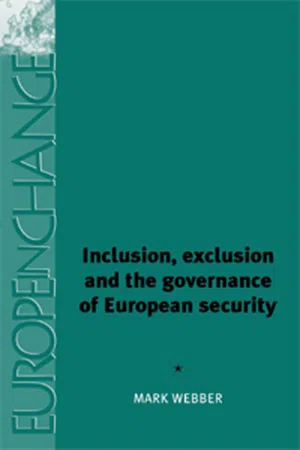
Inclusion, exclusion and the governance of European security
About this book
Information
1
European security and the inclusion/exclusion dynamic
For those fortunate to live in a prosperous democratic state in the first decade of the 2000s, the politics of inclusion seems a natural state of affairs. It is indeed one of the most powerful legitimating claims of democratic political life. The ability to deliver welfare, prosperity and security to all citizens is the premise of successful electoral politics. Similarly, at the international level, the politics of Europe is increasingly the politics of cooperation. The latter, although sometimes taken for granted, might be regarded as truly historic. The history of Europe during the ‘short twentieth century’ was, after all, that of revolution, war and ideological antagonism, bookended by the First World War and, between 1989 and 1991, the triple collapse of the Cold War, communism and the Soviet Union. With the passing of this ‘age of extremes’ in Eric Hobsbawn’s phrase, a Europe of possibilities was opened up.1 This brought with it certain intimations of catastrophe, not least Yugoslavia’s violent collapse, but it also permitted, in the words of another prominent historian, a fundamental rethink of both ‘the common European past’ and ‘a common European future’.2 This was by no means a comfortable process, for it implied that the relatively prosperous West Europeans (and their American allies) would have to come to terms with the uncertain and vulnerable status of their Eastern neighbours, states no longer sectioned off by the Cold War divide and now as important to the future of the continent as they had been before 1939. An important part of the response has been to extend eastward (and latterly, southward) those forms of organisation which had for many decades defined Europe’s Western half and indeed ‘the West’ more broadly. The upshot, the enlargement of both the North Atlantic Treaty Organisation (NATO) and the European Union (EU) had, by the mid-2000s, proceeded to a point where the idea of European unity could, without seeming irony or exaggeration, be talked about as an achievable prospect.
The inclusiveness which this claim implied has, however, been contested. Here it is worth noting a simple but very important point: relations of inclusion, unless they are universal, presuppose some form of simultaneous exclusion. Exclusion, Andrew Linklater has argued, is ‘constitutive of all forms of life [… and] all social systems are constructed from the complex webs of inclusion and exclusion’.3 This is an insight that applies as much to gangs as it does to political parties; to clans, citizenship and ethnic groups as much as military alliances and international organisations. What this book seeks to do is to consider one important aspect of the relationship between inclusion and exclusion, namely how it has been played out in the sphere of international security, how the organisation of security on a European level has developed since the Cold War watershed and what enduring forms of exclusion have remained. While inclusion is important, it is this exclusionary dimension which is given a more prominent treatment, not least in order to provide a corrective to some of the more overblown claims concerning the prospects of European unification.
Part of the purpose of this first chapter is to sketch out some of the themes which ground the book and also to summarise its content. Equally, and by way of orientation, it provides a schematic overview of the book’s central analytical focus. In the following section, two ‘ideal types’ of inclusion and exclusion will be presented as alternative representations of Europe’s security relations. The relationship between these two will then be considered.
Security inclusion
The discourse of inclusion
The historical significance of the end of the Cold War was, in large measure, appreciated by its contemporaries. The Charter of Paris for a New Europe signed by some thirty-four states from across the continent in November 1990 declaimed that ‘[t]he era of confrontation and division of Europe has ended’.4 And at that historical juncture grand visions were elaborated of a unified Europe made possible by the disintegration of the Iron Curtain. For President George Bush Sr this was a Europe ‘whole and free’; for his Soviet counterpart, Mikhail Gorbachev, ‘a common European house’ and for the West German Foreign Minister Hans-Dietrich Genscher, a ‘pan-European cooperative security order’.
What was not readily apparent at the time was that this vision would come to centre on NATO and the EU. However, as the Cold War ended, both bodies laid claim to a pan-European vision (see Chapters 4 and 5) and this would continue to be held as enlargement proceeded. The year 2004 was thus a watershed year in Europe. In March, NATO admitted seven new member states (Bulgaria, Estonia, Latvia, Lithuania, Romania, Slovakia and Slovenia) – ‘[a]n event’, according to Italian Foreign Minister Franco Frattini, ‘that will stand out in the history of […] Europe’ as confirming ‘that the divisions of the past have been overcome’. Or, in the words of Frattini’s Bulgarian counterpart, Solomon Passy, one that brings ‘us ever closer to [a] united democratic Europe without dividing lines’.5 The EU, meanwhile, in May formalised its own ‘big bang’ enlargement with the accession of ten new members (the Czech Republic, Cyprus, Estonia, Hungary, Latvia, Lithuania, Malta, Poland, Slovakia and Slovenia). On this occasion the President of the European Commission Romani Prodi was moved to declare that the event would ‘go down in history as the day of the continent’s unification; when Europe’s decades-long divide was healed; when a dream was realised and a tragic historical absurdity laid to rest’.6
Enlargement (and accompanying forms of partnership with non-members), moreover, had a particular security relevance. A NATO publication in 2002 argued that the organisation was changing from ‘a tightly-knit alliance with responsibility for [the] collective defence [of its members]’ to ‘the dynamo at the hub of a profound new set of security relationships’, ‘an inclusive framework for the Euro-Atlantic area as a whole’.7 Statements emanating from the EU have carried a similar message. Agenda 2000, published by the European Commission in 1997, argued that enlargement would help ‘form Europe into an area of unity and stability’.8 Commenting on the 2004 enlargement Romani Prodi suggested that the EU, founded with the ‘overriding objective’ of eradicating war, had consolidated and extended a ‘Union for peace’ in Europe.9
The demand for inclusion
The credibility of the claims made on behalf of the EU and NATO rest on enlargement and partnership and, in security terms, the functional competence of these two organisations in addressing post-Cold War concerns. What has mattered equally is perceptions held of the organisations. How, in other words, they have been seen by aspirant members as a means of satisfying their security needs.
At the outset, it is worth noting that the power of attraction has been a truly pan-European phenomenon. In the case of NATO, to the seven entrants admitted in 2004 one can add three earlier acceding states (the Czech Republic, Hungary and Poland), three (Albania, Croatia and Macedonia) within the Membership Action Plan (MAP) and a further four (Azerbaijan, Georgia, Moldova and Ukraine) who had by 2004 made a clear political commitment to accession. As for the EU, to the enlargement of 2004 one can add the three states (Austria, Finland and Sweden) involved in the ‘northern’ enlargement of 1995, Bulgaria and Romania who signed accession treaties in 2005, Croatia and Turkey who initiated accession negotiations later the same year, the states of the Western Balkans (Albania, Bosnia-Herzegovina [BiH], Macedonia and Serbia-Montenegro) whose accession has been recognised as a possibility by the EU, and a handful of states (Georgia, Moldova and Ukraine) in the former Soviet Union (FSU) who have made a case for admission.
The differences between these states, coupled with the often overt distinction they have drawn between the attractions of NATO and the EU, mean it is difficult to generalise on the pull of enlargement. Indeed, a wide range of factors has motivated the candidate and new members. Membership has been desired for reasons of economic benefit, political stabilisation and regime consolidation. These factors have a particular resonance for the large number of former communist states all of which have faced profound social, economic and political transition, although even this commonality has only a very general application – the transition in say the East-Central European (ECE)states being very different from that in the Western Balkans, in turn, different from that in the Baltics. And one should bear in mind that transition is not simply a post-communist phenomenon – Turkey since the late 1990s has experienced a transformation arguably as far-reaching as that in many former communist states.
Yet what all these states share is a preoccupation with the insecurities of internal transition. Equally important have been issues of external security. It would be stretching the analysis to argue that the variety of states listed above share the same security problems or that they have a common appreciation of how to address them. The largest group has joined, or has sought to join, both the EU and NATO. Others (Austria, Sweden, Finland, Cyprus, Malta and Serbia-Montenegro) have joined the former (or, in the case of Serbia-Montenegro, aspire to join it) but have not made any movement towards the latter. Turkey, meanwhile has sought to join the EU while already a long-time member of the Alliance. The basic point to be made here, however, is that even allowing for such variety, security broadly understood has been an additional but nonetheless compelling factor behind these different patterns of accession.
In this light, what has been the security context facing these states? Here, the end of the Cold War is crucial. This is a theme we shall return to throughout the text, however, briefly stated, this historical juncture had a profound effect on the security situation of states globally and most notably on Europe’s periphery. For those not already members of NATO and the EU at the Cold War’s end, the effects were particularly urgent. According to Christian Haerpfer and others, during the early 1990s ‘[t]he stability provided by the Cold War [was] replaced by the threat of confusion, disintegration and chaos’, and this was a problem that mattered as much for states such as ‘traditionally neutral Austria as [it did] for the newly emerging [post-communist] democracies’.10 There was, in other words an abundance of insecurity that stretched throughout Central, Eastern and SouthEastern Europe, the South Caucasus (Armenia, Azerbaijan and Georgia), the Baltic region and the Western FSU. This involved at its worst civil war, state collapse and ethnic cleansing in the former Yugoslavia and the South Caucasus, fears of domination by an over-bearing neighbour (be this Germany in the cases of Poland and the Czech Republic, Turkey in the case of Bulgaria, or Russia in the case of Georgia, the Baltic states and Ukraine) and exposure to a multiplicity of security ‘risks’ relating to the emergence of new inter-state borders, the status of national and ethnic minorities, unchecked migration, transnational crime, environmental degradation and terrorism.11
These concerns were, in turn, compounded by what might be called status insecurity, an uncertainty stemming from geopolitical location, the demands of foreign policy reorientation and detachment from international institutions. This condition has taken different forms at different moments in time. Among the ECE states, the anxieties it spawned were at their height in the early 1990s. At this point, the region was characterised as occupying a security vacuum or ‘grey zone’, under-institutionalised and lacking in security guarantees. This zone, moreover, fell within Zwischeneuropa – a ‘Europe in between’ located at the edge of competing spheres of influence (Russian–German traditionally and Soviet–Western after 1945) exposed to invasion, domination and subjugation, and subject, according to Sergei Medvedev, to a ‘geopolitical identity […] based on a cultural duality […] the hope of being accepted into the West and the fear of being dominated by the East’.12
With varying degrees of emphasis, this condition of separation and consequent insecurity has applied throughout the post-communist world, and indeed to most of Europe beyond its integrated Western part. The practical response to these various security predicaments has (as noted above) been a movement toward the EU and NATO. For some, this orientation has been associated with a historical even philosophical claim – the notion of a ‘return to Europe’ articulated in ECE and the Baltic states. For the vast majority it also represents the absence or weakness of meaningful alternatives – be this military self-sufficiency...
Table of contents
- Cover Page
- Title Page
- Copyright Page
- Dedication
- Contents
- List of tables and figures
- Acknowledgements
- List of abbreviations
- 1 European security and the inclusion/exclusion dynamic
- 2 Inclusion, exclusion and the international politics of the Cold War
- 3 Security community and security governance: a framework of inclusion and exclusion
- 4 NATO: ‘a just and lasting peaceful order in Europe’
- 5 The European Union: ‘overcoming the divisions of Europe and restoring the unity of the continent’
- 6 Russia: ‘included out’
- 7 Turkey: ‘neither in nor out’
- 8 Conclusion
- Select bibliography
- Index
Trusted by 375,005 students
Access to over 1.5 million titles for a fair monthly price.
Study more efficiently using our study tools.
Frequently asked questions
Yes, you can cancel anytime from the Subscription tab in your account settings on the Perlego website. Your subscription will stay active until the end of your current billing period. Learn how to cancel your subscription
No, books cannot be downloaded as external files, such as PDFs, for use outside of Perlego. However, you can download books within the Perlego app for offline reading on mobile or tablet. Learn how to download books offline
Perlego offers two plans: Essential and Complete
- Essential is ideal for learners and professionals who enjoy exploring a wide range of subjects. Access the Essential Library with 800,000+ trusted titles and best-sellers across business, personal growth, and the humanities. Includes unlimited reading time and Standard Read Aloud voice.
- Complete: Perfect for advanced learners and researchers needing full, unrestricted access. Unlock 1.5M+ books across hundreds of subjects, including academic and specialized titles. The Complete Plan also includes advanced features like Premium Read Aloud and Research Assistant.
We are an online textbook subscription service, where you can get access to an entire online library for less than the price of a single book per month. With over 1.5 million books across 990+ topics, we’ve got you covered! Learn about our mission
Look out for the read-aloud symbol on your next book to see if you can listen to it. The read-aloud tool reads text aloud for you, highlighting the text as it is being read. You can pause it, speed it up and slow it down. Learn more about Read Aloud
Yes! You can use the Perlego app on both iOS and Android devices to read anytime, anywhere — even offline. Perfect for commutes or when you’re on the go.
Please note we cannot support devices running on iOS 13 and Android 7 or earlier. Learn more about using the app
Please note we cannot support devices running on iOS 13 and Android 7 or earlier. Learn more about using the app
Yes, you can access Inclusion, exclusion and the governance of European security by Mark Webber in PDF and/or ePUB format, as well as other popular books in Politics & International Relations & Film & Video. We have over 1.5 million books available in our catalogue for you to explore.