- 213 pages
- English
- ePUB (mobile friendly)
- Available on iOS & Android
eBook - ePub
About this book
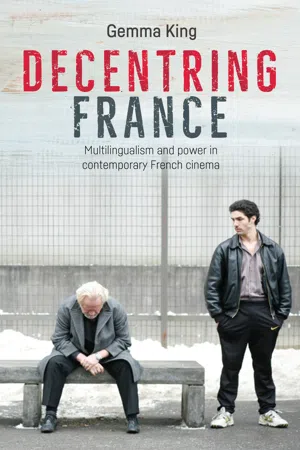
In a world defined by the flow of people, goods and cultures, many contemporary French films explore the multicultural nature of today's France through language. From rival lingua francas such as English to socio-politically marginalised languages such as Arabic or Kurdish, multilingual characters in these films exploit their knowledge of multiple languages, and offer counter-perspectives to dominant ideologies of the role of linguistic diversity in society. Decentring France is the first substantial study of multilingual film in France. Unpacking the power dynamics at play in the dialogue of eight emblematic films, this book argues that many contemporary French films take a new approach to language and power, showing how even the most historically-maligned languages can empower their speakers. This book offers a unique insight to academics and students alike, into the place of language and power in French cinema today.
Information
Publisher
Manchester University PressYear
2017Print ISBN
9781526113580
9781526113573
eBook ISBN
9781526113603
Subtopic
Film & Video1
Introduction
In a dreary Paris office, a Tamil man, woman and child sit across a desk from a French immigration officer. Newly arrived from war-torn Sri Lanka, the family must plead their case for asylum in France. As the man relates his family’s suffering, of how they came to be in Europe and why they deserve asylum, an interpreter of Sri Lankan origin translates his speech from Tamil into French. So begins a crucial scene in Jacques Audiard’s 2015 Palme d’or-winning film, Dheepan.
Unknown to the officer, these three people are not exactly who they claim to be. They had purchased the identity of a murdered family before fleeing Sri Lanka, paying a people smuggler to transport them by boat to India and on to France. They are virtual strangers, three individuals banded together in desperation. Though they are true victims of the Sri Lankan civil war, their stories are murky, their backgrounds mysterious, their identities unknown even to one another. The girl is an anonymous orphan, the woman an unidentified victim of the conflict. The man is a former Tamil general with a controversial history. Each has lost their entire family. Each risks immense danger, and even death, should their application for asylum in France be rejected.Yet this is not the story the man, Dheepan, tells to the immigration officer and the interpreter. ‘I was working for an NGO. I was a journalist and peace activist. The Sri Lankan government accused me of …’ The interpreter stops Dheepan in his tracks. ‘I know your story. The one about you being a peace activist. Did your smuggler feed you that story?’
The refugees have been told that such a sanitary and noble story would be sure to curry favour with the French authorities. But the interpreter has heard this canned response many times, and knows the French officer has as well. In a relaxed, level voice, the interpreter tells Dheepan that to use such a story would be to reveal himself as a liar. In response to the lengthy, untranslated exchange, the French officer interjects and asks what is being said. The interpreter feigns confusion, explaining that he doesn’t understand, implying differences in dialect between the two men. He asks Dheepan his true name, and when Dheepan responds Savidhasan, it becomes clear the interpreter has heard of him. Taken aback, he exclaims, ‘I thought you were dead.’ However, the officer has picked up on the word ‘Savidhasan’ and asks its meaning. Without missing a beat, the interpreter tells him Savidhasan is the name of the family’s home village in Sri Lanka. He then concocts a more convincing story for Dheepan to use, insisting he will have more success with the grittier tale. ‘Say that the Tigers recruited you by force, that the Sri Lankan army captured and tortured you and that they tried to kill you.’ The interpreter then relays the story in French. The asylum request is granted.
This scene presents a rich and complex picture of language relations. Of course, in a legal sense, the French immigration officer is the individual with the institutional power to accept or reject Dheepan and his family’s claim for asylum; to allow or deny them legal admittance into the French nation. Yet the interpreter, the only person in the room who is fluent in both French and Tamil, is able to control the situation in a unique way, to place the family in an advantageous position and to concoct a narrative designed to ensure their acceptance into France. In this situation, the ability to speak multiple languages is a distinct advantage. The Tamil language becomes a disguise the interpreter can exploit in order to protect his fellow compatriots, and a tool for controlling the outcome of the exchange.
In Dheepan, language is a barrier between monolingual groups, and a challenge for the film’s Sri Lankan characters to surmount. Monolingualism (in either Tamil or French) is a hindrance to social interaction, and even what Claire Kramsch calls a ‘handicap’ (2006: 102) preventing cultural integration. Yet multilingualism – the ability to learn, use and transition among multiple languages – is an opportunity. This scene, and the film in general, is about cultural difference, language barriers, the politics of migration, tensions between the First and Third worlds, the moral ambiguity of war and the trauma of displacement. But it is also about social power, as enacted through strategic use of language.
In a cinematic landscape increasingly characterised by multiculturalism and linguistic diversity, a number of contemporary French films are beginning to represent multilingualism as a means of attaining and exerting social power. In multilingual film, language functions not only as a vessel of meaning, but also as a loaded and complex tool. Characters actively exploit their multilingualism in order to exert symbolic power: they may switch into a language other characters cannot understand to conspire, exclude or intimidate, or flaunt their competence in a certain language to gain access to a particular cultural group. Language learning expands characters’ skill sets and opens up new possibilities for accessing knowledge and control. Beyond the inclusion of languages other than French in film dialogue, this phenomenon is remarkable for its foregrounding of language not only as a theme or narrative device, but as a weapon to be harnessed and deployed in the pursuit of power.
In contrast to more traditional, twentieth-century portrayals of multilingualism, contemporary French multilingual films often portray language difference as a narrative device in itself, and a means of obtaining and wielding influence over others.The twenty-first-century French cultural landscape is one shaped by globalisation and postcoloniality. As migration towards metropolitan France booms, postcolonial legacies continue to make themselves felt in social, cultural and economic contexts, cities strain under the weight of tensions between urban centre and fractured periphery, the global refugee crisis intensifies, Paris reels from unprecedented terrorist attacks and the European Union struggles to maintain and define itself, language is coming to the forefront of cinematic representations of multicultural France. Contemporary French films frequently concern themselves with spaces of social and cultural tensions, with what Mary-Louise Pratt calls ‘contact zones’: ‘social spaces where cultures meet, clash, and grapple with each other, often in contexts of asymmetrical relations of power, such as colonialism, slavery, or their aftermaths as they are lived out in many parts of the world today’ (1991: 34). In the language contact zones of locations like Paris, other large cities like Lyons and Marseilles, the port regions of the English Channel and the Mediterranean, cross-cultural international spaces like other European cities or former French colonies and the banlieues in which many communities of international origin or background reside, multilingualism is a fact of everyday life, and many contemporary French films investigate these loaded spaces with and through language.
Despite depicting a more realistic cultural and linguistic landscape than many monolingual films, multilingual dialogue is not only included in contemporary films as a means of representing realism, and language choice is rarely arbitrary. Instead, multilingualism is a central thematic concern and, frequently, a plot device in itself. As Carol O’Sullivan explains, ‘subtitled foreign dialogue is no longer used merely as ornament, to mark location or nationality, but becomes a vehicle for plot and character development’ (2008: 84). Languages are not simply modes of communication, but sociocultural elements and tools that can be used to exert authority, infiltrate cultural groups and manipulate others. In a wide range of situations, the ability to understand and speak multiple languages, and especially the ability to move strategically among multiple languages, is of distinct benefit to even the most marginalised characters. Knowledge of French is essential, but knowledge of other languages, from English to Arabic to Bambara and beyond, is not a hindrance, a disadvantage or a point of shame, but an asset, an advantage and an opportunity. Thus, contemporary French multilingual film places the relationship between multilingualism and power at its core.
Beginning in the early twenty-first century and flourishing from approximately 2005 onwards, multilingual cinema is an increasingly prevalent phenomenon in French film. This book is the first sustained project to map out and analyse this rich group of films, using transnational film discourse to focus critical attention on eight core case studies ranging in date from 2007 to 2015. This book is informed by Foucault’s vision of power as ‘strategy’ from his 1976 Histoire de la sexualité I, and by the theoretical framework of Ella Shohat and Robert Stam’s polycentric multiculturalism, which ‘is about dispersing power, about empowering the disempowered, about transforming subordinate institutions and discourses’ (1994: 48–9). It approaches contemporary French multilingual films from a non-hierarchical, non-Eurocentric perspective, in order to uncover the many possible fields of social power at play in multilingual scenes. This cinema does not ignore the imbalances of social power that continue to impact multicultural communities in contemporary France. In his manifesto ‘Cinéma-monde?’ Bill Marshall points out that polycentric multicultural theory ‘does not elide the inequality of media power relations, but places them in a recognised and often contradictory plurality’ (2012: 37). Instead, within this inherently imbalanced historical context, it envisions multilingual interaction as being driven by ‘a systematic principle of differentiation, relationality, and linkage [in which] no single community or part of the world, whatever its economic or social power, is epistemologically privileged’ (Shohat and Stam 1994: 48). When examined from this standpoint, the power relations at play in dialogue between, for example, French and Tamil characters (as in Dheepan) or Guernsian francophone and Malian francophone characters (as in Rachid Bouchareb’s London River) reveal themselves to be far more complex than a Eurocentric standpoint might reveal. According to Jan Blommaert’s conception of language and globalisation, ‘authority emanates from real or perceived “centres”, to which people orient when they produce an individual trajectory in semiosis’ (2010: 39). Contemporary French multilingual films resist monopolistic centrings of authority and situate multiple language use within correspondingly polycentric French and global spaces.
Films such as Polisse (Maïwenn 2011), Entre les murs (Laurent Cantet 2008), Un prophète (Jacques Audiard 2009), Dheepan (Jacques Audiard 2015), Welcome (Philippe Lioret 2009), La Graine et le mulet (Abdellatif Kechiche 2007), London River (Rachid Bouchareb 2009) and Des hommes et des dieux (Xavier Beauvois 2010) thus re-envision the role multilingualism has to play in contemporary French culture. In her analysis of beur and other multicultural French films, Carrie Tarr writes that films can ‘destabilize and rearticulate the “national” of French cinema, and invite spectators to acknowledge the multicultural nature of contemporary, postcolonial French society’ (2009: 291). Engaging with the work of French and transnational film scholars like Tarr, this book delves into the above eight films to investigate their representation of multilingualism in the contemporary universe and how they show the potential for languages to afford social power. Subsequently, the book will reveal how these films are emblematic not only of how multilingualism is being foregrounded, but of how the once-monopolistic role of the French language is being revised in French film.
Historically, languages other than French have occupied a marginal position in French cinema, besides a handful of exceptions such as Jean Renoir’s 1937 La Grande Illusion or Jean-Luc Godard’s 1963 Le Mépris. Despite the many historical periods of multilingualism which have marked French history, including colonisation and decolonisation, the First and Second World Wars and the large-scale migration waves of the twentieth century, the vast majority of French cinema has been monolingual. When other languages began to appear on the French screen in far greater numbers in the 1980s, they found themselves locked into a sociolinguistic hierarchy. In these films of the 1980s and 1990s, languages associated with colonisation or immigration are portrayed as dominated by French, isolating, undesirable or even endangering. If languages other than French do appear in earlier films, they are usually relegated to background noise and unsubtitled, stripped of their semantic meaning. Characters who elect to speak in a language such as Turkish or Arabic are frequently maligned, and those who fail to learn French invariably suffer. Language learning may occur in such films, but this usually involves migrant characters learning French to survive. The acquisition of new language by French characters is generally limited to other Western European tongues, such as Italian or English, and even then remains quite rare.
In contrast, in post-2005 cinema, multilingualism does not merely function as a secondary, trivial or decorative element. Instead, language is a central narrative component, a ‘thematic fulcrum’ (Gramling 2010: 353) and a means of establishing authority, gaining leverage or exerting control. The characters of these films knowingly exploit their multilingualism in order to exclude, infiltrate, negotiate, persuade or manipulate others. Sequences depicting interpreting and translation, language classes, individual or informal language learning, cross-cultural intimate relationships, conflicts between different cultural groups (including between religious and political factions), intertextuality and code-switching are at the heart of these films, revealing complex social hierarchies among characters. Inevitably, these hierarchies reveal themselves along class-based, racial, sociocultural, politicised, gendered and (post)colonial lines. However, such hierarchies do not remain fixed and multilingualism is not a static attribute of these films. It is used by characters, even those in a position of submission or oppression, in order to renegotiate hierarchical relations. Reflecting Claire Kramsch’s scholarship on critical multilingualism, such films ‘diversify the notion of communicative competence and empower multilingual speakers to use language in ways that might differ from those of monolingual speakers’ (2012: 116). Thus, in a fresh and innovative way rarely seen in French cinema prior to the contemporary period, multilingual French films do not cement their characters in immovable power structures, but equip them with tools to reshape them.
Multilingualism, French cinema and power
This book investigates a phenomenon that finds itself at the nexus of three fundamental terms: multilingualism, French cinema and power. The following sets out the field of study for this book, and the ways in which I propose to approach the complementary concepts of multilingualism, cinema and power.
Multilingualism
On the most basic level, the term ‘multilingual cinema’ refers to films whose dialogue is composed of several languages. However, it would seem absurd to label a film which includes a smattering of words or phrases in a different language (a ‘bonjour’ or an ‘Inch’Allah’ uttered here and there, without any full multilingual sentences or conversations)...
Table of contents
- Cover
- Half Title
- Title Page
- Copyright
- Contents
- List of figures
- Acknowledgements
- List of abbreviations
- Note on translations
- 1 Introduction
- 2 A brief history of multilingualism in French cinema
- 3 Decentred perspectives: case studies
- 4 Capital centres: Polisse and Entre les murs
- 5 Urban margins: Un prophète and Dheepan
- 6 Coastal borders: Welcome and La Graine et le mulet
- 7 International spaces: London River and Des hommes et des dieux
- 8 Conclusion
- Appendices
- Filmography
- References
- Index
Trusted by 375,005 students
Access to over 1.5 million titles for a fair monthly price.
Study more efficiently using our study tools.
Frequently asked questions
Yes, you can cancel anytime from the Subscription tab in your account settings on the Perlego website. Your subscription will stay active until the end of your current billing period. Learn how to cancel your subscription
No, books cannot be downloaded as external files, such as PDFs, for use outside of Perlego. However, you can download books within the Perlego app for offline reading on mobile or tablet. Learn how to download books offline
Perlego offers two plans: Essential and Complete
- Essential is ideal for learners and professionals who enjoy exploring a wide range of subjects. Access the Essential Library with 800,000+ trusted titles and best-sellers across business, personal growth, and the humanities. Includes unlimited reading time and Standard Read Aloud voice.
- Complete: Perfect for advanced learners and researchers needing full, unrestricted access. Unlock 1.5M+ books across hundreds of subjects, including academic and specialized titles. The Complete Plan also includes advanced features like Premium Read Aloud and Research Assistant.
We are an online textbook subscription service, where you can get access to an entire online library for less than the price of a single book per month. With over 1.5 million books across 990+ topics, we’ve got you covered! Learn about our mission
Look out for the read-aloud symbol on your next book to see if you can listen to it. The read-aloud tool reads text aloud for you, highlighting the text as it is being read. You can pause it, speed it up and slow it down. Learn more about Read Aloud
Yes! You can use the Perlego app on both iOS and Android devices to read anytime, anywhere — even offline. Perfect for commutes or when you’re on the go.
Please note we cannot support devices running on iOS 13 and Android 7 or earlier. Learn more about using the app
Please note we cannot support devices running on iOS 13 and Android 7 or earlier. Learn more about using the app
Yes, you can access Decentring France by Gemma King in PDF and/or ePUB format, as well as other popular books in Media & Performing Arts & Film & Video. We have over 1.5 million books available in our catalogue for you to explore.