This book brings together for the first time five French directors who have established themselves as among the most exciting and significant working today: Bruno Dumont, Robert Guédiguian, Laurent Cantet, Abdellatif Kechiche, and Claire Denis. Whatever their chosen habitats or shifting terrains, each of these highly distinctive auteurs has developed unique strategies of representation and framing that reflect a profound investment in the geophysical world.
The book proposes that we think about cinematographic space in its many different forms simultaneously (screenspace, landscape, narrative space, soundscape, spectatorial space). Through a series of close and original readings of selected films, it posits a new 'space of the cinematic subject'.
Accessible and wide-ranging, this volume opens up new areas of critical enquiry in the expanding interdisciplinary field of space studies. It will be of immediate interest to students and researchers working not only in film studies and film philosophy, but also in French/Francophone studies, postcolonial studies, gender and cultural studies.
Listen to James S. Williams speaking about his book http://bit.ly/13xCGZN. (Copy and paste the link into your browser)
- 333 pages
- English
- ePUB (mobile friendly)
- Available on iOS & Android
eBook - ePub
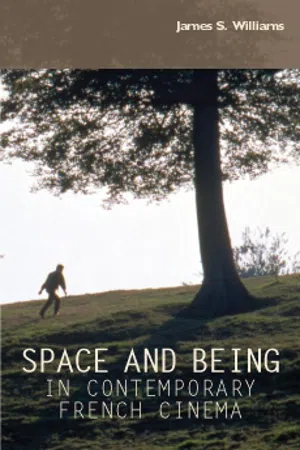
Space and being in contemporary French cinema
About this book
Information
Publisher
Manchester University PressYear
2015Print ISBN
9781784993788
9780719084324
eBook ISBN
9781526102225
Subtopic
English Literary Criticism1
Space, cinema, being
Space, vast space, is the friend of being.
(G. Bachelard)
Space is to place as eternity is to time
(J. Joubert)
Space in cinema
The great American film critic Manny Farber memorably declared space to be the most dramatic stylistic entity in the visual arts – from Giotto to Kenneth Noland, from Intolerance to Week-end (Farber 1998: 3). He posited three primary types of space in fiction cinema: the field of the screen, the psychological space of the actor, and the area of experience and geography that the film covers (ibid.). Yet putting aside for a moment the particular spatial demands of character and plot, what exactly is cinematic space? It appears an impossibly vast realm, encompassing both mechanically reproduced external space and the artistic means of representing it. Mise-en-scène, or the composition and articulation of cinematic space, covers potentially everything in the staging of a shot, from the disposition of the actors to the arrangement of the décor and props, the placement of cameras, lighting, and the use of different lenses and film stock. The always magical process whereby real physical space (the setting) is reborn as fictional, two-dimensional cinematic space generates a panorama of spatial forms defined by differences in size, depth, design, angle, proximity, density, colour, contrast and proportion. In his seminal 1982 study of sentiment and affect in the cinema, which examines in detail the emotional implications of different effects and processes, Charles Affron presented a rich typology of screenspaces and spatial codes, from deep space and camera movement to spatial locus, focal length, the formal act of framing, photographic portraiture imposing stasis, protracted shots, and so on (see Affron 1982). Such an array of spatial techniques can assert the integrity of aesthetic space and cause it to expand and reverberate, whether, for example, in the manipulation of focal distance (the movement, say, from extreme close-up to far long-shot, and its reverse) or by means of devices such as superimposition, which can bring different spaces and realities together and allow them mutually to coalesce in temporary osmosis. This has led another critic, Stephen Heath, to refer to space as the ‘superior unity’ that ties a film to its spectator. He highlights the specificity and contingency of places and bodies in narrative cinema and its binding mechanisms such as the 180º rule (Heath 1981: 40).
Cinema is, of course, simultaneously an art of space and of time. A moving body occupies space, yet these spaces are not fixed moments but acts of duration, or space-in-time, recorded and projected in the classic celluloid format at a speed of twenty-four frames per second. The moving body thus succeeds in ‘being’ (spatial) and ‘becoming’ (temporal) by expressing duration, with time and space collapsing together to form a moving present. Or, put another way, place functions as the common denominator of movement (across) and duration (within). For this reason, space is intrinsically linked to time in cinema, and their combined effect as coterminous forces has given rise to some of French cinema’s most original achievements, from the extensive investigations in space-time by Jean Cocteau, for whom temporal perspectives obeyed the same relative rules as those of space, to the modernist deployment of space and time by Agnès Varda, Alain Resnais, Marguerite Duras, Chris Marker, Jean-Luc Godard and Chantal Akerman (to name just a few). One thinks in particular of Varda’s Cléo de 5 à 7/Cleo from 5 to 7 (1962), a pioneering experiment in female flânerie and ‘real time’, as well as of Krzysztof Kieślowski’s dazzling exploration of the virtual possibilities of time and parallel worlds in La Double vie de Véronique/The Double Life of Veronique (1991). The expansion and unification of cinematic space in and through time are central to our experience of film’s spatial dynamics.
I wish to acknowledge from the outset that cinema, in its physical latitude and plastic extension, offers a unique sensation of spatial freedom on a level at once perceptual, intellectual and affective. For a permanent sense of movement is created by the mobile, material process of passing through multiple planes and spatial axes (left to right, top to bottom, across the frame, etc.), which are also different temporalities. Moreover, cinema is a medium that allows us exceptionally to shift back and forth between subjective and objective worlds, such that internal, mental moments can become external, and vice versa. The potential for such interspaces appears limitless. Indeed, the arrangement of subjective and objective point-of-view shots and reverse-field shots in montage opens up the possibility of constantly moving between different levels of reality and consciousness, or ‘virtual’ states of being. The formal dialectics of inside and outside, of intimate proximity and distant isolation, of the private and impersonal, is often intensified by the changing status of represented physical space as either outside and exposed, or inside and enclosed. Further, configurations of subjective and objective points of view do not always require a strictly subjective shot, because the exclusive close focus on one character moving through screenspace can itself often function as an implied subjective point of view. Such privileged experiential movement, provoking at times an exhilarating, even subversive, illusion of unboundedness, naturally carries certain limits, as, for instance, when continuous space suddenly becomes discontinuous through editing, or when the apparent promise of spectatorial identification and unstoppable access into a character’s subjective space is peremptorily thwarted by the film’s withdrawal into another type of objective space and the threat of opacity is renewed (for instance, the spatially disruptive use of flashbacks which thrust past moments within a diegetical present).
To take the particular case of framing: there is always a structural tension between the profilmic field (the ‘real’ space being photographed) and the cinematic space of the frame which serves as a marker of spatial difference between what is included (and therefore intrinsic) and what is omitted (extrinsic). Yet it is precisely because frame selection can convey point of view as well as metaphorical meaning that framing can become an expressive tool of cinematic narration rather than merely a receptacle for the reproduction of reality. The creative potential of such a resource has inspired Des O’Rawe to propose a poetics of the frame, ranging from the ‘indiscernible’ (as in the ‘frameless framing’ of mainstream cinema) to the figurative, aleatory and reflexive. O’Rawe contrasts the austere, minimalist framing of Michelangelo Antonioni, who crafts an evasive, detached and seemingly autonomous frame to signify emptiness and alienation, with more expressionistic styles of framing where the effects of infinite regress in mise en abyme (for instance, the ‘virtual space’ created by mirrors drawing our attention to perpetually extended depth) can be compounded by framing to create a kind of ‘double framing’, or encadrement en abyme (see O’Rawe 2011).
However, space is not only what we glimpse within the immediate, provisional frame, whether fixed or mobile, but also what lies outside it. Off-screen space (or ‘blind space’) exists in the diegesis but is not visible in the frame, thus producing a distinction between onstage and offstage. For the filmmaker Jean-Louis Comolli, the continually restless hors-champ, whereby what is inside an image can leave it and what is outside can enter it, gestures always towards the world of the imaginary. It is, according to Comolli, what makes cinema such an original invention compared with other art forms. This conjunction of two separate yet interconnected spaces imposes itself even in the current era of digital imagery because, as Comolli notes, it cannot simply be ‘recycled’ (Gorce 1994: 34–5). Within this formal dramatics of space, place resides on multiple spatio-temporal registers, whether its own distinct world which exceeds the film frame, or a world furnished for our immersed view, or a sphere in tension between the two. It is not just that cinematic space is always in potential expansion: the ‘transspatial’ zone of the hors-champ is a flux that can threaten our ability to locate the image and ourselves in relation to it (we shall consider the implications of this shortly).
So far I have confined myself largely to visual space, yet filmic space covers a range of sensory fields that are equally integral to its coherency. As Thomas Elsaesser and Malte Hagener have recently emphasised, sound is a pre-eminently spatial phenomenon in the cinema and constitutes a ‘third dimension’ (Elsaesser and Hagener 2010: 137). It, too, can move between interior and exterior, as between the diegetic and the non-diegetic (voice-over commentary, musical underscoring, etc.), to create what Robynn Stilwell has proposed very suggestively as a ‘fantastical gap’ (Stilwell 2007: 187). This is part of a larger gap formalised by Michel Chion between the visualised zone of on-screen sound (that is, sound whose source appears in the image and belongs to the reality represented therein) and the ‘acousmatic’ zones of off-screen sound where the source is hidden or invisible, whether temporarily or not.1 These general distinctions still remain valid despite the many recent advances in multi-track sound which now constitutes a quasi-autonomous ‘superfield’ (Chion 1990). The result is a fluid set of inner and outer sonic and auditory spaces, making hearing a multidimensional, acoustic space (what Mary Ann Doane has called the ‘sonorous envelope provided by the theatrical space’ (Doane 1985: 171)). Increasing the volume of sound, as in audio close-ups, or rendering sound ‘interior’ through the use of voice-over, creates new volumes of space and new levels of consciousness and affect within the film. This takes us into Maurice Merleau-Ponty’s phenomenal world of embodied perception and existential space (see Merleau-Ponty 1945), one of the key points of reference for Laura U. Marks’s influential theory of filmic touch and ‘haptic vision’. Marks argues that the material experience of touch, taste and smell in cinema may be a new vehicle of knowledge, beauty and even ethics since proximal senses operate as a membrane between the sensible and the thinkable (see Marks 2000 and 2002). In the same vein, in Cinema and Sensation (2007), a study of the physical nature of film and the viewing experience in contemporary French film, Martine Beugnet suggests that to experience cinema as a physical and multisensory embodiment of culture is to participate in sensual perception and a form of spectatorship alive to the sensory qualities and textures of the moving image. Again, we are dealing with the movement between inside and outside space, for certain films construct haptic modes of vision that destabilise our common apprehension of the relationship between the subjective body and the objective world (see Beugnet 2007: 63–124).
Of course, as Deborah Thomas reminds us in a very different discussion of film spectatorship in classic Hollywood cinema, the viewer is positioned at the boundary produced by the screen (or by the extended virtual screen) and thus, ultimately, always spatially excluded from the film’s narrative world. Even within subjective point-of-view shots, a sense of differentiation pertains and an imaginary space is formed between ‘us’ and the characters, though without this necessarily forcing us to relinquish access to their visual field (Thomas 2001: 114). Hence, just as the characters can inhabit an ‘ontological borderland between diegetic and non-diegetic spaces’, so, too, the viewer exists neither wholly within, nor completely outside, the narrative world (ibid.: 113–14). Taken together, however, the multiple fields of cinematic space I have enumerated constitute a living, breathing, contrapuntal process of drives, rhythms and counter-rhythms: of waves and surges, booms and retreats, cycles and repetitions, echoes and velocities, detours and divagations, exits and re-entries. The immersive and transformational nature of this multi-levelled spectatorial experience of cinematic space has been well captured by Daniel Yacavone in his developing theory of ‘film worlds’, which recognises both the symbolic and cognitive nature of films and their worlds, and their experiential, affective immediacy and presence (Yacavone 2008: 105). Drawing in particular on Mikel Dufrenne’s The Phenomenology of Aesthetic Experience (1953), Yacavone conceives of film worlds as intercinematic ‘object-experiences’ with a particular internal coherence intuited by the viewer (ibid.: 101), the essential duality of which may be described in terms of the polarities of external/internal, objective/subjective, representational/expressive, ontological/phenomenological (ibid.: 105). Yacavone endorses Merleau-Ponty’s idea of the intersubjective field of perception and action, citing him thus: ‘in the perception of another, I find myself in relation with another “myself”, who is, in principle, open to the same truths as I am, in relation to the same being that I am’ (Yacavone 2006: 92–3).2 By its very nature film has the potential to dramatise the dynamic field of perception as the ‘commingling of consciousness with the world, its involvement in a body, and its co-existence with others’ (Merleau-Ponty 1964b: 59). Yacavone argues persuasively that ‘by putting us into imaginative contact with lives, situations and forms of being-in-the-world other than our own, representational works of art can cultivate empathetic understanding, a recognition of the shared ground of being’ (Yacavone 2006: 93).
The intersubjective ‘live’ spaces formed between a film in process, its real (or implied) viewer, and its real (or implied) author, are necessarily shifting, contingent and constructed. For cinema is always experienced in a specific place at a particular time, and the creation of new worlds of meaning and affectivities within the work is matched by what takes place during the actual viewing encounter (what Roland Barthes called the personal ‘situation de cinéma’) which comprises desires, projections and fantasies relating even to the material set-up of the auditorium.3 In fact, the screen is transformed into what Dudley Andrew terms, with particular reference to André Bazin, a concrete ‘threshold’ through which the viewer passes on the way to visual experience. In the classic model of public film-viewing there are always two projections: one ‘filtered’ by the author-filmmaker, the other ‘filled’ by the spectator who projects him/herself towards the screen, thus taking the film into unforeseen networks (see Andrew 2010: 79–90). Cinema is literally a ‘project’ taking place inside the threshold of the screen which disrupts the film’s framing, understood in general thematic terms as the ‘design of its emplotment’, or the way ‘a view, a situation, a story, or an argument is framed when pertinent elements are taken together as a set, so that the position and function of all elements mutually determine one another in relation to the world’ (ibid.: 91). The porous screen becomes ‘the unstable meeting place on which are projected fragments of unlimited worlds from both directions’ (ibid.). As such, the screen overrides the ‘grip’ of the frame – what André Bazin, who prized the plenitude of the photographed real world, regarded as the hostile agent of spatial difference and exclusion, and what 1970s’ framing theory, focused on the materiality of film, sought to demystify and expose as the fixed ideological framing of perception.4
The composite viewing experience of cinematic space as material form, and the drama of how we orient ourselves in relation to reproduced sound and the projected moving image, set in motion different kinds of perception and subjectivity that are always in transition. Moreover, in its infinite variety and transformability, filmic space enables us to conceive of new forms of relations with the world and draws us into new kinds of sensory and existential zone, including that of free-floating memory. As Isabelle McNeill eloquently writes: ‘Cinema, with its capacity for instability and errancy, offers a potential flânerie in which the viewer can be conducted into a past not his or her own’ (McNeill 2010a: 45). I want to suggest in what follows, where I aim to give critical space to all forms of cinematic space and spatial enquiry, that the formation of new spatial thresholds generates, in turn, potential new sites and possibilities for understanding human relations and existence. Indeed, I will argue that the extensibility of cinematic space reveals new aesthetic dimensions of being, and that cinema is truly cinema only when it fully exploits its spatial potential and takes us to new and unguessed spaces, at once formal, imaginary and real.
Space in modern French thought
Up to now I have used the terms ‘space’ and ‘place’ as virtually interchangeable. Yet the distinction between the two has been a central concern of much recent French thought. It is vital for any extended discussion of modern French cinema to acknowledge fully the evolution in thinking about space, the influence of which extends far beyond the simple theorising of cinematic space in linguistic terms (for example, André Gardies’s assertion that filmic space requires a decoding of place as the ‘text of space’, with place serving as the texte/parole of a langue constituted by space (see Gardies 1993)). In his landmark 1974 work, The Production of...
Table of contents
- Cover
- Half Title Page
- Title Page
- Copyright Page
- Contents
- List of illustrations
- Acknowledgements
- Preface: Making space
- 1. Space, cinema, being
- 2. Topographies of being: space, sensation, and spectatorship in the films of Bruno Dumont
- 3. Requiem for a city: the symbolics of space in the cinema of Robert Guédiguian
- 4. Heading nowhere: framing space and social exclusion in the films of Laurent Cantet
- 5. Re-siting the Republic: Abdellatif Kechiche and the politics of reappropriation and renewal
- 6. Beyond the Other: grafting space and human relations in the trans-cinema of Claire Denis
- 7. In lieu of a conclusion
- Bibliography
- Select Filmography
- Index
Trusted by 375,005 students
Access to over 1.5 million titles for a fair monthly price.
Study more efficiently using our study tools.
Frequently asked questions
Yes, you can cancel anytime from the Subscription tab in your account settings on the Perlego website. Your subscription will stay active until the end of your current billing period. Learn how to cancel your subscription
No, books cannot be downloaded as external files, such as PDFs, for use outside of Perlego. However, you can download books within the Perlego app for offline reading on mobile or tablet. Learn how to download books offline
Perlego offers two plans: Essential and Complete
- Essential is ideal for learners and professionals who enjoy exploring a wide range of subjects. Access the Essential Library with 800,000+ trusted titles and best-sellers across business, personal growth, and the humanities. Includes unlimited reading time and Standard Read Aloud voice.
- Complete: Perfect for advanced learners and researchers needing full, unrestricted access. Unlock 1.5M+ books across hundreds of subjects, including academic and specialized titles. The Complete Plan also includes advanced features like Premium Read Aloud and Research Assistant.
We are an online textbook subscription service, where you can get access to an entire online library for less than the price of a single book per month. With over 1.5 million books across 990+ topics, we’ve got you covered! Learn about our mission
Look out for the read-aloud symbol on your next book to see if you can listen to it. The read-aloud tool reads text aloud for you, highlighting the text as it is being read. You can pause it, speed it up and slow it down. Learn more about Read Aloud
Yes! You can use the Perlego app on both iOS and Android devices to read anytime, anywhere — even offline. Perfect for commutes or when you’re on the go.
Please note we cannot support devices running on iOS 13 and Android 7 or earlier. Learn more about using the app
Please note we cannot support devices running on iOS 13 and Android 7 or earlier. Learn more about using the app
Yes, you can access Space and being in contemporary French cinema by James S. Williams in PDF and/or ePUB format, as well as other popular books in Media & Performing Arts & English Literary Criticism. We have over 1.5 million books available in our catalogue for you to explore.