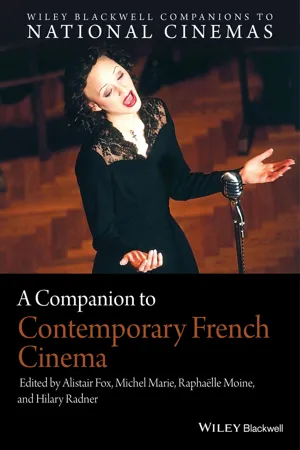
A Companion to Contemporary French Cinema presents a comprehensive collection of original essays addressing all aspects of French cinema from 1990 to the present day. Featuring contributions from an international cast of established and emerging scholars of French cinema, these innovative essays highlight the diversity of French films and filmmaking techniques that have emerged since the New Wave era. Themes and topics covered include the social, political, and cultural contexts of recent French cinema; contemporary filmmakers and performers; genres, cycles, and cinematic forms; gender and sexuality; and emerging trends and innovative new filmmaking forms. Among the French films examined in depth are hit comedies including Bienvenue chez les Ch'tis and Intouchables, blockbusters such as The Crimson Rivers, police films like 36th Precinct, historical films such as Farewell My Queen and Days of Glory, celebrated animated features such as Kirikou and the Sorceress, films representative of the "new French extreme," such as Romance, Baisemoi, and Trouble Every Day, and numerous auteur films ranging from Bruno Dumont's Hors Satan and François Ozon's shorts to Pascale Ferran's Lady Chatterley and Alain Guiraudie's L'Inconnu du lac. Combining cutting-edge scholarship with wide-ranging methodological approaches and perspectives, A Companion to Contemporary French Cinema is an invaluable resource for students and scholars of French film, as well as all those interested in the evolution of this celebrated cinematic tradition.
eBook - ePub
A Companion to Contemporary French Cinema
- English
- ePUB (mobile friendly)
- Available on iOS & Android
eBook - ePub
A Companion to Contemporary French Cinema
About this book
A Companion to Contemporary French Cinema
Information
Part I
Economic, Institutional, and Political Contexts
1
The Political Economy of French Cinema
Attendance and Movie Theaters
Laurent Creton
In France, cinema has a special status, manifest in a centrality that seems to persist, and also a kind of sacralization. In accordance with the tradition of the enthusiasts who have contributed to its elevation to the status of the seventh art, it is inseparable from its aura, from film criticism, from the simmering debates that it arouses, from the ceremonies that glorify it, and from the whole media set-up that ensures its promotion to a large audience. In most other countries, cinephilia has not exerted such a powerful influence, and, in most cases, cinema is viewed mainly as a mere entertainment. Such a divergence in assumptions is responsible for the lack of mutual comprehension that has arisen between the different parties involved in international debates concerning the “cultural exception,” with one party referring to an art and culture that is considered distinctive and specific, and the other invoking the rules of the World Trade Organization as needing to be applied to all goods.
Another domain in which France constitutes a unique point of reference comprises its institutional and regulatory arrangements for the support of cinematic activities. Often, however, these policies are reduced to the famous “avance sur recettes,” to the corresponding cultural and artistic ambitions, and to the promotion of a distinctive auteur cinema (cinéma d’auteur) since the 1960s.1 Certainly, this system continues to encompass provisions that, beyond automatic grants based on past successes, have put in place selective advances determined according to quality criteria relating to the nature of the work, its inventiveness, its originality, and the degree to which it displays “auteurity,” but it is the set of arrangements in their totality that one needs to consider. They cover, in fact, both cinema and the audiovisual; they involve the organization of the relations between different stages in the cinematic industry (production, distribution, and exploitation), and also between the closely related sectors comprising the professions that deal with the image and sound.2
Contrary to certain accounts arising from ignorance or malicious intent, policies governing cinema in France cannot be reduced merely to a rationale based on financial assistance. In contrast to the picture painted by those who would love to see the disappearance of the cultural exception, which continues to frustrate the accomplishment of a messianic vision of the “free market,” it is not simply a matter of a system of “protection” – in the habitually pejorative sense associated with this word – nor of a state-imposed system based on taxation. Instead, it is a system of regulation, the aim of which is to try and ensure that long-term collective interests, both sector-based and cross-sector, prevail. It does this by introducing qualitative factors for the sake of constraining the primacy of the short-term interests of economic agents who merely seek to maximize financial profits, particularly the most powerful among them. Another error that is current is the belief that this system pertains only to the national interests of a single country. The systems of support for cinema, just like the Cannes Festival, are French on account of their geographical location and their origin, but they are international in their mission, which is to defend and promote a particular conception of cinema that, by its very nature, does not have any frontiers.3
In many countries looking to develop a policy for supporting cinema, priority is given to the allocation of resources for film production, forgetting, or relegating to a secondary order of importance, the issues of distribution, exploitation, and audiences. Doing this might satisfy certain objectives arising from cultural politics, but in practice risks, above all else, increasing the contradictory tension between the growing abundance of films and the possibility that the majority of them will ever find an existence through encountering an audience. It is seldom acknowledged that one of the greatest virtues of French policy regarding cinema resides in the existence of a system of specified support and regulation involving all aspects of the industry – production, distribution, and exploitation – without forgetting the technical industries and those who are at the end point of the whole system: the audience. Attention is habitually focused on the production and financing of films, which is certainly an important subject, but the question of theaters is generally seldom addressed, even though they play a decisive role in the success of any policy relating to cinema.
France furnishes an exception in the world on account of its pool of theaters, the number of screens per person, a network that reflects an ambition to stimulate the cultural life of the country, an active commitment to promote a diversity of seats in order to make possible the existence of different kinds of films. Resulting, to a large extent, from a committed cinema policy that has been pursued for decades, this situation continues to be marked by a number of uncertainties. One relatively self-congratulatory attitude reflects the risk of supposing that this situation has been securely acquired, whereas any deterioration could quickly call it into question, especially in the context of a European economic crisis that could potentially lead not only to a loss of purchasing power, but also to a withdrawal of national cultural policies and support from local collectivities. One needs, in particular, to be aware of the dangers resulting from an insidious erosion of the French system, a benchmark model, the health of which depends, to a large extent, on the diversity of its theaters, which is, in turn, a precondition for a lasting diversity of works and their distribution. Experience during the past few decades has shown how quickly dangers can arise when laisser-faire principles come to be privileged, from acquiescing to a retreat from the ambitions of France’s cultural policy, and also from viewing public institutions as the sole representatives of collective interests. It is all the more necessary to reflect more deeply on these sensitive issues, given that there is no guarantee that conventional wisdom and existing practices will continue to be as effective as they have been in the past. The characteristics that define the cinematic sector, including its ambivalent combination of art and industry, make it constantly necessary to rethink the nature of the balance between the market and public policies, and to keep working towards the perfecting of the regulatory system in a context of very rapid change.
The aim of this chapter is to highlight the issues and perspectives relating to the French cinema industry by focusing discussion on the evolution of attendance at theaters, and on the structures (economic and industrial) of the exploitation sector. The investigation covers essentially the period from 1992 (the low point of attendance at cinemas) to 2012. This period constitutes 20 years characterized by the rebound of French cinema generally, a phenomenon that becomes apparent when one takes into consideration several key economic variables in the sector, as well as the volume of entries relative to investment, the number of films produced, and the renewal of the pool of theaters. In order to analyze such questions of political economy, and to be able to envisage their future, it will be necessary, however, to place them in a longer historical perspective, particularly as illustrated by a number of graphs.4
The factors that determined this resurgence need to be discussed, along with an assessment of fluctuations in the “desire for cinema,” so often evoked, but so intangible, before one analyzes the part played by the renewal and modernization of the pool of theaters. Given that the analysis cannot rely merely on global figures, and risks being biased by a focus on a limited number of successes that might mask a very different underlying reality, it is also necessary to consider the evolution of a concentration of theater entries (i.e., ticket sales) on a limited number of films, and the extent to which diversity is involved: diversity in the type of theaters, and diversity in the kind of films shown. I will pay particular attention to issues relating to changes in the composition of the pool of theaters, and to challenges they have to meet in the face of intensified competition and rapidly evolving cultural practices.
Changing Patterns of Cinema Attendance
In France, the collapse of attendance at cinemas observed during the 1960s has often been explained by the growing power of television, and the ongoing decline in the 1980s brought about by the proliferating modes through which the audience could gain access to cinema films: an increase in the number of television channels, the development of video, and so on. Discourses at the time were particularly alarmist, and explanations merely par...
Table of contents
- Cover
- Series page
- Title page
- Copyright page
- List of Contributors
- Acknowledgments
- Editorial Practice
- Introduction
- Part I: Economic, Institutional, and Political Contexts
- Part II: Auteurs and Auteurism
- Part III: Genres, Cycles, and Cinematic Forms
- Part IV: Gender and Sexuality
- Part V: Continuities and Emerging Trends
- List of Contemporary French Films Since 1990 Cited in this Volume
- Bibliography
- Index
- End User License Agreement
Trusted by 375,005 students
Access to over 1.5 million titles for a fair monthly price.
Study more efficiently using our study tools.
Frequently asked questions
Yes, you can cancel anytime from the Subscription tab in your account settings on the Perlego website. Your subscription will stay active until the end of your current billing period. Learn how to cancel your subscription
No, books cannot be downloaded as external files, such as PDFs, for use outside of Perlego. However, you can download books within the Perlego app for offline reading on mobile or tablet. Learn how to download books offline
Perlego offers two plans: Essential and Complete
- Essential is ideal for learners and professionals who enjoy exploring a wide range of subjects. Access the Essential Library with 800,000+ trusted titles and best-sellers across business, personal growth, and the humanities. Includes unlimited reading time and Standard Read Aloud voice.
- Complete: Perfect for advanced learners and researchers needing full, unrestricted access. Unlock 1.5M+ books across hundreds of subjects, including academic and specialized titles. The Complete Plan also includes advanced features like Premium Read Aloud and Research Assistant.
We are an online textbook subscription service, where you can get access to an entire online library for less than the price of a single book per month. With over 1.5 million books across 990+ topics, we’ve got you covered! Learn about our mission
Look out for the read-aloud symbol on your next book to see if you can listen to it. The read-aloud tool reads text aloud for you, highlighting the text as it is being read. You can pause it, speed it up and slow it down. Learn more about Read Aloud
Yes! You can use the Perlego app on both iOS and Android devices to read anytime, anywhere — even offline. Perfect for commutes or when you’re on the go.
Please note we cannot support devices running on iOS 13 and Android 7 or earlier. Learn more about using the app
Please note we cannot support devices running on iOS 13 and Android 7 or earlier. Learn more about using the app
Yes, you can access A Companion to Contemporary French Cinema by Alistair Fox, Michel Marie, Raphaëlle Moine, Hilary Radner, Alistair Fox,Michel Marie,Raphaëlle Moine,Hilary Radner in PDF and/or ePUB format, as well as other popular books in Media & Performing Arts & Film History & Criticism. We have over 1.5 million books available in our catalogue for you to explore.