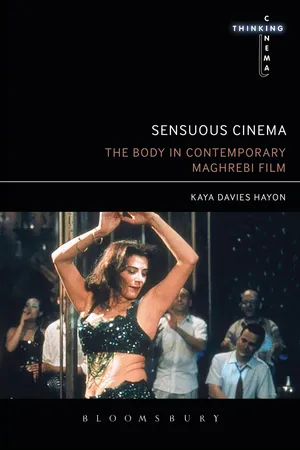
Sensuous Cinema: The Body in Contemporary Maghrebi Film examines a cluster of recent films that feature Maghrebi(-French) people and position corporeality as a site through which subjectivity and self-other relations are constituted and experienced. These films are set in and between the countries of the Maghreb, France and, to a lesser degree, Switzerland, and often adopt a sensual aesthetic that prioritizes embodied knowledge, the interrelation of the senses and the material realities of emotional experience. However, despite the importance of the body in these films, no study to date has taken corporeality as its primary point of concern.
This new addition to the Thinking Cinema series interweaves corporeal phenomenology with theological and feminist scholarship on the body from the Maghreb and the Middle East to examine how Maghrebi(-French) people of different genders, ethnicities, sexualities, ages and classes have been represented corporeally in contemporary Maghrebi and French cinemas. Via detailed textual and phenomenological analyses of films such as Red Satin (Amari 2002), Exiles (Gatlif 2004), Couscous (Kechiche 2007) and Salvation Army (Taïa 2014), Kaya Hayon Davies conveys the pivotal role that corporeality plays in articulating identity and the emotions in these films.
- 192 pages
- English
- ePUB (mobile friendly)
- Available on iOS & Android
eBook - ePub
About this book
Information
1
Introduction
Towards the middle of Tony Gatlif’s road movie, Exils (2004), a young Maghrebi-French woman and her French pied-noir boyfriend find themselves on a hot and crowded train on the way to Algiers.1 Unlike her male counterpart, the young woman, Naïma (Lubna Azabal), seems agitated and sits on the floor, biting her nails anxiously. As she sits, the use of tight spatial framing combines with the increasingly invasive sounds of the train to communicate her feelings of claustrophobia and confinement. After a couple of seconds, the camera cuts to a low-angle medium close-up of a local veiled woman as a bead of sweat trickles down her forehead and onto Naïma’s uncovered shoulder. The bead of sweat hits the heroine’s skin as the diegetic sound stops and a shot/reverse shot shows the two women looking at one another curiously. Not only is their intercultural encounter mediated through their bodies, but they are momentarily connected by the droplet of bodily fluid that passes between the surfaces of their skin.
The emphasis this sequence places on the body, the senses and the emotions is reflective of a cluster of recent films that feature Maghrebi, Maghrebi-French and to a lesser degree Swiss characters of Maghrebi heritage, and that position corporeality as a site through which subjectivity and self–other relations are constituted and experienced. These films are set in and between the countries of the Maghreb, France and, in some cases, Switzerland, and often adopt a sensual aesthetic that prioritizes embodied knowledge, the interrelation of the senses and the material realities of emotional experience. However, despite the importance of the body in these films, no study to date has taken corporeality as its primary point of concern. Existing research focuses almost exclusively on the phenomenon of French beur cinema or the sociopolitical dimensions of film-making from the Maghreb.2 As a result, there has been less research into questions of subjectivity and no extended scholarly investigation has examined the importance of the body for expressing identity in films featuring people of Maghrebi heritage.
This book begins to address this gap in the field by providing the first longitudinal and comparative account of how Maghrebi people of different genders, ethnicities, sexualities, ages and classes have been represented corporeally in Maghrebi and French cinemas since the year 2000. It interweaves corporeal phenomenology and film theory with feminist scholarship on the body from the Middle East and North Africa (MENA) to elucidate our understanding of the representations of embodied subjectivity in a discrete corpus of films featuring Maghrebi(-French) people. Via its acute focus on images of people of Maghrebi heritage and how their representations show them engaging with their environments through their bodies, this book is the first to apply the recent turn to corporeal phenomenology in film studies and feminism to critical interrogations of Maghrebi identities in Maghrebi and French films since the new millennium. It thinks with and through these films to reveal crucial points of intersection between Western notions of embodied subjectivity and theoretical and philosophical perspectives on the body from the MENA region.
A note on terminology
Before examining the key role that corporeality plays in articulating identity and the emotions in films featuring people of Maghrebi heritage, it is necessary to provide some explanation of the terminology adopted throughout the remainder of this book. Following Sylvie Durmelat and Vinay Swamy, I understand the Maghreb ‘to designate the former French colonies of Morocco, Algeria and Tunisia, north of the Atlas Mountains, and in contrast with the territories to the east, known as the Machrek (sometimes transliterated from the Arabic as Mashreq or Machreq)’.3 Throughout this study, I refer to people from Algeria, Tunisia and Morocco as Maghrebi, but recognize that this label could be seen to be reductive as it groups people according to a regional identity that disregards other (ethnic, gendered, sexual and national) modes of affiliation.4 I do not wish to homogenize important differences and understand that people in and from the Maghreb often identify more with national or ethnic identities (particularly those of Berber heritage). However, I believe that the term Maghrebi is useful shorthand for referring to people (or films) that originate from Algeria, Tunisia and Morocco as it acknowledges their shared history, geography and culture.5
By contrast, I use the term Maghrebi-French/Swiss to refer to people of Maghrebi origin who were born and/or raised in France or Switzerland. Will Higbee argues that this appellation is problematic because it implies a clear-cut division between ‘two distinct national histories, cultural identities and social realities, whose relationship (due to a shared colonial past) is contested, complex and uneven in terms of cultural, political and economic power’.6 Despite these potential pitfalls, however, Higbee claims that the term ‘at least attempts to articulate the bicultural identity of French descendants of North African immigrants’ and therefore enables us to ‘[move] beyond the generational specificity of the term beur’.7 Like Higbee, I recognize the problems with using an umbrella term like Maghrebi-French, but find it preferable to previous labels, such as beur, which are now considered to be limiting and essentialis t. Wherever possible, I try to use specific designations that take into account individual characters’ self-definitions and national or ethnic origins.
The body in contemporary Maghrebi(-French) cinemas
Having outlined the terminology at use throughout this study, this introduction now discusses the integral role that the body plays in films featuring people of Maghrebi heritage. The importance of the body in Maghrebi cinemas has been confirmed by the veteran Tunisian film-maker, Nouri Bouzid. Despite Islamic aniconism, Bouzid believes that the body plays a ‘fundamental’ role in Maghrebi cinemas as it represents an ‘extraordinary area of expression’ and ‘the most important vector of dramatic technique and conflicts, dramas, characters’.8 The significance of the body for Maghrebi film-making became particularly evident in the late 1970s and 1980s when many key directors began to emphasize its expressive qualities and important role in communicating their protagonists’ interior emotions. Assia Djebar’s now canonical film, La Nouba des femmes du Mont Chenoua (1978), represented the lived and embodied existences of rural Algerian women, while Nouri Bouzid’s early features, such as L’Homme des cendres (1986) and Les Sabots en or (1988), used the suffering and emasculated bodies of their adult protagonists to criticize political repression and child sexual abuse in Tunisian society. In the early 1990s, Moufida Tlatli foregrounded servant women’s lived and material experiences of sexual exploitation in her now-celebrated first feature Les Silences du palais (1994). Despite differences in approach, these film-makers all positioned their protagonists’ bodies as vehicles through which they examined the sociopolitical realities of the present as well as those of the colonial past.
Since the turn of the century, there has been a rise in production across the countries of the Maghreb and a growing number of film-makers have been able to tackle increasingly ‘taboo’ topics, such as religion, women’s rights and (male) same-sex desire. In New Voices in Arab Cinema, Roy Armes attributes this increased liberalism to the emergence of a new generation of Maghrebi directors, who were born after independence and ‘have experienced the rise of Islamic fundamentalism and life under often brutal dictatorships’.9 Unlike the first generation of film-makers, these directors have no first-hand experience of colonialism and are therefore more concerned with criticizing ‘a maladministration occurring in the present’ than the faults of the colonial past.10 Crucially, many of these directors are women, who have been educated abroad and, according to Armes, are ‘[changing] the way in which a whole array of aspects of Arab society are experienced and depicted’.11 To a greater degree than most of their predecessors, these new directors are unafraid to challenge dominant societal mores and use their protagonists’ embodied experiences to criticize societal inequalities across the countries of the Maghreb.
I will argue shortly that the work of this new cohort of Maghrebi film-makers is one of the major reasons why we need to analyse post-millennial Algerian, Tunisian and Moroccan cinemas in tandem with one another and their former colonial power. However, it is first important to consider how their representations of the body might be inflected by national histories and, in Patricia Caillé’s words, individual ‘film … policies and economies as well as certain aspects of film aesthetics’.12 In post-millennial Algerian cinema, for instance, Ratiba Hadj-Moussa argues that women are the focal point and it is against ‘[their] bodies that all the contradictions of Algeria surface’.13 Whereas Rachida (Bachir-Chouikh 2002) tells the story of a young Algerian school teacher who is shot in the womb by terrorists because she refuses to carry a bomb to the school where she works, Viva Laldjérie (Moknèche 2004) focuses on an urban woman called Goucem (Lubna Azabal) who spends the latter half of the film searching for the body of her murdered best friend and prostitute Fifi (Nadia Kaci).14 These films not only foreground women’s lived and material experiences of the recent Algerian Civil War, but also position their protagonists’ abused or absent bodies as metaphors for the Algerian nation and the wider national tragedy.15
In Tunisian cinema, Robert Lang argues that film-makers are quite unique in their ‘willingness to show the body’ and explore ‘public/societal problems in the private terms of sexuality’.16 Following Bouzid’s candid exploration of sexual taboos in L’Homme des cendres, Lang believes that Tunisian directors are ‘generally not interested in, nor perhaps even capable of, making films without the “body”’ or a frank depiction of sexuality.17 This point is illustrated clearly by the subject matter and style of a number of recent Tunisian films. For instance, Moufida Tlatli’s La Saison des hommes (2000) and Karin Albou’s Le Chant des mariées (2008) both adopt a deeply sensual aesthetic to represent the erotic desires of Tunisian women. More recently, Mehdi Ben Attia’s first film, Le Fil (2009), focuses on a cross-class love affair between a wealthy Tunisian man named Malik (Antonin Stahly Viswanadhan) and his mother’s handyman Bilal (Salim Kechiouche). This latter film, in particular, foregrounds the extent to which desire is experienced at the level of the body and causes its protagonist to act against the prevailing morality in contemporary Tunisian society. Though different in terms of context and content, these films all offer candid representations of the body and are unafraid to highlight their characters’ ‘transgressive’ desires.
In the run up to and after the Tunisian revolution, a number of Tunisian films interrogated the impact of religious fundamentalism upon their characters’ embodied existences and identities.18 Making of (Bouzid 2006) uses an experimental approach to represent a confused young breakdancer who commits suicide after he is indoctrinated by Islamic fundamentalists, while Millefeuille (Bouzid 2012) and À Peine j’ouvre les yeux (Leyla Bouzid 2016) foreground young Tunisian women who struggle for the right to dress and define their bodies as they please on the eve of and after the uprising in 2011. In all of these films, the representation of the central characters’ bodies is directly impacted by recent sociopolitical events that have occurred within the Tunisian nation’s borders.
In Morocco, a number of recent films have also started to criticize the restrictions that patriarchal religious traditions place upon their characters’ embodied identities and desires. In 2005, Laïla Marrakchi’s highly controversial film, Marock (2005), foregrounded a sexual relationship between a Muslim girl and a Jewish boy in urban Casablanca. The film was extremely ...
Table of contents
- Cover
- Half-Title
- Series
- Title
- Contents
- Acknowledgements
- 1 Introduction
- 2 The Materiality of Exile
- 3 Dance, Performance and the Moving Body
- 4 Embodying Islam
- 5 Queer Desires in the Maghreb and France
- 6 Conclusion
- Bibliography
- Filmography
- Index
- Copyright
Trusted by 375,005 students
Access to over 1.5 million titles for a fair monthly price.
Study more efficiently using our study tools.
Frequently asked questions
Yes, you can cancel anytime from the Subscription tab in your account settings on the Perlego website. Your subscription will stay active until the end of your current billing period. Learn how to cancel your subscription
No, books cannot be downloaded as external files, such as PDFs, for use outside of Perlego. However, you can download books within the Perlego app for offline reading on mobile or tablet. Learn how to download books offline
Perlego offers two plans: Essential and Complete
- Essential is ideal for learners and professionals who enjoy exploring a wide range of subjects. Access the Essential Library with 800,000+ trusted titles and best-sellers across business, personal growth, and the humanities. Includes unlimited reading time and Standard Read Aloud voice.
- Complete: Perfect for advanced learners and researchers needing full, unrestricted access. Unlock 1.5M+ books across hundreds of subjects, including academic and specialized titles. The Complete Plan also includes advanced features like Premium Read Aloud and Research Assistant.
We are an online textbook subscription service, where you can get access to an entire online library for less than the price of a single book per month. With over 1.5 million books across 990+ topics, we’ve got you covered! Learn about our mission
Look out for the read-aloud symbol on your next book to see if you can listen to it. The read-aloud tool reads text aloud for you, highlighting the text as it is being read. You can pause it, speed it up and slow it down. Learn more about Read Aloud
Yes! You can use the Perlego app on both iOS and Android devices to read anytime, anywhere — even offline. Perfect for commutes or when you’re on the go.
Please note we cannot support devices running on iOS 13 and Android 7 or earlier. Learn more about using the app
Please note we cannot support devices running on iOS 13 and Android 7 or earlier. Learn more about using the app
Yes, you can access Sensuous Cinema by Kaya Davies Hayon in PDF and/or ePUB format, as well as other popular books in Media & Performing Arts & Film & Video. We have over 1.5 million books available in our catalogue for you to explore.