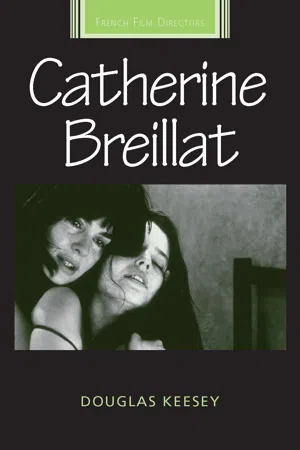
This is the first English-language book on controversial female director Catherine Breillat, whose films include Romance, A ma soeur! (Fat Girl), Anatomy of Hell and The Last Mistress.
This volume explores the director's complex relation to religion and to feminism, and it examines the differences between Breillat's films and patriarchal pornography, engaging in detailed analysis of her intimate scenes between men and women. Keesey also discusses the literature, films, paintings and photos that have influenced Breillat's work, and extends this to show how Breillat's films have influenced other filmmakers and artists in turn.
A lively and accessible introduction, this book will appeal to students and researchers, as well as all those with an interest in gender studies, French film and contemporary cinema.
- 178 pages
- English
- ePUB (mobile friendly)
- Available on iOS & Android
eBook - ePub
Catherine Breillat
About this book
Information
Publisher
Manchester University PressYear
2016Print ISBN
9780719085628
9780719075308
eBook ISBN
9781526110664
Subtopic
Film & Video
Female virgins and the shaming gaze
Une vraie jeune fille (A Real Young Girl)
Given Breillat’s efforts over the years to distance her work from mere pornography, there is some irony in the fact that her first directing opportunity was partly owing to the popularity of pornographic films. After the abolition of censorship in 1974 and the box-office success of Emmanuelle, the tide of pornographic films rose in France, amounting to almost half of all French film production in 1974 and 1975. In line with this trend, producer André Génovès offered Breillat the chance to make her first movie: ‘Il désirait un porno soft réalisé par une femme’1 (Ciment 1988: 3). Not knowing the rules or norms and having no one to guide her, Breillat took a three-person crew from the porn industry, with herself serving as writer, director and production designer, and made her first film in four weeks, shooting without sound and with only one take per shot. The result – not a softcore porn film, but instead what Breillat has called ‘a kind of underground, “wild” movie’ (Vincendeau 1989: 41) – would have made a striking directorial debut, but due to a fateful turn of events Une vraie jeune fille would not be released for another twenty-four years.
First, in December 1975 the government re-imposed a kind of censorship on pornographic films by increasing the tax on their production and distribution and by subjecting them to an X classification. When Génovès viewed the rushes of Breillat’s film, he thought it would be branded with an X, so he lost faith in it and reduced her already meagre financing. Then Génovès’ production company went bankrupt, and Une vraie jeune fille was consigned to judicial limbo. There was thus a sense in which Breillat’s film, explicit but not pornographic, was nevertheless blotted out by the anti-porn crusade. As she sees it, her ‘film was “censored”, even though it wasn’t physically censored, because there was a compulsion in society that was saying that films that talked about sexuality should be banned. Distributors, newspapers, critics – everybody thought it was a horrible pornographic film. So as a fact, it was censored’ (Wiegand 2001). It was only after the international success of Breillat’s Romance that her very first film, Une vraie jeune fille, would finally see the screen in 2000.
Like many other neophyte directors, Breillat included a number of autobiographical elements in her first feature. Alice, the eponymous heroine of Une vraie jeune fille, is fourteen verging on fifteen years of age during her summer vacation in the early 1960s (TV broadcasts in the film put the date at 1963), and Breillat was born on 13 July 1948. This means that Alice is still a minor, the age of consent in France being fifteen back then as well as now. Like Alice, Breillat was subject to a strict Catholic upbringing, which included close supervision by the nuns at a girls’ boarding school and rigid control by her parents at home and on vacation. The Landes region in southwest France where Alice spends her family vacation is the same area that Breillat used to pass on the way to summer break with her parents. Like Alice, the young Breillat matured early, getting her first period at age nine and developing full breasts by age twelve, and she was similarly subjected to her parents’ vociferous disapproval of her womanly body, with her mother even calling her a ‘pute’ (‘whore’) (Clouzot 2004: 16). (It is interesting to note that, in post-synching the film’s sound, Breillat had her own mother dub the voice of Alice’s mother, while Breillat’s sister dubbed Alice’s dialogue.) Both Alice and Breillat suffer the disparagement directed at their bodies by their parents, the nuns and the local townsfolk (the people of ‘Aupom’ for Alice, Niort for Breillat), and both girls experience this adult disapproval as a kind of anti-education or un-birth: ‘Je n’ai pas été très bien élevée, je suis très mutilée’2 (Clouzot 2004: 171); ‘Ce ne sont pas mes parents qui m’ont fait exister, ni la ville de Niort. Eux faisaient tout pour que je n’existe pas. C’étaient des bourgeois puritains et censeurs’3 (Breillat 2006: 16).
Alice’s first thoughts in the film, conveyed as a voice-over interior monologue, are ‘Je m’appelle Alice, Alice Bonnard, du nom de mon père et de ma mère. Je n’aime pas les gens. Ils m’oppressent’.4 The heaviness and heat of the summer weigh on Alice like the stifling feeling that she is expected to become just like her mother, a ‘grosse vache’, ‘frigide mesquine et ménagère’, one of those ‘femmes que la vie, la fatalité et la pesanteur ont beaucoup abîmées’5 (Breillat 1974: 51, 15, 52). The mother’s first words to Alice in the film are ‘ma fille’, claiming her as her daughter, her girl. At night she turns out the light in her daughter’s bedroom in order to stop Alice from writing in her diary, much as the dorm supervisor at her Catholic boarding school would remove Alice’s hand from between her legs and shush her to sleep. In these ways, her mother and the nuns stifle Alice’s literary and sexual self-expression. When Alice applies lipstick and mascara to go to the fair, her mother interrogates her from the other side of the bathroom door, and when Alice daydreams about kissing a boy, her mother throws cold water from wet laundry onto her daughter’s bikini top and accuses Alice of being ‘encore habillée comme une pute’.6 Horrified to learn from the village grocer lady (a petty, spiteful woman) that Alice has been roaming the countryside on her bicycle, her mother panics at the thought that Alice might get pregnant and shuts her up within the narrow confines of the house and grounds.
While the mother may sometimes seem like a wicked witch from a fairytale (particularly as the film is very much told from young Alice’s perspective), it’s important to understand the mother’s repressive and overprotective behaviour within the context of that time. As Breillat has said about her own mother, who in the early 1960s was hypervigilant regarding Breillat’s and her sister’s sexuality and who curtailed their freedom through a similar home confinement, ‘A l’époque, la pilule n’existait pas, il n’y avait rien pour réparer les dégâts si dégâts il y avait, et l’avortement était un crime. La seule chose que les parents croyaient pouvoir faire, c’était d’enfermer leurs enfants, de les enfermer sous clé’7 (Breillat 2006: 13). Contraception did not become legally available in France until 1967, and women were not granted the right to abortion until 1975. Only ‘bad girls’ had premarital sex and got into trouble. ‘Good girls’ or ‘vraies jeunes filles’ were expected to abstain until they were properly wed, with their virginity as guarantee that they were viable commodities on the marriage market. Indeed, for Breillat, ‘la “vraie jeune fille” fait référence à la virginité comme valeur établie et presque “marchande”’8 (Breillat 2006: 12).
And once married, women were expected to be ‘good’ wives and mothers, to keep house and bear children who would grow up to be ‘good girls’ and do likewise. Even though French women were given the right to vote in 1944, pro-natalist propaganda by the postwar government discouraged women from seeking independent careers and instead promoted ‘la femme au foyer’ (‘the homemaker’) as the ideal woman: ‘Women’s world was still defined as private, as domestic; women’s fulfilment was still thought to be wrapped up in house and home; women’s biology was still destiny. A good woman was a good mother; a good mother was a wife and a housewife; and, for at least fifteen years after the war, no vision of fulfilled femininity involving anything other than domesticity and motherhood was readily available to women’ (Duchen 1994: 64). When Alice’s mother criticises one of Alice’s schoolgirl friends for wanting to be a pilot, she is merely expressing the then-common view that any role for women besides that of ‘mère-ménagère’ (‘housewife and mother’) is presumptuous and selfish. Near the end of the film, we learn that Alice’s mother may have given up several lovers and a more independent life in Paris to settle for domestic life in the provinces with Alice’s father. Like most women of that time, she is entirely dependent on her husband for both love and money, a fact she begins to rue when he becomes a philanderer and his business shows signs of impending failure. Even though she slaves away at home, he is contemptuous of her housework, saying that she has never had the audacity to do anything but darn stockings and be frugal, that she has never earned anything. Yet her life has been subject to the prevailing division of labour whereby man is the breadwinner and woman the homemaker. In fact, until 1965 married women in France did not have the right to get a job, open a bank account or dispose of their own property without their husbands’ permission, and despite women’s marital dissatisfaction it was not until 1975 that divorce by mutual consent became legal.
In the face of her mother’s attempts to confine her to home and to the role of ‘good girl’ and future homemaker, Alice looks for freedom wherever she can find it. Turning to the ‘chansons yéyé’ (‘pop songs’) she hears on the radio and to the ‘copains’ and ‘copines’ (‘male and female pop star pals’) she sees on TV, Alice finds cultural forms and role models that both express and give shape to her new sexual feelings. (It is interesting to note that, when Breillat was young, she not only wanted to be a writer and director but also entertained the notion of becoming a singer or actress.) As Alice listens to a song on the car radio, we see her framed from below with her eyes half-closed and then with the sun shining on her face as she looks up. Alice worships the female singer for transporting her to another world of the music’s making: ‘Ecoute ça. Je ferais n’importe quoi pour cette femme’.9 Later, Alice’s face lights up as she watches a TV performance by the same female pop star, who is dressed in a frilly blouse while coyly holding a daisy as she sings, ‘Suis-je une petite fille / je ne sais pas / je ne sais pas / ou bien une grande fille / vous le savez bien pour moi’.10 These lyrics seem to express Alice’s self-doubt regarding her transitional state, but they also embolden her with their suggestion that girls on the verge of change can be seductive. Indeed, as Alice stands in her parents’ kitchen taking in the pop star’s ‘little girl’ act, Alice’s pink headband and blue shirt with white polka dots are in provocative contrast to the black bikini with red fringe that she is wearing underneath. Soon thereafter, Alice is listening to the same ‘little girl’ song on the radio while stretched out in her sexy bikini on the lawn, as if she were the nymphet Sue Lyon sunning herself in Stanley Kubrick’s Lolita (1962). (The ‘Suis-je une petite fille’ ditty even has a teasing sound like the ‘ya ya / ya-uh ya-uh / ya ya’ song that Lolita listens to on her radio.) Alice’s radio tune prompts her to have an erotic fantasy in which she is lying, coyly seductive, on the sand and attracts the attentions of a playfully aggressive beach boy, as in a rock-and-roll beach-party movie.
Popular culture also shapes Alice’s masculine object of desire – the sexualised male as ‘bad boy’ – much as songs and images had lent a form to her desiring self – the ‘naughty girl’. Again in the kitchen with her parents, Alice’s eyes open wide as she watches a male rock star belt out a tune, his hair in a pompadour, his lips snarling and his hips gyrating like Elvis’s. As Susan Weiner has noted about France’s own answer to Elvis, Johnny Hallyday, ‘When Johnny first appeared on the TV show “L’Ecole des vedettes” in 1960 at the age of seventeen, clad in tight black leather pants, to sing “T’Aimer Follement”, his French version of Elvis Presley’s “Makin’ Love”, he became notorious overnight. … Parents were horrified; teenagers were thrilled’ (Weiner 2001: 146). As the rock star on Alice’s TV sings about a tumultuous love affair (‘je vivais sur un volcan’),11 Alice may imagine herself as his fiery lover, and when he screams that he doesn’t give a damn about the ‘petite amie’ who left him, that he just wants to ride around in his sports car and pick up lots of girls, Alice may dream of being the one girl so passionate she will make him care. Later, Alice goes to a bar where rock music is on the jukebox, and flirts with a boy who’s playing the tough guy with slicked-back hair and a leather jacket. He may callously trade queens in a card game with his buddies, but he ends up following Alice out the door and chasing after her on his motorbike. Still later, when Alice is in the car with Jim – a James Dean look-alike who smokes cigarettes and sports an arm tattoo – the voice of a male rock singer on the soundtrack seems to be telling her just what she wants to hear from Jim, that only her love can tame this bad boy: ‘si … on objecte / que je ne suis qu’un voyou / aucune loi ne m’arrête / je m’arrête à tes genoux / … je ne demande / que de t’aimer à la folie’.12
‘Naughty girls’ may get to play with ‘bad boys’, but they are still ‘naughty’: her parents’ repression of her sexually developing body, their looks of disapproval, make Alice feel ashamed of herself. As Breillat has said, ‘on vous enferme et on vous suspecte. Mais de quoi peut-on suspecter une petite fille? J’ai intégré la haine et la honte que l’on m’a inculquées si fortement à un âge où l’on est si faible’13 (Guilloux 1999). In one scene, while having tea and jam with her parents, Alice drops a spoon under the table and then surreptitiously slips it inside her panties. Editing in the scene shows that the spoon, sticky with Alice’s secretions, is connected in her mind to the viscous jam and the tacky flypaper with its dirty, dying flies: ‘je me livrais encore et encore...
Table of contents
- Cover
- Half Title Page
- Title Page
- Copyright Page
- Contents
- List of Plates
- Series Editors’ Foreword
- Acknowledgements
- Introduction
- 1 Female virgins and the shaming gaze
- 2 Sisters as one soul in two bodies
- 3 Masculine tenderness and macho violence
- 4 Staging masochism, facing shame
- Conclusion
- Filmography
- Select Bibliography
- Index
Trusted by 375,005 students
Access to over 1.5 million titles for a fair monthly price.
Study more efficiently using our study tools.
Frequently asked questions
Yes, you can cancel anytime from the Subscription tab in your account settings on the Perlego website. Your subscription will stay active until the end of your current billing period. Learn how to cancel your subscription
No, books cannot be downloaded as external files, such as PDFs, for use outside of Perlego. However, you can download books within the Perlego app for offline reading on mobile or tablet. Learn how to download books offline
Perlego offers two plans: Essential and Complete
- Essential is ideal for learners and professionals who enjoy exploring a wide range of subjects. Access the Essential Library with 800,000+ trusted titles and best-sellers across business, personal growth, and the humanities. Includes unlimited reading time and Standard Read Aloud voice.
- Complete: Perfect for advanced learners and researchers needing full, unrestricted access. Unlock 1.5M+ books across hundreds of subjects, including academic and specialized titles. The Complete Plan also includes advanced features like Premium Read Aloud and Research Assistant.
We are an online textbook subscription service, where you can get access to an entire online library for less than the price of a single book per month. With over 1.5 million books across 990+ topics, we’ve got you covered! Learn about our mission
Look out for the read-aloud symbol on your next book to see if you can listen to it. The read-aloud tool reads text aloud for you, highlighting the text as it is being read. You can pause it, speed it up and slow it down. Learn more about Read Aloud
Yes! You can use the Perlego app on both iOS and Android devices to read anytime, anywhere — even offline. Perfect for commutes or when you’re on the go.
Please note we cannot support devices running on iOS 13 and Android 7 or earlier. Learn more about using the app
Please note we cannot support devices running on iOS 13 and Android 7 or earlier. Learn more about using the app
Yes, you can access Catherine Breillat by Douglas Keesey in PDF and/or ePUB format, as well as other popular books in Media & Performing Arts & Film & Video. We have over 1.5 million books available in our catalogue for you to explore.