Álex de la Iglesia, initially championed by Pedro Almodóvar, and at one time the enfant terrible of Spanish film, still makes film critics nervous. The director of some of the most important films of the Post-Franco era – Acción mutante, El día de la bestia, Muertos de risa – receives here the first full length study of his work. Breaking away from the pious tradition of acclaiming art-house auteurs, The cinema of Álex de la Iglesia tackles a new sort of beast: the popular auteur, who brings the provocation of the avant-garde to popular genres such as horror and comedy.
This book brings together Anglo-American film theory, an exploration of the legal and economic history of Spanish audio-visual culture, a comprehensive knowledge of Spanish cultural forms and traditions (esperpento, sainete costumbrista) with a detailed textual analysis of all of Álex de la Iglesia's seven feature films.
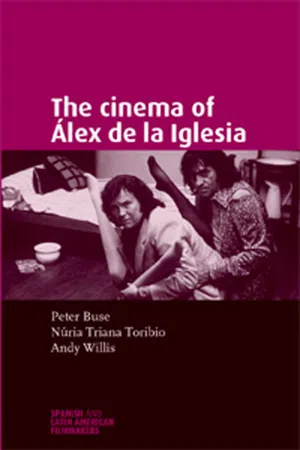
eBook - ePub
The cinema of Álex de la Iglesia
- 214 pages
- English
- ePUB (mobile friendly)
- Available on iOS & Android
eBook - ePub
The cinema of Álex de la Iglesia
About this book
Information
Publisher
Manchester University PressYear
2013Print ISBN
9780719071379
9780719071362
eBook ISBN
9781847796295
Subtopic
English Literary Criticism1
Acción mutante (1993): against the conspiracy of boredom
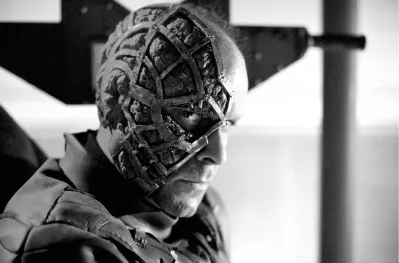
Speaking at the Manchester Spanish Film Festival in 2000, Álex de la Iglesia declared that he was not really a film director. ‘I’m more of a barman’, he declared, ‘I just make cocktails’. His films, he implied, were simply an elaborate montage of quotations from other directors, genres, and film-styles, a self-assessment well borne out by Acción mutante (1993), the De la Iglesia team’s first feature film, which promiscuously mixes science fiction and comedy, film noir and western, Almodóvar and Ridley Scott. Were such a claim, and its associated renunciation of auteur status, to issue from an American independent director, or even a relatively self-conscious Hollywood director, would it even raise an eyebrow, so eloquently does it express postmodern orthodoxy? And does it make any difference when it comes from a modern Spanish director? As a bravura cut-and-paste job, a frenetic exercise in filmic intertextuality, Acción mutante is highly accomplished, but it would be a mistake to praise or criticize it on the grounds of its postmodern sensibilities alone without taking into account the intervention it made into a specifically Spanish filmic context where, in the words of the title song ‘Esto no es un juego, es acción mutante.’
The protagonists of Acción mutante are a collection of politically radicalized disabled men who have formed a ‘mutant action’ terrorist group to carry out guerrilla warfare on a culture obsessed with fitness and beauty, some time in an ill-defined future. In the absence of their imprisoned leader, Ramón, they badly botch kidnapping attempts and attacks on televised aerobics programmes. Once Ramón is released and returns to guide them, however, they successfully kidnap Patricia, a wealthy heiress, from her wedding party, slaughtering most of the guests in the process, as well as losing two of their own number. Escaping in their space ship, the mutants prepare to rendezvous with the heiress’ father, Orujo, on the distant planet of Axturias to collect the ransom. On the journey, Ramón’s followers realize that he is short-changing them, and after they confront him, he murders them one by one, finishing with Álex, one of a pair of conjoined twins. The ship crash lands, and Ramón begins to drag the heiress across the desert planet to the rendezvous point, pursued by Álex who has in fact survived. After a series of violent incidents, all remaining characters assemble in The Lost Mine Bar for a final showdown with the vengeful Orujo.
After the decreto Miró
In 1997 Álex de la Iglesia defined his cinema in terms of what it was not. He claimed that he and co-writer Jorge Guerricaechevarría had set out to write Acción mutante with three basic premises:
1 evitar la Guerra civil y la posguerra,
2 no adaptar una novella de prestigio y,
3 no recrear traumas infantiles (Ordoñez 1997, 100)
1 to avoid the Civil War and the post-war era
2 not to adapt a culturally prestigious novel
3 not to recreate childhood traumas
There is no great mystery about what sort of cinema De la Iglesia refers to here – one need not look far in the Spanish cinema of the immediate post-Franco era (1975–90), just before De la Iglesia started making feature films, to find numerous examples of films from these categories, and sometimes all three at once. If we accept that De la Iglesia necessarily caricatures that cinema to which he opposes his own, it is nevertheless worthwhile examining more closely what he objects to in it. Although the three things to be avoided (childhood, the Civil War, literary adaptations) overlap, we will take them one at a time.
1 Childhood If we ask whose childhood is at stake in films such as La guerra de papa / Daddy’s War (Antonio Mercero, 1977), El Sur / The South (Víctor Erice, 1983), or Las bicicletas son para el verano / Biclycles Are for Summer (Jaime Chávarri, 1983), then we quickly come to the crux of the issue. These are the childhoods of a generation of directors who lived through the Civil War or at least under Franco, a generation removed from De la Iglesia’s by twenty years or more. The childhoods depicted in these films are almost universally negative, etched by trauma and psychological dislocation. As Marsha Kinder, who has canonized this cycle, puts it, these children have to cope with ‘the crimes of their devouring mothers and murderous fathers … They are the children of Franco, who bear the crippling legacy of Francoist cultural and political repression’ (1993, 215). For De la Iglesia’s relatively privileged generation, this agonized, introspective view of childhood is virtually unrecognizable and clearly no longer necessary.
2 The Civil War With the death of Franco and the coming of democracy Spanish cinema carried out a much-needed reexamination of both the Civil War and Franco’s regime, which until that point had been represented within Spain almost entirely from the point of view of the right. It was considered the political and even moral duty of cinema to ‘reconstruct’ the past, and this was done rigorously in a well-known sequence of films including the ones already mentioned as well as, for instance, La vaquilla / The Heifer (Luis García Berlanga, 1985), ¡Ay Carmela! (Carlos Saura, 1990), and Después del sueño / After the Dream (Mario Camus, 1992) (see Jordan and Morgan-Tamosumas 1998, 15–60). De la Iglesia, on the other hand, was part of the desencanto, the period of disillusionment with politics in general and with the leftist parties (PSOE) in particular, which had failed to deliver the changes they promised. De la Iglesia, then, like Almodóvar, would set out to make cinema as if Franco had never existed (see Kinder 1987, 42).
3 Literary adaptations The mainstream cinema in the years prior to Franco’s death had been dominated by popular and non-literary genres such as the ‘sexy Spanish comedies’, the melodramas of Pedro Masó, and the horror genre. From 1975 onwards, ‘serious’ directors undertook the task of rescuing the national production from such ‘cheap and nasty’ forms - what better way to elevate cinema than by privileging high culture and literature? Not only did literary adaptations bring automatic respectability to cinema, but the authors adapted usually possessed excellent liberal or leftist credentials. To take just one example, four of the novels of Miguel Delibes were either adapted directly or inspired screenplays during this period, the most well-known of these being Los santos inocentes / The Holy Innocents (Mario Camus, 1984). This emphasis on the literary of course implies a concomitant distrust of cinema as cinema, of cinema as a mass cultural form. The rejection of literary adaptations by De la Iglesia signals a renewed interest in exclusively cinematic codes, and more importantly, a disavowal of the ‘respectability’ literature endows on cinema.
A cursory examination of Acción mutante reveals how De la Iglesia and his team break away from the dead hand of literary adaptations about children of the Civil War. Far from being a reexamination of the past, it is set in a murky future where a group of men with various disabilities appropriate for themselves the designation ‘mutants’ and wage terror on the establishment, represented by the whole-wheat bread-making tycoon Orujo. Leaving aside the fact that many of the characters are infantile or puerile in their actions and desires, there is only one child in this film, and he is no innocent traumatized by the misdeeds of his elders. The demented and sadistic Zacarías (Carlos López Perea) is a perpetrator, rather than a victim of violence, torturing the mutant leader Ramón on the dinner table (he is, in any case, played by a suspiciously adult-looking, if small, actor). Finally, if it were absolutely necessary to trace the literary antecedents of Acción mutante, the path would lead to alternative comic books, while most of the sources for the film, as has already been noted, are cinematic (genre films) rather than literary.
Acción mutante is an all-out assault on what De la Iglesia has called the ‘conspiracy of boredom’ (Ordoñez 1997, 73) in Spanish cinema, by which he means the hegemonic literary-political cinema of the 1980s. This might be an exaggeration on De la Iglesia’s part were it not for the fact that the sort of cinema he excoriates was ultimately endorsed and sponsored by the Spanish state from the mid-1980s. When the PSOE were elected in 1982 they set about fulfilling their promise to reassess and reorganize the Spanish film industry. The result, under the direction of Pilar Miró, was the decreto Miró (1983), or Miró decree (popularly known also as Ley Miró), which encouraged a very particular sort of cinema production through the concentration of funds on a smaller number of productions, the awarding of grants and prizes, and assistance in distribution of those films approved by the Comisión de Calificación de las Películas Cinematográficas (Committee for Cinema Classification) and the Subcomisión de Valoración Técnica (Subcommittee for Technical Valuation). One of the main objectives of the legislation was the elimination or at least squeezing of the ‘subproductos’, the many genre films (horror, soft-porn, comedy) being made in Spain, and considered ‘undignified’ by the new cinema authorities. In practical terms this attack on genre cinema meant the consolidation - not for the first time - of realism as the ‘official’ style of Spanish national cinema (see Triana Toribio 2003, 108–19). In its efforts to curtail the perceived excesses of genre cinema, the decreto Miró must be judged a success, but in its desire to capture the audiences who once enjoyed the genre cinema, the decreto Miró was an unqualified failure (see Ansola Gonzalez 2004, 121). By the early 1990s, the policies driven by the decreto Miró had been exhausted through shortage of funds, and its main legacy, besides a national cinema distrustful of ‘entertainment’, was the promotion of new young film-makers who failed to fit the decreto Miró mould - Pedro Almodóvar, whose films wed art cinema and genre cinema, was a notable beneficiary. It is within this context of a decaying anti-popular cinema policy that Acción mutante must be understood.
Non-literary, anti-realist
The opening shot of Acción mutante is a close-up of the soon-to-be suffocated President of the National Association of Bodybuilders, Matías Pons, screaming in protest against the attentions of his would-be kidnappers. In the ‘future’ Spain of Acción mutante, Matías Pons represents all that is hegemonic: celebrity, beauty, health, physical perfection. The opening sequence which follows is designed to elicit an equivalent dismay in the hegemonic milieus of Spanish cinema production. Mock television footage is integrated with the opening credits in a film style which acts as a miniature manifesto against both realism and the literary pretensions of decreto Miró cinema. Jaime Blanch, dressed in a suit inscribed repeatedly with the word ‘Sucesos’ (News) reports on the bungled kidnapping of the previous scene. His mention of the group ‘Acción mutante’ cues the credits, and when these are finished we return to the ‘JQK’ television news which introduces us to the ‘mutants’ through spinning mugshots, as well as the Orujo family who are to be the next victims of ‘Acción mutante’. The use of television news serves more than one purpose. Clearly it provides an economical mode of exposition, introducing the characters and the basic plot backgrounds, which is a common enough deployment of television’s documentary function, but it also calls attention to the conventions of news presentation - its visual style (back projection, the positioning of the presenter in relation to the audience) and its sensationalist and frivolous content (‘periodismo rosa’ or celebrity news). The credit sequence is also highly self-conscious in relation to the cinematic apparatus and announces a comic, anti-realist aesthetic. The actors parade theatrically in front of a fiery back projection, the character M. A. approaches the camera directly and simulates hitting the lens (at one point cracking a screen placed in front of it), and when Manitas’ machine-gun fails to fire (during the credits for special effects), a props man enters the scene from behind the camera to assist him. The characters are also introduced in a style more appropriate to cartoons than to a cinema with pretensions to psychological insight. The mugshots identify and characterize each mutant through his single deformity, mutation or handicap, thereby asserting the two-dimensionality of fantasy over the cherished depth of realism. The references to comic-book conventions are deliberate, as are the other citations of mass cultural forms: in addition to the framing device of television news, the credit sequence clearly pastiches Bond films’ opening credit conventions, and the accompanying hip-hop lyrics are provided by popular band Def Con Dos. It should also be noted that the satirizing of televisual conventions comes hand in hand with an admiration for their visual potential and takes for granted the relevance of such a mass cultural medium to its audience - hardly an assumption acceptable to the proponents of the decreto Miró style who were keen to disavow the popular mass cultural side of their medium.
Generic impurities
As we have already noted, one of the key achievements of the decreto Miró was the denigration and suppression of the Spanish tradition of genre cinema. Not only Acción mutante, but all De la Iglesia’s films, draw unashamedly on genres usually eschewed by Spanish auteurist cinema. In fact, one of the most important developments in Spanish cinema in recent years - certainly in terms of box-office takings - has been the rejuvenation of genre cinema. One need only mention the success of Alejandro Amenábar’s psychological thriller Abre los ojos / Open Your Eyes (1997) and ghost story Los otros / The Others (2001), as well as the inexorable rise of Santiago Segura and his growing Torrente (1998–) empire. In the case of De la Iglesia, the revivification of genre cinema has not been an exercise in nostalgia; it has not been an attempt to go back to the ‘good old days’ prior to the decreto Miró by directly revisiting those genres Spain excelled at in the 1960s and early 1970s. Clearly, such an approach would be at best naive, at worst backward looking. The sentimental resurrection of earlier Spanish styles has of course taken place, yielding, for example, the anodyne and socially conservative El amor perjudica seriamente la salud/Love Can Seriously Damage Your Health (Manuel Gómez Pereira, 1997), a ham-fisted rehashing of the sexy Spanish comedy genre. De la Iglesia is not interested in mining a supposed seam of indigenous Spanish cinematic tradition. If anything, his films are rather a bold statement that anything can be Spanish cinema, or better yet, forget the idea of Spanish cinema as some discrete and bounded entity.
The ‘main’ genre upon which Acción mutante is based, if one can say such a thing about this generically eclectic film, is science fiction. Science fiction cinema has no established tradition in Spanish cinema and there is still no entry for ‘ciencia ficcion’ in the Diccionario del cine español (Academia de las Artes, 1998) nor in any of the encyclopedic works on Spanish cinema. Acción mutante may very well be the first ever Spanish science fiction-comedy (the classification it is given on IMDB).1 For various historical reasons to do with frontiers, space exploration, the Cold War, and the advances of US corporate capital, science fiction cinema has been a predominantly American phenomenon. Keeping this in mind, it is useful to consider what Acción mutante borrows from the SF canon and how it deviates from it. H. Bruce Franklin has devised an ironic and economical typology to distinguish early, technologically optimistic SF film from the post-utopian films which came to the fore from the 1970s onwards. The ‘archetypal image[s] of the future projected in early SF film’are ‘THE WONDER CITY OF THE FUTURE’ and ‘THE MARVELLOUS FLYING MACHINE’ (1990, 20–1). Drawing on films such as Alien (1979), Outland (1981), The Last Chase (1981), Parasite (1982) and Blade Runner (1982), Franklin claims that
THE WONDER CITY OF THE FUTURE rarely appears any longer in the cinematic visions of tomorrow, except occasionally as some kind of domed world of illusory pleasures, as in Logan’s Run or Futureworld. Instead the cities of the present have been reduced to rubble through which our poor descendants have their last pathetic adventures … When THE MARVELLOUS FLYING MACHINE makes an appearance, it is usually as a harbinger not of progress but of terror. It may be a vehicle bringing either some threatening alien life-form - as in The Andromeda Strain (1971) or Alien; or assassins sent by human powers - as in Outland. (1990, 23)
Broadly speaking, Acción mutante subscribes to this post-utopian view of the future. What we see of the city (Bilbao) of the future in the first third of the film contains little in the way of stunning progress or technological wonders. Like the Los Angeles of Blade Runner (Ridley Scott, 1982) this city seems to be devoid of sunlight, a dim visibility provided instead by neon street signs and car headlights. Although we see the decadent rich devoted to hedonistic partying, there is no sign of a social or governmental structure beyond the unseen guard who releases Ramón from prison and helmeted and faceless police gratuitously doling out beatings to protestors and ‘mutants’. Meanwhile, the spaceship, Virgen del Carmen, which hosts the middle third of the film, resembles not in the least the gleaming fantasies of triumphant technology to be found in so much science fiction. Its computer is unreliable, from the outside it looks if anything like a grey-brown bon-bon on stilts, and its ‘bridge’ is more mechanic’s yard than Enterprise. Perhaps the most striking feature of Virgen del Carmen is its constant need for greasing and its tendency to spurt brake fluid with great gusto at the least provocation. Even Han Solo’s Millennium Falcon, the paradigm for such decaying and inefficient spaceships, was hi-tech enough not to require ministrations as mundane as the oilcan, although the immediate model for Virgen del Carmen is the spaceship in John Carpenter’s satirical Dark Star (1974). Robots, another staple of the SF film, also appear here, but they too fail to testi...
Table of contents
- Cover Page
- Title Page
- Copyright Page
- Contents
- List of illustrations
- Acknowledgements
- Introduction
- 1 Acción mutante (1993): against the conspiracy of boredom
- 2 El día de la bestia (1995): comedy, subcultures, television
- 3 Perdita Durango (1997): the body, sex and Mexico
- 4 Muertos de risa (1999): comedy, television, history
- 5 La comunidad (2000): modernity and the cinematic past
- 6 800 balas (2002): undoing theignominy of boyhood
- 7 Crimen ferpecto (2004): the mise-en-scène of mise-en-scène
- Conclusion
- Filmography of Álex de la Iglesia
- Bibliography
- Index
Trusted by 375,005 students
Access to over 1.5 million titles for a fair monthly price.
Study more efficiently using our study tools.
Frequently asked questions
Yes, you can cancel anytime from the Subscription tab in your account settings on the Perlego website. Your subscription will stay active until the end of your current billing period. Learn how to cancel your subscription
No, books cannot be downloaded as external files, such as PDFs, for use outside of Perlego. However, you can download books within the Perlego app for offline reading on mobile or tablet. Learn how to download books offline
Perlego offers two plans: Essential and Complete
- Essential is ideal for learners and professionals who enjoy exploring a wide range of subjects. Access the Essential Library with 800,000+ trusted titles and best-sellers across business, personal growth, and the humanities. Includes unlimited reading time and Standard Read Aloud voice.
- Complete: Perfect for advanced learners and researchers needing full, unrestricted access. Unlock 1.5M+ books across hundreds of subjects, including academic and specialized titles. The Complete Plan also includes advanced features like Premium Read Aloud and Research Assistant.
We are an online textbook subscription service, where you can get access to an entire online library for less than the price of a single book per month. With over 1.5 million books across 990+ topics, we’ve got you covered! Learn about our mission
Look out for the read-aloud symbol on your next book to see if you can listen to it. The read-aloud tool reads text aloud for you, highlighting the text as it is being read. You can pause it, speed it up and slow it down. Learn more about Read Aloud
Yes! You can use the Perlego app on both iOS and Android devices to read anytime, anywhere — even offline. Perfect for commutes or when you’re on the go.
Please note we cannot support devices running on iOS 13 and Android 7 or earlier. Learn more about using the app
Please note we cannot support devices running on iOS 13 and Android 7 or earlier. Learn more about using the app
Yes, you can access The cinema of Álex de la Iglesia by Peter Buse,Nuria Triana-Toribio,Andy Willis,Andy Willis,Nuria Triana-Toribio in PDF and/or ePUB format, as well as other popular books in Media & Performing Arts & English Literary Criticism. We have over 1.5 million books available in our catalogue for you to explore.