- Presents an insightful and provocative collection of newly commissioned essays and original research by top international scholars from a variety of theoretical, disciplinary and geographical perspectives
- Offers a systematic historical, thematic, and theoretical approach to Spanish cinema, unique in the field
- Combines a thorough and insightful study of a wide spectrum of topics and issues with in-depth textual analysis of specific films
- Explores Spanish cinema's cultural, artistic, industrial, theoretical and commercial contexts pre- and post-1975 and the notion of a "national" cinema
- Canonical directors and stars are examined alongside understudied directors, screenwriters, editors, and secondary actors
- Presents original research on image and sound; genre; non-fiction film; institutions, audiences and industry; and relations to other media, as well as a theoretically-driven section designed to stimulate innovative research
- English
- ePUB (mobile friendly)
- Available on iOS & Android
eBook - ePub
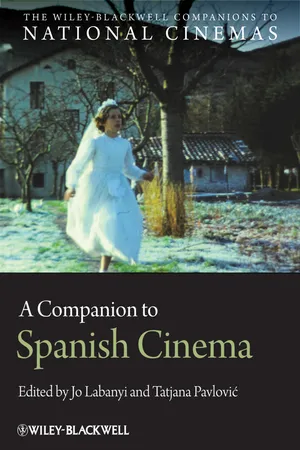
A Companion to Spanish Cinema
About this book
A Companion to Spanish Cinema is a bold collection of newly commissioned essays written by top international scholars that thoroughly interrogates Spanish cinema from a variety of thematic, theoretical and historic perspectives.
Information
1
Introduction
The aim of this volume is not only to provide detailed information about cinema made in Spain from its beginnings to the present day but also, above all, to question existing paradigms. A key issue that emerges in its chapters is the transnational nature of Spanish cinema throughout its history – even under the highly nationalistic Franco dictatorship. To talk of Spanish cinema is to talk of its relations with other cinemas, through coproductions, through the sharing of actors and technical personnel, and particularly through its drawing on a common fund of formal, generic, and thematic concerns. Several chapters argue against the notion of Spanish cinema’s exceptionalism while also insisting on the importance of considering its historical and geographical specificities. The volume also makes a point of decentering the study of Spanish cinema by stressing the importance of Barcelona as the center of the film industry in its early decades (to our knowledge, the volume offers the first history of cinematic production in Catalonia from its origins to the present available in any book on Spanish cinema) and by giving detailed attention to cinematic production in Spain’s major autonomous communities: not just those that have their own language (Catalonia, the Basque Country, and Galicia) but also Andalusia, which has marketed “Andalusian cinema” as a brand – one that is transnational rather than strictly local, since the aim has been to attract filmmakers from outside the area to film there. The transnational and the local are thus seen as intertwined throughout the history of cinematic production in Spain.
The volume also works against the common concentration on art cinema in much discussion of Spanish film. We have given equal attention to production aimed at a discerning elite and that aimed at the popular audiences to which the film industry – for it is an industry – has always catered, examining the often political processes that assign certain directors to the canon or exclude them from it. In this respect, cinema is seen as part of a continuum of cultural production involving other media – such as amusement parks, bullfighting and football, popular theater and the musical revue, literature, and television – and as bound up with other forms of cultural practice such as fashion and political activism. Considerable attention is given to the ways in which audiences have engaged with Spanish films, through their active participation in the star system (one of the industry’s major marketing devices, but one gladly embraced by spectators) and fandom (particularly for genres perceived as marginal to hegemonic values, such as horror). The volume consequently considers cinema – especially in the case of cult movies and box-office hits – to be a valuable indicator of how cultural tastes have evolved in Spain over the course of the twentieth and early twenty-first centuries.
While most individual chapters adopt a chronological approach, the volume as a whole has been conceived on a thematic basis – something that again distinguishes it from existing histories of Spanish cinema. This allows consideration not just of individual films (though these are considered too, since many chapters focus on particular case studies) but of how these films form part of a cinematic apparatus comprising production companies, film studios, a broad range of film workers (cameramen, screenwriters, editors, as well as directors and actors), film clubs, festivals, archives, and film magazines directed at both specialist and popular audiences. In addition to the making and exhibition of films, the volume also considers questions of state regulation (censorship and subsidies), including the cinema policies of the major film-producing autonomous communities, and of preservation and restoration. We have made a point of including discussion of non-fiction film, often left out of studies of “national” cinemas since newsreels, documentaries, shorts, and animation have their own conventions and – with the exception of the mid-twentieth-century newsreels screened in cinema theaters, such as the Francoist NO-DO – have different exhibition circuits from the feature film. Experimental film is considered together with other forms of non-fiction film, to avoid subjecting it to the same analytical criteria that govern the fiction film. It is noted that some Spanish practitioners of non-fiction film have obtained a level of international recognition rarely achieved by Spanish feature-film directors.
We have also aimed to avoid the analysis of films primarily in terms of their subject matter, which characterizes much existing work on Spanish cinema. We thus have no chapters devoted to films “about” a particular topic (the city, women, or immigrants, to cite some of the favorites with critics), though of course such issues come up in the process of discussing films grouped together under other headings. One section focuses exclusively on cinematic techniques, visual and acoustic: we believe the discussion in this section of the historical evolution of camerawork, production design, editing, and soundtrack (including dubbing and film music) to be unique as well as enormously productive. Our main category for organizing the discussion of film texts has been not subject matter but genre. Given that genre is a classification system aimed at audiences, through its twin function as a marketing device and as a set of conventions that enable spectators to “read” films associated with a particular generic label, the focus on genre has the advantage of allowing consideration of how films connect with their public. The substantial discussion of genre also provides a historical overview of changing cultural tastes. Our desire to go beyond the discussion of Spanish cinema in terms of subject matter is also the impulse behind our inclusion of a section of theoretically informed analyses of specific film texts.
Despite the fact that Spanish cinema’s patterns of production and consumption have from its inception been linked with global film industries, the ingrained critical paradigm of “national” production still dominates the field of Spanish film studies. Part I, “Reframing the National,” thus seeks to deterritorialize the concept of national cinema by placing it in dialogue with other film industries both inside and outside Spain. Transnational modes of production are above all economic models, conditioned by the Spanish film industry’s limited domestic audience. Expansion has been into two principal areas: (1) the transnational Hispanic market, facilitated by affective affinities of language and culture (yet not without its neo-colonial dimension), and (2) the European market created more recently through political union. Both markets provide the Spanish industry with a means of maintaining autonomy in the face of US hegemony and the growing encroachment of leviathan media corporations. However, Hollywood distributors’ mergers and alliances with Spanish companies and the arrival of new technologies (such as cable and satellite provision, digital platforms, and multimedia formats) have threatened the very notion of a uniquely Spanish national film industry. Spain’s incorporation into the European Union, with its protectionist laws, subsidies, and cross-European production standards, has created new tensions between, on the one hand, maintaining styles of film production that are understood and marketed as culturally European and, on the other, the pressures of a more standardized audiovisual industry dominated by the large Hollywood corporate media monopolies.
Within these emerging contexts, the cinema production of Spain’s autonomous communities has made innovative connections between the local and the transnational, bypassing the national by aligning with world markets. Such ventures show that promotion of area-specific culture can benefit from the “branding” that global capitalism makes possible. Nonetheless, the challenge of reaching sufficiently broad audiences to guarantee box-office success remains. To speak of “Spanish cinema” is thus to speak of a tension between the assertion of local cinemas and homogenizing structural or marketing trends. The essays in Part I also show that transnationalism can correspond to political rather than economic factors – as with the “export” and “import” of film professionals thanks to political exile and the use of international film festivals to consecrate the careers of antiregime directors. In practice, the transnational strategies of cinema production in Spain’s contemporary autonomous communities have obeyed ends that are as much nationalist as economic – the two usually but not necessarily working together. We are also reminded that cinema production in Catalonia and Galicia (the former particularly) goes back way before political devolution, and that, although the politics of language is an important factor, Catalan, Galician, and Basque cinemas cannot be limited to films made in the local vernacular. In order to reinforce this last point, we have included Andalusia in this discussion.
Part II, “The Construction of the Auteur,” discusses the contentious concept that originated with Cahiers du Cinéma’s politique des auteurs in the 1960s. Despite focusing on canonical figures who have been perceived as forming the pantheon of Spanish cinema (such as Buñuel, Saura, and Almodóvar), the first of the two chapters questions common assumptions – and their ideological underpinnings – about the canon, including its equation with arthouse cinema and the conception of filmmaking as the artistic product of the director’s personal vision. This critique is taken further in the second chapter, which sees auteurism not in terms of the film’s qualities but as a strategic practice that can be carried out by directors, critics, and fans alike – as it was by the producers discussed in Part I, who consolidated the reputation of antiregime directors by playing the international film festival circuit. In so doing, this chapter recuperates the less-known, often discordant voices of Spanish cinema obscured by the discourse of auteurist cinema and its dismissive attitude toward the collaborative processes essential to filmmaking. Consequently, the chapter highlights the work of secondary actors, screenwriters, and editors and exposes the explicit androcentrism of the politique des auteurs. The chapter also traces a definitive shift away from 1960s auteurist film culture (which had in fact foreshadowed the later critical interest in popular cinema by constructing Hollywood classics as the creation of auteurs) by considering wider “authorial signatures” of understudied popular directors and avant-garde and pulp filmmakers.
Just as critics, academics, and fans strategically construct certain film directors as cult figures, auteurs too – be they avant-garde, popular, pulp, or women – embrace their authorial aura, succumb to self-mythologizing narratives, and invest in self-authorizing strategies. The successful construction of auteurist status in Spanish cinema involves both official recognition at home and the prestige bestowed upon national cinema abroad. Auteurism still predominates because the “director brand” continues to be a key commercial strategy for marketing films and priming audience reception. The synergies and tensions between the two chapters of Part II show how malleable labels associated with auteurism can be, and how fragile – even if deep-seated – are current notions of national cinema, art cinema, cultural prestige, and commercial value.
The three chapters in Part III, “Genre,” each discuss two or three cognate film genres: respectively, comedy and musicals; melodrama and historical film; and noir, the thriller, and horror. In all cases, genre is considered as a flexible category that groups together a number of features, frequently in combination with features of other genres. Despite this definitional fuzziness, analysis of the historical evolution of films loosely pertaining to a particular genre can be instructive, particularly in revealing continuities as well as change. As is noted, such continuities, while they can be taken to indicate a specifically Spanish tradition (often going beyond cinema to encompass other cultural forms), are in most cases linked to similar trends in other national cinemas and cultures.
We start with a discussion of comedy and the musical in order to rescue them from the subordinate status to which they are often relegated because of their appeal to popular audiences: both genres have had a rich history in Spanish cinema, reinforcing but also challenging received ideas. Melodrama, too, is considered as a popular genre whose emotionalism can encourage acceptance of suffering (especially female suffering, given melodrama’s conventional classification as the “woman’s film”) but that can also trigger emotions that work against the plot resolution, and particularly against conventional gender roles. Frequently overlapping with melodrama, the historical film is shown to be a particularly sensitive barometer for measuring changes in social attitudes, given that its representation of the past necessarily illustrates concerns appropriate to the time of the film’s making. The anachronism that is built into the historical film can, despite the genre’s ostensible escapism, allow a working through of issues that remain unresolved in the present.
The thriller, too, is shown to obey an evolution that parallels political and social change, with certain periods – the late 1940s with their intense use of noir techniques; the transition to democracy when the future remained uncertain – proving particularly conducive to the use of the investigative and/or suspense format. The thriller’s focus on deviance has made it an especially important genre for the construction of social norms through the very process of showing how they are flouted; in this sense, the thriller has served to push the boundaries of what, in any given period, has been regarded as permissible in cinema. The horror film – which often merges with the thriller – has played a similar role in testing the limits of the permissible, in this case through the intense participation of fans in the construction of cult movies valued precisely for their positioning on the margins of mainstream culture.
In the case of all the genres discussed in Part III, a common thread emerges in their reliance on haptic forms of visuality that trigger a bodily, material response in the spectator: through farce and the carnivalesque in comedy; through dance and song in the musical; through tears in melodrama; through the emphasis on mise-en-scène in noir and on period costume and décor in the historical film; and through the viscerality of horror.
Part IV, “Stars as Cultural Icons,” considers how the star system has worked, since the 1920s, to generate audience loyalty through an intense affective engagement with particular actors. The haptic plays a significant role here too, through the erotic charge generated by stars, perhaps particularly in times of sexual prudery, when the taboo on the display of naked flesh makes its limited exhibition on the cinema screen all the more riveting. The construction of a desiring machine built around film stars involved the creation of a whole material infrastructure from publicity photos to fashion tie-ins, disseminated particularly through the film magazines that proliferated from the 1920s on – an infrastructure that measured the appeal of Spanish stars in terms of the same criteria applied to their foreign (especially Hollywood) equivalents. Indeed, as the chapter on the early star system shows, stardom was frequently linked to triumph overseas, in Europe or the Americas, and this theme forms the plotline of innumerable films, as well as being illustrated by the careers of a considerable number of Spanish actors. If glamour had a compensatory function in the largely underdeveloped Spain of the 1920s and 1930s, and for those experiencing the hardships and repression of the early Franco dictatorship, from the 1960s onward stars came to incarnate the contradictions of a belatedly modernizing society – exemplified starkly in the vogue for child stars, precariously poised between infancy and adulthood, that coincided with late-Francoist fast-track capitalist development, and in the career in the same period of Sara Montiel on her return from Mexico and Hollywood as the star of nostalgia films that set new standards of permissiveness for female behavior. Since the transition to democracy, stars have increasingly become sucked into transnational celebrity culture and maligned as much as they are revered – particularly in the case of the considerable number who have engaged in left-wing political activism. From the cosmopolitanism of the stars of the 1920s to the transnationalism of the stars of the early twenty-first century, there is a long historical trajectory that constructs stars as national idols through their ability to transcend national borders.
Part V, “Image and Sound,” takes readers through the history of visual and acoustic techniques deployed in Spanish cinema. The discussion of photography, production design, and editing insists on the technical continuum between cinema made in Spain and elsewhere, in some cases through its incorporation of foreign film professionals and in all cases through familiarity with (and sometimes direct experience of working in) other cinemas. At the same time, it is noted that Spanish cinema clung to studio production longer than was the case in most other countries, with the result that the use of location shooting and the concomitant editing and lighting techniques, production design, and use of direct sound were slow to take hold as standard practice. Curiously, the prevalence today of the action film, influenced by the rapid editing of television and the video clip, can be seen as an unacknowledged return to the early “cinema of attractions” designed to subject the spectator to a series of shocks. The transition to sound, which on the one hand severely curtailed the cosmopolitanism of silent cinema, paradoxically meant the internationalization of many Spanish film professionals recruited to work on Hollywood’s multilingual and Spanish-language films in the early 1930s. Another phenomenon related simultaneously to internationalism (the viewing of foreign films) and nationalism (their exhibition in Spanish) was dubbing: a significant aspect of the Spanish film industry – particularly with the compulsory dubbing of all foreign films instituted by the Franco dictatorship in 1941 (creating habits that continue today) – and yet one that has mostly been ignored. The discussion of film sound questions assumptions about linear progress by recovering the artistry of Spanish dubbing professionals of the 1940s and 1950s, which was also the great period of the symphonic musical score in Spain as elsewhere. Indeed, it is noted that Spanish film composers of the 1940 and 1950s would have been shocked by the downgrading of the film composer’s status in later Spanish cinema, though today the release of musical soundtracks on CD has brought a renewed attention to the film composer as artist, as well as a return to the symphonic score. The questioning of linear progress is also illustrated through discussion of the achievements of postproduction sound in Spanish cinema of the 1950s and 1960s, challenging the assumption that direct sound is always best.
Part VI, “The Film Apparatus: Production, Infrastructure, and Audiences,” examines the collaborative medium of motion pictures as a mixture of interconnected industrial, artistic, and political practices, all of which were marked by censorship. Paradoxically, the mechanisms of censorship generated not only strategies of resistance on the part of producers and directors but also an audience of active, savvy spectators. The production apparatus in Spain has been further complicated by tensions between the private sector, state financing, and transnational interests. The latter were a major feature of Spain’s early industrial history, with the first studios relying on foreign collaboration in the form of investment, technical expertise, and coproductions but still plagued by bankruptcies. This early economic instability of Spain’s cinema infrastructure helps us to understand why, of the two economic models adopted by Spanish production companies from the 1930s to the early 1950s, only one would thrive in the long term. Filmófono and CIFESA imitated the Hollywood studio system by hiring a regular production crew and roster of in-house stars, albeit on a much reduced scale – even CIFESA, the company most often compared to Hollywood, never had its own studios. Other companies – the vast majority – sought greater financial and production flexibility by issuing short-term contracts to directors, film crews, actors, and studios: this was the model that survived. Contrary to received opinion, no production company bore the exclusive ideological stamp of its proprietors. Tellingly, it was the global expansion model pioneered by Cesáreo González’s Suevia Films – the marketing of stars popular on both sides of the Atlantic, a worldwide movie-house network, and appeal to a broad transnational base – that anticipated today’s independent producers and model of international collaboration. In the early twenty-first century, the picture is complicated by the industry’s uneasy relationship with television, exacerbated by the requirement that television companies put five percent of their profits into subsidizing cinema production, which has led them to create their own film companies.
The second chapter in Part VI turns to issues of promotion, by examining the interlinked networks of film clubs, festivals, and magazines, as well as archives, preservation and restoration, and audiences. Film clubs and magazines were, from their inception and during Francoism, key to the promotion of an alternative film culture, the formation of political dissidents, and the recuperation of cinema history. After 1975, film magazines would cease to fulfil their earlier political function and would become absorbed into an increasingly commercial mass culture, as well as contributing to the growth of film studies as an academic discipline in Spain. A similar political function can be seen in film festivals that initially seemed to legitimize the dictatorship but subsequently served the political opposition – paralleling the lionization of dissident filmmakers at international film festivals discussed in Chapter 2. Today, film festival massification illustrates the cultural shift to micropolitics (with increasing specialization tied to genre, gender, autonomous communities, and specific demographics) and an overriding concern with commercial niche ma...
Table of contents
- Cover
- Series page
- Title page
- Copyright page
- Acknowledgments
- List of Figures
- List of Contributors
- 1 Introduction
- Part I: Reframing the National
- Part II: The Construction of the Auteur
- Part III: Genre
- Part IV: Stars as Cultural Icons
- Part V: Image and Sound
- Part VI: The Film Apparatus
- Part VII: Relations with Other Media
- Part VIII: Beyond the Fiction Film
- Part IX: Reading Films through Theory
- Index
Trusted by 375,005 students
Access to over 1.5 million titles for a fair monthly price.
Study more efficiently using our study tools.
Frequently asked questions
Yes, you can cancel anytime from the Subscription tab in your account settings on the Perlego website. Your subscription will stay active until the end of your current billing period. Learn how to cancel your subscription
No, books cannot be downloaded as external files, such as PDFs, for use outside of Perlego. However, you can download books within the Perlego app for offline reading on mobile or tablet. Learn how to download books offline
Perlego offers two plans: Essential and Complete
- Essential is ideal for learners and professionals who enjoy exploring a wide range of subjects. Access the Essential Library with 800,000+ trusted titles and best-sellers across business, personal growth, and the humanities. Includes unlimited reading time and Standard Read Aloud voice.
- Complete: Perfect for advanced learners and researchers needing full, unrestricted access. Unlock 1.5M+ books across hundreds of subjects, including academic and specialized titles. The Complete Plan also includes advanced features like Premium Read Aloud and Research Assistant.
We are an online textbook subscription service, where you can get access to an entire online library for less than the price of a single book per month. With over 1.5 million books across 990+ topics, we’ve got you covered! Learn about our mission
Look out for the read-aloud symbol on your next book to see if you can listen to it. The read-aloud tool reads text aloud for you, highlighting the text as it is being read. You can pause it, speed it up and slow it down. Learn more about Read Aloud
Yes! You can use the Perlego app on both iOS and Android devices to read anytime, anywhere — even offline. Perfect for commutes or when you’re on the go.
Please note we cannot support devices running on iOS 13 and Android 7 or earlier. Learn more about using the app
Please note we cannot support devices running on iOS 13 and Android 7 or earlier. Learn more about using the app
Yes, you can access A Companion to Spanish Cinema by Jo Labanyi, Tatjana Pavlović, Jo Labanyi,Tatjana Pavlović in PDF and/or ePUB format, as well as other popular books in Media & Performing Arts & Film History & Criticism. We have over 1.5 million books available in our catalogue for you to explore.