This book makes an important contribution to the existing literature on European social democracy in the wake of the 2008 financial crash and ensuing recession. It assesses how social democratic parties have responded, at the national as well as at the European Union level. A wide range of leading political scientists provide the reader with an in-depth understanding of the prospects for social democracy in the midst of an unprecedented crisis for neoliberalism.
The book draws together some of the most well-known and prestigious scholars of social democracy and social democratic parties, along with a number of impressive new scholars in the field, to present a compelling and up to date analysis of social democratic fortunes in the contemporary period. It benefits from an analysis of social democratic parties' experiences in 6 different countries – the UK, Sweden, Germany, France, Spain and Greece – along with a number of chapters on the fate of social democracy in the institutions of the EU.
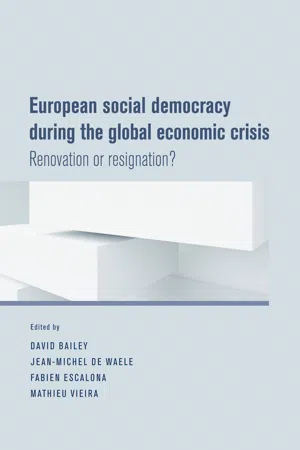
eBook - ePub
European social democracy during the global economic crisis
Renovation or resignation?
- 285 pages
- English
- ePUB (mobile friendly)
- Available on iOS & Android
eBook - ePub
European social democracy during the global economic crisis
Renovation or resignation?
About this book
Information
1
Introduction
The global economic crisis (GEC) began as a housing market crisis in 2007, and rapidly developed into the subprime crisis before subsequently transforming (with the collapse of Lehman Brothers in 2008) into a global financial crisis. From that point, it morphed into a prolonged Great Recession that has seen growth stagnate across the developed world since 2009, and has simultaneously been accompanied by the Euro-zone crisis and severe fiscal and monetary instability for both the PIIGS member states and the Euro as a whole. In terms of centre-left social democratic party politics, however, what has perhaps been most notable throughout this period is the coexistence of two contrasting trends. On the one hand, prominent social democrats and social democratic parties have been repeatedly looked to as the political vehicle through which a coherent crisis resolution could and should be coordinated (see, for instance, the contributions to Callaghan et al., 2009). Financial regulation, housing market regulation, fiscal reflation and redistribution, quantitative easing, a tempering of austerity measures and the defence of the welfare state have been consistently identified as part of a centre-left, social democratic response to the crisis that could and/ or should be adopted as a means of tackling the clear examples of market failure witnessed over the past decade. This, so the argument goes, represents a viable alternative to the current range of policy responses – which essentially (especially in the European context) amounts to a neo-liberal remedy to cure a crisis caused by neo-liberalism. On the other hand, and despite widespread anticipation for a social democratic remedy, we have also witnessed repeated frustration that empirically such a response has consistently failed to materialise (on this mismatch between social democratic expectations and outcomes, see also Bailey and Bates, 2012: 195–6). This frustration was perhaps most clearly visible in the surprise that met the decline in social democratic votes in the 2009 European Parliament. But it also met the ejection from office of the British Labour Party, the Spanish Socialist Workers’ Party (PSOE), and the massive decline in electoral support for PASOK in Greece. In the view of many observers, social democratic parties have responded (or, rather, failed to respond) to the global economic crisis (GEC) with a continuation of the capitulation to neo-liberalism that also characterised the social democratic party family during the pre-2007 period. This coexists with a corresponding inability by social democratic parties to appeal to an electorate that desires a coherent and progressive alternative.
This therefore represents something of a paradox. Despite a crisis of neo-liberalism, no clear and viable social democratic alternative appears to have (thus far) been forthcoming. Of course, some might respond that this nonsocial democratic response is to be expected, particularly given the widespread jettisoning of traditional social democratic values during the move to ‘third way’ social democracy, which most social democratic parties actively embraced. Nevertheless, the pro-market position adopted by social democratic parties during the ‘third way’ period was more often than not legitimated through a ‘logic of no alternative’ discourse (Watson and Hay, 2003), according to which social democratic parties presented the jettisoning of some of their core aims as part of a wider attempt to ensure their continued relevance (and that of their remaining social democratic values) to contemporary politics (Klitgaard, 2007). From this perspective, the global economic and financial crisis creates a potential opportunity to question the ‘logic of no alternative’. The paradox, therefore, is that so few social democratic parties have seemingly taken up this opportunity. While it would be simplistic to expect an ‘automatic’ resurgence of support for, or the renewed promotion of, a revived centre-left programme, it is nevertheless the case that the historic episode of the Great Depression of the 1930s has taught us that social democrats have in the past proved able to welcome and conceive of new ideas, and in some cases to implement them in the context of prolonged economic crisis (in Scandinavia in particular) (Blyth, 2002; Ryner, 2002). In addition, we have seen some centre-left parties returning to power after 2008, in some cases on an agenda that proclaimed a forthcoming leftward shift. The election of François Hollande is perhaps the most obvious example. Although in this case it is not clear that the record in office matches the ambitions held while out of office.
The present book therefore seeks to address an apparent dilemma facing social democracy and social democratic parties. The opportunities seem ripe for social democratic alternatives, but no such viable alternative appears to be forthcoming. This raises a number of questions. Is social democracy even capable of producing a response to the GEC that will see its renovation and rejuvenation as a political movement able to mobilise support for a coherent and progressive alternative to neo-liberalism’s crisis? Or are we witnessing (and likely to continue to witness) a sustained incapacity by social democratic parties and a continued resignation in the face of an apparently hegemonic neo-liberal global economic (dis)order?
In opting to focus on social democratic parties in the European context we seek to explore the point at which this dilemma is perhaps most pronounced: social democratic parties have been historically strong within Europe; the European Union has often been noted as a means by which social democracy could overcome some of the problems associated with ‘globalisation’; and the European integration project itself is currently in crisis (thereby potentially creating a new set of opportunities for change). The book therefore hopes to consider ways in which European social democratic parties – at both the national and European level – have responded to the GEC, and the extent to which we might envisage alternatives to the neo-liberal consensus being successfully promoted by those parties within the European Union. We have also chosen to select our cases from ‘western Europe’ – i.e. we include no country cases from the 2004–07 EU accession. This reflects our desire to consider those social democratic parties with the strongest historical tradition of social democracy, considered particularly in terms of their commitment to reformism, Keynesianism and parliamentarism – with social democratic parties absent from eastern Europe prior to 1989, we have chosen not to focus there. The book is therefore focused in large part upon western Europe, due in part to its being in many ways the ideological and historical centre of social democracy. Of the West European countries, perhaps most notable by its absence is the Italian case. Indeed, we decided not to include a chapter on Italy due largely to problems in terms of categorising a social democratic party within that country. Thus, the dominant historic left party in Italy was, throughout most of the post-war period, the Italian Communist Party (PCI). This has subsequently morphed into the Democratic Party, itself not a straightforward social democratic party.
Social democracy and economic crisis: a historical relationship?
The question of social democracy’s response to the GEC can also be situated historically. Commentators have commonly identified the Great Depression as the period during which ‘traditional’ social democracy was first formulated. Thus, the failure of democratic capitalism to produce either stable democracy or stable capitalism during the inter-war period has been shown by scholars such as Mark Blyth (2002) and Sheri Berman (2006) to have been a prompt for social democratic actors to experiment with new policy responses that would both (in a mutually dependent way) stabilise capitalism through the Keynesian solution of reflationary measures that simultaneously redistribute resources to social democracy’s core industrial working-class constituents.
It is perhaps this experience – of social democratic parties constructing a coherent ‘Keynesian’ macroeconomic programme, as a response to, and in the light of, the Great Depression – that continues to most inform the current commonly held anticipation that the GEC will witness a similarly coherent social democratic response emerge in an attempt to counter the recurrent bouts of economic crisis, stagnation and austerity measures that characterise the present. If Polanyi’s ‘double movement’ could emerge out of the Great Depression and crystallise in the form of the traditional, Keynesian, social democratic party programme, so this reasoning goes, so we should expect and anticipate another ‘double movement’, again led by social democratic parties, in response to the current GEC. Others, meanwhile, have been less optimistic. As Nancy Fraser has argued, the lack of political leadership on the left, the disorganised state of the working class, and the absence of a territorialised (nation state) authority through which to focus demands for renewed social protection, have each been cited as reasons for the absence of a so-called ‘double movement’ during the present crisis. Further still, Fraser highlights how the political terrain has changed since the 1930s, in that political movements and social struggles are now far more attuned to the limitations of a strategy focused solely on social protection without an equally keen awareness of the risks of introducing other forms of inequalities and hierarchies apart from those arising solely from economic relations and ‘commodification’. A desirable response, therefore, is perhaps more likely to be a ‘triple movement’ that is able to combine social protection with emancipation from gender, race, and other ‘identity’-based forms of dominance (Fraser, 2013).
For others still, the ‘double movement’ (at least at the point at which it is institutionalised in the form of a coherent social democratic response) is something to be avoided rather than sought. From this perspective, the labour movement’s turn to parliamentarism and the pursuit of office represents a dampening and co-optation of what could otherwise have been a vibrant movement for radical social change. Thus, as Piven and Cloward show in the case of the United States, the turn during the inter-war years towards an institutionalised labour movement also brought with it an electoralism that undermined the movement’s social power and leverage.
Union leaders became more dependent on the Democratic Party (for prominence, not concessions) than the party was on them. Acting accordingly, union leaders promoted partisan allegiance, and by doing so, blunted the electoral impact of worker discontent. The unions became the legitimate political voice of industrial workers, and that legitimate voice spoke out repeatedly against strikers, and in support of Democratic leaders. (Piven and Cloward, 1979: 171)
Similarly, in the case of the British Labour Party, Ralph Miliband highlights the debilitating effect of entering Parliament upon the nascent workers’ movement that had become energised by the General Strike and Great Depression. Thus, upon their election to Parliament, socialists and radical members of the Labour Party found themselves, ‘effectively contained by their own leaders, who held that containment to be one of their prime tasks’ (Miliband, 1961: 95). This need to appear electable, respectable and ‘fit to govern’ was also quickly internalised by the militants themselves. Indeed, as Miliband documents, the radicals found themselves in Parliament faced with a culture that acted to subdue and dampen their earlier anger and indignation. In the words of the so-called ‘wild man’ Labour MP, David Kirkwood, the simple, friendly and pleasant nature of opponent MPs within the House of Commons, ‘pierced a link in my armour that had never been pierced before’ (quoted in Miliband, 1961: 96).
The historical relationship between economic crisis and social democracy is therefore both intrinsic and far from straightforward. Whether we are likely to see a second Keynesian consensus emerge from the crisis remains moot empirically; and whether we should seek such an outcome remains contested normatively and strategically. The contributors to the present volume each contribute to these ongoing debates, especially in their empirical assessment of social democratic parties’ response thus far to the crisis, and the implications this has for social democratic and broader left strategy for the future.
Social democracy during the global economic crisis
In terms of evaluating the social democratic response to the GEC, there are perhaps three (interrelated) dimensions that demand our attention: electoral performance, programmatic change, and the experience of office and/or opposition. First, in terms of electoral trends, we are interested in the response of the electorate to social democratic parties during the course of the crisis. In particular, we want to know whether the electorate has turned either towards or against social democratic parties as a result of the GEC. Second, in terms of programmatic developments, we are interested in the policies that have been advocated and/or implemented by social democratic parties in the light of the GEC. In particular, we want to understand whether policies adopted by social democratic parties have taken on a progressive character – i.e. that they potentially form an alternative to the prevailing neo-liberal consensus of the past three or four decades – or whether we see a (continued) capitulation of social democratic values. Finally, in terms of the experience of being in office and/or opposition, we are interested in how the social democratic agenda has fared in terms of parties in office and their ability to circumnavigate the constraints that unavoidably characterise the present crisis context. We seek an assessment of the degree to which being in opposition creates new opportunities for social democratic parties. We also need an analysis that is able to connect developments in each of these spheres: how does party policy (developed either in office or in opposition) translate into electoral viability for social democratic parties; what can social democratic parties achieve programmatically with strong (or weak) electoral support in the current context? Each of these questions forms the basis for the discussion of the rest of the book. However, we can nevertheless offer here our own initial (unavoidably superficial) mapping of these developments.
In terms of electoral performance, an overview suggests that social democratic parties have fared badly as a result of the GEC. As Table 1.1 highlights, in the large majority of countries in western Europe (except for France, Ireland and the Netherlands), the onset of global economic crisis has been accompanied by a decline in electoral support. Overall, we witness a decline by 4.7 percentage points in the average electoral support experienced by social democratic parties in western Europe during this period. Similarly, as we shall see, the experience of programmatic developments does not represent a source of optimism for those anticipating some kind of Polanyian ‘double movement’. To an extent this varies in terms of whether the social democratic party is in office or in opposition (for details, see Table 1.2) – with those in opposition arguably being more inclined towards experimenting with a more progressive position (although note the case of Sweden, where we witness an oscillation between the left and right wings of the social democratic movement), and those in office tending towards a more acquiescent approach towards the purported logic of ‘no alternative’ to austerity as the so-called ‘solution’ to stagnation and fiscal crises. This trend is perhaps most clearly visible in the single case of the French Parti Socialiste and its changing programmatic agenda before and after entering office. This also possibly explains the ability of the Party of European Socialists to adopt one of the clearest moves towards a coherent and progressive alternative to neo-liberalism – i.e. that the absence of a clear partisan supranational government ensures a near-permanent experience of opposition for the PES.
While there is clear variation between countries, therefore, the current volume sugges...
Table of contents
- Cover
- Half Title
- Title Page
- Copyright
- Contents
- List of tables
- List of contributors
- Acknowledgements
- List of abbreviations
- 1 Introduction: David J. Bailey, Jean-Michel De Waele, Fabien Escalona and Mathieu Vieira
- Part I The political economy of European social democracy under global economic crisis
- Part II National responses to crisis
- Part III Towards a social democratic European Union?
- Index
Trusted by 375,005 students
Access to over 1.5 million titles for a fair monthly price.
Study more efficiently using our study tools.
Frequently asked questions
Yes, you can cancel anytime from the Subscription tab in your account settings on the Perlego website. Your subscription will stay active until the end of your current billing period. Learn how to cancel your subscription
No, books cannot be downloaded as external files, such as PDFs, for use outside of Perlego. However, you can download books within the Perlego app for offline reading on mobile or tablet. Learn how to download books offline
Perlego offers two plans: Essential and Complete
- Essential is ideal for learners and professionals who enjoy exploring a wide range of subjects. Access the Essential Library with 800,000+ trusted titles and best-sellers across business, personal growth, and the humanities. Includes unlimited reading time and Standard Read Aloud voice.
- Complete: Perfect for advanced learners and researchers needing full, unrestricted access. Unlock 1.5M+ books across hundreds of subjects, including academic and specialized titles. The Complete Plan also includes advanced features like Premium Read Aloud and Research Assistant.
We are an online textbook subscription service, where you can get access to an entire online library for less than the price of a single book per month. With over 1.5 million books across 990+ topics, we’ve got you covered! Learn about our mission
Look out for the read-aloud symbol on your next book to see if you can listen to it. The read-aloud tool reads text aloud for you, highlighting the text as it is being read. You can pause it, speed it up and slow it down. Learn more about Read Aloud
Yes! You can use the Perlego app on both iOS and Android devices to read anytime, anywhere — even offline. Perfect for commutes or when you’re on the go.
Please note we cannot support devices running on iOS 13 and Android 7 or earlier. Learn more about using the app
Please note we cannot support devices running on iOS 13 and Android 7 or earlier. Learn more about using the app
Yes, you can access European social democracy during the global economic crisis by David J. Bailey,Jean-Michel De Waele,Fabien Escalona,Mathieu Vieira,Jean-Michel de Waele,Fabien Escalona,Mathieu Vieira, David J. Bailey, Jean-Michel De Waele, Fabien Escalona, Mathieu Vieira in PDF and/or ePUB format, as well as other popular books in Politics & International Relations & Economic Conditions. We have over 1.5 million books available in our catalogue for you to explore.