In a world of increasing austerity measures, democratic politics comes under pressure. With the need to consolidate budgets and to accommodate financial markets, the responsiveness of governments to voters declines. However, democracy depends on choice. Citizens must be able to influence the course of government through elections and if a change in government cannot translate into different policies, democracy is incapacitated.
Many mature democracies are approaching this situation as they confront fiscal crisis. For almost three decades, OECD countries have - in fits and starts - run deficits and accumulated debt. As a result, an ever smaller part of government revenue is available today for discretionary spending and social investment and whichever party comes into office will find its hands tied by past decisions. The current financial and fiscal crisis has exacerbated the long-term shrinking government discretion; projects for political change have lost credibility. Many citizens are aware of this situation: they turn away from party politics and stay at home on Election Day.
With contributions from leading scholars in the forefront of sociology, politics and economics, this timely book will be of great interest to students and scholars throughout the social sciences as well as general readers.
eBook - ePub
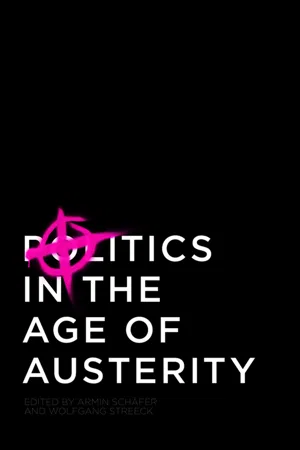
Politics in the Age of Austerity
- English
- ePUB (mobile friendly)
- Available on iOS & Android
eBook - ePub
Politics in the Age of Austerity
1
Introduction: Politics in the Age of Austerity
Armin Schäfer and Wolfgang Streeck

Democracy depends on choice. Citizens must be able to influence the course of government through elections. If a change in government cannot translate into different policies, democracy is incapacitated. Many mature democracies may well be approaching such a situation as they confront fiscal crisis. For almost three decades, OECD countries have – in fits and starts – run deficits and accumulated debt. Rising interest payments and welfare-state maturation have meant that an ever smaller part of government revenue is available today for discretionary spending and social investment. Whichever party comes into office will find its hands tied by past decisions. The current financial and fiscal crisis has only exacerbated the long-term shrinking of the room governments have to manoeuvre. As a consequence, projects for policy change have lost credibility – at least if they imply the redistribution of resources from old purposes to new ones. This is clearly the situation in those countries that were hit hardest by the ‘Second Great Contraction’ (Reinhart and Rogoff 2009). In Ireland, Italy, Portugal, Spain and of course Greece, governments of any colour will for decades be forced to cut and hold down spending.
In a number of farsighted articles, Pierson has outlined what he calls a ‘fiscal regime of austerity’ (Pierson 2001a, 2001b). Permanent austerity, according to Pierson, results when the ability to generate revenues is limited while at the same time spending needs to increase. In the 1990s, three causes came together that were not present in the decades immediately following the Second World War: diminished growth rates, the maturation of welfare states and an aging population. The diminished growth rates had their start in the mid-1970s, and since then rates have been lower on average than during the trente glorieuses. After the ‘easy financing era’ (Steuerle 1996: 416) had come to an end, revenues increased more slowly and, with few exceptions, public expenditure since then has exceeded government receipts (Streeck and Mertens, chapter 2 in this volume). In principle, governments could have counteracted this tendency through higher taxes. However, growing international tax competition has rendered it more difficult to raise taxes on companies and top income earners (see Genschel and Schwarz, chapter 3 in this volume). At the same time, taxing ordinary citizens more heavily through higher indirect taxes and social security contributions has become politically more costly, since real wages have also grown more slowly, if at all, than in the past (Pierson 2001b: 62).
On the expenditure side, Pierson emphasizes the ‘maturation’ of the welfare state and demographic change, both of which he suggests are bound to keep expenditure at high levels. Welfare-state maturation means that today a much larger share of the population is entitled to receive pensions than when public pension programmes were created. In the beginning, a very limited number of people qualified for benefits, while the working population financed the welfare state through (payroll) taxes. This favourable demographic profile changes, however, once the first generation of contributors retires (Pierson 2001b: 59). What is more, in an aging society people will receive benefits for a longer period of time, whereas the number of contributors will stagnate or even shrink. In combination, these long-term trends lead to a mismatch of spending obligations and public revenue.
The financial and subsequent economic crisis of recent years has resulted in a vast deterioration in public finances. In all OECD countries except Norway, Sweden and Switzerland, the need to save banks and jobs has meant a sharp rise in public debt (figure 1.1). In some countries, it has more than doubled since the onset of the crisis, surpassing 100 per cent of GDP in eight countries in 2012 (Obinger 2012).1 High levels of public debt make it even more difficult to allocate resources from old to new purposes, since mandatory expenditures will tend to consume almost the entire budget. This puts pressure on governments to make unpopular choices. ‘Responsible’ or, for that matter, fiscally prudent choices may be at odds with citizens’ needs and demands, in effect rendering governments less responsive to their constituencies (Mair, chapter 6 in this volume).
In parallel with the faltering capacity for discretionary spending, public fatigue with democratic practice and core institutions has grown. Turnout in parliamentary elections has been declining almost everywhere (Franklin 2004); electoral volatility is rising (Mair 2006); trust in politicians, parties and parliaments is on the decline (Putnam et al. 2000); party membership is collapsing (Van Biezen et al. 2012); and there is a noticeable gap between democratic aspirations and satisfaction with the way democracy actually works (Norris 2011). As opposition parties in heavily indebted countries can no longer promise not to cut expenditure in order to consolidate public finances, electoral choice becomes limited. At the same time, new anti-establishment parties have emerged or have gained new impetus in many countries (Norris 2005; Berezin, chapter 10 in this volume), and incumbent parties are finding it more difficult than in the past to stay in office. This book investigates what mechanisms may be at work to link rising debt and democratic disaffection. In this introduction, we focus more narrowly on the link between debt and falling turnout. After discussing each trend separately in the next two sections, we will discuss a number of direct and indirect pathways that seem to connect the two trends.
Figure 1.1: Increase in sovereign debt during the financial crisis, 2008–2012

Source: OECD Economic Outlook No. 90.
1 Rising debt
While the fiscal crisis of today’s rich democracies became apparent only after 2008, it has long been in the making. Since the 1970s, almost all OECD countries have had to borrow money to cover a chronic gap between public expenditure and public revenue, resulting in a steady increase in public debt. Like declining electoral participation, rising indebtedness was also observed throughout the OECD: in Social Democratic Sweden as well as in the Republican United States; in ‘liberal market economies’ such as the UK and in ‘coordinated’ ones such as Germany, Japan and Italy; in presidential as well as parliamentary democracies; under first-past-the post systems and under proportional representation; and in competitive as much as in one-party democracies such as Japan.
Figure 1.2: Government debt as a percentage of GDP, seven countries, 1970–2010

Source: OECD Economic Outlook No. 87.
Figure 1.2 shows the more or less steady rise of public debt as a percentage of GDP for seven selected countries over four decades, with the United States and the United Kingdom as the prototypical Anglo-American democracies, Japan as the leading capitalist democracy in Asia, France and Germany standing for the ‘Rhineland capitalism’ of continental Europe, Italy representing the Mediterranean pattern, and Sweden exemplifying the Scandinavian one. While there are differences between the seven curves, the overall trend is the same for all of them, and indeed for the OECD as a whole (figure 1.3). Initial questions as to whether rising debt levels were ‘sustainable’ in the longer term came up as early as the late 1970s in several countries, and there were various attempts by economists to determine a maximum level of debt beyond which macro-economic performance would suffer. In the meantime debt continued to increase, however, falsifying successive claims that the debt build-up had hit a ceiling.
Figure 1.3: Government debt as a percentage of GDP, OECD average, 1970–2010

Note: Countries included in unweighted average: Austria, Belgium, Canada, France, Germany, Italy, Japan, Netherlands, Norway, Sweden, UK, US.
Source: OECD Economic Outlook No. 90.
In the 1990s, led by the United States under the Clinton administration, an OECD-wide attempt was made to consolidate public budgets, mostly through privatization and cuts in social welfare spending, with the hope of using the post-1989 ‘peace dividend’ towards fiscal relief. It was at this time that Pierson saw a new age of permanent austerity on the horizon, one in which public spending would be cut back to match stagnant or even declining tax revenue. Much hope was placed by economists and political leaders, increasingly including those on the left, in institutional reforms of national parliaments’ budgeting procedures, as strongly propagated by international organizations. Apart from Sweden, however, which went through a dramatic financial-cum-fiscal crisis in the mid-1990s (see Steinmo, chapter 4 in this volume), and the United States, which by the end of the century was running a budget surplus, not much was achieved. It is important to keep in mind that the latest jump in public debt (which wiped out the gains of the – politically very costly – consolidation efforts of the 1990s and early 2000s almost completely) was caused by the financial crisis of 2008 turning into a fiscal crisis when governments needed to rescue financial institutions that had been allowed to become ‘too big to fail’ and had to reinflate the ‘real economy’ through ‘Keynesian’ deficit spending.
Figure 1.4: The causes of the fiscal crisis

Naturally there has been and continues to be discussion on the causes of the long-drawn build-up of public debt in an entire family of countries in the absence of major wars. On the surface, we may observe that indebtedness began to develop with the end of the postwar growth period in the late 1960s (figure 1.4). At this time public expenditure continued to increase, while the rising taxation that had accompanied it up to this point began to come to an end (figure 1.5). The 1970s was a period of high inflation throughout the industrialized capitalist world, which for a while served to devalue national debt burdens, just as growth had in the preceding period. When OECD countries, under the leadership of the Federal Reserve Bank of the United States, ended inflation in the early 1980s, however, three developments coincided to push up public debt. First, structural unemployment ensued almost everywhere, resulting in rising demand on the coffers of the welfare state. Second, the end of ‘bracket creep’ – the automatic advancement of taxpayers with nominally increasing incomes to higher tax rates under progressive taxation – made for rising tax resistance. And third, with lower nominal growth rates, in addition now to continuously lower real growth, past debt was no longer devalued with time. At this point, monetary stability encouraged holders of financial assets to lend money to governments, while governments felt encouraged to borrow by the low interest rates that followed the victory over inflation. Expanding asymmetries in international trade contributed as well. As surplus countries, first in the Middle East and later also in Asia, were seeking safe havens for their export earnings, the United States deregulated its financial industry to attract and absorb foreign capital, in an effort to finance the country’s double deficit. Financial deregulation then resulted in the crash of 2008, which led to further accumulation of public debt and became the proximate cause of the current fiscal crisis in most advanced capitalist countries.
Figure 1.5: Government expenditure and revenue, as a percentage of GDP, seven countries, 1970–2010

Note: a Estimate.
Source: OECD Economic Outlook No. 87.
Expectations of an impending ‘fiscal crisis of the state’ have been around for some time (O’Connor 1973; Bell 1976). In the public finance theory tradition, the anticipated problem was that the revenue the ‘tax state’, or Steuerstaat (Goldscheid 1926; Schumpeter 1991 [1918]), would over time be able to raise (‘confiscate’) in a democratic-capitalist society whose assets were mostly privately owned would not be enough to cover the growing collective needs that social and economic progress were expected to generate. One can easily recognize the background to this argument in nineteenth-century debates on the future of capitalism and industrialism, where bourgeois-conservative Kathedersozialisten such as Adolph Wagner (with his ‘law of expanding state activity’) agreed with the Marxian diagnosis of a growing ‘socialization of production’ (Vergesellschaftung der Produktion) that required more and more collective regulation and support.2 It was only ...
Table of contents
- Cover
- HalfTitle
- TitlePage
- Copyright
- Content
- Contributors
- 1 Introduction: Politics in the Age of Austerity Armin Schäfer and Wolfgang Streeck
- 2 Public Finance and the Decline of State Capacity in Democratic Capitalism Wolfgang Streeck and Daniel Mertens
- 3 Tax Competition and Fiscal Democracy Philipp Genschel and Peter Schwarz
- 4 Governing as an Engineering Problem: The Political Economy of Swedish Success Sven Steinmo
- 5 Monetary Union, Fiscal Crisis and the Disabling of Democratic Accountability Fritz W. Scharpf
- 6 Smaghi versus the Parties: Representative Government and Institutional Constraints Peter Mair
- 7 Liberalization, Inequality and Democracy’s Discontent Armin Schäfer
- 8 Participatory Inequality in the Austerity State: A Supply-Side Approach Claus Offe
- 9 From Markets versus States to Corporations versus Civil Society? Colin Crouch
- 10 The Normalization of the Right in Post-Security Europe Mabel Berezin
- 11 The Crisis in Context: Democratic Capitalism and its Contradictions Wolfgang Streeck
- Notes
- Index
Trusted by 375,005 students
Access to over 1.5 million titles for a fair monthly price.
Study more efficiently using our study tools.
Frequently asked questions
Yes, you can cancel anytime from the Subscription tab in your account settings on the Perlego website. Your subscription will stay active until the end of your current billing period. Learn how to cancel your subscription
No, books cannot be downloaded as external files, such as PDFs, for use outside of Perlego. However, you can download books within the Perlego app for offline reading on mobile or tablet. Learn how to download books offline
Perlego offers two plans: Essential and Complete
- Essential is ideal for learners and professionals who enjoy exploring a wide range of subjects. Access the Essential Library with 800,000+ trusted titles and best-sellers across business, personal growth, and the humanities. Includes unlimited reading time and Standard Read Aloud voice.
- Complete: Perfect for advanced learners and researchers needing full, unrestricted access. Unlock 1.5M+ books across hundreds of subjects, including academic and specialized titles. The Complete Plan also includes advanced features like Premium Read Aloud and Research Assistant.
We are an online textbook subscription service, where you can get access to an entire online library for less than the price of a single book per month. With over 1.5 million books across 990+ topics, we’ve got you covered! Learn about our mission
Look out for the read-aloud symbol on your next book to see if you can listen to it. The read-aloud tool reads text aloud for you, highlighting the text as it is being read. You can pause it, speed it up and slow it down. Learn more about Read Aloud
Yes! You can use the Perlego app on both iOS and Android devices to read anytime, anywhere — even offline. Perfect for commutes or when you’re on the go.
Please note we cannot support devices running on iOS 13 and Android 7 or earlier. Learn more about using the app
Please note we cannot support devices running on iOS 13 and Android 7 or earlier. Learn more about using the app
Yes, you can access Politics in the Age of Austerity by Wolfgang Streeck, Armin Schäfer, Wolfgang Streeck,Armin Schäfer in PDF and/or ePUB format, as well as other popular books in Economics & Political Economy. We have over 1.5 million books available in our catalogue for you to explore.