What was a Buddhist monk doing at the 2014 World Economic Forum in Davos lecturing the world's leaders on mindfulness? Why do many successful corporations have a 'chief happiness officer'? What can the chemical composition of your brain tell a potential employer about you? In the past decade, governments and corporations have become increasingly interested in measuring the way people feel: 'the Happiness index', 'Gross National Happiness', 'well-being' and positive psychology have come to dominate the way we live our lives. As a result, our emotions have become a new resource to be bought and sold.
In a fascinating investigation combining history, science and ideas, William Davies shows how well-being influences all aspects of our lives: business, finance, marketing and smart technology. This book will make you rethink everything from the way you work, the power of the 'Nudge', the ever-expanding definitions of depression, and the commercialization of your most private feelings. The Happiness Industry is a shocking and brilliantly argued warning about the new religion of the age: our emotions.
eBook - ePub
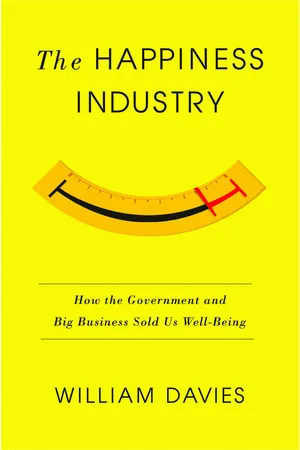
The Happiness Industry
How the Government and Big Business Sold Us Well-Being
- 320 pages
- English
- ePUB (mobile friendly)
- Available on iOS & Android
eBook - ePub
About this book
Information
1
Knowing How You Feel
Jeremy Bentham was sitting in Harper’s Coffee Shop in Holborn, London, when he shouted, ‘Eureka!’ The prompt was not some intellectual inspiration from within, as it had been when Archimedes immortalized the exclamation from his bath, but a passage from a book, Essay on Government, by the English religious reformer and scientist Joseph Priestley. The passage was this:
The good and happiness of the members, that is, the majority of the members, of any state, is the great standard by which everything relating to that state must finally be determined.
Bentham was eighteen years old and the year was 1766. Over the next sixty years, he took Priestley’s insight and converted it into an extensive and hugely influential doctrine of government: utilitarianism. This is the theory stating that the right action is whichever one produces the maximum happiness for the population overall.
There is something telling about the fact that Bentham’s ‘eureka’ moment was not a matter of great intellectual originality. Nor did he ever claim to be much of a philosophical pioneer. In addition to Priestley’s influence, Bentham was content to admit that much of his account of human nature and motivation was lifted from the Scottish philosopher David Hume.1 He had little interest in producing new theories or weighty philosophical tomes, and never took much enjoyment in writing. As far as Bentham was concerned, there was a limit to what any idea or text could hope to achieve when it came to the political or social improvement of mankind. Merely believing that ‘the greatest happiness of the greatest number’ should be the goal of politics and ethics was of little consequence, unless a set of instruments, techniques and methods could be designed to turn this belief into the founding principle of government.
Rather than as an abstract thinker, Bentham is best understood as half philosopher and half technician, and from this various contradictions followed. He was an intellectual with a classically English distaste for intellectualism. A legal theorist, who believed that much of what law rested on was simple nonsense. An Enlightenment optimist and modernizer, who scoffed at any notion of inherent human rights or freedoms. And an advocate for hedonism, who insisted that every pleasure be neurotically accounted for. Reports of his personality vary wildly, with some discovering a man of great warmth and humility, and others one who was vain and dismissive.
Bentham’s relationship with his father caused him considerable misery. He was a weak, shy and often unhappy child, and appears to have been bullied into the status of a child prodigy by his father, who insisted on teaching him Latin and Greek from the age of five. He attended Westminster School but was made miserable by being the smallest boy there. Aged twelve, Bentham went to Oxford, where he was drawn towards chemistry and biology. If anything, he was even less happy at university than at school. He established a small chemistry laboratory in his room and felt a strong affinity for the natural sciences, which he pursued throughout his teens. With a less domineering father, this would no doubt have provided him with the intellectual satisfaction that his mathematical mind was seeking. But his father was a lawyer and insisted his son follow in his footsteps in order to earn a decent income. Under duress, he became a barrister in London’s Lincoln’s Inn.
Practising law did not make Bentham happy, and nor did the continued influence of his father. His shyness made him dread having to stand up and speak in court. Perhaps he still longed for his homemade chemistry laboratory. He certainly pined for emotional and sexual intimacy, but when he fell in love in his early twenties, yet again his father stood in his way, vetoing the relationship on the basis that the woman in question wasn’t rich enough. In this conflict between love and money, the measurable thwarted the immeasurable. Later in life, Bentham would be an outspoken advocate for sexual freedoms, including the tolerance of homosexuality, which he saw as an inevitable component of the maximization of human pleasure.2
His career, as it developed from his arrival at Lincoln’s Inn, was always a compromise, between the professional and moral injunctions imposed by his father, and the scientific and political urges that drove him from within. The law would indeed become the field in which he made his name, but never as his father intended. Instead, he set about criticizing law, ridiculing its language, demanding more rational alternatives and designing policies and instruments through which government could finally escape the philosophical nonsense of abstract moral principles. This stance did not make him rich, and Bentham ended up financially dependent on a stipend from his father, whose disappointment in his failed barrister son never lifted.
There were times when Bentham the technician overshadowed Bentham the philosopher. During the 1790s his activities were those of what we might now associate with a public sector management consultant. He spent much of this period designing exotic schemes and technologies, which he believed could improve the efficiency and rationality of the state. He wrote to the Home Office suggesting that the various departments of government be linked up by a set of ‘conversation tubes’ for better communication. He drew up plans for what he termed a ‘fridgarium’, to keep food fresh. And he wrote to the Bank of England with the blueprint for a printing device that would produce unforgeable bank notes.
This engineer’s vocation was integral to his vision of a more rational form of politics. It drove many of his more famous policy proposals, such as the ‘Panopticon’ prison, which was very nearly signed into English law during the 1790s before falling by the wayside. During the late 1770s, Bentham began to write on the topic of punishment, specifically because punishment seemed to offer a rational means of influencing human behaviour, if it could target the natural psychological propensity to pursue pleasure and avoid pain. This was never a merely academic or theoretical issue, and very little of this writing was published until several years later. His goal was always to achieve reform of public policy. But this did require a little deeper thinking about the nature of human psychology.
The science of happiness
Bentham was a fierce critic of the legal establishment, but he was scarcely much more sympathetic to the radical and revolutionary movements which were erupting elsewhere. Confronted by the political claims of the French and American revolutionaries, Bentham was scornful. ‘Natural rights is simple nonsense’, he declared, ‘natural and imprescriptible rights, rhetorical nonsense – nonsense upon stilts.’3 When radical philosophers such as Thomas Paine appealed to such ideas, they were making the identical mistake that monarchs or religious leaders made when they claimed some divine or magical sanction for their actions: they were talking about something which had no tangible existence.
Bentham’s alternative was to ground political and legal decision-making in hard, empirical data. In that respect, he was the inventor of what has since come to be known as ‘evidence-based policy-making’, the idea that government interventions can be cleansed of any moral or ideological principles, and be guided purely by facts and figures. Whenever a policy is evaluated for its measurable outcomes, or assessed for its efficiency using cost-benefit analysis, Bentham’s influence is present.
The great advances of the natural sciences, as he saw it, derived from the ability to avoid the meaningless use of language. Politics and the law had to learn this lesson. In Bentham’s view, every noun either refers to something ‘real’ or something ‘fictitious’ – but we often fail to notice the difference. Words such as ‘goodness’, ‘duty’, ‘existence’, ‘mind’, ‘right’, ‘wrong’, ‘authority’ or ‘cause’ might mean something to us, and they have come to dominate philosophical discourse. But, as far Bentham was concerned, there is nothing which these words actually refer to. ‘The more abstract the proposition is’, he argued, ‘the more liable is it to involve a fallacy.’4 The problem is that we often mistake such propositions for reality.
By contrast, the language of natural science is organized in relation to physical, tangible things, which each word is attached to. But how would government or law be organized in this fashion? It is one thing for a chemist to attach names to specific compounds, but it is quite another for a judge or a government official to be quite so disciplined in their use of words. In any case, what are the physical, tangible things which make up politics? If politics is no longer to concern itself with abstract problems such as ‘justice’ or ‘divine right’, what will it concern itself with instead?
Bentham’s answer was happiness, thereby assuming that this entity was rooted in something ‘real’. But how? In what sense is the term ‘happiness’ any less fictitious than, say, ‘virtue’? To answer this, Bentham fell back on a form of naturalistic assertion. ‘Nature has placed mankind under the governance of two sovereign masters, pain and pleasure’, and that just happens to be a fact.5 Happiness itself may not be an objective, physical phenomenon, but it occurs as a result of various sources of pleasure, which have a firm, physiological basis.
Unlike many other things that arise in our minds, happiness is prompted by something real, something objective. It reminds us that we are biological and physical beings, with urges and fears, not unlike other animals. We can be scientific about happiness in a way that we simply can’t about virtually any other philosophical category. If such a science could be pursued, it would provide governments with an entirely new basis on which to design policies and laws, so as to improve the welfare of mankind in the only realistic or rational sense.
It’s possible to spot elements of Bentham’s own life experiences in this psychological theory of politics. Its premise was a tragic one, which spoke of its author’s own unhappiness: the one thing which all human beings hold in common is their capacity to suffer. Optimism could only lie in a wholesale reorientation of the state, towards the relief of suffering and the promotion of pleasure. Bentham was known to be unusually empathetic, often to a fault. His sensitive nature made him highly attuned to the unhappiness of others. One of the great virtues of utilitarianism, as a moral philosophy, is this empathetic dimension, its belief that we should take all others’ welfare as seriously as our own. Given that humans are not the only species that suffers, many utilitarians also extend this to animals.
With a better understanding of what motivates human psychology, policy-makers might be able to divert human activity towards the greatest happiness of all. The question of punishment captured so much of Bentham’s time and energy because it appeared to be the most effective tool in the possession of lawmakers when it came to steering individual activity in the optimal direction. ‘The business of government is to promote the happiness of society, by punishing and rewarding’, he argued.6 The free market, of which Bentham was an unabashed supporter, would largely take care of the reward part of this ‘business’; the state would take responsibility for the former part. To inflict pain on people, either via their bodies or their minds, was to bring politics into the realm of tangible reality, and to leave the world of linguistic illusions behind. As a vision of Enlightenment optimism goes, Bentham’s had a darker edge than most.
Bentham’s emphasis upon the brute reality of physical pain and his distrust of language can be seen as mutually reinforcing. The cultural historian Joanna Bourke has highlighted the fraught relationship between language and pain since the eighteenth century.7 Either pain seems to defy description altogether, or it has been treated as a taboo subject to be experienced silently. There is a long history of viewing sufferers, especially those of suspicious character, as exaggerating or wrongly describing pain. This assumes, as Bentham did, that there is an objective reality about pain which could be represented if only words or sufferers were better equipped to do so. This opens the way for experts to grasp or describe that reality, given the sufferer himself cannot, and for numbers to represent such feelings on the assumption that words cannot.
The science of happiness was therefore a critical component in achieving a rational form of politics and law. It could be used to divert behaviour towards goals that would be best for everyone. And as government became more scientific, so it would be able to predict how different interventions influenced individual choices. This is not ‘happiness’ in some ethereal or metaphysical sense, and certainly not in any ethical sense, as Aristotle had understood it. It was happiness in the sense of a physical occurrence within the human body. Contemporary neuroscience, which consummates this reduction of psychology to biological processes, would have looked to Bentham like the answer to all of our political and moral questions. Conversely, a great deal of contemporary scientific interest in the brain and behaviour has strongly Benthamite presuppositions.
This is well illustrated by one neuroscientific study published by a group of researchers at Cornell in 2014. Claiming to breach the ‘last frontier’ of neuroscience, namely the secrets of our inner feelings, the researchers argued that they had unlocked the ‘code’ through which the human brain deals with all different pleasures and pains. As the lead author explained:
It appears that the human brain generates a special code for the entire valence spectrum of pleasant-to-unpleasant, good-to-bad feelings, which can be read like a ‘neural valence meter’ in which the leaning of a population of neurons in one direction equals positive feeling and the leaning in the other direction equals negative feeling.8
This description of how pleasure and pain operate physically is more or less what Bentham had already assumed, posing questions as to how successfully neuroscience can ever hope to escape its protagonists’ cultural presuppositions. For scientists armed with measuring devices to discover that a bodily organ is also armed with measuring devices sounds like a coincidence to say the least.
The study touches upon one of the great controversies of utilitarianism, of whether diverse types of human experience can all be located on a single scale. The Cornell neuroscientists clearly believe that they can: ‘If you and I derive similar pleasure from sipping a fine wine or watching the sun set, our results suggest it is because we share similar fine-grained patterns of activity in the orbitofrontal cortex’. This is a relatively innocent remark when it is fine wine or sunsets that are at stake. But when profound experiences of love or artistic beauty are rendered equivalent to baser experiences, such as drug taking or shopping, the claim that all pleasures are computed in the orbitofrontal cortex in the same way becomes more problematic.
Philosophers refer to this argument, that all pleasures and pains can be located on a single scale, as ‘monism’. Bentham was the monist par excellence.9 He couldn’t deny that we speak of different varieties of happiness and contentment using different words, but the objective underpinning of all these forms was always the same – that is, physical pleasure. We naturally seek ‘benefit, advantage, pleasure, good or happiness, all of which ultimately comes to the same thing’.10 Likewise, suffering, rooted in the physical experience of pain, represents an entity that varies in quantity, but not quality.
Once we accept that there is a single, ultimate and physical sensation underlying all ‘good’ and ‘bad’ experiences and actions, then it follows that this sensation varies only in terms of quantity. Bentham never conducted any scientific research on the question but proposed a psychological model, detailing the different ways in which pleasure could vary in quantity. In his most famous statement on the topic, ‘Introduction to the Principles of Morals and Legislation’, he offered seven of these, most of which were easy to conceive of in quantitative terms.11 ‘Duration’ of pleasure was one relatively obvious quantitative category. ‘Certainty’ of future pleasure is something that we would now see as amenable to mathematical risk modelling. ‘Extent’ of the population affected by an action is another simple quantitative yardstick.
The main scientific stumbling block for Bentham’s entire enterprise was one category of variation in particular, namely ‘intensity’. How could a scientist, legislator, punisher or policy-maker know how intense a particular pleasure or pain was? Of course one might draw on one’s own experience through introspection, but that is scarcely a very scientific approach. Or one might ask people to report on their experiences using their own words. But then wouldn’t utilitarianism be drawn back into the hall of mirrors that is philosophical language, the ‘tyranny of sounds’ through which we describe what it is like to be human? Measuring the intensity of different pleasures and pains was the technical task on which the Benthamite project would stand or fall.
How to measure?
The eighteenth century was a time of great inventiveness in the creation of measurement tools. The thermometer was invented in 1724, the sextant (which measures angles between any visible objects, such as stars) in 1757, and the marine chronometer in 1761. The introduction of new measuring tools and standards was one of the first achievements of the French revolutionaries in the 1790s. This involved the commissioning of an original platinum metre, the famous mètre des archives, which was placed in a vault in the National Archives in Paris.
The need for reliable standardized measures cut to the heart of the Enlightenment, whose high point coincided with the ...
Table of contents
- Cover Page
- Halftitle Page
- Title Page
- Dedication
- Copyright Page
- Contents
- Preface
- 1. Knowing How You Feel
- 2. The Price of Pleasure
- 3. In the Mood to Buy
- 4. The Psychosomatic Worker
- 5. The Crisis of Authority
- 6. Social Optimization
- 7. Living in the Lab
- 8. Critical Animals
- Acknowledgements
- Notes
- Index
Trusted by 375,005 students
Access to over 1.5 million titles for a fair monthly price.
Study more efficiently using our study tools.
Frequently asked questions
Yes, you can cancel anytime from the Subscription tab in your account settings on the Perlego website. Your subscription will stay active until the end of your current billing period. Learn how to cancel your subscription
No, books cannot be downloaded as external files, such as PDFs, for use outside of Perlego. However, you can download books within the Perlego app for offline reading on mobile or tablet. Learn how to download books offline
Perlego offers two plans: Essential and Complete
- Essential is ideal for learners and professionals who enjoy exploring a wide range of subjects. Access the Essential Library with 800,000+ trusted titles and best-sellers across business, personal growth, and the humanities. Includes unlimited reading time and Standard Read Aloud voice.
- Complete: Perfect for advanced learners and researchers needing full, unrestricted access. Unlock 1.5M+ books across hundreds of subjects, including academic and specialized titles. The Complete Plan also includes advanced features like Premium Read Aloud and Research Assistant.
We are an online textbook subscription service, where you can get access to an entire online library for less than the price of a single book per month. With over 1.5 million books across 990+ topics, we’ve got you covered! Learn about our mission
Look out for the read-aloud symbol on your next book to see if you can listen to it. The read-aloud tool reads text aloud for you, highlighting the text as it is being read. You can pause it, speed it up and slow it down. Learn more about Read Aloud
Yes! You can use the Perlego app on both iOS and Android devices to read anytime, anywhere — even offline. Perfect for commutes or when you’re on the go.
Please note we cannot support devices running on iOS 13 and Android 7 or earlier. Learn more about using the app
Please note we cannot support devices running on iOS 13 and Android 7 or earlier. Learn more about using the app
Yes, you can access The Happiness Industry by William Davies in PDF and/or ePUB format, as well as other popular books in Business & Consumer Behaviour. We have over 1.5 million books available in our catalogue for you to explore.