- 248 pages
- English
- ePUB (mobile friendly)
- Available on iOS & Android
eBook - ePub
About this book
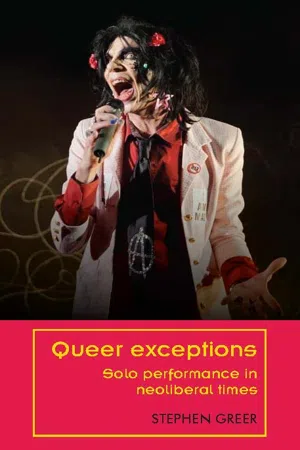
Queer exceptions is a study of contemporary solo performance in the UK and Western Europe that explores the contentious relationship between identity, individuality and neoliberalism. With diverse case studies featuring the work of La Ribot, David Hoyle, Oreet Ashery, Bridget Christie, Tanja Ostojic, Adrian Howells and Nassim Soleimanpour, the book examines the role of singular or 'exceptional' subjects in constructing and challenging assumed notions of communal sociability and togetherness, while drawing fresh insight from the fields of sociology, gender studies and political philosophy to reconsider theatre's attachment to singular lives and experiences. Framed by a detailed exploration of arts festivals as encapsulating the material, entrepreneurial circumstances of contemporary performance-making, this is the first major critical study of solo work since the millennium.
Information
Publisher
Manchester University PressYear
2018Print ISBN
9781526113702
9781526113696
eBook ISBN
9781526113726
Subtopic
Theatre1
Locating solo performance
Hannah Gadsby’s critically acclaimed show Nanette (2017) may or may not be her last work as a stand-up comedian. Toured internationally since its premiere at the Melbourne International Comedy Festival, the show presents a swansong to comedy in which Gadsby revisits material from earlier acts – most notably, jokes about her experiences of homophobia – to refuse the comedian’s obligation to deliver cathartic relief to an audience confronted with difficult topics. ‘I have a responsibility to make you laugh’, she offers at one point, ‘But I’m not in the mood’. In part, the show is structured as a masterclass in the convention of creating tension in order to diffuse it with a punchline. In the latter part of the hour, though, Gadsby deliberately abandons the pay-off in order to deconstruct comedy’s potentially ‘abusive’ relationship to its audience, and to call attention to the human cost of gender violence. Gadsby has had enough and, we are told, she is walking away from comedy: whatever balm was offered by performance in the past now threatens to make living with her life experiences more difficult. Perhaps ironically, Nanette has been a considerable commercial success: touring to sell-out performances at the Edinburgh Festival Fringe and for a month at the Soho Theatre, London, attracting multiple awards including the Helpmann Award for Best Comedy Performer, and recently recorded live at the Sydney Opera House for release on the streaming service Netflix. Though Nanette might challenge the demand for self-exploitation in stand-up, it also reflects Gadsby’s self-description as a comedian who likes ‘to take a story of woe from my actual factual life and make it hilarious’ (Gadsby 2017). If Nanette ultimately defers laughter for a critique of anger, it may do so in active recognition of a complicity which exists between an audience and industry’s appetite for a particular kind of comedy, and Gadsby’s willingness – if not desire – to create it.
This introductory chapter examines contemporary arts festivals as spaces which provide the most intense examples of the neoliberal economies within which solo performance is produced and consumed, and in which dynamics of self-exploitation are informed by the intersection of creative and economic imperatives. In doing so, I first locate the work of the contemporary solo performer in relation to the figure of the solitary, entrepreneurial arts worker. Though theatre-makers involved in the creation of solo performance are not necessarily solo workers – and are more frequently engaged in collective or collaborative labour with a range of others in different creative and administrative roles – the paradigm of individualised entrepreneurship nonetheless dominates the larger context in which contemporary performance is commissioned, produced and presented. Both product and driver of post-industrial economies, that field is defined by forms of immaterial and affective labour: work centred on the production of information, services, entertainment and culture rather than material goods. Accounts of affective labour as a form of postmodern immaterial labour developed through the work of Maurizio Lazzarato, Antonio Negri and Michael Hardt have emphasised the intangible quality of its products, even as the act of producing them ‘remains corporeal and intellectual’ (Hardt and Negri 2009: 132). Seeking to avoid ‘misrecognizing the ontological immateriality of performance, its ephemerality and disappearance’ with an inherent resistance of commodification, Bojana Cvejić and Ana Vujanović have argued for the need to treat performance as ‘a material artefact, being a product and commodity of the institutional market of the performing arts’ (in Puar 2012: 175). In turn, Gabriele Klein and Bojana Kunst’s introduction to ‘On Labour and Performance’ (a special issue of Performance Research) argues that any claim about the capacity of performance to ‘directly challenge the practices of value-circulation and production of subjectivity in contemporary capitalism’ (2012: 2) requires the critical contemplation of the proximity between performance and contemporary modes of labour.
In response, this chapter explores the material and organisational circumstances in which solo work is made to offer a structural analysis of the demand for artists to self-exploit as entrepreneurial individuals motivated by risk and characterised by a willingness to subsidise their own labour. While I will argue throughout this volume that the experience of contemporary neoliberalism is characterised by our complicity in its operation, this chapter’s particular examination of performance labour acknowledges the alluring and problematic belief that the arts play a pioneering role in the critique of capitalism (Abbing 2014) and the oftentimes romanticised ‘aesthetics of self-invention’ (Waldrep 2004) which surrounds popular conceptions of the artist. First tracing the key terms of entrepreneurialism in the arts – an aspect of what I will explore in later chapters as liberalism’s ‘excessive freighting’ of the individual with self-making agency (Brown 2006: 17) – I then focus on contemporary arts festivals as environments in which the pressures on the creators of solo performance to conduct themselves as entrepreneurs are felt most acutely, and where the ambivalent relationship between opportunity and exploitation is most sharply expressed. Widely construed within globalisation as ‘entrepreneurial displays, as image creators capable of attracting significant flows of increasingly mobile capital, people and services’ (Quinn 2005: 931), festivals are spaces in which solo performance finds its broader audience, and in which experimental forms and practices enter the mainstream. Moreover, they are spaces in which broader commercial imperatives and professional logics find their focus, with the comparatively low cost and high mobility of much solo work rendering it particularly compatible with the financial and logistical constraints of festival contexts (and, consequently, to the venue-based networks of touring which conjoin them). Nonetheless, and while festivals reflect the dominant conditions of the cultural marketplace in which performance is produced, they also indicate the ways in which neoliberal economies of value have been challenged and in which alternatives have been pursued.
The creative entrepreneur
Following the Blair Labour government’s mapping of the ‘creative industries’ at the end of the 1990s – a methodology since adopted around the world as the basis for economic planning and development – the cultural entrepreneur has emerged as the figurehead of a new creative workforce that is ‘meant to be young, multiskilled, flexible, psychologically resilient, independent, single and unattached to a particular location’ (Ellmeier 2003: 3) and whose employment is characterised by atypical forms of labour defined by ‘flexibility, mobility, project work, short-term contracts and voluntary or very low-paid activities’ (Ellmeier 2003: 10). As political theorist Greig de Peuter observes, the freelance, contract and self-employed nature of employment in the arts, media and cultural industries has led to the depiction of arts workers ‘as paradigmatic figures of 21st century capitalism’ (2014: 264) whose compatibility with the conditions of the creative economy is manifest in the qualities of habituated self-reliance, adaptability and a willingness to self-exploit in the name of getting ahead. For cultural theorist Angela McRobbie, the imperative to ‘be creative’ is also a ‘potent and highly appealing mode of new governmentality … whose main effect is to do away with the idea of welfare rights in work by means of eclipsing normal employment altogether’ (2016: 14) wherein creative workers have served to ‘test out the water of working life without welfare or with substantially reduced welfare’ (2016: 58). Creative workers, in other words, are intended to model a broader shift to a post-industrial ‘liquid’ employment market in which insecurity, uncertainty and temporariness in the conditions of one’s labour are intended to service the greater and more efficient exchange of capital, freed from the dead hand of government regulation.
At the same time, the figure of the creative entrepreneur has been celebrated by Richard Florida (2002) and other proponents of the ‘creative classes’ as enabling forms of affirmative self-realisation through modes of ‘non-alienated labour’ in which capacities for self-expression and experimentation are ‘facilitated and liberated by development of one’s career within an expanding marketplace for creative work’ (Brouillette 2009: 142). This narrative of self-authored fulfilment may be exemplified in Charles Leadbeater and Kate Oakley’s The Independents: Britain’s New Cultural Entrepreneur (1999), a study produced by the New Labour-aligned think-tank Demos which figures the model entrepreneurial worker as having few material, social or financial commitments and whose ‘main assets’ are ‘creativity, skill, ingenuity and imagination’ (1999: 11). For Leadbeater and Oakley, cultural entrepreneurs believe in ‘small is beautiful’ and make a virtue of running ‘small, under-capitalised and quite fragile companies’ (1999: 26), while productively blurring the distinctions between production and consumption, and between work and leisure. Making it as an independent requires that prospective entrepreneurs take control of their creative destiny by surrendering themselves to the whims of the market. While ‘timing is critical’ because technology ‘is moving so fast it’s easy to be either too early or too late’, they are warned against having a plan (‘it will come unstuck because it’s too inflexible’) and advised instead to ‘have an intuition and a feel for where the market is headed which can adapt and change with the consumers’ (Leadbeater and Oakley 1999: 28). Success, in short, turns on almost preternatural capacity to anticipate and respond to change, and a willingness to embrace if not actively pursue the conditions of social and economic precarity by strategically undervaluing one’s labour in the hope of a return which is always projected further into the future.
Crucial to this affirmation of entrepreneurialism ‘is the belief that one has chosen his or her own living and working situations and that these can be arranged relatively freely and autonomously’ (Lorey 2009: 187), presented in the figural form of the romanticised creative whose satisfaction with the conditions of their labour evokes the ‘dubious yet enduring notion that self-expressive work offers “nonmonetary rewards” … which counteract the sting of low earnings’ (de Peuter 2014: 271). This narrative requires that artists and other culture workers embrace precarious and informal working as virtuous ‘flexibility’ and, moreover, as evidence of their compatibility with (and hence suitability for) contemporary funding regimes. Jen Harvie’s extended discussion of the figure of the ‘artrepreneur’ and the rise of creative economy policy discourse in Fair Play (2013), for example, opens with the observation that public and private funding regimes
regularly exhort artists to model creative entrepreneurialism, marked by independence and the ability to take initiative, take risks, self-start, think laterally, problem solve, innovate ideas and practices, be productive, effect impact and realize or at least stimulate financial profits. (2013: 62)
In this frame, entrepreneurialism is both the engine and end-goal of a policy intended to further reduce the need for institutional support by producing workers who do not need to turn to the state or private enterprise in order to ‘self-start’.
For Harvie, an emphasis on entrepreneurialism is not inherently problematic and may indeed carry benefits, with greater business acumen and financial independence allowing artists to retain greater artistic control over their work without ceding it to others, and with multiple forms of employment allowing artists to develop ‘multiple artistically complementary talents and modes of expression’ across a range of fields including film and media production, education and arts administration (Harvie 2013: 75) while gaining temporary access to rehearsal spaces and other technical and administrative resources. As a form of post-Fordist labour, work as an artrepreneur may indeed endow considerable flexibility to one’s working patterns, affording greater choice in potential projects and collaborators while also rewarding flexible forms of specialisation. Characterised by economies of scope (that is, efficiencies of variety rather than volume), such work may also provide considerable opportunities for personal and career development, with a mix of employment and self-employment allowing one to reflect and explore different facets of one’s interests and abilities. In the absence of a ‘job for life’, a portfolio career allows individual workers to continually explore new experiences and opportunities. The difficulty with this narrative – and as Harvie herself infers – is the degree to which it frames structural conditions as choices (with the supposed freedom to ‘cross-subsidise’ one’s own practice somewhat perversely framed as an affirmation of artistic practice rather than offering evidence of the underpayment of creative labour) and with a perpetual requirement to continually re-invent oneself understood as an advantage rather than a stressful burden which might interfere with one’s ability to make work.
The self-employed artist
Though arts and cultural policy discourses continue to emphasise the benefits (and even necessity) of entrepreneurialism, there is widening institutional recognition of the particular challenges faced by those working in the arts. While part of the steep rise in the number of workers who are self-employed – and on whom economic growth depends – creative freelancers are rarely consulted on the policies that affect them, or have not been considered when policy was originally designed, such as higher education policy or the need for freelance visas (Easton and Cauldwell-French 2017: 4). Creative Scotland’s Arts Strategy 2016/7 is notable for its explicit acknowledgement of how
[b]eing an artist, and working in the arts, is not always an easy choice. Many artists and cultural producers work as freelancers, are self-employed and juggle more than one job. This can result in challenging working patterns and unpredictable and uneven rates of pay despite the fact that many in the sector are highly trained, educated to degree, and often to postgraduate and Masters, level. Others are self-taught and learn in more informal but equally important ways … However, there is no guarantee of ever earning a stable salary. Artists often work for very little or for free. They devote long periods of unpaid time for the artistic research, fundraising and professional development necessary in order for them to progress their work. They are not recognised as ‘job-less’, even though they may be ‘income-less’ … Disabled artists often find themselves unable to earn as doing so could mean losing their benefits. (Creative Scotland 2016: 15)
These structural conditions stand at the centre of artists’ practice, where self-employment as an artist demands a continuous negotiation of pay and conditions, and an uncertain commitment that extends beyond the terms of any one contract or project.
As I have explored elsewhere in the life and career of theatre-maker Adrian Howells – whose work is considered in chapter 2 – artists who notionally work for themselves will be obliged to sign many contracts with others, and manage and administer their labour so that it might become intelligible as work (Greer 2016). Howells’ personal financial papers – held at the Scottish Theatre Archive – record how each instance of his employment during the peak of his career demanded a separate contract setting out the terms of his labour: teaching on a particular course for a university, mentoring another artist, a commission to produce a new work or an engagement to perform an existing one. Howells is repeatedly reminded in the formal terms of his contracts that as a self-employed worker he is personally liable for his own payment of tax and national insurance and, in the case of at least one university employer, required to prove his eligibility in accordance with the Asylum and Immigration Act 1996 to work in the UK. These terms do not appear as bespoke conditions, unique to Howells’ work, but rather as the standard terms of arts industry practice even though his work – frequently centred on one-to-one exchanges, as in the intimate ceremony of Footwashing for the Sole (2008) – brought with it particular demands for his own individually embodied labour, not least of which was the expectation that he should offer additional performances for the same fee so as to make the work more financially viable for programmers (Greer 2016: 267).
While dominated by short-term contracts, Howells’ practice was enabled by a number of long-term associations – most notably a three-year Creative Fellowship funded by the Arts and Humanities Research Council (AHRC) in the department of Theatre Studies at the University of Glasgow from 2006 to 2009 (and thereafter an Honorary Research Fellow – an unpaid position) and his role as The Arches artist-in-residence from 2011. Though the development of these longer-term relationships may mark the mitigation of precarity, they do not describe security – pointing instead towards the affective labour required in cultivating profes...
Table of contents
- Cover
- Half Title
- Series Information
- Title Page
- Copyright Page
- Contents
- List of figures
- Acknowledgements
- Introduction
- 1 Locating solo performance
- 2 The martyr: dramaturgies of endurance, exhaustion and confession
- 3 The pariah: queer outcasts and the politics of wounded attachment
- 4 The killjoy: public unhappiness and theatrical scapegoats
- 5 The stranger: performing ‘out-of-placeness’ in the UK and Europe
- 6 The misfit: illness, disability and ‘improper’ subjects
- 7 The optimist: alternatives in the here and now
- Conclusion
- References
- Index
Trusted by 375,005 students
Access to over 1.5 million titles for a fair monthly price.
Study more efficiently using our study tools.
Frequently asked questions
Yes, you can cancel anytime from the Subscription tab in your account settings on the Perlego website. Your subscription will stay active until the end of your current billing period. Learn how to cancel your subscription
No, books cannot be downloaded as external files, such as PDFs, for use outside of Perlego. However, you can download books within the Perlego app for offline reading on mobile or tablet. Learn how to download books offline
Perlego offers two plans: Essential and Complete
- Essential is ideal for learners and professionals who enjoy exploring a wide range of subjects. Access the Essential Library with 800,000+ trusted titles and best-sellers across business, personal growth, and the humanities. Includes unlimited reading time and Standard Read Aloud voice.
- Complete: Perfect for advanced learners and researchers needing full, unrestricted access. Unlock 1.5M+ books across hundreds of subjects, including academic and specialized titles. The Complete Plan also includes advanced features like Premium Read Aloud and Research Assistant.
We are an online textbook subscription service, where you can get access to an entire online library for less than the price of a single book per month. With over 1.5 million books across 990+ topics, we’ve got you covered! Learn about our mission
Look out for the read-aloud symbol on your next book to see if you can listen to it. The read-aloud tool reads text aloud for you, highlighting the text as it is being read. You can pause it, speed it up and slow it down. Learn more about Read Aloud
Yes! You can use the Perlego app on both iOS and Android devices to read anytime, anywhere — even offline. Perfect for commutes or when you’re on the go.
Please note we cannot support devices running on iOS 13 and Android 7 or earlier. Learn more about using the app
Please note we cannot support devices running on iOS 13 and Android 7 or earlier. Learn more about using the app
Yes, you can access Queer exceptions by Stephen Greer in PDF and/or ePUB format, as well as other popular books in Media & Performing Arts & Theatre. We have over 1.5 million books available in our catalogue for you to explore.