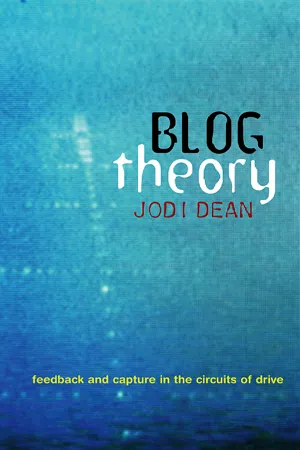
Blog Theory offers a critical theory of contemporary media. Furthering her account of communicative capitalism, Jodi Dean explores the ways new media practices like blogging and texting capture their users in intensive networks of enjoyment, production, and surveillance. Her wide-ranging and theoretically rich analysis extends from her personal experiences as a blogger, through media histories, to newly emerging social network platforms and applications.
Set against the background of the economic crisis wrought by neoliberalism, the book engages with recent work in contemporary media theory as well as with thinkers such as Giorgio Agamben, Jean Baudrillard, Guy Debord, Jacques Lacan, and Slavoj ?i?ek. Through these engagements, Dean defends the provocative thesis that reflexivity in complex networks is best understood via the psychoanalytic notion of the drives. She contends, moreover, that reading networks in terms of the drives enables us to grasp their real, human dimension, that is, the feelings and affects that embed us in the system.
In remarkably clear and lucid prose, Dean links seemingly trivial and transitory updates from the new mass culture of the internet to more fundamental changes in subjectivity and politics. Everyday communicative exchangesÑfrom blog posts to text messagesÑhave widespread effects, effects that not only undermine capacities for democracy but also entrap us in circuits of domination.
- English
- ePUB (mobile friendly)
- Available on iOS & Android
eBook - ePub
About this book
Information
1
Blog Settings
1
The challenge of this book is thinking critically about media practices in a setting where they are fast, fun, and ubiquitous. As an avowedly engaged and political approach to thought, critical theory of any sort encounters challenges. Attempting to analyze and intervene in the present, it nonetheless adopts a backward gaze, an idea G.W.F. Hegel figures with the owl of Minerva flying at dawn, Michel Foucault practices through his historical methods of archaeology and genealogy, and Slavoj Žižek conceptualizes with the notion of “retroactive determination.” A problem specific to critical media theory is the turbulence of networked communications: that is, the rapidity of innovation, adoption, adaptation, and obsolescence.1 The object of one’s theoretical focus and critical ire quickly changes or even vanishes. The time of theory is over-taken, even taken over, by ever-morphing, interlinking, media.2
Since books can easily be surpassed by events, they appear particularly ill chosen as a medium through which to present a critical media theory. A theory that is current, if it is possible at all, seems confined to presentation within the forms and circuits it analyzes. It can be presented in face-to-face conferences, workshops, or meet-ups; it can be posted on discussion lists or blogs. It can be visualized, videoed, shared and distributed, critiqued, amended, sampled, and forwarded. Thought can be made immediate, an element of its moment or, more precisely, of the fantasy that attempts to delimit a moment out of the present’s rush to the future and absorption into the past.
A book that makes critical-theoretical claims about blogging thus encounters a double problem of its object and its form of presentation. Each side of the problem entraps theory in its setting. To address its object in a timely fashion, the book has to be new, fresh, up-to-the-minute, fashion-forward, bleeding-edge. It needs to predict or at least hazard a guess as to where things are going, what’s going to happen. The book is pushed to adopt, in other words, the entrepreneurial expectations of the venture capitalist, racing to be the first out of the block. This side of the problem highlights one of the specific ways communicative capitalism captures critique and resistance, formatting them as contributions to the circuits in which it thrives.3 The temporal take-over of theory displaces sustained critical thought, replacing it with the sense that there isn’t time for thinking, that there are only emergencies to which one must react, that one can’t keep up and might as well not try.
The second side of the problem, the form of theory’s presentation, likewise highlights how communicative capitalism fragments thought into ever smaller bits, bits that can be distributed and sampled, even ingested and enjoyed, but that in the glut of multiple, circulating contributions tend to resist recombination into longer, more demanding theories. It’s like today we can have and share insights, but these insights must not add up to something like a theory that might aid us in understanding, critically confronting, and politically restructuring the present. Theodor Adorno’s criticism of the passion for information in mass culture applies more to contemporary communication and entertainment networks than it did to film and radio, the mass media he has in mind when he writes, “However useful it might be from a practical point of view to have as much information as possible at one’s disposal, there still prevails the iron law that the information in question shall never touch the essential, shall never degenerate into thought.”4 As multiple-recombinant ideas and images circulate, stimulate, they distract us from the antagonisms constitutive of contemporary society, inviting us to think that each opinion is equally valid, each option is equally likely, and each click is a significant political intervention. The deluge of images and announcements, enjoining us to react, to feel, to forward them to our friends, erodes critical-theoretical capacities – aren’t they really just opinions anyway? Feelings dressed up in jargon? Drowning in plurality, we lose the capacity to grasp anything like a system. React and forward, but don’t by any means think.
My wager is that critical media theory is possible in book form. The wager is inspired by a time-honored tactic in workers’ struggle: the slow-down. As an object whose form installs delays in sampling and syndication and whose content demands postponed gratification, the book mobilizes the gap of mediacy so as to stimulate thought. E-books and articles as well as blog posts on theoretical topics are convenient ways to store and share ideas. But these benefits come at a cost: we pay with attention.5 It’s easy to give into the temptation to keep moving, to follow links, to see what others think about it before one even knows what “it” might be, then to see what else others are thinking about, especially if their posts aren’t too long … and once we’re already a few clicks in, why not go ahead and check our blog stats, update our Facebook profiles, and engage in a few rounds of Mafia Wars or other games helpfully supplied by our favorite social network. It only takes a minute. Or two.
More important, though, is whether the technologies and practices of new media are appropriate objects for critical-theoretical inquiry. Again, my wager is yes. This isn’t a risky bet. In recent decades, scholars, artists, and activists working at the interface of communications, media, and cultural studies and social studies of science and technology have developed critical approaches to digital media and their networked environments. Rather than restricted to positivist methods of description and measurement or linear, developmentalist, histories of technical change, this emerging critical media theory anchors its analyses of technologies, users, and practices in an avowedly political assessment of the present.
What that assessment is, or, more specifically, how to theorize the political implications of networked communications and entertainment media, is a matter of passionate disagreement. I take the position that contemporary communications media capture their users in intensive and extensive networks of enjoyment, production, and surveillance. My term for this formation is communicative capitalism. Just as industrial capitalism relied on the exploitation of labor, so does communicative capitalism rely on the exploitation of communication. As Michael Hardt and Antonio Negri argue, “communication is the form of capitalist production in which capital has succeeded in submitting society entirely and globally to its regime, suppressing all alternative paths.”6 A critical theory of communicative capitalism requires occupying (rather than disavowing) the trap in which it enthralls and configures contemporary subjects. I argue that this trap takes the form that modern European philosophy heralded as the form of freedom: reflexivity. Communicative capitalism is that economic-ideological form wherein reflexivity captures creativity and resistance so as to enrich the few as it placates and diverts the many.
2
Communicative capitalism designates the strange convergence of democracy and capitalism in networked communications and entertainment media. On the one hand, networked communications technologies materialize the values heralded as central to democracy. Democratic ideals of access, inclusion, discussion, and participation are realized in and through expansions and intensifications of global telecommunication networks. On the other hand, the speed, simultaneity, and interconnectivity of electronic communications produce massive distortions and concentrations of wealth as communicative exchanges and their technological preconditions become commodified and capitalized. David Harvey explains, “technologies of information creation and capacities to accumulate, store, transfer, analyze, and use massive databases to guide decisions in the global marketplace” have been necessary and essential components of globalized neoliberalism.7 As the network of networks through which such transactions take place, the internet is the vehicle and terrain for politics and the economy. Changes in communication technologies associated with digitalization, speed (of computer processors as well as connectivity), and memory/storage capacity impact democracy and capitalism, amplifying elements of each as they consolidate the two into a new ideological formation.
The concept of communicative capitalism draws from Žižek’s Lacanian-Marxist upgrade of ideology critique. Žižek uses the psychoanalysis of Jacques Lacan to reconfigure the notion of ideology so as to theorize the ways our deepest commitments bind us to practices of domination. Rather than following the commonplace notion that ideology is false consciousness or a term for ideas one doesn’t like (the ideas of one’s opponents or everybody except the critic), Žižek formats ideology in terms of the beliefs underlying practice. Ideology is what we do, even when we know better (for example, I know that quizzes on Facebook are ingenious ways of collecting information from me and my friends, but I take them anyway). The psychoanalytic notion of fetishism provides a convenient shorthand: “I know, but nevertheless. … ”
An additional Žižekian concept (one he develops from Claude Lévi-Strauss) important for theorizing communicative capitalism is the decline of symbolic efficiency (aka the collapse of the big Other). If the efficiency of a symbol designates its mobility, its ability to transmit significance not simply from one person to another but from one setting to another, the decline of symbolic efficiency points to an immobility or failure of transmission. Blogs provide a clear example: sometimes it’s difficult to tell when a blog or a post is ironic and when it’s sincere, when it’s funny or when it’s serious. Terms and styles of expression that make sense to an “in-group” can shock, insult, or enrage folks who just happen upon a blog. Moreover, the uncertainty, the potential for unexpected meanings, provides its own affective intensity. Images and affects may flow into the gaps left by the declining symbolic. Despite the fact that bloggers generally decry the degeneration of discussion into ad hominem attacks and flame wars – nearly always the result of a misunderstanding rather than a disagreement – we secretly enjoy them. Hit rates double, even triple. People become invested in, energized by, the exchange: how far will she go? She said that!? Oh no she didn’t! Pwnd!8
In my first months as a blogger, I had to figure out what my deleting and blocking policy would be. Which comments would I let remain and which would I block? I knew that simply disagreeing with me would not be grounds for deletion – after all, I wanted the blog to be a site for discussion. I decided to delete comments that included explicit racist, sexist, homophobic, and anti-Semitic slurs. Then I got a comment from the GNAA or Gay Nigger Association of America, a group of organized anti-blogging trolls who take their name from a 1992 Danish movie, Gay-Niggers from Outerspace. GNAA claims that it promotes neither racism nor homophobia but aims rather to sow disruption on the internet. The comment on my blog was a minor instance of their more extensive disruptive practices (like “crapflooding” a site with a massive amount of text or data with no meaning or relevance: for example, a word, phrase, or group of letters repeated over and over, or producing hoax or shock sites and inserting links or code that redirect viewers to the site).9
The concept of the decline of symbolic efficiency is particularly useful for critical media theory as it designates the fundamental uncertainty accompanying the impossibility of totalization: that is, of fully anchoring or pinning down meaning.10 The contemporary setting of electronically mediated subjectivity is one of infinite doubt, ultimate reflexivization. There’s always another option, link, opinion, nuance, or contingency that we haven’t taken into account, some particular experience of some other who could be potentially damaged or disenfranchised, a better deal, perhaps even a cure. The very conditions of possibility for adequation (for determining the criteria by which to assess whether a decision or answer is, if not good, then at least adequate) have been foreclosed. It’s just your opinion. Additionally, as the efficiency of the symbolic declines, images and affective intensities may appear as all the more powerful, relevant, and effective. A picture is worth a thousand words.
Žižek uses Lacan to express the point as a suspension of the function of the Master signifier: there is no longer a Master signifier stabilizing meaning, knitting together the chain of signifiers and hindering its tendencies to float off into indeterminacy.11 The absence of such a Master might suggest a new setting of complete openness and freedom – no authority tells the subject what to do, what to desire, how to structure its choices. Žižek argues, however, that in fact the result of the Master’s decline is unbearable, suffocating closure.12 The online environment Second Life clearly demonstrates this closure: able to do or create anything (there aren’t even laws of gravity), the majority of users end up with avatars that are sexier versions of themselves walking around shopping, gambling, fixing up their houses, and trying to meet people (“meet” can be read euphemistically here). It’s not only boring – it’s stifling as it confronts users with their lack of skills and imagination.
Žižek’s account of the decline of symbolic efficiency appears in the context of his critique of risk society theory. Some of the primary themes of this account extend ideas he had previously put to work in early essays on cyberspace and virtual reality. In contrast with a dominant strand of nineties media theory, which treated virtual reality as a new, lawless frontier, Žižek’s essays on cyberspace emphasize the virtuality of the symbolic order of meaning and language. The functioning of the Master signifier depends on virtuality. It works not simply as another element in a chain, but as something that is more than itself, something present as potential. Žižek draws an example from Freud: the threat of castration has castrating effects.13 Cyberspace threatens precisely this fundamental virtuality. The paradox: cyberspace is not virtual enough.
Žižek considers several specific ways virtuality is threatened by computer-mediated interaction. One is the loss of the binding power or performative efficacy of words. Words are no longer “subjectivized” insofar as they fail to induce the subject to stand by them. At any moment, visitors to cyberspace can simply “unhook” themselves. Since exit is an option with nearly no costs, subjects lose the incentive for their word to be their bond. A second threat involves the dissolution of the boundary between fantasy and reality, a dissolution affecting identity and desire. Insofar as digital environments enable the realization of fantasies on the textual screen, they close the gaps between the subject’s symbolic identity and its phantasmic background.14 Instant gratification fills in the lack constitutive of desire. Hypertextual play enables the unstated subtext of any text to be brought to the fore, thereby eliminating the textual effects of the unsaid. Put somewhat differently, fantasies that are completely realized cease to be fantasies.15 A repercus...
Table of contents
- Cover
- Dedication
- Title page
- Copyright page
- Acknowledgements
- Epigraph
- 1 Blog Settings
- 2 The Death of Blogging
- 3 Whatever Blogging
- 4 Affective Networks
- Index
Trusted by 375,005 students
Access to over 1.5 million titles for a fair monthly price.
Study more efficiently using our study tools.
Frequently asked questions
Yes, you can cancel anytime from the Subscription tab in your account settings on the Perlego website. Your subscription will stay active until the end of your current billing period. Learn how to cancel your subscription
No, books cannot be downloaded as external files, such as PDFs, for use outside of Perlego. However, you can download books within the Perlego app for offline reading on mobile or tablet. Learn how to download books offline
Perlego offers two plans: Essential and Complete
- Essential is ideal for learners and professionals who enjoy exploring a wide range of subjects. Access the Essential Library with 800,000+ trusted titles and best-sellers across business, personal growth, and the humanities. Includes unlimited reading time and Standard Read Aloud voice.
- Complete: Perfect for advanced learners and researchers needing full, unrestricted access. Unlock 1.5M+ books across hundreds of subjects, including academic and specialized titles. The Complete Plan also includes advanced features like Premium Read Aloud and Research Assistant.
We are an online textbook subscription service, where you can get access to an entire online library for less than the price of a single book per month. With over 1.5 million books across 990+ topics, we’ve got you covered! Learn about our mission
Look out for the read-aloud symbol on your next book to see if you can listen to it. The read-aloud tool reads text aloud for you, highlighting the text as it is being read. You can pause it, speed it up and slow it down. Learn more about Read Aloud
Yes! You can use the Perlego app on both iOS and Android devices to read anytime, anywhere — even offline. Perfect for commutes or when you’re on the go.
Please note we cannot support devices running on iOS 13 and Android 7 or earlier. Learn more about using the app
Please note we cannot support devices running on iOS 13 and Android 7 or earlier. Learn more about using the app
Yes, you can access Blog Theory by Jodi Dean in PDF and/or ePUB format, as well as other popular books in Social Sciences & Media Studies. We have over 1.5 million books available in our catalogue for you to explore.