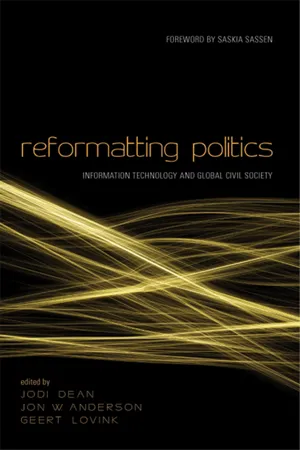
This book examines the ways in which new information and communication technologies (ICTs) are being used by civil society organizations (CSOs) to achieve their aims through activities and networks that cross national borders. These new ICTs (the internet, mobile phones, satellite radio and television) have allowed these civil society organizations to form extensive networks linking the local and the global in new ways and to flourish internationally in ways that were not possible without them.
Reformatting Politics consists of four sections containing essays by some of the top scholars and activists working at the intersections of networked societies, civil society organizations, and information technology. The book also includes a section that takes a critical look at the UN World Summit of Information Society and the role that global governance has played and will play in the use and dissemination of these new technologies. Finally, the contributors aim to influence this important and emerging field of inquiry by posing a set of questions and directions for future research. In sum, Reformatting Politics is a fresh look at the way critical network practice through the use of information technology is reformatting the terms and terrains of global politics.
eBook - ePub
Reformatting Politics
Information Technology and Global Civil Society
- 272 pages
- English
- ePUB (mobile friendly)
- Available on iOS & Android
eBook - ePub
Reformatting Politics
Information Technology and Global Civil Society
About this book
Information
SECTION III
Formats
CHAPTER 11
Understanding the WSIS: An Institutional Analysis of the United Nations World Summit on the Information Society*
The Cold War’s end stimulated new interest in a longstanding United Nations institution: the world summit. World summits are one-time conferences organized by the UN to address global issues like environment, housing, or food. They involve thousands of policy makers working together over periods of years to develop consensual visions of principles and possible solutions to some of humankind’s most challenging problems. Since the Earth Summit of 1992 and counting the World Summit on the Information Society (WSIS) of 2003/2005, the UN has hosted almost one summit per year for eleven years.
World summits are dogged by fundamental questions: What are they good for? Do they produce social and political change commensurate with their enormous cost in money and policy makers’ time? True, at least one world summit has yielded a major result: the 1992 Earth Summit produced the United Nations Framework Convention on Climate Change that led to national commitments to cut greenhouse gas emissions. Other summits, however, have not had such clear-cut results. The question remains, Is a world summit a vehicle for meaningful social and political change?
In what follows, I propose a conceptual framework for addressing this question, and I apply it to the WSIS. From that analysis, I conclude that summits can make a significant contribution to social change. Summits present opportunities, making valuable resources available for political advocacy. However, they are just one element needed for change; also needed are candidate policies that fit those opportunities and policy advocates with the influence to realize those opportunities. When all those elements come together, significant results can be achieved. Evidence of summits’ power can be seen in the 2003 WSIS, which challenged the global Internet governance regime.
Conceptual Framework
In analyzing world summits, I begin by distinguishing between form and content. The content of any summit refers to the particular issues that were discussed at the summit and the particular results that were achieved there. The content of the 1992 Earth Summit consisted of the environmental issues and principles addressed; the content of the 1995 Women’s Summit likewise included the specific policies for women discussed; and so on. In contrast, the form of world summits refers to the enduring organizational form employed for all of them, irrespective of their content. All summits employ a broadly similar form for participation, collective decision making, and implementation, and this form defines the “rules of the game”—which in turn defines opportunities for certain classes of political actors to achieve certain kinds of political outcomes.
Stated differently, a summit is an institution, a recurring social structure that constrains some actions and facilitates others, that presents an opportunity structure, a set of predictable causal mechanisms and political resources through which to pursue social and political change. To assess summits’ utility as vehicles for change, I offer this analysis of the opportunity structures they present.
Two features of summits figure most prominently here: their characteristics as a policy forum and the mechanisms available to them for policy implementation. Summits’ characteristics as forums help us understand what kinds of policies can be effectively advocated. Summits’ repertoires of implementation mechanisms help us understand what kinds of policies, once adopted, can be translated into action. These two features help explain which visions of social change can be most meaningfully endorsed at a summit and then most effectively realized in practice.
Two additional, noninstitutional factors also figure in achieving change. The first is the existence of proposals that “fit” the opportunity structure. These are policies that can benefit from the mechanisms and resources a summit makes available. The particular resources presented by a summit will not be appropriate for all proposals, and those with good fit may advance the most. The second factor is advocacy, which provides the motive force to exploit opportunity; without advocacy opportunities can go wasted.
Thus, a summit is most likely to lead to real change when there exist (1) effective advocates of (2) policies that fit both (3) the characteristics of summits as forums and (4) their associated implementation mechanisms. It is this combination of advocacy, fit, and opportunity that produces change.
I apply this conceptual framework to the WSIS in an attempt to explain that summit’s major outcomes. Held in Geneva in 2003, the WSIS served to articulate a collective vision about the benefits of information to society. It also produced some potentially important policies. Benefiting from a combination of opportunity, fit, and advocacy, two major policies advanced: (1) to review the global system for Internet governance, and (2) to provide funding for developing countries.
The World Summit Forum
Since 1992 the UN has hosted the following summits:
1992: Earth Summit (Conference on Environment and Development), Rio de Janeiro.
1993: Human Rights Summit (Conference on Human Rights), Vienna.
1994: Population Summit (International Conference on Population and Development), Cairo.
1995: Social Summit (World Summit For Social Development), Copenhagen.
1995: Women’s Summit (Fourth World Conference on Women), Beijing.
1996: Habitat II (Conference on Human Settlements), Istanbul.
1996: World Food Summit, Rome
2001: World Summit against Racism (World Summit against Racism, Racial Discrimination, Xenophobia, and Other Related Intolerances), Durban.
2002: World Summit on Sustainable Development, Johannesburg.
2003/2005: World Summit on the Information Society (WSIS), Geneva/Tunis.
This list is not presented as definitive. There were summits held before 1992, and indeed many of the summits on this list built on previous events (e.g., the first Earth Summit of 1972 or the Habitat I summit of 1976.) Furthermore, not all summits are explicitly identified as such. Of the ten summits listed here, only four are explicitly titled “world summits.” (For a larger list of “UN conferences,” see the report by the Office of the Millennium Assembly [2001].)
Nonetheless, from this series we can discern the outlines of what could be called the world summit form. The form consists of a timeline of activities, a pattern of participation, and the summit products. The WSIS illustrates most features of this form (although it included some unique features as well).
Although a world summit lasts just a few days, the preparatory and follow-up processes occur over a period of years. Thus, the initial steps toward the 2003 WSIS began already in 1998, when the UN’s International Telecommunications Union (ITU) proposed it within the UN system. In December 2001 the General Assembly formally authorized the summit, to be held in December 2003 (Phase I) and November 2005 (Phase II).
In any summit the most intense activity occurs in the preparatory phase. In the two years between the authorization of the WSIS in 2001 and the actual event in 2003, the ITU conducted two series of meetings: preparatory committee meetings (“prepcoms”) and regional meetings. Prepcom I followed within six months of the General Assembly’s 2001 Resolution, and Prepcoms II and III were held at additional six month intervals. All were held in Geneva. Regional meetings were held over a briefer period, but were distributed in locations around the world. Between Prepcoms I and II the ITU organized regional meetings for Africa, Asia, Europe/North America, and Latin America. These many meetings served to gather input from around the world and to prepare the documents that would be adopted in 2003.
The summit itself lasts just a few days. It is a ceremony of ratification in which heads of state make speeches and ratify the collective documents produced over the preceding two years. The first phase of the WSIS ran for three days in December 2003.
The final procedural step in the summit form is the follow-up conference, the so-called “summit-plus-five” event. Five years after the event there is a conference to assess the progress made toward implementing the summit plans. An assessment report is written and many of the participants from the original summit reassemble.
Throughout these stages in a summit there is broad and inclusive participation. With the UN grounded in the nation-state system, national governments are the main participants. Thousands of government officials participate in all stages, and the actual summit itself normally attracts most of the world’s heads of state. Additional participants come from industry and from civil society (or nongovernmental organizations [NGOs]—the terms are used interchangeably here). Industry can play an important role in summits closely connected to industrial issues, like environment, food, or housing. NGOs often possess great expertise in issue areas and play important role in policy advocacy. Numerically, NGOs often outnumber other classes of summit participants.
The media is a fourth class of participant. With participation by heads of state, industry leaders, and NGOs, a world summit is a major media event. The 1992 Earth Summit attracted over seven thousand journalists alone, and they in turn provided intensive coverage in print, radio, and television (Grubb 1993). Although the WSIS attracted fewer media representatives, it still generated headlines around the world.
In addition to process and participation, the world summit form also defines product. In the abstract, a summit produces understanding and a collective vision. Concretely, most summits produce two documents: a statement of principles and a plan of action. A statement of principles articulates the normative framework for policy, often building on the UN charter and previous statements on rights. It might refer to earlier established rights, affirm their applicability to specific issue areas likedevelopment or women, and even propose their expansion to new areas. A plan of action translates principles into more specific actions. It might define high-level policy initiatives, set milestones for implementation, or call for funding of program areas. While certainly not a detailed statement of policy suitable for immediate implementation, these summit documents provide the broad outlines of comprehensive policy on the summit topic. (For the purposes of this study, I refer to the high-level principles and actions produced at summits as policy.)
While each summit embodies this form, each also departs from it in some ways. The WSIS adopted two significant innovations. First, the WSIS was a double summit, with the first meeting in Geneva in 2003 and the second in Tunis in 2005. This possibly offered opportunities for more prolonged policy making. Second, the WSIS formalized the role of civil society to an unprecedented degree, creating an official “civil society bureau” that held formal meetings with the bureaus for governments and the private (business) sector. These two characteristics of the WSIS are discussed in greater detail below.
This, then is the world summit form. Two years of preparatory activity precede the event, the summit itself attracts thousands of participants (including heads of state), two documents are produced, and a follow-up conference occurs later. But does anything change as a result? The next section considers summits as a political institution offering an opportunity for policy change.
The Summit as Forum
The analysis here considers a summit as a means to make and implement policy. In this section I analyze a summit’s means for policy making, and in the next section I will analyze its available mechanisms for implementation. Throughout the discussion I consider issues of policy fit.
A summit is first and foremost a forum, which is a means for policy making. A precondition for policy making is the existence of an appropriate forum, without which policy makers may be unable to meet to make collective decisions (Klein 1999). Fundamental characteristics of any forum are its jurisdiction, its participants, and its timing. A world summit embodies a unique set of these characteristics, making it better suited to address some issues than others.
A forum’s jurisdiction can be of two types: spatial or topical. The spatial jurisdiction of a world summit extends—as the name implies—to the entire world. Participants come from all over the world, they collectively identify issues that are relevant at the global level, and they propose global policies. In light of the small number of global policy forums, this spatial jurisdiction renders a world summit a rare and potentially powerful institution. It provides one prerequisite (among others) for global change: a meeting place in which to discuss global issues and formulate global policy.
Topical jurisdiction refers to a summit’s theme. A summit on the topic of environment can meaningfully address environmental issues, and summits on women, housing, or racism can meaningfully address topics on those other themes. Topical jurisdiction limits the kinds of policies a summit can produce but also increases its significance in its topic area.
Recognition of these jurisdictional characteristics allows us to identify issues that are a good fit for world summits. Issues that fit well are (1) in the topical area and (2) global in scope. Some issues that are typically global include functional systems (e.g., global climate, global environment, global economy); human rights (which apply to all humans on the globe); and global equity (which presupposes a global community within which some people suffer an injustice). For example, the issue of climate change was a good fit for the 1992 Earth Summit: climate fit the topic and is a global system.
A second characteristic of a forum is participation. Compared to other global forums, world summits are unusually open, both in the number and the diversity of participants. As described earlier, participants number in the thousands, and government, industry, and civil society all have access to the policy process. Wealthy countries and developing countries participate with formally equal status. At the WSIS the rules for participation broke new ground by granting civil society...
Table of contents
- Cover Page
- Half Title Page
- Title Page
- Copyright Page
- Contents
- Foreword
- Preface
- Introduction
- I Networks
- II Sites
- III Formats
- Glossary of Acronyms
- Editors
- Contributors
- Index
Trusted by 375,005 students
Access to over 1.5 million titles for a fair monthly price.
Study more efficiently using our study tools.
Frequently asked questions
Yes, you can cancel anytime from the Subscription tab in your account settings on the Perlego website. Your subscription will stay active until the end of your current billing period. Learn how to cancel your subscription
No, books cannot be downloaded as external files, such as PDFs, for use outside of Perlego. However, you can download books within the Perlego app for offline reading on mobile or tablet. Learn how to download books offline
Perlego offers two plans: Essential and Complete
- Essential is ideal for learners and professionals who enjoy exploring a wide range of subjects. Access the Essential Library with 800,000+ trusted titles and best-sellers across business, personal growth, and the humanities. Includes unlimited reading time and Standard Read Aloud voice.
- Complete: Perfect for advanced learners and researchers needing full, unrestricted access. Unlock 1.5M+ books across hundreds of subjects, including academic and specialized titles. The Complete Plan also includes advanced features like Premium Read Aloud and Research Assistant.
We are an online textbook subscription service, where you can get access to an entire online library for less than the price of a single book per month. With over 1.5 million books across 990+ topics, we’ve got you covered! Learn about our mission
Look out for the read-aloud symbol on your next book to see if you can listen to it. The read-aloud tool reads text aloud for you, highlighting the text as it is being read. You can pause it, speed it up and slow it down. Learn more about Read Aloud
Yes! You can use the Perlego app on both iOS and Android devices to read anytime, anywhere — even offline. Perfect for commutes or when you’re on the go.
Please note we cannot support devices running on iOS 13 and Android 7 or earlier. Learn more about using the app
Please note we cannot support devices running on iOS 13 and Android 7 or earlier. Learn more about using the app
Yes, you can access Reformatting Politics by Jodi Dean,Jon W. Anderson,Geert Lovink in PDF and/or ePUB format, as well as other popular books in Política y relaciones internacionales & Organizaciones intergubernamentales. We have over 1.5 million books available in our catalogue for you to explore.