![]()
1
The Islamic Headscarf in Western Europe
Islamic headscarf controversy is no longer a peculiarity of France, whose classic Foulard Affair dates back to 1989. In fact, there is no country in western Europe today which does not have its own headscarf controversy.1 And, one must add, each country has the headscarf controversy it deserves. In France, the innocuous bandanna has stirred debate for two decades now, a debate culminating in the 2004 law against ‘ostensible’ religious symbols in public schools. In Britain, which had long considered itself immune to the religious cloth struggles of the continent, it is the more extreme wear of the jilbab and niqab2 that has recently tested the limits of its multicultural leanings. The Netherlands, site of Europe’s most draconian retreat from multiculturalism, has predictably attempted the most draconian anti-veiling measure of all, proposing a law in 2006 that would prohibit the wearing of the face-covering veil in all public places (though it never went beyond the conceptual stage). More moderately, Germany, in a series of sub-federal Länder laws passed in 2004 and 2005, prohibited public school teachers from dressing up religiously, but made a curious exemption for the adherents of the Christian faith.
The European proliferation of headscarf controversies raises at least two questions. First, why is there controversy at all? Secondly, why has it gone to different lengths in different countries? Both questions require different frames of reference. On the side of commonalities, there are certain liberal norms, most notably gender equality, which seem to be violated by the ‘submissive’ headscarf. On the side of variation, national legacies of relating religion to the state fare centrally, among other factors.
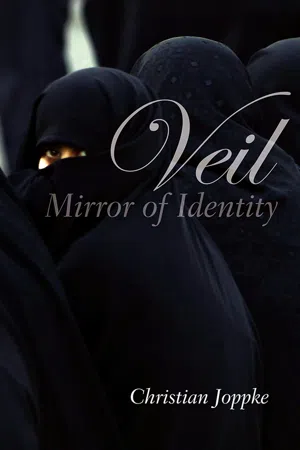
However, at a deeper level still, the Islamic headscarf functions as mirror of identity which forces the Europeans to see who they are and to rethink the kinds of public institutions and societies they wish to have. Not by accident, the recent headscarf controversies coincide with a busy reassessment of the meaning of ‘French’, ‘German’, ‘British’ or ‘Dutch’ and with mobilizing law and public policy to make immigrants and ethnic minorities fit these definitions (see Joppke 2007b, 2008). As the challenge is to central precepts of liberal states and societies – the neutrality of the state, individual autonomy, and equality between men and women – it is no wonder that the responses tend to be identical as well: ‘we’, the French, German, British and Dutch, are first and foremost ‘liberal’, cherishing the equality of women and the autonomy of the self, and this may require excluding and banishing from the public realm the affront to liberal self-definition for which the Islamic headscarf stands today above all. Liberalism now does the ‘exclusionary’ work which, at an earlier time, had been done by racism or nationalism (on exclusionary nationalism, see Marx 2003). This does not mean that assertive liberalism does not come in distinct national colors – ‘republican’ in France, ‘Christian–occidental’ in Germany, ‘multicultural’ in Britain – up to a point where liberalism may submerge under resurgent nationalism. The submersion of liberalism by nationalism seems to have happened, in different ways, in France and Germany, reflected in their respective anti-headscarf laws. But notably it has not happened in Britain, where what has come under attack is not the Islamic headscarf as such, but only a particularly extreme version of it.
But why is it only European countries, not the United States or Canada or Australia, that have headscarf controversies? Obviously a facile equation of headscarf opposition with assertive liberalism will not do, because then one would expect similar (if not more) conflict in these other liberal places. With respect to the United States, in the American headscarf controversy that never was, an Oklahoma school district which had excluded a Muslim headscarf girl in March 2004 was immediately opposed by the Federal Department of Justice, which would ‘not tolerate discrimination against Muslims or any other religious group’ because ‘such intolerance is un-American, and […] morally despicable’.3 This is part of the larger paradox that the country which, together with Israel, is the most reviled one in the Muslim world has no domestic problem with integrating Muslim minorities. Instead, as Aristide Zolberg and Long Litt Woon (1999) memorably pointed out, ‘Spanish’ is to the US what ‘Islam’ is to Europe on the immigrant and ethnic minority integration front. The reasons for this are manifold and can only be touched on briefly here (for a good overview, see Foner and Alba 2007).
First, state and religion are more strictly separated in the US than in Europe – even than in France, where Christianity and Judaism enjoyed certain privileges and corporate status which have only recently – and haltingly – expanded to Islam. Secondly, in a curious counterpoint to this, European societies have become thoroughly secularized in the past half-century or so, now constituting the main exception to religious revivalisms around the world. By contrast, American society has become even more religious over time, up to a point of becoming the most religious society of the western world. In such a pious setting, Muslims’ religious claims raise fewer eyebrows than in Europe. Finally and perhaps most importantly, there is less potential in the United States than in Europe for the Islamic headscarf to become a ‘stigma symbol’ (Göle 2003) through which a sign of oppression is re-fashioned into one of resistance. This is because Muslims in the US are not as socio-economically deprived as in Europe. Their smaller numbers, dispersed settlement, and elevated socio-economic status and education make American immigrant Muslims less attuned to the globally politicized Islam which is, ultimately, the driving force behind the proliferation of the headscarf (see Skerry 2006).
The Meanings of the Headscarf
If some western societies like the United States have no problem with the headscarf, on the part of organized Islam and many a Muslim the headscarf seems to carry a broadly anti-western meaning. Hans Küng, in his monumental study of Islam (2004: 739), even flatly holds that the headscarf is a ‘symbol of religious–political conviction […] for Islam and against the secular state’. This has not always been so. Originally the Islamic headscarf bore neither political nor religious meaning. It was instead a symbol of status which stood for the ‘protection of the private sphere of the wives of Mohammad’ (Küng 2004: 738). Accordingly, the Koranic prescriptions for the female wardrobe are in terms of ‘societal conventions’, not of ‘religious obligations’ (ibid.). This situation has changed with the headscarf revival in Iran and in the Middle East a quarter-century ago, which in the meantime has caught up with the young second and third-generation Muslims across Europe. Here is how a noted anthropologist reflected on more than twenty years of fieldwork in Egypt: ‘I cannot think of a single woman I know, from the poorest rural to the most educated cosmopolitan, who has ever expressed envy of US women, women they tend to perceive as bereft of community, vulnerable to sexual violence and social anomie, driven by individual success rather than morality, or strangely disrespectful of God’ (Abu-Lughod 2002: 788).
In one of the first studies of the headscarf revival, observing a ‘new Egyptian woman’, college educated or in the process of becoming so but ‘completely “veiled” – face and body’, Fadwa El Guindi (1981) noted that the ‘immodesty’ which the veil repudiates is ‘associated with westernism’ (quotes from p. 465 and 476). Is it then far-fetched if, some twenty years later, a French president perceived the Islamic headscarf as a ‘kind of aggression’?4 Grosso modo, today’s Islamic headscarf stands for the rejection of ‘western materialism, commercialism, and values’ (El Guindi 2001: 110) whether this is intended by its wearer or not, and this is why there has been controversy surrounding it.
However, the Islamic headscarf is a provocation which cannot be suppressed unless the West denies its own values, such as tolerance and religious freedoms. This is the central paradox of all headscarf controversies: the headscarf is an affront to liberal values, but its suppression is illiberal also and as such a denial of these same values.
It has become commonplace to stress the modernity of the headscarf, conceiving of it not as something imposed by traditionalist milieux but as a self-chosen sign of female emancipation (the paradigmatic statement of this view is Göle 1996). But it is a highly truncated kind of modernity, which has been well captured in Saba Mahmood’s ethnography of the women’s mosque movement in Egypt (Mahmood 2005). This study gives profound insight into the ‘Islamic revival’, which is at the same time modern, anti-western, and in search of a pure, de-ethnicized essence of Islam. The women’s mosque movement, which began in the 1980s, has grown out of opposition to an increasing ‘secularization’ and ‘westernization’ of Egyptian society as a result of which Islam had been reduced to ‘custom and folklore’ (Mahmood 2005: 44). As a female Mosque activist put it, the point was to ‘make our daily lives congruent with our religion’ instead (ibid., p. 45). And the true essence of this religion was to be retrieved from its original revelation, the Koran. As archaic as it sounds, the prerequisite for this was a modicum of modernity – public education and urbanization that made ‘modern Muslim citizens […] well versed in doctrinal arguments […] hitherto confined to […] religious specialists’ (p. 79). But particularly the fact that women made these claims attests to the modernity of the Islamic revival: reference to a pure Islam was these women’s way of claiming a place in public, outside their home.
However, the rub is that pure Islam, at least in the form it has been retrieved by the revival, underwrites patriarchy. As Mahmood concedes, ‘piety’ (which is the ethos of the female mosque movement) ‘and male superiority are ineluctably intertwined’ (p. 175). And the most pertinent sign of male superiority is the headscarf itself. The famous headscarf verse of the Koran prescribes: ‘Enjoin believing women to turn their eyes away from temptation and to preserve their chastity; not to display their adornments […] to draw their veils over their bosoms and not to display their finery except to their husbands (and other male kin).’5 This entails the reduction of women to their sexuality, which represents a ‘danger […] to the sanctity of the Muslim community’ (Mahmood 2005: 111). The function of the headscarf is to limit and confine this sexuality to its rightful owner, the husband (although all male relatives are allowed to see the unveiled woman too). This ownership is established through the overall assumption that men are the natural guardians of women. Surah 4(34) of the Koran states: ‘Men have authority over women because God has made the one superior to the other, and because they spend their wealth to maintain them. Good women are obedient […] As for those from whom you fear disobedience, admonish them, forsake them in beds apart, and beat them’ (The Koran 2003: 64). To the degree that women ‘choose’ a pious life, which is one obedient to the Koranic God, they enter a condition which even a sympathetic observer like Saba Mahmood finds structurally akin to that of a ‘voluntary slave’ (2005: 149): they choose subordination.
Having established that Islam, as understood within the ‘politics of piety’, entails the subordination of women, Mahmood helps herself out of the dilemma thus created by arguing, in learned but arcane prose, that heteronomy is part of the human condition. Quoting Aristotle and Foucault, she holds that there cannot be a ‘self’ before ‘socially prescribed forms of behavior’, so that the autonomous self so dear to the West is a mirage, an Enlightenment fiction. This yields an interesting perspective on the ‘politics of piety’: the latter is not a politics of identity, as one might think, because ritual practice, in the view of the practitioner, is a tool for the creation of the self, and hence cannot be its expression. But this does not change the fact that female subordination and affirmation of patriarchy is still the outcome. As Mahmood (2001) concedes, ‘the very idioms that women use to assert their presence in previously male-defined spheres are also those that secure their subordination’ (p. 205). Nilüfer Göle’s celebrated study of the 1980s Islamic veiling movement of female university students in Turkey comes to the same conclusion: ‘With the act of veiling women perform a political statement against Western modernism, yet at the same time they seem to accept the male domination that rests their own invisibility and their confinement to the private sphere’ (Göle 1996: 136).
The modern veiling movement’s claim to return to a ‘golden age’ of Islam, in which there was ‘equality between women and men’ (ibid., pp. 104–8), is futile: this age never existed. As Leila Ahmed showed in her authoritative study on women and gender in Islam, the moment at which classic Islamic law was formulated ‘was a singularly unpropitious one for women’ (Ahmed 1992: 100). The early Muslim conquests led to a ‘continuity and accentuation of the life-styles already in place’ in the conquered lands of Mesopotamia, among which a ‘fierce misogyny’ stood out (p. 35). If one adds that Islam is originally, as Max Weber put it memorably, a religion of ‘world-conquering warrior(s)’ (Weber 1976: 311), it is no surprise that ‘the feminine dimension of experience is excluded’ from it, to quote the sociologist of religion Robert Bellah (1970: 155). This picture of Islam contrasts to that of Christianity (more precisely, of Catholicism), where the masculinity of the Old Testament God is loosened up by ‘the person of Mary’ (ibid.). E. Çelebi, a Turkish writer famous in his own time, who was visiting Vienna in 1665 as part of an Ottoman diplomatic mission, observed: ‘In this country and in general in the lands of the unbelievers, women have the main say. They are honored and respected out of love for Mother Mary’ (quoted in Lewis 2002: 65). By contrast, Robert Bellah finds that a certain machismo is inherent in Islam, in that ‘(t)he second-class position of women has been reflected in an inability by men to accept the feminine aspects of their own personalities’ (Bellah 1970: 164).
Comparing Christianity and Islam, Bernard Lewis similarly finds that the ‘status of women’ is ‘probably the most profound single difference between the two civilizations’ (Lewis 2002: 67). Although conceding that Islam is inherently ‘an egalitarian religion’ in which ‘the actions and utterances of the Prophet […] are overwhelmingly against privilege by descent, by birth, by status, or even by race’ (p. 82), Lewis identifies three groups who are excluded from Islam’s penchant for equality: unbelievers, slaves, and women. And women are the ‘worst-placed of the three’ (p. 67), because neither conversion nor abolition is on offer for them.
It is therefore no wonder that the subordination of women has been at the center of the western critique of Islam ever since colonial times, the veil being the most obvious symbol of this subordination. Of course, this critique was strikingly hypocritical. Leila Ahmed cites the case of Lord Cromer, who indicted veiling and segregation in colonized Egypt, but back home in England was the president (and a founding member) of the Men’s League for Opposing Women’s Suffrage (Ahmed 1992: 153). As Ahmed bitingly states, ‘the Victorian colonial paternalistic establishment appropriated the language of feminism in the service of its assault on the religions and cultures of Other men’ (p. 152). In turn, to the degree that ‘the occupier was bent on unveiling’ Muslim society, as Frantz Fanon put it with respect to the French in Algeria, the veil took on the new meaning of resistance, which it would recover in the 1980s Islamic revival, with the ironic implication that ‘it is Western discourse that in the first place determined the new meanings of the veil’ (quoted ibid., p.164). The Islamic headscarf has evidently been a central stake of conflict ever since the West has encountered Islam. Accordingly, a contemporary critic of ‘colonial feminism’ refers to Lord Cromer to denounce the western attacks on the Islamic headscarf, in the Taliban’s Afghanistan and elsewhere, as ‘white men saving brown women from brown men’ (Abu-Lughod 2002). As the Columbia University anthropologist put it rather slickly: ‘We need to have as little dogmatic faith in secular humanism as in Islamism, and as open a mind to the complex possibilities of human projects undertaken in one tradition as the other’ (p. 789).
There is no doubt that ‘secular humanism’ has its own dark history with respect to women. The Greco-Roman and Jewish-Christian traditions are not devoid of hierarchical thinking in gender relations, to say the least – equating maleness with reason and womanhood with nature, as they did, and subordinating the latter to the former. Leila Ahmed quotes Aristotle claiming, in the Politics, that the rule of man over woman is like the rule of ‘soul over the body, and of the mind and the rational element over the passionate’ (Ahmed 1992: 29). And she observes that Augustine failed ‘to see what use woman can be to men […] if one excludes the function of bearing children’ (ibid., 36).
However, the difference seems to be that ‘secular humanism’ could gradually rid itself of such views, whereas ‘Islamism’ (to use Abu-Lughod’s terms) did not. Ernest Gellner (1992: 6) located this difference in Islam’s penchant for being ‘secularization-resistant’. To explain this resistance, one has to consider two elements of Islam: extreme scripturalism and monism. With respect to scripturalism, more than the preceding two monotheisms, Judaism and Christianity, ‘Islam is a founded religion, claiming to complete and round off the Abrahamic tradition and its Prophets, and to do so with finality’ (ibid). Mohammad is the last prophet, through whom God has spoken to humankind for the last time (Schluchter 1991: 299). There is to be no addition, divine or human, to the revelation of God’s word in the Koran. Being ‘revealed not enacted’ (Lewis 1993: 43), Islamic law cannot be changed in any way, and least of all by human beings. Of course, a sacred script is a feature of all western monotheisms, which are religions of the book, Islam only being the most completely developed variant. The dif...