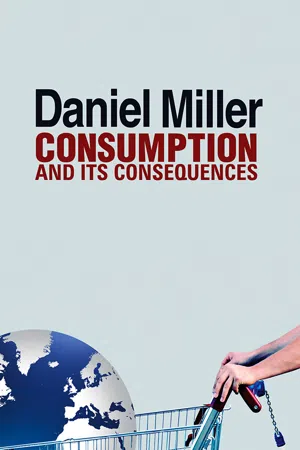
Miller responds to these questions by proposing feasible and, where possible, currently available alternatives, drawn mainly from his own original ethnographic research. Here you will find shopping analysed as a technology of love, clothing that sidesteps politics in tackling issues of immigration. There is an alternative theory of value that does not assume the economy is intelligent, scientific, moral or immoral. We see Coca-Cola as an example of localization, not globalization. We learn why the response to climate change will work only when we reverse our assumptions about the impact of consumption on citizens. Given the evidence that consumption is now central to the way we create and maintain our core values and relationships, the conclusions differ dramatically from conventional and accepted views as to its consequences for humanity and the planet.
- English
- ePUB (mobile friendly)
- Available on iOS & Android
eBook - ePub
Consumption and Its Consequences
About this book
This is a book for those looking for different answers to some of today's most fundamental questions. What is a consumer society? Does being a consumer make us less authentic or more materialistic? How and why do we shop? How should we understand the economy? Is our seemingly insatiable desire for goods destroying the planet? Can we reconcile curbs on consumption with goals such as reducing poverty and social inequality?
Information
1
What’s Wrong with Consumption?
The scene
The conversation takes place in the kitchen of Mike’s comfortable North London home.
MIKE is in his late fifties. You can see his hair was once chestnut, though now what’s left is mainly grey. A quick glance at the labels of organic and other products on the shelves tells you he sits clearly in the green corner, but also that he is something of a hobbyist with respect to technologies and gadgets. He is a professor of environmental studies.
CHRIS is in his mid-forties, not well favoured in looks, but possessing a face that makes him appear quick and lively, always ready to argue and expecting to win. Within a few sentences it is clear that he sits firmly in the red corner. He is a senior lecturer in sociology.
GRACE is in her late thirties – slim, with long hair, and attractive. Born in the Philippines, she is married to Chris. She is a lecturer in anthropology. She smiles a lot, sometimes wryly, especially when Chris is talking.
MIKE met Chris and Grace recently at a conference on consumption and the environment. When he realised that all three teach courses about consumption within their respective disciplines, he decided to invite them over for what he hoped would be the first of many discussions. Being professional academics, they agreed that they would each come ready to discuss some books, ideally something classic they use in teaching and also something new, that would illustrate their respective approaches to consumption. This first meeting takes place at Mike’s house.
MIKE: That is so purple, it’s beyond purple. Are you really telling me there is no artificial colour in it? But it’s also delicious. What did you say it’s called?
GRACE: Ube, and, given that I made it with my own fair hands, I think I can vouch for the contents. Ube is simply our word for purple yam, but for this dessert, which is one of the most common in the Philippines, you add condensed milk, butter and sugar. Some people also add coconut milk. Glad you like it. When a friend of mine, who lives in Manila, has visitors from abroad she always takes them first to one of our fast food outlets, where the most common dessert is ice cream made with ube topped by grated cheese. It certainly satisfies their desire for the exotic.
MIKE: OK, well, I think I’d better start our conversation, if only to stop myself devouring the lot. So, when we met I recall we hoped for three initial meetings: today’s would be generally about consumption, the second devoted to practical solutions to problems arising from consumption and climate change, and the third a comparison of our course contents for our teaching on consumption. So perhaps we should start off by outlining our positions on consumption. I should be upfront and confess that I simply can’t help but feel that those of us in environmental studies occupy a kind of higher ground in the arguments about consumption. The simple point is that you can discuss all you like about the causes, the meaning and the nature of consumption, and obviously I work on these issues. But today you have to see this primarily as a contribution to an imperative which cuts straight through all such debates, and it emanates from the green position to which I have devoted my academic life.
Actually, more than my academic life. I was only a teenager in 1972 when I first heard about something called The Limits to Growth that had been issued by an organisation called the Club of Rome.1 I was quite proud of the fact that I managed to get hold of a copy. It was really the first time the general public had any indication at all of what was to become the core of the green movement. It set out the proposition that our planet’s resources are finite and irreplaceable. Of course, at that time, whenever I tried to convince my family and friends that this was a kind of global wake-up call, they dismissed me like I was some kind of freak. I suppose my purple flared trousers and flowered shirts didn’t help.
GRACE: Sorry, I just need a second to get myself into the flower shirt image. Do you have any photographs? Hair length?
MIKE: That’s why you really don’t want to see the photos. My hair just didn’t suit long. It just gave me that drugged up and dozy look. Have you read Linda Grant’s new novel, We Had it So Good?2 It took me back to those days. Anyway, being an incipient green at that time was taken simply as further sign of my stupidity, not my prescience; they thought I was on another planet rather than trying to save this one.
The blessing of hair loss is that I now seem to be taken quite seriously. It’s amazing how things have gone into reverse. When we are told Republican politicians in the US don’t believe in climate change, we see this as a sign that they are either buffoons or liars.
CHRIS: Why do you think that is?
MIKE: Well partly, I guess, this reflects the shift away from the main point made in The Limits to Growth about natural resources. That was a complex position because the consideration of each resource led to a specific argument as to how much of it actually exists. It probably hasn’t helped that estimates for oil and other natural elements kept being underestimated, and soon we sounded like we were crying wolf. Again, we have problems when people realise that what we call rare earths include some substances that are not at all rare. Today we tend to have a single focus upon climate change, which makes it rather simpler to put the case for being green. It is much easier to focus upon the overwhelming evidence for this one trajectory, with potentially even more catastrophic consequences than the depletion of each particular resource.
GRACE: So you’re saying that it’s just easier and simpler to convince people about one thing, which is global warming.
MIKE: Precisely. As it happens, the fourth report of the IPCC in 2007 and the Stern Report3 of around the same time brought the economists out firmly on our side, and my sense is that, once you have the economists, you find that both the politicians and the media these days tend to follow slavishly whatever they say. As a result, at least in the UK, it feels like the issue of evidence has been largely won.
GRACE: So what are the implications for our discussion of consumption?
MIKE: Well, for me, the question ‘What is consumption?’ is no longer just some rarefied academic debate of only esoteric or commercial interest. It becomes the single most pressing point of academic enquiry, since we urgently need to commit unequivocally to an immediate and sustained reduction in consumption. We are at a particularly dangerous moment when the vast populations of China and South Asia seem poised to launch an assault intended to reach our levels of consumption in the shortest possible time. Given that they represent the majority of the world’s population, and that even current levels of consumption are unsustainable, this will be environmentally catastrophic. It means that our children and grandchildren will inherit less of a planet – or at least less of its landmass – and face vast changes in agriculture to which they may find it impossible to adapt. So we can’t duck this one. If we gather here today to talk about consumption, it is surely with the essential aim of reducing it.
OK so this explains the two books I have brought for discussion today. One is called Why We Disagree about Climate Change, by Mike Hulme, and the other is Heat, by George Monbiot.4 You may find the first an odd choice, since it makes almost no mention of consumption. So let me start with the more straightforward position, which is that of Monbiot.
GRACE: Oh, I am a huge fan of Monbiot. I read The Guardian daily and I always reckon that Jonathan Freedland helps me understand the reasons why I think what I think, Monbiot gives me the critical ammunition that other journalists won’t, and I practically stalk Hadley Freeman.
MIKE: Hadley Freeman?
CHRIS: She writes mainly on fashion, but hilarious. She also helps men avoid inadvertent crimes, like double denim.
MIKE: Well, I am sticking with Monbiot for now – he deals with crimes of a slightly larger scale than double denim. What I love about his work is the sheer relentlessness. His style of argument creates a clear road from knowledge to necessary action as an absolute logic of common sense – a sort of ‘given that, we must surely do this’ style. And there are always twists in the tail of consequence. So we might just think we need to reduce energy use in the home. But then he predicts that those energy savings will actually lead to greater energy expenditure, as we will put any time and money gained into some other energy-inefficient activity. So each trajectory of effects has to be followed through until there is a demonstrable payoff in the overall saving of energy, a plausible solution that will work. He also shares my love of sorting such plausible science from science fiction. One of my friends constantly derides the way I keep coming up with what he calls my ‘small boy dreams big idea that saves the planet’ stuff, which he blames on my reading too many Superman comics as a kid.
CHRIS: You mean that poster on the wall is your doing, not your kids’?
MIKE: Absolutely. Anyway, in 2006 Monbiot was talking about turning cement, whose production at that time created more carbon dioxide, into a new kind of cement that would absorb carbon dioxide. Now, in 2011, this is starting to look like a serious possibility with companies such as Novacem. In fact he is very useful for our discussion of consumption because a lot of his concerns relate to home and transport in these – pun alert – very concrete ways.
CHRIS: Oh, good, puns are allowed then!
MIKE: Of course. Monbiot is also great at exposing the hypocrisies common among all of us who want to appear visibly green, such as flying across the world for eco-holidays which create unnecessary carbon miles.
GRACE: Oh, and of course we had to go there because we were due to give a paper at an academic conference, and the one in Vietnam was so much more relevant than the one in Loughborough. And, once you were there, the fact that there was a resort nearby …
CHRIS: Before you go on, Mike, to be honest, we have both read Monbiot, but not this other one, Mike Hulme?
MIKE: Oh, OK. Well, I rather like the juxtaposition of Monbiot and Hulme, which is a bit of a ‘ships passing in the night’ comparison. Monbiot, as I understand it, was not trained in science, but his book is in thrall to science and replete with statistics. By contrast, Hulme reads like a scientist on a journey to somewhere else. He’s actually one of the leading figures in the science of climate change, but recently he has steered his course to a land of radical doubt, against the presumption of some pure science decontextualised from cultural life.
CHRIS: Are we talking Bruno Latour?5
MIKE: Yes, that would be fair. Hulme notes that climate change involves a complex set of variables only some of which could ever be subject to the kind of testable quantitative analysis that we imagine as science. But his point is that most climate scientists are perfectly sensible to a situation where they can provide estimates of risk only within wide parameters. They have just as much a problem with media that think, because they are called scientists, they must be purveyors of certainty through clear, repeatable, testable and definitive results.
GRACE: The waves will start lapping at Buckingham Palace on the first of June 2023.
MIKE: That sort of thing. Hulme then suggests that the results of climate science are better regarded as a kind of discourse that we only ever see through the lens of some or other interested group. Economists turn it into measures of value and create a carbon market to trade with. Activists turn it into a condemnation of the capitalist system and grounds for revolution. Governments turn it into a security risk to be treated as a global threat on a par with terrorism. Everyone sees it in their own light because, in the end, it is a form of risk, and people assess risks differently.
To add further complexity, the problem of climate change is always relative to people’s particular situation. It’s an urgent priority for people who live on low-lying Pacific atolls, less for an inland nation protected from sea-level rises. It may conflict with another priority such as poverty reduction.
CHRIS: Too right. Biofuels may look attractive from a green perspective but take vast amounts of land from food production and thereby decrease food security. There are things your lot are doing which clearly increase poverty.
MIKE: Acknowledged. And Hulme sees this clearly. His aim is not ultimately to weaken the green case. He clearly feels that, actually to have the requisite impact, climate science needs to work with this plurality and messiness rather than wish it away. So that’s really why I brought both books. I always start by giving Monbiot to the students. He works brilliantly for the kind of shock and awe impact that helps create green activists. But I am a bit long in the tooth, and since The Limits to Growth I have seen both the statistics and the main green arguments change again and again. So I like to temper Monbiot with Hulme, and cook up a dish of science flavoured with doubt.
GRACE: That’s quite funny, because that exactly describes your response to my ube; you ate it, but it was like you couldn’t quite believe it.
CHRIS OK, but it’s a pretty hard dish to reject.
(laughs):
MIKE: I am not quite sure if you’re referring to ube or to my metaphorical dish. But I guess it’s true of both. OK then, Chris, since you see yourself as the more political animal, let me move things in that direction a bit. For me, the climate change clouds have a silver lining. They give us the ammunition to deal with those desperate problems of modern life, materialism and over-consumption.
I speak from the heart because I can’t help thinking, maybe obsessing, about my own sixteen-year-old son. He only ever seems interested in the most mindless materialism – a life devoted to computer games, hair styles created with some revolting gel, the latest smart phone. His only aspirations are towards whatever job might make him so rich that he can immediately gratify every whim, from the jacuzzi in the garden to the flashy car. He has become devoted to unbelievably expensive male perfumes that only suggest to me how gullible he has become, and undermine the basic respect I would like to have in my own son.
I don’t want to pre-empt your stance, Chris, but I suspect that, like me, you believe that under a market system we can never say that the success of a product is evidence that it serves the welfare of consumers. We can only assume it has thereby served the profits of commerce.
CHRIS: I think I can live with that characterisation, though I’m not sure I always want to be seen as so predictable.
MIKE: I don’t know anything about that fashion reporter you seem to follow, but it seems to me we are flooded with the most ridiculous amounts of new fashions which serve only the makers of walk-in wardrobes. And to be able to afford all this consumption we create an ever more heartless system of employment that in turn results in unprecedented levels of stress and overwork. The green connection is partly that I think we fail to prevent the imminent destruction of the planet partly because we are losing our ability to appreciate nature. And partly because I think we can kill these two vultures that plague our world with the same stone. I am not a religious man, but I have to believe there is something transcendent in life itself that we see in nature. I go hiking at weekends just to find places some distance from this deluge of commodities. There I breathe in more than fresh air. I regain some sort of connection with nature, an appreciation of bird sound and the profusion of wild flowers, of landscapes and seabirds soaring above cliffs.
So, whatever the difference between Monbiot and Hulme, all green thinking involves a much bigger system of basic values and ethics. We can’t but regard the environmental crisis as also something of a saviour, a means to resurrect some form of morality, to rethink basic human values. It’s a once-only opportunity to retract this ugly and facile consumerism and actually end up with not just a happier planet but a happier population. I guess you have also read Layard’s book Happiness6 and the Easterlin Paradox.
CHRIS: I have read Layard, but the other thing? Sounds like science fiction.
MIKE: I suppose it does a bit. Actually it comes from a 1970s paper7 by the economist Richard Easterlin, who was the first to demonstrate that, in comparing countries (though not within countries), there was no clear statistical association between higher incomes and levels of reported happiness. He paved the way for Layard and the other economists who are trying to make happiness the measure of economic success rather than simply income.8 I think this just confirms what we already know from our own experience about wealth not bringing happiness. So let me conclude my ‘where I am coming from’ bit. I am essentially interested in understanding consumption in order to create an effective means of curbing excessive consumption – firstly for the sake of the planet but also for the sake of our souls.
GRACE: Thanks for that, Mike. Well, we needn’t have worried about whether we would find ourselves a good argument, because, as the saying is, I couldn’t agree with you less. But if you ended on a personal note, to explain your stance, perhaps I should start on one. I want to tell you something of my history. One hears about Asian tigers, but the Philippines, I am afraid, is an Asian sloth.9 Nothing we have tried to do to get our economy moving seems to have worked. The rest of South-East Asia leaps ahead and we are left behind. Most families traditionally worked, as mine did, as tenant farmers. This meant we had to be able to afford to rent the very land we farmed. One year my parents invested in a new crop, a kind of maize that had a sweeter taste. But the trouble was that everyone in our area had the same idea, and the price collapsed. So the next year my family didn’t even have the money to rent land and couldn’t farm. But they had started to invest in me. I had managed to win pretty much every scholarship to better education open to me. Being in state schools, I started with very limited prospects, but I was seen as a swot and a star. I loved school. In such cases most kids learn nursing, but even with those scholarships the cost of such training was beyond our means. So I got as far as nursing assistant. My family couldn’t afford the next step, which was to send me abroad, but, as is often the case, the more extended family joined in. One uncle even sold some land. Twice we gave money to agencies who kept it and turned out to be running scams. Even more family members had to be...
GRACE: Ube, and, given that I made it with my own fair hands, I think I can vouch for the contents. Ube is simply our word for purple yam, but for this dessert, which is one of the most common in the Philippines, you add condensed milk, butter and sugar. Some people also add coconut milk. Glad you like it. When a friend of mine, who lives in Manila, has visitors from abroad she always takes them first to one of our fast food outlets, where the most common dessert is ice cream made with ube topped by grated cheese. It certainly satisfies their desire for the exotic.
MIKE: OK, well, I think I’d better start our conversation, if only to stop myself devouring the lot. So, when we met I recall we hoped for three initial meetings: today’s would be generally about consumption, the second devoted to practical solutions to problems arising from consumption and climate change, and the third a comparison of our course contents for our teaching on consumption. So perhaps we should start off by outlining our positions on consumption. I should be upfront and confess that I simply can’t help but feel that those of us in environmental studies occupy a kind of higher ground in the arguments about consumption. The simple point is that you can discuss all you like about the causes, the meaning and the nature of consumption, and obviously I work on these issues. But today you have to see this primarily as a contribution to an imperative which cuts straight through all such debates, and it emanates from the green position to which I have devoted my academic life.
Actually, more than my academic life. I was only a teenager in 1972 when I first heard about something called The Limits to Growth that had been issued by an organisation called the Club of Rome.1 I was quite proud of the fact that I managed to get hold of a copy. It was really the first time the general public had any indication at all of what was to become the core of the green movement. It set out the proposition that our planet’s resources are finite and irreplaceable. Of course, at that time, whenever I tried to convince my family and friends that this was a kind of global wake-up call, they dismissed me like I was some kind of freak. I suppose my purple flared trousers and flowered shirts didn’t help.
GRACE: Sorry, I just need a second to get myself into the flower shirt image. Do you have any photographs? Hair length?
MIKE: That’s why you really don’t want to see the photos. My hair just didn’t suit long. It just gave me that drugged up and dozy look. Have you read Linda Grant’s new novel, We Had it So Good?2 It took me back to those days. Anyway, being an incipient green at that time was taken simply as further sign of my stupidity, not my prescience; they thought I was on another planet rather than trying to save this one.
The blessing of hair loss is that I now seem to be taken quite seriously. It’s amazing how things have gone into reverse. When we are told Republican politicians in the US don’t believe in climate change, we see this as a sign that they are either buffoons or liars.
CHRIS: Why do you think that is?
MIKE: Well partly, I guess, this reflects the shift away from the main point made in The Limits to Growth about natural resources. That was a complex position because the consideration of each resource led to a specific argument as to how much of it actually exists. It probably hasn’t helped that estimates for oil and other natural elements kept being underestimated, and soon we sounded like we were crying wolf. Again, we have problems when people realise that what we call rare earths include some substances that are not at all rare. Today we tend to have a single focus upon climate change, which makes it rather simpler to put the case for being green. It is much easier to focus upon the overwhelming evidence for this one trajectory, with potentially even more catastrophic consequences than the depletion of each particular resource.
GRACE: So you’re saying that it’s just easier and simpler to convince people about one thing, which is global warming.
MIKE: Precisely. As it happens, the fourth report of the IPCC in 2007 and the Stern Report3 of around the same time brought the economists out firmly on our side, and my sense is that, once you have the economists, you find that both the politicians and the media these days tend to follow slavishly whatever they say. As a result, at least in the UK, it feels like the issue of evidence has been largely won.
GRACE: So what are the implications for our discussion of consumption?
MIKE: Well, for me, the question ‘What is consumption?’ is no longer just some rarefied academic debate of only esoteric or commercial interest. It becomes the single most pressing point of academic enquiry, since we urgently need to commit unequivocally to an immediate and sustained reduction in consumption. We are at a particularly dangerous moment when the vast populations of China and South Asia seem poised to launch an assault intended to reach our levels of consumption in the shortest possible time. Given that they represent the majority of the world’s population, and that even current levels of consumption are unsustainable, this will be environmentally catastrophic. It means that our children and grandchildren will inherit less of a planet – or at least less of its landmass – and face vast changes in agriculture to which they may find it impossible to adapt. So we can’t duck this one. If we gather here today to talk about consumption, it is surely with the essential aim of reducing it.
OK so this explains the two books I have brought for discussion today. One is called Why We Disagree about Climate Change, by Mike Hulme, and the other is Heat, by George Monbiot.4 You may find the first an odd choice, since it makes almost no mention of consumption. So let me start with the more straightforward position, which is that of Monbiot.
GRACE: Oh, I am a huge fan of Monbiot. I read The Guardian daily and I always reckon that Jonathan Freedland helps me understand the reasons why I think what I think, Monbiot gives me the critical ammunition that other journalists won’t, and I practically stalk Hadley Freeman.
MIKE: Hadley Freeman?
CHRIS: She writes mainly on fashion, but hilarious. She also helps men avoid inadvertent crimes, like double denim.
MIKE: Well, I am sticking with Monbiot for now – he deals with crimes of a slightly larger scale than double denim. What I love about his work is the sheer relentlessness. His style of argument creates a clear road from knowledge to necessary action as an absolute logic of common sense – a sort of ‘given that, we must surely do this’ style. And there are always twists in the tail of consequence. So we might just think we need to reduce energy use in the home. But then he predicts that those energy savings will actually lead to greater energy expenditure, as we will put any time and money gained into some other energy-inefficient activity. So each trajectory of effects has to be followed through until there is a demonstrable payoff in the overall saving of energy, a plausible solution that will work. He also shares my love of sorting such plausible science from science fiction. One of my friends constantly derides the way I keep coming up with what he calls my ‘small boy dreams big idea that saves the planet’ stuff, which he blames on my reading too many Superman comics as a kid.
CHRIS: You mean that poster on the wall is your doing, not your kids’?
MIKE: Absolutely. Anyway, in 2006 Monbiot was talking about turning cement, whose production at that time created more carbon dioxide, into a new kind of cement that would absorb carbon dioxide. Now, in 2011, this is starting to look like a serious possibility with companies such as Novacem. In fact he is very useful for our discussion of consumption because a lot of his concerns relate to home and transport in these – pun alert – very concrete ways.
CHRIS: Oh, good, puns are allowed then!
MIKE: Of course. Monbiot is also great at exposing the hypocrisies common among all of us who want to appear visibly green, such as flying across the world for eco-holidays which create unnecessary carbon miles.
GRACE: Oh, and of course we had to go there because we were due to give a paper at an academic conference, and the one in Vietnam was so much more relevant than the one in Loughborough. And, once you were there, the fact that there was a resort nearby …
CHRIS: Before you go on, Mike, to be honest, we have both read Monbiot, but not this other one, Mike Hulme?
MIKE: Oh, OK. Well, I rather like the juxtaposition of Monbiot and Hulme, which is a bit of a ‘ships passing in the night’ comparison. Monbiot, as I understand it, was not trained in science, but his book is in thrall to science and replete with statistics. By contrast, Hulme reads like a scientist on a journey to somewhere else. He’s actually one of the leading figures in the science of climate change, but recently he has steered his course to a land of radical doubt, against the presumption of some pure science decontextualised from cultural life.
CHRIS: Are we talking Bruno Latour?5
MIKE: Yes, that would be fair. Hulme notes that climate change involves a complex set of variables only some of which could ever be subject to the kind of testable quantitative analysis that we imagine as science. But his point is that most climate scientists are perfectly sensible to a situation where they can provide estimates of risk only within wide parameters. They have just as much a problem with media that think, because they are called scientists, they must be purveyors of certainty through clear, repeatable, testable and definitive results.
GRACE: The waves will start lapping at Buckingham Palace on the first of June 2023.
MIKE: That sort of thing. Hulme then suggests that the results of climate science are better regarded as a kind of discourse that we only ever see through the lens of some or other interested group. Economists turn it into measures of value and create a carbon market to trade with. Activists turn it into a condemnation of the capitalist system and grounds for revolution. Governments turn it into a security risk to be treated as a global threat on a par with terrorism. Everyone sees it in their own light because, in the end, it is a form of risk, and people assess risks differently.
To add further complexity, the problem of climate change is always relative to people’s particular situation. It’s an urgent priority for people who live on low-lying Pacific atolls, less for an inland nation protected from sea-level rises. It may conflict with another priority such as poverty reduction.
CHRIS: Too right. Biofuels may look attractive from a green perspective but take vast amounts of land from food production and thereby decrease food security. There are things your lot are doing which clearly increase poverty.
MIKE: Acknowledged. And Hulme sees this clearly. His aim is not ultimately to weaken the green case. He clearly feels that, actually to have the requisite impact, climate science needs to work with this plurality and messiness rather than wish it away. So that’s really why I brought both books. I always start by giving Monbiot to the students. He works brilliantly for the kind of shock and awe impact that helps create green activists. But I am a bit long in the tooth, and since The Limits to Growth I have seen both the statistics and the main green arguments change again and again. So I like to temper Monbiot with Hulme, and cook up a dish of science flavoured with doubt.
GRACE: That’s quite funny, because that exactly describes your response to my ube; you ate it, but it was like you couldn’t quite believe it.
CHRIS OK, but it’s a pretty hard dish to reject.
(laughs):
MIKE: I am not quite sure if you’re referring to ube or to my metaphorical dish. But I guess it’s true of both. OK then, Chris, since you see yourself as the more political animal, let me move things in that direction a bit. For me, the climate change clouds have a silver lining. They give us the ammunition to deal with those desperate problems of modern life, materialism and over-consumption.
I speak from the heart because I can’t help thinking, maybe obsessing, about my own sixteen-year-old son. He only ever seems interested in the most mindless materialism – a life devoted to computer games, hair styles created with some revolting gel, the latest smart phone. His only aspirations are towards whatever job might make him so rich that he can immediately gratify every whim, from the jacuzzi in the garden to the flashy car. He has become devoted to unbelievably expensive male perfumes that only suggest to me how gullible he has become, and undermine the basic respect I would like to have in my own son.
I don’t want to pre-empt your stance, Chris, but I suspect that, like me, you believe that under a market system we can never say that the success of a product is evidence that it serves the welfare of consumers. We can only assume it has thereby served the profits of commerce.
CHRIS: I think I can live with that characterisation, though I’m not sure I always want to be seen as so predictable.
MIKE: I don’t know anything about that fashion reporter you seem to follow, but it seems to me we are flooded with the most ridiculous amounts of new fashions which serve only the makers of walk-in wardrobes. And to be able to afford all this consumption we create an ever more heartless system of employment that in turn results in unprecedented levels of stress and overwork. The green connection is partly that I think we fail to prevent the imminent destruction of the planet partly because we are losing our ability to appreciate nature. And partly because I think we can kill these two vultures that plague our world with the same stone. I am not a religious man, but I have to believe there is something transcendent in life itself that we see in nature. I go hiking at weekends just to find places some distance from this deluge of commodities. There I breathe in more than fresh air. I regain some sort of connection with nature, an appreciation of bird sound and the profusion of wild flowers, of landscapes and seabirds soaring above cliffs.
So, whatever the difference between Monbiot and Hulme, all green thinking involves a much bigger system of basic values and ethics. We can’t but regard the environmental crisis as also something of a saviour, a means to resurrect some form of morality, to rethink basic human values. It’s a once-only opportunity to retract this ugly and facile consumerism and actually end up with not just a happier planet but a happier population. I guess you have also read Layard’s book Happiness6 and the Easterlin Paradox.
CHRIS: I have read Layard, but the other thing? Sounds like science fiction.
MIKE: I suppose it does a bit. Actually it comes from a 1970s paper7 by the economist Richard Easterlin, who was the first to demonstrate that, in comparing countries (though not within countries), there was no clear statistical association between higher incomes and levels of reported happiness. He paved the way for Layard and the other economists who are trying to make happiness the measure of economic success rather than simply income.8 I think this just confirms what we already know from our own experience about wealth not bringing happiness. So let me conclude my ‘where I am coming from’ bit. I am essentially interested in understanding consumption in order to create an effective means of curbing excessive consumption – firstly for the sake of the planet but also for the sake of our souls.
GRACE: Thanks for that, Mike. Well, we needn’t have worried about whether we would find ourselves a good argument, because, as the saying is, I couldn’t agree with you less. But if you ended on a personal note, to explain your stance, perhaps I should start on one. I want to tell you something of my history. One hears about Asian tigers, but the Philippines, I am afraid, is an Asian sloth.9 Nothing we have tried to do to get our economy moving seems to have worked. The rest of South-East Asia leaps ahead and we are left behind. Most families traditionally worked, as mine did, as tenant farmers. This meant we had to be able to afford to rent the very land we farmed. One year my parents invested in a new crop, a kind of maize that had a sweeter taste. But the trouble was that everyone in our area had the same idea, and the price collapsed. So the next year my family didn’t even have the money to rent land and couldn’t farm. But they had started to invest in me. I had managed to win pretty much every scholarship to better education open to me. Being in state schools, I started with very limited prospects, but I was seen as a swot and a star. I loved school. In such cases most kids learn nursing, but even with those scholarships the cost of such training was beyond our means. So I got as far as nursing assistant. My family couldn’t afford the next step, which was to send me abroad, but, as is often the case, the more extended family joined in. One uncle even sold some land. Twice we gave money to agencies who kept it and turned out to be running scams. Even more family members had to be...
Table of contents
- Cover
- Title page
- Copyright page
- Prologue
- 1 What’s Wrong with Consumption?
- 2 A Consumer Society
- 3 Why We Shop
- 4 Why Denim?
- 5 It’s the Stupid Economy
- 6 How Not to Save a Planet
- Postscript
- Index
Trusted by 375,005 students
Access to over 1.5 million titles for a fair monthly price.
Study more efficiently using our study tools.
Frequently asked questions
Yes, you can cancel anytime from the Subscription tab in your account settings on the Perlego website. Your subscription will stay active until the end of your current billing period. Learn how to cancel your subscription
No, books cannot be downloaded as external files, such as PDFs, for use outside of Perlego. However, you can download books within the Perlego app for offline reading on mobile or tablet. Learn how to download books offline
Perlego offers two plans: Essential and Complete
- Essential is ideal for learners and professionals who enjoy exploring a wide range of subjects. Access the Essential Library with 800,000+ trusted titles and best-sellers across business, personal growth, and the humanities. Includes unlimited reading time and Standard Read Aloud voice.
- Complete: Perfect for advanced learners and researchers needing full, unrestricted access. Unlock 1.5M+ books across hundreds of subjects, including academic and specialized titles. The Complete Plan also includes advanced features like Premium Read Aloud and Research Assistant.
We are an online textbook subscription service, where you can get access to an entire online library for less than the price of a single book per month. With over 1.5 million books across 990+ topics, we’ve got you covered! Learn about our mission
Look out for the read-aloud symbol on your next book to see if you can listen to it. The read-aloud tool reads text aloud for you, highlighting the text as it is being read. You can pause it, speed it up and slow it down. Learn more about Read Aloud
Yes! You can use the Perlego app on both iOS and Android devices to read anytime, anywhere — even offline. Perfect for commutes or when you’re on the go.
Please note we cannot support devices running on iOS 13 and Android 7 or earlier. Learn more about using the app
Please note we cannot support devices running on iOS 13 and Android 7 or earlier. Learn more about using the app
Yes, you can access Consumption and Its Consequences by Daniel Miller in PDF and/or ePUB format, as well as other popular books in Social Sciences & Cultural & Social Anthropology. We have over 1.5 million books available in our catalogue for you to explore.