- 264 pages
- English
- ePUB (mobile friendly)
- Available on iOS & Android
eBook - ePub
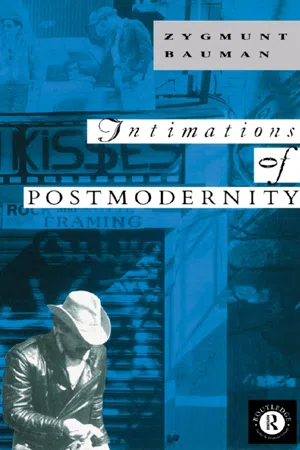
Intimations of Postmodernity
About this book
This thoughtful and illuminating book provides a major statement on the meaning and importance of postmodernity.
Information
1
LEGISLATORS AND INTERPRETERS
Culture as the ideology of intellectuals
Antonio Gramsci (1957) reserved the marker, ‘organic’, for those intellectuals who articulated the world view, interests, intentions and histor ically determined potential of a particular class; who elaborated the values which needed to be promoted for such a potential to be fully developed; and who legitimized the historical role of a given class, its claim to power and to the management of social process in terms of those values.
Ideologies were the product of such articulation, elaboration and legitimation. Their production, discursive defence and dissemination were the work of organic intellectuals: the activity that simultaneously defined the specifically intellectual praxis and the function played by the intellectuals in the reproduction of the social system.
As ‘organic’, intellectuals remained invisible as the authors of ideological narratives. The pictures of society or history they painted seldom contained their own representation. As a rule, the organic intellectuals hid behind the broad shoulders of their ostensible heroes. In class-related ideologies, the role of historical actors was normally assigned to classes defined by activities different from those that distinguished their intellectual authors.
A closer scrutiny, however, would pierce the camouflage. It would reveal the uncanny resemblance the stage actors of ideological scenarios bore to the intellectual scriptwriters. Whoever happened to be named as the sitter in a given portrait-painting session, the product was invariably a thinly disguised likeness of the painter. In organic ideologies, the intellectuals painted their selfportraits, though only rarely did they admit this to be the case.
Like other authors of narratives, organic intellectuals could hardly eradicate or dissolve their presence in the products of their work; this much has been readily admitted of virtually all kinds of authorship, though paradoxically the pretensions of objectivity in the field of ideological narratives tend to be defended with more zeal than elsewhere. Yet in organic ideologies the intellectual authorship leaves a particularly heavy imprint—and this in two respects above all.
First, the intellectuals’ own mode of praxis serves as the natural base line against which the features of the ostensible sitter of the portrait are plotted. The sitter’s own characteristics tend to be trimmed, underplayed or domesticated, while the painter’s experience is projected onto the finished work. Thus the portraits invariably represent heroes accredited with acute interest in knowledge, disinterested pursuit of truth, moral proselytism and other traits inextricably associated with the self-interpretation of the intellectual mode of life.
Second, the ostensible heroes of organic ideologies are assigned the role of ‘historical agents’ in so far as they are believed to promote a kind of society in which the continuation of the intellectual mode of life is guaranteed to be untrammelled and is assigned a considerable, if not the central, importance in the work of the social system. In other words, the ‘good society’ of which the heroes are believed to be agents, is a projection of the intellectual mode upon the society as a whole; alternatively, it is a model trusted to provide optimal conditions for the proliferation of such a mode.
There is, however, one ideology in which the intellectual authors of the narrative appear virtually undisguised; in which they constitute, so to speak, part of the plot. To use Gramsci’s terms again, in this ideology the intellectuals appear as the ‘organic intellectuals of themselves’. This unique ideology is one of culture: that narrative representing the world as man-made, guided by manmade values and norms and reproduced through the ongoing process of learning and teaching.
The notorious diversity of definitions of culture given currency in sociological, anthropological and non-academic literature—even of discursive contexts in which the concept of culture is situated and given meaning—should not conceal the common basis from which all such definitions and approaches derive. However the phenomenon of culture is defined, the possibility of the definition, of the very articulation of culture as a phenomenon of the world, is rooted in a particular vision of the world that articulates the potential, elaborates the values and legitimizes the role of the intellectuals.
The vision in question is directed by three tacitly, yet axiomatically accepted premises.
First, human beings are essentially incomplete and not selfsufficient. Their humanization is a process taking place after birth, in the company of other human beings. The distinction between the inherited insufficiency and acquired completeness is conceptualized as the opposition between ‘biological’ and ‘social’ aspects of the ‘homo duplex’, or between ‘nature’ and ‘nurture’.
Second, humanization is essentially a learning process, split into the acquisition of knowledge and the taming, or repressing, of animal (and almost invariably antisocial) predispositions. The distinction between knowledge to be put in place of the natural predispositions, and the predispositions it is to replace, is often conceptualized as the opposition between ‘reason’ and ‘passions’, or between ‘social norms’ and ‘instincts’ or ‘drives’.
Third, learning is just one side of the relation of which the other side is teaching. The completion of the humanization process, therefore, requires teachers and a system of—formal or informal— education. The educators hold the key to the continuous reproduction of cohabitation as a human society.
Thanks to the profuse historical studies (originated by Lucien Febvre, Febvre et al. 1930) we can locate the birth of this thoroughly modern vision of the world fairly precisely. It took place in the later part of the seventeenth and the first half of the eighteenth centuries and coincided with the birth and the institutionalization of the modern intellectuals.
The ideology of culture represents the world as consisting of human beings who are what they are taught. It therefore brings into relief the induced diversity of human ways of life; it makes possible the articulation of a plurality of ‘ways to be human’. This feature of the ideology of culture lends plausibility to a supposition that the birth of the ‘cultural vision’ of the world was linked primarily to the newly acquired modern sensitivity to cultural differences. The story often found in the sociological and anthropological texts is that of Europe suddenly opening its eyes to the diversity of cultural modes of life previously unnoticed or considered uninteresting. This story, however, misses the point crucial for the birth of cultural ideology: the perception of diversity as culturally induced, of differences as cultural differences, of variety as man-made and brought about by the teaching/learning process. It was a particular articulation of diversity, and not newly aroused sensitivity to differences, that was the constitutive act of the ideology of culture.
Europeans were avid travellers; pilgrims to the Holy Land, late medieval sailors could not help noticing strange ways of life alongside unfamiliar shapes of shelters or unusual physiques of people they met on their way. They recorded what they saw in a similar ‘alongside’ manner; all perceived differences appeared as if on the same plane, variety of skin colors being a part of the order of things in the same way as the variety of customs and revered idols. Fashionable travelogue literature revelled in reporting genuine and fantastic findings as so many curiosities in the same fashion the early-modern Kunstkamera collected them—mixing double-headed calves with strange man-made implements of unknown destination. The founder of modern taxonomy, Linnaeus, considered the differences between straight and curly hair equally symptomatic for the differentiation of human species as the variety of the forms of government.
The contemplative mood in which European travellers viewed the richness of human forms they found in the foreign lands was an attitude trained at home. The premodern society was split into selfenclosed ranks; each rank carried a life deemed uniquely suited to it and to no one else, and advised to ‘stick to its own kind’ or admonished for peeping beyond the confines of its own station. Ranks were part of the ‘great chain of being’, a testimony to the preordained order of things; they lived together, equally ancient and immutable, guarded against contaminating each other; emulation across the boundaries was frowned upon and considered morally morbid—a tinkering with the divine order. Not that the idea of self-improvement was totally unheard of; individual members of the ranks were indeed encouraged to strive for perfection. But the ideals of perfection were as numerous as the ranks themselves; and as impenetrable, separate, and—in theory—immune to change. ‘Selfperfection’ meant becoming more like the model assigned to the rank and avoiding confusion with other models.
Such a coexistence of forms of life, with none considering itself as a universal model for imitation and none bent on submerging or eradicating the others—provided no room for the ‘nature-culture’ or ‘nature-nurture’ distinction. Only once it had broken, could the ‘culture vision’ as a peculiar modern intellectual ideology emerge.
The cultural ideology became possible when the ostensibly peaceful coexistence between forms of life turned untenable; either through the malfunctioning of its reproductive mechanism, or because of its unsuitability for the novel form of social domination, or for both reasons. The reality cultural ideology reflected at its birth was one of the abruptly changing relations between rankascribed forms of life: with some forms of life becoming problems for some others, problems calling for being acted upon. Forms of life (or their selected aspects) came to be seen as ‘culturally produced’ after they had turned into objects of practice, became things one ‘had to do something about’ in order to contain, change or replace them. It was the intention to terminate their existence, and the underlying practice of enforced uniformization, that cast the diversity of the forms of life as an artificial, contingent, ‘merely man-made’ phenomenon. A ‘historical origin’ of forms of life was postulated once their ‘historical end’ had been envisaged as a practical and desirable possibility.
It was the extent of ambitions to interfere with forms of life, and of resources available to support such ambitions, that determined the newly discovered boundary between ‘nature’ and ‘culture’ and its subsequent shifts. In the previously uniformly preordained world, an enclave had been cut out that invited human designs (and had been theorized, therefore, as humanly designed). Its growth, at the expense of shrinking ‘nature’, followed closely the expansion of proselytizing ambitions, systemic needs that made such ambitions necessary, and the mobilization of social power that rendered them realistic.
The appearance of proselytizing practices and ambitions in earlymodern Europe was linked to a number of far-reaching structural dislocations; among the latter, the breakdown of the traditional mechanisms of social control and societal reproduction and the gestation of the modern state must be offered pride of place.
Surveillance-based, disciplinary power was the major tool of social control throughout the history of premodern Europe (a fact glossed over in the otherwise seminal analysis of Foucault 1980). This particular tool was not, however, employed by the state, confined as it were to the ‘sovereign’ power of the prince, focused almost solely on securing the princely and the aristocratic share in economic surplus. Instead, disciplinary power was deployed within communities and corporations small enough to make surveillance reciprocal, ubiquitous and comprehensive. Social order at the level of daily life was reproduced through the pernickety and oppressive surveillance exercised matter of factly, thanks to the permanent physical proximity of its, simultaneously, subjects and objects.
It was the breakdown of self-enclosed communities and the ensuing appearance of the ‘masterless men’—vagabonds, vagrants, shifting population nowhere at home, belonging to no specific community or corporation, at no locality subject to continuous and all-embracing surveillance—that rendered the issue of social control, and of the reproduction of social order, problematic. The heretofore invisible, ‘natural’ flow of things had been brought abruptly into relief as a ‘mechanism’—something to be designed, administered and monitored, something not functioning, or not functioning properly, unless attended to and operated skilfully. The timeless, yet never before problematized, control through surveillance, reproduction of order through disciplining bodily drill, had turned into an object of systematic inquiry, specialized skills and a function of experts. The diffuse activity of community had been transformed into an asymmetrical relationship between the subjects and the objects of the supervision. As such, it called for a support in a supracommunal authority. It needed resources no community could provide. It required deployment by the state; it rendered the state a systemic prerequisite of the reproduction of social order, the mainstay of the perpetuity of social domination. By the same token, the crisis of traditional vehicles of social control ushered in the modern state.
The latter meant first and foremost the centralization of social powers previously localized. This, however, was not simply a matter of transferring power from one setting to another; the very character of power changed considerably in the process. The destruction of les pouvoirs intermédiares, which the entrenchment of the modern absolutist state was about, was tantamount to the annihilation of the only institutional setting in which control could be exercised in a ‘traditional’ way (i.e. unreflectively) without the purpose of the exercise having been clearly articulated and the exercise itself transformed into a specialized function. The advent of the absolutist state was hence tantamount to the transformation of control into a consciously administered, purposeful activity conducted by specially trained experts. The state had now to take care of creating conditions in which surveillance and bodily drill could be effectively operated.
If the community-based social control resulted in perpetuating and reinforcing local differentiations of the forms of life, the state-based control could only promote supracommunal uniformity. Universality as an ideal and a measure of social improvement was born of this need of the modern state; and of its practical ability to act on such a need.
Bent on uniformity, the unprecedented practice of the earlymodern state was bound to clash with the still well-entrenched reproductive mechanisms that constituted the substance of communal autonomy. Concentration of power could never be complete without that autonomy being shattered—weakened or preferably uprooted. An indispensable part of the absolutist state bid for comprehensive power was therefore the notorious culture crusade that took off in the seventeenth century and continued well into the nineteenth. The crusade redefined the relations between diverse forms of life; mere superiority turned into hegemony.
Ranks were ‘lower’ or ‘higher’ well before the advent of modernity. So were their ways of life. Yet they were seen as separate entities, to be prevented rather than encouraged to come into direct contact with each other—each being viable in its own right and dependent but on itself for its own reproduction. ‘Superiority’ of one rank over another (and of corresponding ways of life) was hence a category of comparison, and not a concept standing for a specific task the ‘superior’ rank bore in relation to other ways of life. Such a task, on the other hand, is the essence of the thoroughly modern idea of ‘hegemony’: the role of the ‘superior’ way of life and its carriers as the moral mentor, missionary and pattern to be followed by all the others.
The universalistic ambitions of the modern state led inevitably to further weakening of the localized mechanisms of reproduction of previously autonomous ways of life; such mechanisms appeared to central power as so many obstacles on the way to the kind of society it projected, given its tendency to uniform administrative principles. Differences between ways of life were correspondingly redefined as relations of active mutual engagement. Popular, locally administered ways of life were now constituted, from the perspective of universalistic ambitions, as retrograde and backwardlooking, a residue of a different social order to be left behind; as imperfect, immature stages in an overall line of development toward a ‘true’ and universal way of life, exemplified by the hegemonic elite; as grounded in superstition or error, passion-ridden, infested with animal drives, and otherwise resisting the ennobling influence of the truly human—shortly to be dubbed ‘enlightened’—order. Such a redefinition placed the elite, for the first time, in a position of a collective teacher on top of its traditional role as the collective ruler. Diversity of ways of life has become now a temporary phenomenon, a transient phase to be left behind in the effort aimed towards a universal humanity.
The new character of relations between forms of life inside the society, now claimed by the absolutist state, served as a pattern for consideration of the relations between ways of life in general. The same active, proselytizing stance—once extended beyond the confines of its own society—constituted alien forms of life as ossified relics of the past, or otherwise artificially arrested stages of human development. Such aspects of human life as the emerging absolute power was bent on reshaping, or bound to reshape, had been selected as the bearers of a special status: men were about to reform them, hence they had to be conceived of as man-made in the first place. Those aspects were now seen as distinguished by their plasticity, temporariness, transitoriness—and, above all, amenability to purposeful regulation. The relative inferiority of the strange forms of life was interpreted, therefore, as the outcome of wrong regulation, and the local equivalents of the judging powers were charged with responsibility for the evil. On the whole, the inferiority of other forms of life, and the range of those of their aspects to which the judgment of inferiority was applied, were a function of the judging power’s ambitions—their scope and administrative skills to back them.
The aspects of human life now picked up for conscious regulation came to be known as ‘culture’. Historians agree that for almost a century, up to the last quarter of the eighteenth century, ‘culture’ (its French form of ‘civilisation’, German of ‘Bildung’, English of ‘refinement’) was used in the public discourse as a name of an activity, of something some people were doing, or exhorted to do, to others—much as a farmer cultivated his plants to ennoble the seeds and enrich the crop. The immediate interest that led to the coining of the idea of ‘culture’ as such aspects of human life as can be consciously regulated and given deliberately selected shape (unlike the other aspects that human powers were still unable or unwilling to reach) was one in the practice of changing the ways of life viewed as a symptom, and a source, of the morbid resilience of local autonomy pitted against the universalistic ambitions of the modern state. Culture, civilizing, refining were so many names given to the crusade proclaimed against the Vulgar, ‘beastly’, ‘superstitious’ habits and customs and the forces allegedly presiding over their perpetuation.
The givers of names were the first modern intellectuals—the members of la république des lettres, of les sociétés de pensée, men free of all institutional dependencies and loyalties, united solely by their voluntary participation in a discussion of issues that, thanks to the public nature of the discussion, came to be defined as ‘public’. It was the action of that new brand of educated elite (brilliantly analysed by François Furet (1978), in reference to the rich ideas contained in the literary legacy of Alexis de Tocqueville, and to heretofore little-known studies of Augustin Cochin (1978)) that provided an experience from which the new vision of the social world, as constituted by the learning/teaching activity, was to be extrapolated. I have described the process at length in Bauman (1987).
In response to the demand potentially present in the expanding ambitions of the absolutist state, la république des lettres offered the ideal design of the polity toward which the lawgivers should strive, the method of its attainment (the process of enlightenment through the diffusion of right ideas), and their own skills as the guarantee that the method would be applied effectively. The overall effect of the triple offer was the constitution of knowledge as power; the establishment of a privileged, foolproof access to right knowledge as the legitimation of the right to tell the others, deprived of such an access, what to do, how to behave, what ends to pursue and by what means.
The cognitive perspective grounded in the practice of la république des lettres rearranged the vision of the diversity of forms of life, now seen as first and foremost a cultural diversity. Other forms of life were now seen as products of a wrong kind of teaching, of malice or error, of ignorance at best. Behind the teaching, teachers were surmised in the image of the conscious educators of the day. Les philosophes named the clergy, old wives and folk proverbs as the teachers responsible for the lamentable state of popular habits. In the new vision of the social world, nature did not tolerate void—for every way of life there had to be a teacher responsible for its shape. The choice was not any more between a guided and regimented education and the autonomous selfconstitution of forms of life—but between good and bad education. Not only was knowledge power; all power was knowledge. All efficient power had to rely on good knowledge for its efficiency.
The power/knowledge syndrome was, from the very start, a double-edged phenomenon, and hence prone to internal contradiction. On the one hand, it contained what later came to be called the ‘rational government’—a global administration of the society as a whole aimed at creating and maintaining conditions eliciting ‘good’ behaviour and eliminating or preventing the ‘bad’.
On the other, it entailed a direct manipulation of cognitive maps, values and motives of the individual members of the society in order to prompt what later cam...
Table of contents
- Cover Page
- Title Page
- Copyright Page
- Introduction
- 1: Legislators and Interpreters
- 2: Sociological Responses to Postmodernity
- 3: The Changing Discursive Formation of Sociology
- 4: Is There a Postmodern Sociology?
- 5: Philosophical Affinities of Postmodern Sociology
- 6: The World According to Jean Baudrillard
- 7: Communism: A Postmortem
- 8: Living without an Alternative
- 9: A Sociological Theory of Postmodernity
- Appendix
Trusted by 375,005 students
Access to over 1.5 million titles for a fair monthly price.
Study more efficiently using our study tools.
Frequently asked questions
Yes, you can cancel anytime from the Subscription tab in your account settings on the Perlego website. Your subscription will stay active until the end of your current billing period. Learn how to cancel your subscription
No, books cannot be downloaded as external files, such as PDFs, for use outside of Perlego. However, you can download books within the Perlego app for offline reading on mobile or tablet. Learn how to download books offline
We are an online textbook subscription service, where you can get access to an entire online library for less than the price of a single book per month. With over 1.5 million books across 990+ topics, we’ve got you covered! Learn about our mission
Look out for the read-aloud symbol on your next book to see if you can listen to it. The read-aloud tool reads text aloud for you, highlighting the text as it is being read. You can pause it, speed it up and slow it down. Learn more about Read Aloud
Yes! You can use the Perlego app on both iOS and Android devices to read anytime, anywhere — even offline. Perfect for commutes or when you’re on the go.
Please note we cannot support devices running on iOS 13 and Android 7 or earlier. Learn more about using the app
Please note we cannot support devices running on iOS 13 and Android 7 or earlier. Learn more about using the app
Yes, you can access Intimations of Postmodernity by Zygmunt Bauman in PDF and/or ePUB format, as well as other popular books in Social Sciences & Post-Structuralism in Philosophy. We have over 1.5 million books available in our catalogue for you to explore.