- English
- ePUB (mobile friendly)
- Available on iOS & Android
eBook - ePub
About this book
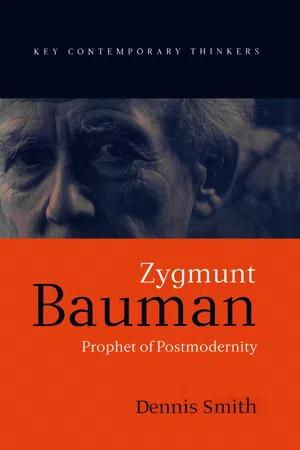
In this major new assessment of Zygmunt Bauman's work, Smith gives a clear introduction to this controversial and challenging sociologist.
Information
Part I
Setting the Agenda
1
Living Without a Guidebook
Introduction
If you are new to the hotly raging debate about modernity and postmodernity, start by reading Zygmunt Bauman. He is one of the most interesting and influential commentators on these aspects of our human condition.
Zygmunt Bauman has brilliantly described humankind’s trek through modernity during the past few centuries. He has also drawn a vivid map of the new world coming into being as modernity turns postmodern.
Bauman is part of the story he tells. He can be found on the map he draws. Born in 1925 in Poland and educated in Soviet Russia, Bauman fought with the Red Army against the Germans during World War II. He emigrated from Poland to the West in 1968. Since then he has published a new book every one or two years.
Critical perspectives
This book presents an overview of Bauman’s work between the 1960s and the late 1990s, and it also provides a critical perspective on that work. I have tried to get ‘behind’ the texts themselves in order to understand why they were produced and what they were intended to achieve.
Bauman wants to awaken people to their creative potential and to their moral responsibilities. That is not difficult to discover, since he is quite explicit about it. However, the way Bauman defines his objectives changes over the decades. So does the way he tries to achieve them. Bauman does not announce these alterations of definition and direction. They have to be reconstructed through the kind of critical analysis I have carried out in the first part of this book, where I trace the main outlines of Bauman’s life and career as a young refugee, a wartime soldier, a military bureaucrat, a revisionist intellectual and an émigré.
Analysis of this kind asks ‘why this agenda?’ and ‘why this change of agenda?’ Our response to a specific text is altered if we are able to see it as part of a larger constellation of writing, especially if that larger constellation tells its own story. I say ‘tells its own story’ as if the process were unproblematic, a matter of simply downloading a file. In fact, it requires a concentrated effort of interpretation, in the course of which one has to keep the imagination under tight control, avoid unwarranted assumptions, try to avoid going too far beyond the evidence, but, at the same time, not ignore the evidence that exists.
These are, I assume, the working practices of a good detective, although I must say straightaway that I am not looking for a ‘conviction’. I am in broad sympathy with Zygmunt Bauman’s objectives. My curiosity comes out of fascination, not suspicion.
This first part of the book, ‘Setting the Agenda’, sets out my understanding of the long process that led from Bauman’s search for a ‘modern Marxism’ in the 1960s (Bauman 1969: 1) to his evocation of ‘postmodernity and its discontents’ in the 1990s (Bauman 1997). In the second part of the book, entitled ‘The Road to Postmodernity’, I show how Bauman’s major works in English can be understood in the light of the interpretation developed in part I. In particular, I trace the genealogy of Bauman’s vision of modernity and postmodernity, and explore its intellectual content.
In the final part of the book, ‘Dialogue’, I appraise Bauman’s work from two other directions. I locate Bauman in the field of play occupied by critical theory and post-structuralism, examining the points of convergence and tension. In this context, I pay particular attention to Adorno, Habermas, Foucault and Lyotard. Finally, I debate the nature of modernity and postmodernity with Zygmunt Bauman in a correspondence that appears as the last chapter in the book.
This book exemplifies one of the methodological principles explored by Bauman. To borrow a passage from his Thinking Sociologically, my narrative
goes in circles rather than developing in a straight line. Some topics return later, to be looked upon once again in the light of what we have discussed in the meantime. This is how all effort of understanding works. Each step in understanding makes a return to previous stages necessary. What we thought we understood in full reveals new question marks we previously failed to notice. The process may never end; but much may be gained in its course. (Bauman 1990b: 19)
So it is with this book about Bauman.
Sociology plus
Bauman is a sociologist. That means he is in the business of ‘viewing human actions as elements of wider figurations’ and seeing human actors as ‘locked together in a web of mutual dependency’. As a sociologist, he wants to ‘defamiliarize the familiar’ and make the world more amenable to individual and collective freedom. He realises very well that, when people are free to think and act for themselves, this ‘may be seen as having a destabilizing effect on the existing power relations’ (Bauman 1990b: 7, 15, 17; emphases in original).
Bauman’s sociology is intrinsically critical, dedicated to testing ‘common sense’ (p. 8): in other words, the unsystematic mixture of conventions and prejudices in terms of which we typically manage the routines of daily life. However, when Bauman has breached the barricade of ‘common sense’, which way does he march? This question could be asked of any critical sociologist – and most sociologists would say that their discipline is intrinsically critical.
At this point, it becomes relevant that Bauman is more than ‘just’ a sociologist. He is also a highly competent social philosopher, well versed in, for example, Hegel, Husserl, Heidegger, Wittgenstein and Lévinas. More than that, Bauman has been a socialist for most of his life. In the late 1980s, his wife wrote that he was still ‘a sincere socialist … deep in his heart’ (J. Bauman 1988: 115). He retains a very strong commitment to equality, freedom and justice, although he now prefers to describe these as ‘western, Enlightenment values’ (Bauman 1992a: 225).
Finally, Bauman is not only a sociologist, a social philosopher and (in some sense, at least) a socialist. He is also an accomplished storyteller, a maker of historical narratives. A significant part of the power of Bauman’s work comes from the stories he relates. The structure and dynamic of these narratives tell readers where they are located in time and space. They also tell them the direction in which they are moving, or perhaps should be.1
Two narratives are central to Bauman’s early and later work, respectively: the narrative of progress towards a socialist utopia; and the narrative of the transition from modernity to postmodernity. They both begin with the breakdown of a ‘traditional’ social order, have heroes or pioneers, and end by challenging the reader to take some action or make some choice.
I imagine that some readers will come to this book feeling rather puzzled about the meaning of the terms ‘modernity’ and ‘postmodernity’. If their meaning is not problematic for you, then you would do well to skip the next two sections. However, if you remain puzzled, or if you are simply curious about the way I understand these ideas, then read on, aware that I am aiming these passages at ‘beginners’.
What is modernity?
Everyone knows that if something is ‘modern’ it is up to date, in tune with the latest ideas, more advanced than previous versions. That applies, most obviously, to things like cameras, cars and high-tech kitchen equipment. These modern items are desired and bought by modern people. They are made and distributed by modern organizations, most of which are trying to design something even more modern for next year or the year after that.
The modern world is permanently on fast forward. Modernity means constant change. Many terms in this paragraph would have made no sense to anyone in 1975. Go to your lap-top or palm-top computer. Use it to get on to the Internet. Access a search engine. Now find some web-sites dealing with the idea of modernity. Surf between them. Follow the links. Find out when in history men and women started describing themselves as modern people living in a modern age.
You will discover that the idea of modernity, of living in the ‘modern age’, began in Europe sometime during the late sixteenth century. It implied a contrast with other ‘ages’ that were not modern, epochs that had gone before, that were out of date, whose moment had passed. Europeans began to see history as divided into three epochs: ancient, medieval and modern. The Greeks and Romans did not know they were ‘ancient’. Medieval knights did not realize they were in the ‘middle’ of history. But we, like our sixteenth-century ancestors, ‘know’ we are modern.
In the modern age, three powerful forces have come into play. The first is the modern national state. The state has dug its roots deep into the soil of society and sucked up resources in the form of tax revenues. States have used tax income to build up their muscle power (more soldiers, more bureaucrats, more display) and used that muscle power to defend, develop and, in some cases, terrorize the populations they control.
The second powerful force is modern science. Scientists and engineers have explored the properties of the environment and tried to discover the operating principles of matter. They have developed tools for manipulating the natural world, asserting greater human influence over it. Weapons have become more deadly, medicines more effective, engines more powerful. Systems of transport and communications have penetrated into the world’s furthest recesses.
The third great force is capitalism – the systematic pursuit of profit. Traders and manufacturers have pushed and shoved local communities into producing for the market. They have cut their way through the thicket of habit and custom to bring labour, skills, energy sources and raw materials into new money-making relationships. Capitalism has drawn the whole population into activities that feed into the creation of mobile wealth – resources that can be used to engineer still further change.
At the heart of modernity is a struggle for betterment: being better, doing better, getting better. The competition takes place at several levels: between individuals, families, cities, empires, governments and companies, for example. Any group prevented from taking part in the contest on equal terms (due to discrimination, disability, oppression or imprisonment) feels extremely discontented.
The ‘modern’ assumption is that everybody has a right to take part in the struggle for betterment. Or, rather, every group claims that right for its own members. They may wish to deny the same right to certain other groups whom they regard as ‘inhuman’ or ‘uncivilized’.
An aspect of the struggle within modernity is the contest between ideologies. These idea-systems compete to justify the different demands and restrictions imposed upon the masses by bureaucrats, bosses and experts. At the heart of all these ideologies of modernity is the promise of a better earthly existence to come.
One powerful ideology inspired by the progress of science is the ethos of planning: the idea that experts can manipulate the world to produce desirable outcomes by using their scientific knowledge in a rational way. Another, opposing, ideology also draws inspiration from a scientific source. This is social Darwinism, the notion that social competition, however nasty, tends to favour those fittest to survive. The assumption is that we all benefit from this in the long run.
Social Darwinism is sometimes interwoven with the laissez-faire ideology of the market. This approach argues that an invisible hand ensures that, even though people pursue their own selfish interests as buyers and sellers, the total amount of useful wealth within society tends to increase and, again, we all benefit from this in the fullness of time.
Both laissez-faire and social Darwinism were powerful in the nineteenth century, although their influence remained powerful in the twentieth. During the past seventy-five years, other ideologies have become prominent. Democracy gained a powerful global advocate when the United States came out of its long period of isolation, especially during and after World War II.
Democracy has often been interlinked with Keynesian welfarism. This is the idea that the state can manage capitalism in such a way that the people enjoy full employment as well as social rights such as education, health care and pensions.2 The modern national state has also been the focus of other ideologies, notably fascism and communism. Each of these two systems claims that state power can be used to make society perfect.
Every ideology assigns a particular role to each of the ‘big players’: in other words, the state, science, capitalism and the people themselves. For example, communism and fascism both give leading roles to the state and science, while laissez-faire emphasizes the capitalist market. In all cases, the ‘winners’ are, supposedly, the people. This entity is presented sometimes as a hive of busily interacting individuals (workers, consumers or citizens), sometimes as a united body (a Volk, a ‘nation’ or a proletariat).
During the past century, men and women have been trained to see modernity through the rose-coloured spectacles provided by ideologies of this kind. The job of making these spectacles, keeping them well polished and ensuring that they are worn properly has fallen to the ranks of the intellectuals, in government, in education and in the media. They have been the priests of modernity.
What is postmodernity?
One of the notable features of Western culture in the present phase of modernity is the widespread use of the idea of postmodernity by intellectuals. Talk about postmodernity does not mean that modernity has ended. It is more accurate to say that postmodernity is a key idea employed by intellectuals trying to cope with the impact of four massive changes in the ‘big picture’ of modernity during the last three decades of the twentieth century.
Firstly, national states have been cut down to size. They have become much less ambitious in the claims they make about their capacity to reshape society. During the 1980s, the US federal government and many European governments abandoned Keynesian welfare strategies. When the Soviet Union broke up during the early 1990s, this brought the twentieth century’s most sustained and ambitious experiment in state-sponsored modernization to an end. Opponents of the ethos of planning argued that this finally destroyed the claims of that ideology.
Secondly, awareness of risk has increased. People in the West are being forced to stop expecting that a caring state will protect them from cradle to grave. They must live with a high level of risk and make what arrangements they can to cope. The old safety nets have been torn to bits. The family is an increasingly unstable institution. The welfare state cannot meet the demands placed upon it. Most frightening of all, science has shown its dangerous side.
We use science and technology to drive the world faster, to squeeze more out of nature, to give us a better life. But we do not feel in control. The level of risk is spiralling upward. The explosion in the Soviet nuclear plant at Chernobyl, the discovery of the hole in the ozone layer, the scare over British beef and BSE, the shock of AIDS and our failure to find a cure for this disease: all these happenings have combined to popularize a very pessimistic thesis. This has three parts. Science is just as likely to produce bad outcomes as good outcomes. The risk of science threatening life and health is high and difficult to predict. Finally, bureaucrats and officials are likely to disguise or underestimate the level of risk.
Thirdly, capitalism has become global. Large-scale businesses have cut themselves free from the close links with national states that Keynesian welfarism required. Multinational companies conduct their operations across national borders. They can shift their investments from country to country depending on which government offers them the best deal. They are intrinsically unreliable as long-term partners for states trying to manage particular national economies. In fact, the very idea of a ‘national economy’ has become an anachronism.
Fourthly, European imperialism has come to an end. In 1900, cities such as London, Paris, Brussels, Amsterdam, Vienna and Moscow were not just political or commercial capitals of their respective countries. They were all the headquarters of vast multinational or multiethnic empires, both within Europe and beyond. This vast imperial structure has sunk like the Titanic. The iceberg it struck was the United States, an ex-colony of the British empire which grew more powerful than its old master. America’s interventions in World War I and World War II were decisive and had fatal results for European imperialism.
The European empires sank below the waves in an uneven way. Some were more buoyant than others and broke surface again, briefly. World War I swept away the Austrio-Hungarian empire of the Hapsburgs and its arch rival the Ottoman empire. The Russian and German empires were also broken up. However, by the early 1940s a multiethnic German empire had been re-established under Hitler.
Further decline was precipitated by World War II. The Allied victory destroyed Hitler’s German empire. The war also led to the final disintegration of the British and French empires. However, after the war Stalin...
Table of contents
- Cover
- Title page
- Copyright page
- Key Contemporary Thinkers
- Preface
- Part I: Setting the Agenda
- Part II: The Road to Postmodernity
- Part III: Dialogue
- Bibliography
- Index
Trusted by 375,005 students
Access to over 1.5 million titles for a fair monthly price.
Study more efficiently using our study tools.
Frequently asked questions
Yes, you can cancel anytime from the Subscription tab in your account settings on the Perlego website. Your subscription will stay active until the end of your current billing period. Learn how to cancel your subscription
No, books cannot be downloaded as external files, such as PDFs, for use outside of Perlego. However, you can download books within the Perlego app for offline reading on mobile or tablet. Learn how to download books offline
Perlego offers two plans: Essential and Complete
- Essential is ideal for learners and professionals who enjoy exploring a wide range of subjects. Access the Essential Library with 800,000+ trusted titles and best-sellers across business, personal growth, and the humanities. Includes unlimited reading time and Standard Read Aloud voice.
- Complete: Perfect for advanced learners and researchers needing full, unrestricted access. Unlock 1.5M+ books across hundreds of subjects, including academic and specialized titles. The Complete Plan also includes advanced features like Premium Read Aloud and Research Assistant.
We are an online textbook subscription service, where you can get access to an entire online library for less than the price of a single book per month. With over 1.5 million books across 990+ topics, we’ve got you covered! Learn about our mission
Look out for the read-aloud symbol on your next book to see if you can listen to it. The read-aloud tool reads text aloud for you, highlighting the text as it is being read. You can pause it, speed it up and slow it down. Learn more about Read Aloud
Yes! You can use the Perlego app on both iOS and Android devices to read anytime, anywhere — even offline. Perfect for commutes or when you’re on the go.
Please note we cannot support devices running on iOS 13 and Android 7 or earlier. Learn more about using the app
Please note we cannot support devices running on iOS 13 and Android 7 or earlier. Learn more about using the app
Yes, you can access Zygmunt Bauman by Dennis Smith in PDF and/or ePUB format, as well as other popular books in Social Sciences & Sociology. We have over 1.5 million books available in our catalogue for you to explore.