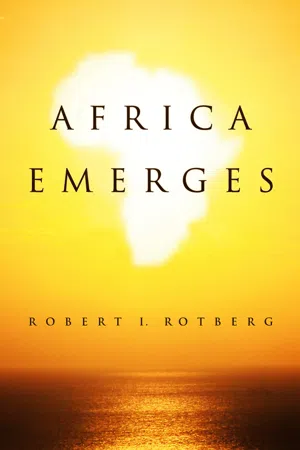
Sub-Saharan Africa is no longer a troubled 'dark continent.' Most of its constituent countries are now enjoying significant economic growth and political progress. The new Africa has begun to banish the miseries of the past, and appears ready to play an important role in world affairs. Thanks to shifts in leadership and governance, an African renaissance could be at hand.
Yet the road ahead is not without obstacles. As world renowned expert on African affairs, Robert Rotberg, expertly shows, Africa today maybe poised to deliver real rewards to its long suffering citizens but it faces critical new crises as well as abundant new opportunities. Africa Emerges draws on a wealth of empirical data to explore the key challenges Africa must overcome in the coming decades. From peacekeeping to health and disease, from energy needs to education, this illuminating analysis diagnoses the remaining impediments Africa will need to surmount if it is to emerge in 2050 as a prosperous, peaceful, dynamic collection of robust large and small nations.
Africa Emerges offers an unparalleled guide for all those interested in the dynamics of modern Africa's political, economic, and social development.
- English
- ePUB (mobile friendly)
- Available on iOS & Android
eBook - ePub
1
Myriad Challenges and Opportunities
Africa, especially the 49 countries south of the Sahara that belong to the African Union, is poised to grow and mature – to begin rapidly catching up with progress and modernity in the rest of the developing world and, soon, with advances everywhere. Its 900 million people, much more urbanized and urbane than before, and much more driven than in past decades by middle-class aspirations similar to those voiced everywhere around the globe, seek to transform the missed opportunities of the era from 1960 to 2000 into the sustainable successes of an Africa newly emergent and newly ready to triumph over the myriad geographical, material, and human vicissitudes that have for far too long prevented Africa from meeting the lofty expectations of its peoples and its more responsible rulers. Africans now seek to reclaim the promise of their independence years. They not only wish to assume their rightful place in the corridors of world diplomatic and political power but also want gradually to achieve parity of opportunity and prosperity with Asia and Latin America.
Africa has lagged the rest of the world for decades, failing overall to deliver to its numerous peoples the improved incomes and life chances to which they have long aspired. Compared to East Asia, Southeast Asia, the Caribbean, and Latin America, Africans today remain under-educated; more afflicted with deadly tropical and other diseases; deficient in preventive and curative health care and facilities; particularly susceptible to the periodic stresses and strains of global warming and climate change; prone to low crop yields; desperately poor; malnourished; bereft of water; short of power; under-served by road and rail; and limited by flimsy Internet connections. Yet Africa is rich in potential, with vast supplies underground of critical industrial minerals, gems, and gold. Off or near its coasts there are substantial quantities of newly discovered deposits of oil and gas, many already productive and others awaiting exploitation. Only a few countries are now densely populated on the land, although those densities are about to increase exponentially. For the most part, Africa’s countries enjoy abundant sunshine to compensate for deficient soils and erratic rainfalls, and their indigenous farmers are endlessly inventive, conservative, and hard-working. Moreover, and significantly, in 2013, Africa is much better led and much better governed than it was during the first post-colonial period. Overcoming its deficits and bringing all of the positive attributes and possibilities together is the challenge of Africa’s next era of growth and development. Yet, policy makers must lead responsibly if Africa is to emerge healthy and strong in 30, and then 50, years’ time.
Middle-class expectations
Sub-Saharan Africa’s middle class has emerged as a critical driving force of positive change. Before this decade, Africa lacked a substantial middle class just as it had long lacked a meaningful hegemonic bourgeoisie. Now Africa’s middle class (defined by the World Bank and the Asian and African Development Banks as persons earning between $2 and $20 a day) has grown since 1990 from 117 million to over 200 million (in 2012). Thus, of Africa’s 900 million people, nearly a quarter are “middle-class” in wealth and, presumably, attitude and aspiration. About 60 million households now have yearly incomes equivalent to $3,000. (Nevertheless, this is a new middle class that has much less disposable income than comparable middle classes elsewhere. Most are still very poor by the standards of industrialized countries. Few are able to afford the “white goods” – appliances – on which middle-class households elsewhere dote. They do not routinely carry credit cards.) A Pew Foundation poll of 13 emerging markets confirms anecdotal evidence that the new middle classes in Africa and the rest of the developing world are more politically engaged than the poor for whom popular politicians in African states have long catered. Members of the middle class “consistently” care about such values as free speech and free elections; the poor seek primarily to improve their incomes. As it grows, the middle class acts on abstract ideas about governance and thus demands improved political leadership and service delivery. The middle class mobilizes via the new social media and the Internet, and uses mobile telephones more innovatively than do others. Sub-Saharan Africa has about 500 million mobile telephone users, and more everyday.1
The new urban middle-class Africans are members of the global village. They have largely thrown off traditional or “tribal” attitudinal shackles. They want jobs, but hardly ever on farms, and now try to hold their rulers to standards of responsible governance and transparency that are refreshingly novel for Africa. Too long in thrall, these middle classes are the driving forces of change and modernization in an Africa that has seen the rest of the world race far ahead across several dimensions; Africa’s citizens, now more empowered than ever before, intend to catch up. These newly empowered citizens are what Ayittey calls the new “Cheetahs” – swift, assertive, accountable, and technologically sophisticated.2 Active stakeholders, they demand enlightened and responsive policies from their ruling classes.
Africa’s renaissance
This renaissance has been a long time coming. In the 1960s, when most of Africa cast off the chains of colonial domination, several West African and East African nations boasted per-capita GDPs higher than similarly new former colonies in Asia, notably Singapore and Malaysia, but also Taiwan and South Korea. Those outposts became economic wonders – the Asian Tigers – while the economically leading countries of Africa slipped inexorably into decades of intense impoverishment. Most of the rest of post-colonial Africa joined them in perpetuating this immiserating condition. Some of the new African countries, forgetting fundamental economic rules, attempted to surge to prosperity through import substitution, protection of infant industries, and neglect of traditional agriculture. But grasping at grandiose panaceas gained them little. The experiments largely failed. Many countries forfeited their previous ability to feed themselves. Many went heavily into debt as they attempted massive uplifts of their educational and health services, created their own airlines, expanded their armies and purchased tanks and aircraft, opened diplomatic missions across the globe, and naturally attempted to become big players on the world scene.
These lost decades – modern Africa’s dark ages, corresponding in time to the era of the Cold War and reflecting many of its Manichaean absolutes – were desperate ones for many of Africa’s peoples. They mostly lost the representative institutions that they had inherited from departing colonial rulers. Almost everywhere, democracy was replaced by Afro-socialism and single-party rule, or by a succession of military dictatorships. The “big man” – the ruling individual hegemon, rule giver, autocrat – became the norm. Rejecting democracy as a “Western” invention and a product of “imperialist dogma,” these new leaders “established Soviet-style one-party states and declared themselves ‘presidents for life.’ ”3 Citizens became objects rather than subjects and were preyed upon by rulers and ruling classes as their individual standards of living declined dramatically and those of the overweening potentates exploded exponentially. Even in those few countries governed by well-intentioned autocrats, benevolent dictatorship deprived most citizens of opportunities to achieve relatively higher levels of prosperity, improved educational attainments, and modern social advances. Almost everywhere, Africa fell backwards, missing opportunities to grow and progress with the rest of the developing world. For the most part lacking responsible leadership and good governance, and mired in a morass of spreading corruption, Africans also found themselves engaged in bitter, seemingly interminable, civil wars. Diseases spread, too, and large swathes of Africa suffered from periodic famines as the rains failed and the new national social safety nets proved nonexistent or inadequate. Whole generations lost hope while their leaders ostentatiously paraded around the world and grandly neglected their long-suffering subjects.
Nigeria, Africa’s largest nation and among its very wealthiest per capita in 1960, spent most of its first 40 years of independence in turmoil and tragedy. Military officers ousted the post-independence elected regime in 1966, and continued to plunge the country back into military dictatorship regularly until 1999. There was a bitter civil war between the eastern third of the country and the rest for three years in the late 1960s, mostly fueled by discoveries of oil. Petroleum-derived revenues and rents have fueled internecine battles over spoils ever since, exacerbating the corrupt practices that had plagued Nigeria for centuries and depriving ordinary citizens of rightful services and entitlements normally expected from governments. Nigeria squandered its new oil-derived riches, failed even to refine sufficient petroleum to fuel its own automobiles and tractors or to power its electricity grid, made farming unprofitable, and drove many Nigerians into crime. (Aviation fuel was in short supply throughout the country, even in 2012.) Nigeria effectively lacked responsive governing bodies for decades, its millions having to suffer under and make do with a shifting array of greedy regimes unable to share spoils with the mass of its dependents. Nigerian generals, mostly from the Muslim north of the country, ate the land and left little that was edible for those unfortunates who tried to go to school, obtain medical services, or make their way economically.4
Africa had many Nigerias, if always on a smaller scale and not always based on rents from oil. But some tightly run satrapies had mountains of bauxite, warehouses of cocoa, vast reserves of copper, piles of uranium, or mines that yielded diamonds, gold, cobalt, cadmium, iron, and other precious minerals. Unhappily, the returns from such resources were usually deployed to benefit new ruling classes, not to uplift the women tilling maize or manioc or the men beating metal in an urban foundry. In places like Zaire (Congo), Uganda, Equatorial Guinea, Togo, and the Central African Republic, rulers became the state, with each country’s large or small resources existing mostly to serve the needs of the tyrant in charge and his entourage.5
Not all of Africa was so despotic during the Cold War, but even in places like Tanzania and Zambia, where the bosses were humanists at heart, people possessed little voice, there was hardly any transparency, and very few attempts were ever made to ascertain what the people preferred. Even in those relatively benign states, there were political prisoners, little freedom of speech or press, and more attention paid to what was deemed politically or socialistically/humanistically correct than to what might uplift and advance the lives of citizens. Conformity, even some attempts to collectivize agriculture, trumped individual initiative; the all-knowing state decided what was permissible.6
The result of all of these missed opportunities to join the global marketplace, embrace international trade, and float currencies was economic decline and social sclerosis. Africa’s emergence was retarded throughout much of its first 30 or 40 years of independence by the greed and obstinacy of its rulers and ruling classes more than by any colonial legacies and hangovers. Leaders were concerned with enriching and advancing themselves and their families, clans, and lineages, not with strengthening the foundations of their states (most were not yet fully fledged nation-states) or uplifting and ennobling their peoples. Mobutu Sese Seko of Zaire/Congo purchased chateaux in Switzerland. He and other patrimonial despots obtained private jet aircraft with state money, distributed funds from the national treasuries to retainers and close followers, and created large and well-equipped armies and even air forces to cow their citizens and display their personal might. Rulers of less well-off or less extravagant African countries might have cried out against the opulence and oppression of their fellow African rulers, but few did. The Organization of African Unity (OAU) did nothing as a regional body to curb or even to complain about the excesses and depredations of some of its members.
Africa slipped farther and farther behind in the race for human advancement. That was the result of the forsaken opportunities, the civil war mayhems, the predatory oppressions, and the mismanagement of Africa by so many of its rulers and ruling classes during the dark decades.7 In Sierra Leone, for instance, a small but well-run ex-colony in West Africa was transformed by the perverted greed of its elected president into a kleptocratic stew of civil conflict and retaliation. Beginning in the late 1970s, President Siaka Stevens gained personal control of his country’s diamond and agricultural wealth and thus systematically benefitted himself and his family at the expense of the nation and its people. “Over the course of one year in the mid-1980s,” Stevens and his financial partners “gained a windfall … [of] … about 3 percent of recorded GDP. … Almost no aspect of the state escaped Stevens’ mania for personal appropriation.”8 Emasculating the state bureaucracy, willfully destroying the formal institutions of the state, and bankrupting the nation by stealing its revenues, Stevens militarized politics, sponsored armed gangs that enforced his predations, and consequently propelled Sierra Leone into a cauldron of conflict and, after his own death, into a civil war of unspeakable depravity. Blood diamonds were his legacy.
Fortunately, two small states in Africa resisted the common tendency to deprive citizens of their rightful deserts. Two leaders, Sir Seretse Khama in Botswana and Sir Sewoosagur Ramgoolam in Mauritius, believed in the responsibilities of leadership, in uplift, in stewardship, and in bucking the common single-party and Afro-socialist preferences of the very best of their peers in the OAU. Being hostile to dictatorship was natural and easy for leaders who were instinctive democrats. But it was harder to hew to a distinctive democratic path when even such well-meaning fellow leaders as Julius Nyerere (Tanzania) and Kenneth Kaunda (Zambia) believed that tight, authoritarian control delivered better results.
Khama inherited a dirt-poor land from Britain and, despite being surrounded by apartheid South Africa, transformed it into mainland Africa’s most well-managed, most thoroughly democratic, and most prosperous land (diamonds were mined and exported only ten years after he had begun to run the new Botswana).9 He even accomplished something which few others have yet done. He built a nation from a collection of tribes and ethnic groups united only in part by a (mostly) common language. He led in such a gifted and honest way, without the taint of corruption, that good governance (the delivery of quality services) is now taken for granted throughout Botswana, and solid institutions now hold its rulers in check and provide such luxuries – for Africa – as a consistent and independent rule of law, an energetic and committed civil service, a self-sufficient private sector, and strong educational and health services.
First forging a lonely, determined, course as a democracy distrusted by the autocracies and military dictatorships of Africa, the Botswanan model pioneered by Khama emphasized strict adherence to the rule of law, an independent judiciary, dedication to free speech, freedom of assembly and religion, widespread citizen participation, prudent management of human and financial resources, and a close attention to the needs of the nation and its people rather than to the demands of the ruling class and its families. Khama was modest and unostentatious – a rare combination in a Cold War Africa of “big men,” self-styled potentates who declared that they knew what was best for their subjects.10 Possibly as much because of Khama’s attention to incentives and honest management, and also because Botswana was strictly well governed, the country prospered (avoiding Dutch disease – overvalued currency and marginalization of all other enterprises) as supplies of gem diamonds were discovered and carefully exploited...
Table of contents
- Cover
- Title page
- Copyright page
- Dedication
- Acknowledgements
- Introduction: A Continent on the Move
- 1 Myriad Challenges and Opportunities
- 2 A Demographic Dividend or Just More People?
- 3 Tropical Dilemmas: Disease, Water, and More
- 4 Educating Future Generations
- 5 To War Rather than to Prosper
- 6 Accountability and the Wages of Corrupt Behavior
- 7 The Infrastructural Imperative
- 8 Harnessing Mobile Telephone Capabilities
- 9 China Drives Growth
- 10 Strengthening Governance
- 11 Creating Responsible Leadership
- Select Bibliography
- Index
Trusted by 375,005 students
Access to over 1.5 million titles for a fair monthly price.
Study more efficiently using our study tools.
Frequently asked questions
Yes, you can cancel anytime from the Subscription tab in your account settings on the Perlego website. Your subscription will stay active until the end of your current billing period. Learn how to cancel your subscription
No, books cannot be downloaded as external files, such as PDFs, for use outside of Perlego. However, you can download books within the Perlego app for offline reading on mobile or tablet. Learn how to download books offline
Perlego offers two plans: Essential and Complete
- Essential is ideal for learners and professionals who enjoy exploring a wide range of subjects. Access the Essential Library with 800,000+ trusted titles and best-sellers across business, personal growth, and the humanities. Includes unlimited reading time and Standard Read Aloud voice.
- Complete: Perfect for advanced learners and researchers needing full, unrestricted access. Unlock 1.5M+ books across hundreds of subjects, including academic and specialized titles. The Complete Plan also includes advanced features like Premium Read Aloud and Research Assistant.
We are an online textbook subscription service, where you can get access to an entire online library for less than the price of a single book per month. With over 1.5 million books across 990+ topics, we’ve got you covered! Learn about our mission
Look out for the read-aloud symbol on your next book to see if you can listen to it. The read-aloud tool reads text aloud for you, highlighting the text as it is being read. You can pause it, speed it up and slow it down. Learn more about Read Aloud
Yes! You can use the Perlego app on both iOS and Android devices to read anytime, anywhere — even offline. Perfect for commutes or when you’re on the go.
Please note we cannot support devices running on iOS 13 and Android 7 or earlier. Learn more about using the app
Please note we cannot support devices running on iOS 13 and Android 7 or earlier. Learn more about using the app
Yes, you can access Africa Emerges by Robert Rotberg in PDF and/or ePUB format, as well as other popular books in Economics & Economic Policy. We have over 1.5 million books available in our catalogue for you to explore.