Today's global energy system faces two major challenges: how to secure the supply of reliable and affordable energy; and how to rapidly transform to a low-carbon, efficient and environmentally harmless energy supply. In this rigorous and illuminating book, Michael Bradshaw explores the key aspects of the current global energy dilemma and examines how it is playing out across the major regions and countries of the world.
The book begins by charting the development of the current global energy system - exploring its key characteristics with a focus upon energy security and the relationship between energy, economic development and climate change. The next four chapters offer in-depth analyses of four distinct global energy dilemmas in different parts of the world: the challenge of sustaining affluence and decarbonising energy services in the high-energy economies of the developed world; the legacies of the centrally planned economy and the consequences of liberalisation in the post-socialist world; growing energy demand and emissions growth associated with the emerging regions; and finally, the quest to provide universal access to modern energy services in the developing world in a manner that is both economically and environmentally sustainable.
Identifying the governance structures and policy options available to tackle the global energy dilemma, the book concludes that only an integrated approach - sensitive to regional issues - can reconcile the interests and needs of those facing differing energy challenges across the world today.
- English
- ePUB (mobile friendly)
- Available on iOS & Android
eBook - ePub
Global Energy Dilemmas
About this book
Information
Chapter One
Introduction
In 2007 the United Nation's Intergovernmental Panel on Climate Change (IPCC, 2007a: 2 and 5) concluded that “Warming of the climate system is unequivocal” and that “Most of the observed increase in global average temperatures since the mid-20th century is very likely [emphasis in original] due to the observed increase in anthropogenic greenhouse gases (GHG) concentrations.” A year later in the introduction to their annual World Energy Outlook, the International Energy Agency (IEA 2008: 37) stated that “It is no exaggeration to claim that the future of human prosperity depends on how successfully we tackle two central energy challenges facing us today: securing the supply of reliable and affordable energy; and effecting a rapid transformation to a low-carbon, efficient and environmentally benign system of energy supply.” This book examines the interrelationships between energy security, globalization, and climate change. It proposes that we face a global energy dilemma: can we have secure, affordable, and equitable supplies of energy that are also environmentally benign? The starting point for this analysis is recognition that the way the global energy dilemma plays out differs greatly around the world and that globalization is a major reason for this geographical variation in the relationship between energy security and climate change. In the world in which we live access to energy services – for heating, lighting, cooking, cooling, transforming, transporting, and so on – is essential for survival. However, as we shall see, how we satisfy those energy needs and the absolute level of energy consumption varies greatly. Consequently, there is an increasingly complex relationship between energy consumption and economic development. There is also a more straightforward relationship between the number of people on the planet and the demand for energy services; put simply, more people means more demand for energy.
In combination, population growth and economic development are resulting in an ever-increasing demand for energy and at present the largest part of that demand is being met by burning fossil fuels. According to Baumert et al. (2005: 41), almost 61 percent of total anthropogenic GHG gas emissions (and almost 75 percent of carbon dioxide [CO2] emissions) come from energy-related activities, with the majority coming from fossil-fuel combustion. It is for this reason that energy policy is central to climate-change mitigation policies that aim to stabilize and then reduce the level of atmospheric concentrations of GHGs. John P. Holden, Science and Technology Advisor to President Obama, explains the intimate relationship between energy, economy, and environment:
Without energy there is no economy. Without climate there is no environment. Without economy and environment there is no material wealth, no civil society, no personal or national security. And the problem is that we have been getting the energy our economy needs in ways that are wrecking the climate that our environment needs. (John P. Holdren, quoted in Ladislaw et al. 2009: 9)
This chapter provides the background needed to understand why we must confront the global energy dilemma and find ways of providing secure, affordable, and equitable access to energy supplies that do not promote further climate change or result in other forms of environmental degradation, such as oil spills, air and water scarcity and pollution, habitat destruction and the loss of biodiversity. The chapter begins by exploring the history of the fossil-fuel energy system. This is important for two reasons. First, in order to change the current system it is necessary to understand how it has developed. Second, there have already been a number of “energy transitions” within the fossil-fuel system and if we are to bring about a purposeful transition to a low carbon-energy system it is important to understand the nature of those earlier transitions. The second section examines the relationship between energy consumption and economic development, and introduces some of the key concepts and measures that are used in subsequent analysis. This is not a book about the science of climate change; however, the third section presents a brief review of our current understanding of the relationship between energy and climate change. The final section explains how the key “drivers” of population growth, economic development, and energy consumption interact to make energy strategy a key element of climate-change policy.
The Fossil-Fuel Energy System
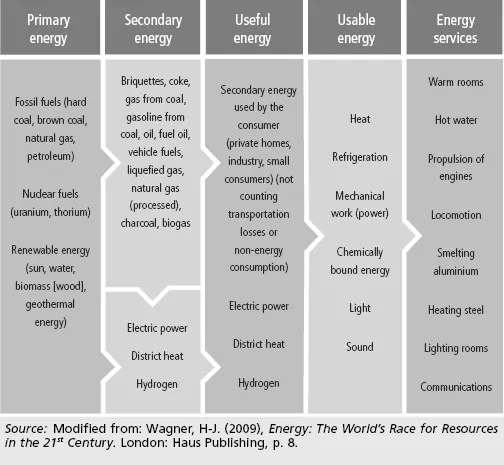
Energy systems have five essential components: the primary energy sources that form the base of the system and that have not been subject to any conversion or transformation process, the range of technologies that are used to convert primary energy into secondary energy products and useful and usable energy, and the eventual energy services that are provided to the energy consumer (see table 1.1). It is demand for energy services that drives overall demand, but a range of different primary resources and secondary energy products can supply those services. Thus, for example, electricity can be generated on the basis of all of the primary energy resources listed in table 1.1 that comprise the current energy system. The process of decarbonization that requires that fossil fuels be replaced by low carbon sources, namely, nuclear power and renewable energy, lies at the heart of policies aimed at resolving the global energy dilemma.
Table 1.1 Components of the contemporary energy system
The current fossil-fuel energy system is a recent invention of human society. It was not until the seventeenth century that coal started to be substituted for wood to provide heat. Before then society was dependent on biomass and human muscle power and, following the invention of agriculture and the domestication of animals, certain animals, together with wind and water power. The resulting “somatic energy system” was basically a solar energy system managed by humans (Sieferle 2001). In this system the only important energy converters were biological ones (McNeil 2000). The system remained essentially unchanged for centuries and the development of society was linked to the fertility of arable land, access to water, and the productivity of the forest. Podobnik (2006: 21) maintains that the Industrial Revolution happened first in Britain because the increasing scarcity and cost of wood and charcoal made coal an economically viable alternative. Smil (2010: 29) adds that the falling cost of coal production was also an important part of the picture. Whatever the case, two limiting factors were that the coalmines were not located in close proximity to major markets and that mining activity was restricted by the problem of flooding. At the time, coal could only be moved short distances by horsepower and over longer distances by river, canal, and sea. Then a series of mutually reinforcing technological and social changes triggered the Industrial Revolution that fundamentally and permanently changed the relationship between energy, society, and the natural environment (Wrigley 2010).
In 1712, Thomas Newcomen invented a steam engine, which although incredibly inefficient, provided a solution to the problem of how to drain the coalmines. It was so inefficient, however, that it could only really be located at or very close to coalmines; thus, it could not provide motive power to the wider economy. That came with the further refinement of the steam engine, most famously by James Watt who patented his new steam engine in 1769. This more efficient engine gained wider application, particularly in the cotton industry. Parallel advances in ferrous metallurgy were also part of the story as they increased demand for coal to produce coke and the resultant steel provided the raw materials with which to build ever more efficient steam engines. In 1830, the first public railway from Liverpool to Manchester was opened, along which ran Stephenson's Rocket. The rapid expansion of the railway system provided more efficient and economic ways of moving coal and other raw materials that in turn further increased the demand for coal and made industry more mobile as it could now move away from its raw material sources, a process that spawned the industrial city. Authors such as Podobnik (2006) and Huber (2009) warn us against “energy determinism” and point out that this transition was only made possible by major changes in society. In the case of Britain, Podobnik argues that the emergence of a capitalist elite – individuals such as Matthew Boulton, the business partner of James Watt – was essential as it provided the capital needed to finance industrialization; at the same time, the expulsion of peasants from rural land provided the workforce for the new towns and factories. Thus, industrialization and urbanization went hand in hand and new cities grew to prominence, all of which drove ever-increasing demand not only for energy, but also raw materials, much of...
Table of contents
- Cover
- Table of Contents
- Dedication
- Title
- Copyright
- Figures, Tables, and Boxes
- Acronyms
- Preface
- Chapter One: Introduction
- Chapter Two: The Global Energy Dilemmas Nexus
- Chapter Three: Sustaining Affluence: Energy Dilemmas in High-Energy Societies
- Chapter Four: Legacies and Liberalization: Energy Dilemmas in the Post-Socialist States
- Chapter Five: Fueling Growth: Energy Dilemmas in the Emerging Economies
- Chapter Six: Energizing Development: Energy Dilemmas in the Developing World
- Chapter Seven: Conclusions
- Appendix: Country Classification
- Bibliography
- Index
- End User License Agreement
Trusted by 375,005 students
Access to over 1.5 million titles for a fair monthly price.
Study more efficiently using our study tools.
Frequently asked questions
Yes, you can cancel anytime from the Subscription tab in your account settings on the Perlego website. Your subscription will stay active until the end of your current billing period. Learn how to cancel your subscription
No, books cannot be downloaded as external files, such as PDFs, for use outside of Perlego. However, you can download books within the Perlego app for offline reading on mobile or tablet. Learn how to download books offline
Perlego offers two plans: Essential and Complete
- Essential is ideal for learners and professionals who enjoy exploring a wide range of subjects. Access the Essential Library with 800,000+ trusted titles and best-sellers across business, personal growth, and the humanities. Includes unlimited reading time and Standard Read Aloud voice.
- Complete: Perfect for advanced learners and researchers needing full, unrestricted access. Unlock 1.5M+ books across hundreds of subjects, including academic and specialized titles. The Complete Plan also includes advanced features like Premium Read Aloud and Research Assistant.
We are an online textbook subscription service, where you can get access to an entire online library for less than the price of a single book per month. With over 1.5 million books across 990+ topics, we’ve got you covered! Learn about our mission
Look out for the read-aloud symbol on your next book to see if you can listen to it. The read-aloud tool reads text aloud for you, highlighting the text as it is being read. You can pause it, speed it up and slow it down. Learn more about Read Aloud
Yes! You can use the Perlego app on both iOS and Android devices to read anytime, anywhere — even offline. Perfect for commutes or when you’re on the go.
Please note we cannot support devices running on iOS 13 and Android 7 or earlier. Learn more about using the app
Please note we cannot support devices running on iOS 13 and Android 7 or earlier. Learn more about using the app
Yes, you can access Global Energy Dilemmas by Mike Bradshaw in PDF and/or ePUB format, as well as other popular books in Politics & International Relations & Environment & Energy Policy. We have over 1.5 million books available in our catalogue for you to explore.