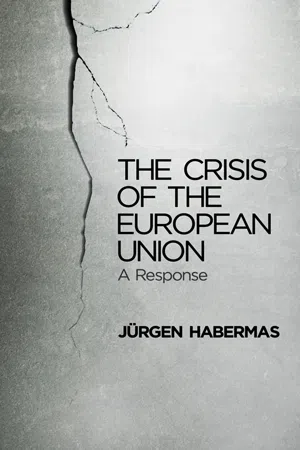
In the midst of the current crisis that is threatening to derail the historical project of European unification, Jürgen Habermas has been one of the most perceptive critics of the ineffectual and evasive responses to the global financial crisis, especially by the German political class. This extended essay on the constitution for Europe represents Habermas's constructive engagement with the European project at a time when the crisis of the eurozone is threatening the very existence of the European Union. There is a growing realization that the European treaty needs to be revised in order to deal with the structural defects of monetary union, but a clear perspective for the future is missing. Drawing on his analysis of European unification as a process in which international treaties have progressively taken on features of a democratic constitution, Habermas explains why the current proposals to transform the system of European governance into one of executive federalism is a mistake. His central argument is that the European project must realize its democratic potential by evolving from an international into a cosmopolitan community. The opening essay on the role played by the concept of human dignity in the genealogy of human rights in the modern era throws further important light on the philosophical foundations of Habermas's theory of how democratic political institutions can be extended beyond the level of nation-states.
Now that the question of Europe and its future is once again at the centre of public debate, this important intervention by one of the greatest thinkers of our time will be of interest to a wide readership.
- English
- ePUB (mobile friendly)
- Available on iOS & Android
eBook - ePub
About this book
Translated by Ciaran Cronin.
Information
The Crisis of the European Union in Light of a Constitutionalization of International Law – An Essay on the Constitution for Europe1
I Why Europe is now more than ever a constitutional project
In the current crisis, it is often asked why we should continue to cling to the European Union at all, not to mention the old aim of an ‘ever closer political Union’, now that the original motive of making wars in Europe impossible is exhausted. There is more than one answer to this question. In what follows, I would like to develop a convincing new narrative from the perspective of a constitutionalization of international law2 which follows Kant in pointing far beyond the status quo to a future cosmopolitan rule of law:3 the European Union can be understood as an important stage along the route to a politically constituted world society.4 Admittedly, on the laborious path leading up to the Lisbon Treaty, the forces friendly to Europe have been worn down by disputes over such constitutional political questions; but, quite apart from the implications for constitutional law of the European ‘economic government’ now planned, this perspective recommends itself today for two further reasons. On the one hand, the current debate has become narrowly focused on the immediate expedients for resolving the current banking, currency and debt crisis and as a result has lost sight of the political dimension (1); on the other hand, mistaken political concepts are obstructing our view of the civilizing force of democratic legal domestication, and hence of the promise associated from the beginning with the European constitutional project (2).
(1) The economistic narrowing of vision is all the more incomprehensible because the experts seem to be in agreement on the diagnosis of the deeper reasons for the crisis: the European Union lacks the competences to bring about the necessary harmonization of the national economies whose levels of competitiveness are drifting drastically apart. To be sure, in the short term the current crisis is monopolizing all of the attention.5 However, this should not lead the actors concerned to forget the underlying construction flaw of a monetary union which lacks the requisite political regulatory capacities at the European level, a flaw which is rectifiable only in the longer term. The ‘pact for Europe’ repeats an old mistake: legally non-binding agreements concluded by the heads of government are either ineffectual or undemocratic and must therefore be replaced by an institutionalization of joint decisions with irreproachable democratic credentials.6 The German government has become the catalyst of a Europe-wide erosion of solidarity because for too long it has shut its eyes to the only constructive expedient, one which even the liberal-conservative Frankfurter Allgemeine Zeitung now paraphrases with the laconic formula ‘more Europe’. None of the governments concerned has yet demonstrated the necessary courage, and they are all strugging ineffectually with the dilemma posed by the imperatives of the major banks and rating agencies, on the one side, and their fear of losing legitimacy among their own frustrated populations, on the other. Their panic-stricken incrementalism betrays the lack of a more expansive perspective.
Since embedded capitalism has run its course and the globalized markets have been outstripping politics, the OECD countries have found it increasingly difficult to stimulate economic growth while at the same time ensuring social security and a tolerably just distribution of income for the mass of the population. After the exchange rates were allowed to float freely, the OECD countries had temporarily defused this structural problem by accepting rising inflation. When this policy generated excessively high social costs, they chose the alternative expedient of increasingly financing public budgets through credit. The statistically well-confirmed trends of the past two decades reveal, however, that there has been an increase in social inequality and status insecurity in most of the OECD countries, even as the governments have covered their need for legitimation through sharp rises in public debt. Now the ongoing financial crisis since 2008 has also blocked the mechanism of incurring public debt. And for the time being it remains unclear how austerity policies imposed from above, which are in any case difficult to push through domestically, can be reconciled with maintaining a tolerable level of social security in the long run. The youth revolts in Spain and Great Britain are a portent of the threat to social peace.
Under these conditions the imbalance between the imperatives of the markets and the regulatory power of politics has been identified as the real challenge. In the euro zone, the vague prospect of an ‘economic government’ is supposed to revitalize the long since hollowed-out stability pact. Jean-Claude Trichet is calling for a joint finance ministry for the euro zone, though without mentioning the parliamentarization of the corresponding financial policy which would then likewise be required – or taking account of the fact that the range of policies relevant for competitiveness extends far beyond fiscal policy and reaches right into the heart of the budgetary privilege of the national parliaments. Still, this discussion shows that the cunning of economic (un)reason has placed the question of the future of Europe back on the political agenda. Wolfgang Schäuble, the last ‘European’ of stature in Angela Merkel’s cabinet, knows that transferring competences from the national to the European level impinges on questions of democratic legitimation. However, the direct election of a president of the European Union, a proposal of which he is a long-standing advocate, would be nothing more than a fig leaf for the technocratic self-empowerment of a core European Council whose informal decisions would circumvent the treaties.
These models of a special kind of ‘executive federalism’7 currently in circulation reflect the reluctance of the political elites to contemplate replacing the established mode of pursuing the European project behind closed doors with the shirt-sleeve mode of a vociferous, argumentative conflict of opinions within the broad public. Given the unprecedented gravity of the problems, one would expect the politicians to lay the European cards on the table without further delay and to take the initiative in explaining to the public the relation between the short-term costs and the true benefits, and hence the historical importance of the European project. In order to do so, they would have to overcome their fear of shifting public moods as measured by opinion polls and rely on the persuasive power of good arguments. All of the governments involved, and for the time being all of the political parties, are flinching at this step. Many of them are instead pandering to the populism which they themselves have cultivated by obfuscating a complex and unpopular topic. Politics seems to be holding its breath and dodging the key issues at the threshold leading from the economic to the political unification of Europe. Why this panic-stricken paralysis?
The familiar ‘no demos’ answer suggests itself from a perspective wedded to the nineteenth century: there is no European people; therefore a political Union worthy of the name is built on sand.8 To this interpretation I would like to oppose a superior one: the enduring political fragmentation in the world and in Europe is at variance with the systemic integration of a multicultural world society and is blocking progress towards civilizing relations of violence within societies and between states through constitutional law.9
(2) I would first like to recall what the civilizing force of democratically enacted law involves by briefly reviewing the precarious relation between law and power. Ever since its inception in the early civilizations, political authority has consistently constituted itself in the form of law. The ‘coupling’ of law and politics is as old as the state itself. Over thousands of years, law has played an ambivalent role in this regard. It served as a means of organization for an authoritarian mode of government, and for the prevailing dynasties it was simultaneously an indispensable source of legitimation. While the legal system was stabilized by the sanctioning power of state, political authority, in order to be accepted as just, relied in turn on the legitimizing force of a sacred law which it administered. The law and the judicial power of the king derived their sacred aura originally from the connection with the mythical gods and spirits and later from the appeal to religious natural law. But it was only after the medium of law had become detached from the ethos of society in the Roman Empire that it could bring its stubborn orientation to bear and finally produce rationalizing effects by legally channelling the exercise of political authority.10
However, political authority first had to be secularized and law had to be positivized throughout before the legitimation of authority could become dependent on the legally institutionalized consent of those subject to authority. Only with this development could that democratic juridification of the exercise of political authority which is relevant in the present context begin. For this juridification develops not only a rationalizing but also a civilizing force insofar as it divests state violence of its authoritarian character and thereby transforms the character of the political as such. As a political theologian, Carl Schmitt viewed this civilizing tendency with suspicion because, by diluting the authoritarian core of political rule, it also robbed it of its sacred aura.11 He conceived of the ‘substance’ of the ‘political’ as the ability to assert itself of a legally constituted authority, on which, however, no normative fetters may be placed.
On Schmitt’s interpretation, this substance was still able to manifest itself at the beginning of the modern era in the struggle of sovereign states against external and internal enemies. It disintegrated – at first in the domestic sphere – only with the constitutional revolutions of the eighteenth century. The constitutional state transforms private citizens into democratic national citizens; it rejects the notion of ‘internal enemies’ and treats its adversaries – even the terrorists – exclusively as criminals.12 Only the relations of the sovereign state to its external environment were temporarily ‘spared’ the normative fetters of democratic legal domestication.13 One need not share the associated evaluation in order to appreciate the descriptive force of freeing the concept of the ‘political’ from the fog of a mystified counter-enlightenment and restricting it to the core meaning of a democratically juridified decision-making and administrative power.
In international relations, it was only after the collapse of the League of Nations and since the end of the Second World War – with the founding of the UN and the beginning of the process of European unification – that a juridification of international relations began which goes beyond the tentative attempts to place restrictions on state sovereignty (at least in bello) through international law.14 The civilizing process that continues in these trends, which have accelerated since the end of the Cold War, can be described under two complementary aspects. The immediate objective of the domestication of international violence is to pacify relations between states; however, by curbing the anarchic competition for power and promoting international cooperation, this pacification also makes it possible to establish new supranational procedures and institutions for political negotiation and decision-making. For it is only through such new transnational steering capabilities that the social forces of nature that have been unleashed at the transnational level – i.e. the systemic constraints that operate without hindrance across national borders, today especially those of the global banking sector – can also be tamed.15
Of course, to date the evolution of the law has been neither peaceful nor linear. Insofar as we wish to speak of accomplishments in this dimension at all – as Kant did in his day in the light of the consequences of the French Revolution16 – such accomplishments, or ‘progress in legality’, have always been incidental consequences of class struggles, imperialistic conquest and colonial atrocities, of world wars and crimes against humanity, postcolonial destruction and cultural uprooting. But remarkable innovations appeared on the horizon of such constitutional change. Two of these innovations explain how a transnationalization of popular sovereignty is possible in the shape of a democratic alliance of nation states. On the one hand, nation states subordinate themselves to supranational positive law; on the other hand, the EU citizenry as a whole shares the constitution-building power with a limited number of ‘constituting states’ which acquire a mandate from their peoples to collaborate in founding a supranational political community.
If one regards the development of the European Union under these aspects, the route to a politically workable and democratically legitimized (core) Europe is by no means blocked. Indeed, with the Lisbon Treaty the longest stage of the journey has already been completed (II). The civilizing role of European unification acquires prominence especially in the light of a more far-reaching cosmopolitanism. In the last part I will take up those trends in international law which began with the prohibition of violence in international law and with the foundi...
Table of contents
- Cover
- Half Title
- Title Page
- Copyright
- Contents
- Preface
- The Crisis of the European Union in Light of a Constitutionalization of International Law – An Essay on the Constitution for Europe
- The Concept of Human Dignity and the Realistic Utopia of Human Rights
- Appendix: The Europe of the Federal Republic
- Sources
Trusted by 375,005 students
Access to over 1.5 million titles for a fair monthly price.
Study more efficiently using our study tools.
Frequently asked questions
Yes, you can cancel anytime from the Subscription tab in your account settings on the Perlego website. Your subscription will stay active until the end of your current billing period. Learn how to cancel your subscription
No, books cannot be downloaded as external files, such as PDFs, for use outside of Perlego. However, you can download books within the Perlego app for offline reading on mobile or tablet. Learn how to download books offline
Perlego offers two plans: Essential and Complete
- Essential is ideal for learners and professionals who enjoy exploring a wide range of subjects. Access the Essential Library with 800,000+ trusted titles and best-sellers across business, personal growth, and the humanities. Includes unlimited reading time and Standard Read Aloud voice.
- Complete: Perfect for advanced learners and researchers needing full, unrestricted access. Unlock 1.5M+ books across hundreds of subjects, including academic and specialized titles. The Complete Plan also includes advanced features like Premium Read Aloud and Research Assistant.
We are an online textbook subscription service, where you can get access to an entire online library for less than the price of a single book per month. With over 1.5 million books across 990+ topics, we’ve got you covered! Learn about our mission
Look out for the read-aloud symbol on your next book to see if you can listen to it. The read-aloud tool reads text aloud for you, highlighting the text as it is being read. You can pause it, speed it up and slow it down. Learn more about Read Aloud
Yes! You can use the Perlego app on both iOS and Android devices to read anytime, anywhere — even offline. Perfect for commutes or when you’re on the go.
Please note we cannot support devices running on iOS 13 and Android 7 or earlier. Learn more about using the app
Please note we cannot support devices running on iOS 13 and Android 7 or earlier. Learn more about using the app
Yes, you can access The Crisis of the European Union by Jürgen Habermas in PDF and/or ePUB format, as well as other popular books in Philosophy & Social Philosophy. We have over 1.5 million books available in our catalogue for you to explore.