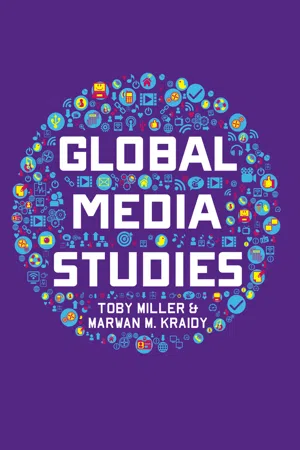
Global Media Studies is unique in its coverage of places, peoples, institutions, and discourses. Toby Miller and Marwan M. Kraidy provide a comprehensive ?how-to? guide to the study of media, going far beyond the established English-language literature and drawing on the best methods and research from around the world. They look at political economy, global policymaking and governance, and the past and present manifestations of cultural imperialism.
In addition to providing a survey of the field, the book introduces a new form of textual analysis, with a special focus on reality television, as well as models of audience research. The authors include original analyses of the US, European, Latin American, and Arab worlds, and case studies of mobile telephony, the impact of US media, and reality television.
This original and uniquely global textbook will be an essential resource for students of global media and international communication.
- English
- ePUB (mobile friendly)
- Available on iOS & Android
eBook - ePub
Global Media Studies
About this book
Information
1
Media Studies
The word “media” is often used in a very limited fashion, to designate a small number of discrete communications technologies and platforms: newspapers, magazines, film, radio, and television.1 But the wider field of communications, from cable to satellite to telephony, have become key sites for producing and receiving the media, and there is increasing overlap between such sectors, as black-box techniques and technologies, once set apart from audiences, become part of public experience and debate.
“Medium,” the singular form of the word “media,” has been in English usage since the seventeenth century. It refers to something that lies between two objects and links them. With that in mind, we use the term “media” as a portmanteau word to cover a multitude of cultural and communicative machines and processes that connect people, processes, institutions, meanings, and power in the material world.
The media constitute and are constituted by:
- technologies, which form their conditions of possibility;
- policies, which determine the field in which they operate;
- genres, which organize texts as drama, music, sport, information, and so on;
- workers, who make media texts through performances and recordings;
- audiences, who receive and interpret the ensuing content; and
- the environment, which is affected by the creation, use, and detritus of the media.
There is increasing convergence across the different media. In 1940s sociology and 1960s economics, the term “convergence” referred to capitalist societies that were becoming more centrally planned even as state-socialist ones grew more capitalist (Galbraith, 1967). In 1980s communication theory, convergence explained the processes whereby people and institutions share expressions and issues (Bormann, 1985).
Today, convergence is occurring across media platforms. Consumer electronics connect to information and communication technologies (ICTs) and vice versa: televisions resemble computers, books are read on telephones, newspapers are written through clouds, and so on. Genres, gadgets, and bodies that were once separate are now linked to produce what the US Television Advertising Bureau calls a “Great Circle of modern consumerism” – while audiences watch programs on TV, they use their tablets to buy the products that are being advertised.2 Film, radio, newspapers, television, and so on can no longer be considered as individually autonomous media, isolated from the internet and mobile telephony. Convergence is at play and work through blogging, fan sites, ringtones, and music and video downloads and applications.
Throughout our investigations, we’ll bear another core concept in mind: “culture.” It derives from the Latin colere, a verb to describe tending and developing agriculture. With the advent of capitalism’s division of labor, culture came both to embody instrumentalism and to abjure it, via the industrialization of farming, on the one hand, and the development of individual taste, on the other (Adorno, 2009: 146; Benhabib, 2002: 2).
Eighteenth-century German, French, and Spanish dictionaries bear witness to a metaphorical shift during this period from agricultural cultivation to spiritual elevation. As the spread of literacy and printing saw customs and laws passed on, governed, and adjudicated through the written word, cultural texts supplemented and supplanted physical force as guarantors of authority. With the Industrial Revolution, populations urbanized, food was imported, and textual forms were exchanged. An emergent consumer society produced such events as horse racing, opera, art exhibits, and balls. The impact of this shift was indexed in cultural labor: poligrafi in fifteenth-century Venice and hacks in eighteenth-century London wrote popular and influential conduct books. These works of instruction on everyday life marked the textualization of custom and the development of new occupations. Anxieties about cultural imperialism also appeared, via debates over Western domination that occupied intellectuals, politicians, and moral guardians beyond the West, particularly in what is often referred to as “the Muslim world” (Briggs and Burke, 2003; Kraidy, 2010; Mowlana, 2000; Sabry, 2010). Welcome to the foundations of media studies.
In the eighteenth century, Immanuel Kant ideologized these commercial and imperial changes, arguing that culture ensured “conformity to laws without the law.” Aesthetics could generate “morally practical precepts,” schooling people to transcend particular interests via the development of a “public sense, i.e. a critical faculty which in its reflective act takes account (a priori) of the mode of representation . . . to weight its judgement with the collective reason of mankind” (1987; also see Hunter, 2008). Kant envisaged an “emergence from . . . self-incurred immaturity,” independent of religion, government, and commerce (1991: 54). In other words, if readers could interpret art, literature, and drama in logical, emotional, and social ways – and comprehend the difference between them – they could be relied upon to govern themselves.
The Beginning – Media Studies 1.0
The media have usually been understood in two quasi-Kantian registers, via the social sciences and the humanities. They emerged as secular alternatives to deistic knowledge (Schelling, 1914) focused on dual forms of “self-realization” (S. Weber, 2000) – truth and beauty.
A heuristic distinction in the sixteenth century, this bifurcation became substantive as time passed (Williams 1983: 38). The media came to be understood as markers of differences and similarities in taste and status within and between groups. These qualities were explored interpretatively or methodically, with the social sciences animated by empirical facts and the humanities exercised by aesthetic qualities.
Today’s social sciences focus on the languages, religions, customs, times, spaces, and exchanges of the media, as explored ethnographically or statistically. The humanities analyze the media through textual criticism and institutional history.
So whereas the social sciences articulate differences within populations through social norms (for example, correlating media usage with health), the humanities do so through symbolic norms (for example, providing some of us with the cultural capital to appreciate high culture) (Wallerstein, 1989; Bourdieu, 1984).
The media’s connection to collective and individual identity and conduct has produced some powerful reactions to emergent media technologies and genres. In the nineteenth century, theorists from both right and left argued that newly literate publics would be vulnerable to manipulation by demagogues. This Kantian concern has continued ever since. For its part, contemporary bourgeois economics may assume that rational consumers determine what is popular in the media, but its sacerdotes are equally concerned that people can be bamboozled by unscrupulously fluent media organizations. On the other side of politics, Marxism has often viewed the media as a route to false consciousness that diverts the working class from recognizing its economic oppression, but also as an opportunity for agitprop. Feminist approaches have moved between condemning the media as distractions from gendered consciousness and celebrating them as distinctive parts of women’s culture; and cultural studies has regarded the media as key locations for symbolic resistance to class, race, and gender oppression (Smith, 1987; Hall and Jefferson, 1976).
From an array of political and epistemological perspectives, there has therefore been an emphasis on the origin, number, and conduct of media audiences: where they came from, how many there were, and what they did as a consequence of being present. Such concerns are coupled with a focus on content: what were audiences watching when they . . . . And so both audiences and texts are conceived as empirical entities that can be known, via research instruments derived from sociology, psychology, history, literary criticism, demography, linguistics, communications, anthropology, accountancy, economics, and marketing.
Perhaps the foremost early theorist of the media in critical thinking of the kind represented in this volume is the Italian Marxist Antonio Gramsci, whose opposition to fascism in the 1920s and ’30s is an exemplar for progressive intellectuals. Gramsci maintained that each social group creates “organically, one or more strata of intellectuals which give it homogeneity and an awareness of its own function not only in the economic but also in the social and political fields” – the industrial technology, law, economy, and culture of such groups. The “‘organic’ intellectuals that every new class creates alongside itself and elaborates in the course of its development” assist in the emergence of that class, for example via military expertise. Media intellectuals operate in “[c]ivil society . . . the ensemble of organisms commonly called ‘private,’ that of ‘political society’ or ‘the State’.” They comprise the “‘hegemony’ which the dominant group exercises throughout society” as well as the “‘direct domination’ or command exercised through the State and ‘juridical’ government.” Ordinary people give “‘spontaneous’ consent” to the “general direction imposed on social life by the dominant fundamental group” (Gramsci, 1978: 5–7, 12). In other words, the media legitimize socioeconomic-political arrangements in the public mind. They can be sites of struggle as well as domination.
Gramsci’s notion of hegemony has had global purchase. The Welsh cultural critic Raymond Williams (1977) developed the idea of residual, dominant, and emergent hegemonies to describe the process whereby class formations compete over media narratives that legitimize social control. At the time he wrote, in the 1970s, examples of these categories included the remains of empire (residual), a modern mixed economy (dominant), and neoliberal transformation (emergent). Extensive use has been made of hegemony theory beyond the Global North. In Latin America, Gramsci’s notion of the national popular harnessing of class interests is common sense for both left and right (Massardo, 1999). The same applies in South Asia and segments of the Middle East and Africa (Patnaik, ...
Table of contents
- Cover
- Title Page
- Copyright
- Abbreviations
- Introduction
- 1 Media Studies
- 2 Global Studies
- 3 Political Economy
- 4 Policy and Governance
- 5 Mobile Telephony (with Richard Maxwell)
- 6 The United States of America as Global Media Behemoth (with Bill Grantham)
- 7 Textual Analysis
- 8 Reality Television
- 9 Audiences
- Conclusion
- References
- Index
- End User License Agreement
Trusted by 375,005 students
Access to over 1.5 million titles for a fair monthly price.
Study more efficiently using our study tools.
Frequently asked questions
Yes, you can cancel anytime from the Subscription tab in your account settings on the Perlego website. Your subscription will stay active until the end of your current billing period. Learn how to cancel your subscription
No, books cannot be downloaded as external files, such as PDFs, for use outside of Perlego. However, you can download books within the Perlego app for offline reading on mobile or tablet. Learn how to download books offline
We are an online textbook subscription service, where you can get access to an entire online library for less than the price of a single book per month. With over 1.5 million books across 990+ topics, we’ve got you covered! Learn about our mission
Look out for the read-aloud symbol on your next book to see if you can listen to it. The read-aloud tool reads text aloud for you, highlighting the text as it is being read. You can pause it, speed it up and slow it down. Learn more about Read Aloud
Yes! You can use the Perlego app on both iOS and Android devices to read anytime, anywhere — even offline. Perfect for commutes or when you’re on the go.
Please note we cannot support devices running on iOS 13 and Android 7 or earlier. Learn more about using the app
Please note we cannot support devices running on iOS 13 and Android 7 or earlier. Learn more about using the app
Yes, you can access Global Media Studies by Toby Miller,Marwan M. Kraidy in PDF and/or ePUB format, as well as other popular books in Social Sciences & Media Studies. We have over 1.5 million books available in our catalogue for you to explore.