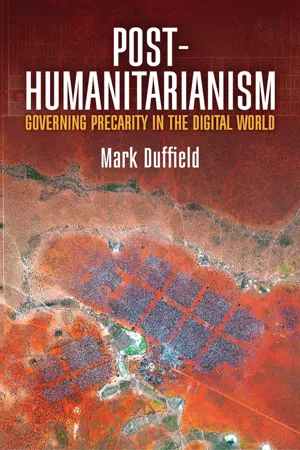
The world has entered an unprecedented period of uncertainty and political instability. Faced with the challenge of knowing and acting within such a world, the spread of computers and connectivity, and the arrival of new digital sense-making tools, are widely celebrated as helpful. But is this really the case, or have we lost more than gained in the digital revolution?
In Post-Humanitarianism, renowned scholar of development, security and global governance Mark Duffield offers an alternative interpretation. He contends that connectivity embodies new forms of behavioural incorporation, cognitive subordination and automated management that are themselves inseparable from the emergence of precarity as a global phenomenon. Rather than protect against disasters, we are encouraged to accept them as necessary for strengthening resilience. At a time of permanent emergency, humanitarian disasters function as sites for trialling and anticipating the modes of social automation and remote management necessary to govern the precarity that increasingly embraces us all.
Post-Humanitarianism critically explores how increasing connectivity is inseparable from growing societal polarization, anger and political push-back. It will be essential reading for students of international and social critique, together with anyone concerned about our deepening alienation from the world.
- English
- ePUB (mobile friendly)
- Available on iOS & Android
eBook - ePub
About this book
Information
Chapter 1
INTRODUCTION: QUESTIONING CONNECTIVITY
At the time of writing, there is a consensus among Western security specialists that the world has entered a period of uncertainty and political instability unprecedented in recent times. One such source is the latest Munich Security Report (MSR 2017) provocatively entitled ‘Post-truth, post-West, post-order?’. Intended for policy and security professionals, the Report is a digest of the latest international trends and events. Like a breathless messenger, it describes the different flags and factions of the illiberal barbarians now massing at the gates. In concert with a clutch of new books,1 it depicts a groundswell of populist and fundamentalist movements, laying claim to local or cultural authenticities, which are now challenging and pushing back cosmopolitan values and libertarian identities. Expected since the mid-1990s, it looks as if the ‘coming anarchy’ may now be arriving (Kaplan 1994). There are several factors, however, that give the present a new and distinct feel. Divisions and contradictions are appearing in the West. Random terrorism is becoming routine, while dissatisfaction is growing among those who feel left behind and abandoned. Apart from increasing security measures and orchestrating public displays of resilience, political elites are challenged for real answers. With Syria as a case in point, compared to the 1990s, Western states have also lost their interventionary nerve.
Citizens of democracies believe less and less that their systems are able to deliver positive outcomes for them, and increasingly favour national solutions and closed borders over globalism and openness. Illiberal regimes, on the other hand, seem to be on solid footing and act with assertiveness, while the willingness and ability of Western democracies to shape international affairs and to defend the rules-based liberal order are declining (MSR 2017: 5).
This book is not concerned with questioning whether this picture of international push-back and Western decline is accurate or not. That it exists and has credence is sufficient. Our point of departure is the stark contrast between this imaginary future–present and a different, earlier one – namely, how the international scene looked a mere five or six decades ago. Driven by frequently violent struggles for national liberation, decolonization and the dismantling of imperialism from below were in full swing. With its excess of youthful radicalism, for many commentators the 1960s were a volatile interregnum of emancipatory forces pushing towards world revolution (Mills 1960). Breaking with Victorian Marxism, the rash of anti-colonial struggles ushered in a New Left convinced that the peasantry was now the true heir of this revolution. As the colonial order eroded, continuing privation and exploitation meant that it was the peasantry, unlike most industrial workers, that now had nothing to gain from compromise: ‘In China and Vietnam, in Cuba, Kenya and Algeria, in Brazil’s North-east and in the back-country of Angola, the peasantry has emerged as the decisive force in revolutionary struggles’ (Buchanan 1963: 11).
Contrary to an earlier Eurocentric left orthodoxy, while a radicalized intelligentsia and worker vanguard could prime the revolutionary fuse in the industrial countries, it was an emergent Third World that would now ignite it (Marcuse 1967). Moreover, without the active alignment and international solidarity between these spatially separated forces and struggles, the chance of world revolution would be lost. Whether such views were realistic or delusional should not detract from the fact that they were real enough to mobilize people on an international scale. The contrast between a revolutionary, anti-racist future–present, where the international appeared as a space of political optimism and fraternity, and today’s more pessimistic vista of rupture and political failure is striking.
This book is a preliminary attempt to try to understand this shift and assess what we may have lost and, for good or ill, what we have gained. Methodologically attentive to history, it addresses this question in relation to the changing understanding of the nature of humanitarian disaster. How disasters are understood and communicated shapes the nature of the global North–South interface (Chouliaraki 2013).2 Indeed, one could go further. Since the 1980s, disasters have become a new ontological force. From the crash of asteroids into a primeval Earth, disasters have been given a pivotal role in the evolution of life, in the development of creativity and, not least, as key punctuation marks in the emergence and spread of human society (Homer-Dixon 2007). This catastrophism has accompanied the rise to dominance of an ecology-based resilience thinking, with its signature view that ‘authentic’ life exists in the jouissance that lies on the edge of extinction. Resilience is a measure of the probability of escaping disaster through socializing the smart moves that drive developmental evolution (Holling 1973). Disasters are thus a potent bridging mechanism that connects humanitarian practice with wider ideological and societal change. These changes, moreover, help illuminate the move from optimism to political pessimism. This shift, it will be argued, is integral to the rise of post-humanitarianism.
However, in making a link from disasters to these broader questions, two additional and accompanying registers or sets of differences are important. Over the period in question, there has been a spatial shift from ‘circulation’ to ‘connectivity’, together with an interrelated ontological, epistemological and methodological transition from deductive ‘knowledge’, framed by history and causation, to an increasing reliance on inductive mathematical ‘data’ and machine-thinking for sense-making. The way we know the world and understand what it means to be human has fundamentally changed (Chandler 2018). Rather than seeing the emergence of a new post-human essence, this book grounds these shifts and registers in the changing nature of capitalism. While corporations, governments and the academy celebrate the age of connectivity, and regard the sort of international foreboding described in the Munich Security Report as a separate issue, we are more open to the possibility of their causal correlation. This Introduction unpacks these registers and gives the reader an indication of the structure of the book.
Circulation and Connectivity
Between the 1960s and the present, the nature and organization of international space have changed. Of primary importance has been the relative shift from ‘circulation’ to ‘connectivity’ (Reid 2009). As a factor of spatial organization, circulation involves the physical movement or flow of people and things within, across or around terrestrial milieus and topographies. Discussed more fully in chapter 5, Foucault has argued, that the principle of circulation was central to a liberal conception of security arising from the discovery of the early modern town in terms of its spatial and logistical dynamics. The problem of the town ‘was essentially and fundamentally a problem of circulation’ (Foucault 2007: 13). During the nineteenth century, improving the circulation of people, goods, sewage, light and air, together with managing the movement of disease, crime and political unrest, would become a key feature of modernist planning and urban design (Rabinow 1995). From the perspective of modern urban planning, the city was an infrastructure designed to maximize the circulatory potential of autonomous people and things, while controlling the bad and inimical. Through the opening-up achieved by roads, canals, sewers and railways, for example, people and things were enabled to move, change place and transact. While not without risks, and thus needing administrative, health and police oversight, the aim was to maximize circulation along such fixed conduits.
Connectivity is similar but fundamentally different. Google’s notion of a data-based urbanism, for example, sees cities as key sites for the conversion of data extracted from the electronic interactions of individuals into continually adapting forms of artificial urban intelligence. A 12-acre site in Toronto’s waterfront area is currently being developed as a testbed. It envisions: ‘Modular buildings assembled quickly; sensors monitoring air quality; traffic lights prioritising pedestrians and cyclists; parking systems directing cars to available slots; delivery robots; advanced energy grids; automated waste sorting and self-driving cars’ (Morozov 2017).
Here the city appears as a closed interactive milieu involving the continuous recording and exchange of information between people, things and computer interfaces in motion. Connectivity draws together different domains such as consumer needs, waste disposal, transport, parking and delivery requirements into an integrated real-time information network. While people and things still move, change place and transact, it is no longer autonomous circulation in the modernist sense. Without triggering a series of alerts, a person could not, for example, arrive unexpectedly at a railway station, and buy a ticket for destination A but leave instead at station B. Within the smart city, movement and behaviour are constantly recorded, algorithmically analysed, optimized and directed (Halpern 2014b). Unlike the spontaneous circulation allowed by the modern city, movement within the smart city is essentially robotic.
As a science of information, cybernetics requires the recording and storing of data on all past interactions as a precondition for predicting future behaviour and signalling the presence of anomalies (Wiener 1954). Unlike free circulation, which always involves a potential threat to security (Foucault 2007: 19), connectivity uses the command and control functions made possible by data informatics to avoid surprise. To put this another way, while circulation is necessary it is also open to accidents, dangers and unforeseen consequences. Air travel, for example, can be a vector in the spread of disease. As a way of controlling the necessary risks of circulation, security has evolved as an expanding and invasive technology of connectivity (see chapter 5).
There is another aspect of connectivity, however, that is also important for this book, and which further distinguishes it from the territorially grounded nature of circulation. Imagine a dozen computers scattered around the globe, networked together via a central hub and each machine being able to transmit and exchange data with the others instantaneously. Rather than having to flow through or circulate within frictive topographies, connectivity has the power to leap directly across them, bypassing terrestrial insecurity while rendering distance insignificant. Finance capital, for example, is not like physical money. The latter constantly circulates between pockets, cash registers and banks until it is worn out. As an example of connectivity, finance is capital encoded as data that travels at the speed of light between the vast territorially dispersed network of computers that constitute the global banking system (Lewis 2014): ‘[Connectivity] de-spatializes the real globe, replacing the curved earth with an almost extensionless point, or a network of intersection points and lines that amount to nothing other than connections between two computers any given distance apart’ (Sloterdijk 2013 [2005]: 13).
Although different, circulation and connectivity are not mutually exclusive. They exist together, shape each other and, over time, exist in varying combinations. For this book, the relative shift from circulation to connectivity is implicated in the displacement of revolutionary optimism by political pessimism. In the 1960s, at the height of international expectation, the ability for people, their histories, experience and politics, to circulate internationally was greater than it is today. For a while, the circulation and flow of political praxis was possible as never before. During the period of decolonization, Western European countries were moved to accept permanent immigrants from their colonies and former colonies, together with allowing refugee settlement and recruiting significant numbers of migrant workers. Aspirational white settler colonies such as Australia, New Zealand and Canada also temporally lifted the ‘colour line’ that had earlier applied, especially toward Asian labour migrants (Meyers 2002). For Herbert Marcuse, as for other radicals exiled at some point in their lives, the ability for political praxis to circulate was taken for granted. At a time when journalists were not embedded (Page 1989), this ability was an essential condition of the international solidarity necessary for world revolution. By the mid-1970s, however, the near-universal curtailment of immigration was already underway.
Driven by a mix of racial, social and security fears, the relative post-World War II openness to migration has narrowed and closed under successive waves of immigration controls, nationality laws and refugee restrictions (Hammerstad 2014). Since the end of the Cold War, as a visible register of this institutional move to closure and return, the number of physical border fences, demarcation walls or separation zones to contain the risk of autonomous movement has exploded globally (Brown 2010). Of course, the barriers and restrictions that now striate the globe have not prevented the urge to move. Indeed, as the upward track of numbers suggests (UNHCR 2017a), the pressure to escape poverty, disaster and war, even at the risk of an arduous and perilous passage, is as strong as ever. With millions in the queue, it shows few signs of abating. While offering no viable sol...
Table of contents
- Cover
- Table of Contents
- Title page
- Copyright page
- Dedication
- Preface
- Chapter 1: Introduction: Questioning Connectivity
- Chapter 2: Against Hierarchy
- Chapter 3: Entropic Barbarism
- Chapter 4: Being There
- Chapter 5: Fantastic Invasion
- Chapter 6: Livelihood Regime
- Chapter 7: Instilling Remoteness
- Chapter 8: Edge of Catastrophe
- Chapter 9: Connecting Precarity
- Chapter 10: Post-humanitarianism
- Chapter 11: Living Wild
- Chapter 12: Conclusion: Automating Precarity
- Bibliography
- Index
- End User License Agreement
Trusted by 375,005 students
Access to over 1.5 million titles for a fair monthly price.
Study more efficiently using our study tools.
Frequently asked questions
Yes, you can cancel anytime from the Subscription tab in your account settings on the Perlego website. Your subscription will stay active until the end of your current billing period. Learn how to cancel your subscription
No, books cannot be downloaded as external files, such as PDFs, for use outside of Perlego. However, you can download books within the Perlego app for offline reading on mobile or tablet. Learn how to download books offline
Perlego offers two plans: Essential and Complete
- Essential is ideal for learners and professionals who enjoy exploring a wide range of subjects. Access the Essential Library with 800,000+ trusted titles and best-sellers across business, personal growth, and the humanities. Includes unlimited reading time and Standard Read Aloud voice.
- Complete: Perfect for advanced learners and researchers needing full, unrestricted access. Unlock 1.5M+ books across hundreds of subjects, including academic and specialized titles. The Complete Plan also includes advanced features like Premium Read Aloud and Research Assistant.
We are an online textbook subscription service, where you can get access to an entire online library for less than the price of a single book per month. With over 1.5 million books across 990+ topics, we’ve got you covered! Learn about our mission
Look out for the read-aloud symbol on your next book to see if you can listen to it. The read-aloud tool reads text aloud for you, highlighting the text as it is being read. You can pause it, speed it up and slow it down. Learn more about Read Aloud
Yes! You can use the Perlego app on both iOS and Android devices to read anytime, anywhere — even offline. Perfect for commutes or when you’re on the go.
Please note we cannot support devices running on iOS 13 and Android 7 or earlier. Learn more about using the app
Please note we cannot support devices running on iOS 13 and Android 7 or earlier. Learn more about using the app
Yes, you can access Post-Humanitarianism by Mark Duffield in PDF and/or ePUB format, as well as other popular books in Politics & International Relations & International Relations. We have over 1.5 million books available in our catalogue for you to explore.