![]()
Part One
Historical Precedents in Urban Design
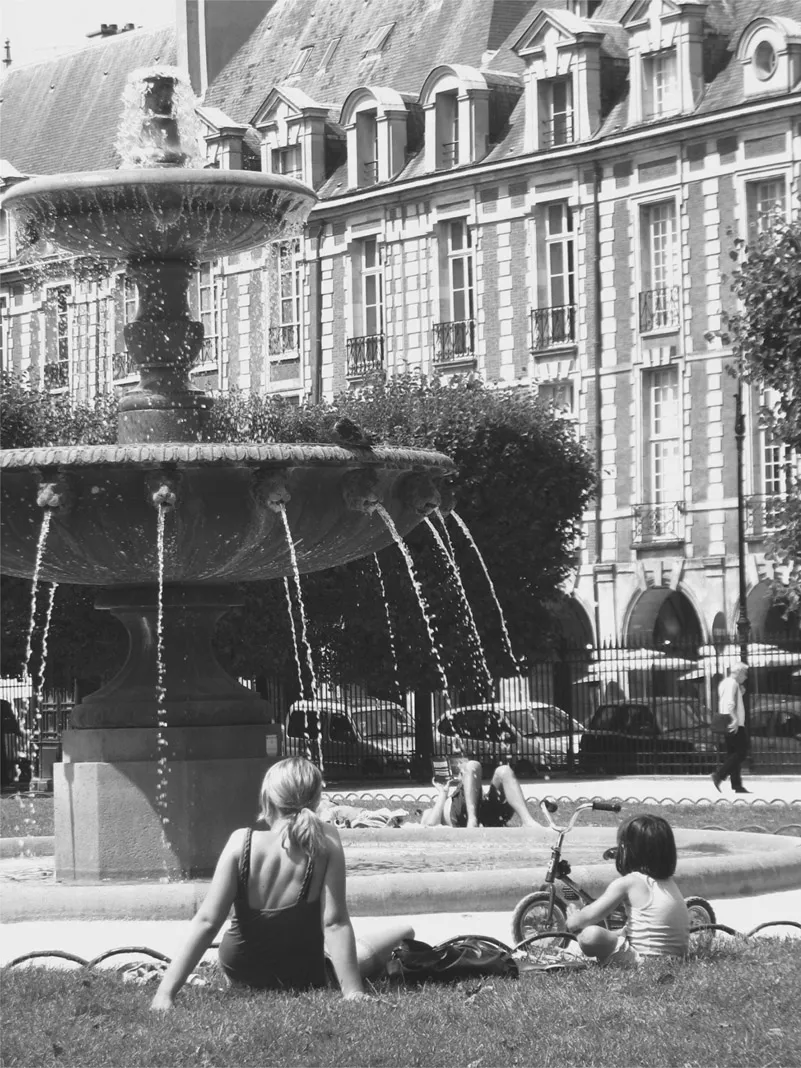
Plate 2 The Place des Vosges in Paris, France is the oldest fully designed square in the city. Constructed under Henri IV in the early seventeenth century as a royal palace in the Marais District, the square has become the prototype for the traditional European residential square. The square’s design is remarkably simple: a uniform four-story arcaded perimeter wall, a fenced public realm space, a symmetrical park, an equestrian statue and bosque of lindens at the center, alleés of clipped linden trees forming a secondary enclosure, plenty of bench seating and lawn space, and fountains at each of the four corners. Today the Place des Vosges has become an important and imageable part of Paris’ public realm; attracting both young and old – lunchtime visitors and weekend picnics – lovers and people watchers. (Photo: E. Macdonald)
![]()
Introduction to Part One
The contemporary urban design field is commonly understood to have had its birth in the mid-1950s, spurred by wide-ranging concerns related to diminishing environmental quality, both ecological and urban, and the emergence of a number of theorists and practitioners whose voices crystalized these concerns and pointed toward more environmentally conscious and humanistic approaches to city-building than the functionalist approach espoused by modernism. The ideas and design approaches of these thinkers are explored in Part Two of this reader. But first, it is important to understand what came before, the many ideas and practices that preceded and helped shape the modern urban design field. Here, in Part One, we explore some of the most important historical precedents in urban design, particularly those that still resonate and continue to influence today’s urban design theory and practice.
The world’s many historic and more recent cities are rich with physical urban forms. Different eras, times, geographies, and economies have produced a variety of urban physical forms that come to us as precedents. So, too, have people from different times and places produced various theories of what makes “the good city.” Present-day urban designers have access to a wealth of experience, design theory, and urban form precedents to draw upon. Some historic ideas and urban forms complement and build upon each other, while others present radical breaks with earlier ideas and ways of building cities. The history of urban form and ideas about good city form have not followed a single, steady path. New physical form ideas – grand diagonal avenues, curvilinear residential streets, garden cities, traffic-protected neighborhood enclaves, high-rise towers – come and have their impacts, then retreat or move in another direction, only to be reborn later or to disappear. For urban designers, it is important to know and understand the origins and impacts of the many different forms that make up today’s cities, including their theoretical foundations, in order to understand why urban fabrics are the way they are, and to have a rich palette to draw upon when creating designs for the future.
The historic ideas and practices we explore in Part One primarily come from the mid-nineteenth to mid-twentieth centuries, although for greater context we first look at the forces that shaped early Islamic cities and the flowering of urban form ideas that arose during the Renaissance period. This is not to undervalue earlier design ideas and physical forms, but rather to present the most useful set of readings for present-day students and practitioners. The ideas and physical forms that have their roots in the modernization processes that started in the early 1800s, with what is commonly referred to as the industrial revolution, are those that most powerfully resonate with our current condition and have had the greatest impact on the form of modern cities. The social and economic changes that accompanied the industrialization of European and North American cities in the late eighteenth and early nineteenth centuries brought forth some of the worst living conditions seen before or since in the western world. Central areas of cities became densely built, overcrowded, heavily polluted, and highly unsanitary. New physical form answers as well as socio-economic reforms had to be found for those conditions, and a host of concerned people came forth with answers.
Before exploring nineteenth- and twentieth-century precedents for urban design, we start with two pieces that present and analyze urban forms and theories about design coming from earlier times. First, a reading from Edmund N. Bacon’s seminal Design of Cities, a path-breaking book in the urban design field, connects us with design ideas and professional practices of the Renaissance. We learn about how, with the invention of perspective drawing and the rise of a humanist desire for visual order, architects took on a major new role as arrangers of urban space. Next, a relatively recent journal article by Janet Abu-Lughod analyzes the cultural forces that shaped the form of traditional Islamic cities in the Middle East and North Africa. Although Islamic cities have long been described by western scholars as having an “organic” urban form, this reading takes a contrary view, arguing that their form derived from cultural processes that profoundly influenced resulting physical forms. It is an important work that helps debunk the myth of organic urban growth that all too often creates nostalgia for earlier ways of city-building.
We turn then to the wealth of ideas and forms that sprang from industrialization. The urban modernization process, in physical terms, can be said to have started with Baron Haussmann’s reconstruction of Paris in the 1850s and 1860s. The two poetically written selections from Marshall Berman’s excellent book, All That is Solid Melts into Air, evoke the feeling of the time and the enormous social changes wrought when the city was opened up with wide new boulevards and public spaces. The glittering café life that developed along the tree-lined boulevards stood in stark contrast to the poverty of surrounding working-class areas, and people for the first time had to contend with fast-moving city traffic. The next reading, “Public Parks and the Enlargement of Towns,” is a classic writing by Frederick Law Olmsted, the father of the American Parks Movement. Written at the same time that the remodeling of Paris was going on, and taking partial inspiration from Haussmann’s parks and boulevards, it extols the virtues of large picturesquely designed urban parks for bringing together diverse urban populations and providing relief from the stresses of urban life. Woven within the narrative is a vision for suburban expansion that includes separated land uses and picturesquely designed residential districts.
The reading from Camillo Sitte, two chapters taken from his book City Planning According to Artistic Principles, which was written at the very end of the nineteenth century, directs attention to the aesthetic deficiencies of the rectilinear street and block patterns that had come into vogue. He urges a re-appreciation of the picturesque layouts of medieval cities, particularly arguing that important public gathering spaces and public buildings were much better defined and emphasized in a picturesquely laid out urban fabric, with its twists and turns and juxtapositions of spatial sizes, than in regular and uniform grid patterns. Rather than looking back to earlier urban forms, another idea from just before the turn of the twentieth century identified large industrial cities as the root cause of modern society’s ills and put forward a radically new approach to city-building. Ebenezer Howard’s Garden City idea, published in a short monograph, proposed decentralizing urbanization and building regional networks of small self-contained cities set within agricultural greenbelts. While Howard’s proposal was expressed only in diagrammatic form and contained within it radical ideas of social reform, it was the captivating image of melding the city with the countryside that captured people’s imagination and soon transformed town planning practice. Although the theoretical Garden City idea remains inspirational to many, in real-world practice it soon morphed into the idea of picturesquely designed and leafy green suburbs. Concerns about the ills of industrial cities also spawned the American City Beautiful Movement, which flourished during the first decade of the twentieth century. Very different than Howard’s visionary theoretical approach, the practically focused City Beautiful Movement was concerned with cleaning up and beautifying the public realm of existing cites. William H. Wilson’s piece “Ideology and Aesthetics,” taken from his book The City Beautiful Movement, provides a good overview of the short-lived and now somewhat maligned movement, identifying how and why it came into being and its lasting influences.
By the late 1920s, widespread ownership of automobiles had transformed many cities into places where the public realm was congested with traffic, leading to a new sense of crisis that was spawned by safety concerns and the perceived need to create areas of refuge from the vehicle onslaught. It was within this context that Clarence Perry originated the neighborhood unit concept, which proposed an altogether new way of designing cities to control traffic and keep it away from residential neighborhoods, using strategies that included street hierarchies, superblocks, and inwardly focused pod-like development. First presented within the 1929 Regional Plan of New York and Its Environs, Perry’s idea had enormous influence on the form of future residential areas in the United States, spawning the ubiquitous suburban subdivision. Finally, two pieces from The City of To-Morrow and Its Planning present in Le Corbusier’s own words his disparagement of pre-modern urban forms and his vision for the rationalized modern city that would become such a paramount force in urban planning and architecture throughout the twentieth century and beyond. His vision compelled the massive urban clearance and redevelopment schemes and urban highway building programs of the 1950s and 1960s, which destroyed the fabrics of so many American city centers.
![]()
“Upsurge of the Renaissance”
from Design of Cities (1967)
Edmund N. Bacon
Editors’ Introduction
The roles and filters of urban designers in the process of city-making evolved dramatically during the Renaissance with the humanist desire for visual order, the discovery of mathematical perspective, and new conceptions of space related to time and experiential movement. Early in Design of Cities, Edmund Bacon notes that a fundamental shift occurred from the medieval city, which was composed intuitively, perceived simultaneously from different viewpoints, and well integrated to its environment – to a perception of the Renaissance city that was dependent on the personal filters of designers at specific geographic locations and moments in time. The rise of one-point perspective in design practice elevated the individual eyes of designers and their particular focus to new importance (typically targeted at works of art or ecclesiastical and civic buildings of the powerful). In addition to reinforcing the power of capital and elite interests, Renaissance designs based in visual order and one-point perspective emphasized harmony in building design, the linearity of streets, and faster movement through the city. As a result, designers occupied a heightened role in urban decision-making processes, either in predicating new designs or in responding to the design of others (see the section on “Principle of the Second Man” herein). Despite Bacon’s suggestion that the form of a city is “determined by the multiplicity of decisions made by the people who live in it,” the influence of the Renaissance designer to evoke a singular vision suggests anything but a participatory multi-stakeholder process of design. Renaissance reliance on the designer’s perspective elevated the role of the design eye and created a new elite class that was able to direct the focus of others and create perceptual harmonies where none previously existed.
Bacon’s intention in writing Design of Cities was to investigate the many decisions that influence urban form and to expose the various individual acts of will used in making the noble cities of the past. This particular reading from the book is notable not only for the specific innovations of the Renaissance, but also because it echoes debates that were occurring at the time of its publication in the mid-1960s over the role of designers and planners in making cities. Emanating from Jane Jacobs’ critique of elite planners and designers in The Death and Life of Great American Cities, Bacon politely refutes the notion of incremental growth and the ad hoc city that was gaining popularity in the mid-1960s. He rejects the notion “that cities are a kind of grand accident, beyond the control of human will,” and instead contends that designers should assume responsibility for expressing “the highest aspirations of our civilization.” In addition to highlighting key theories of city design, it is of little surprise that examples throughout the book accentuate individual acts of will by well-known designers through history, including Hippodamus of Miletus, Michelangelo, Sixtus V, the Woods at Bath, Haussmann in Paris, and Le Corbusier. As a well-positioned practitioner and academic who recognized the ground-shift beginning to occur in the planning field toward more participatory design, Bacon was sensitive to the need for “democratic feedback” and participatory project review to ensure that people’s needs were met. Yet at the same time, he could not deny his own professional standing as a leader in the field, his faith in government to improve society on behalf of the public interest, and the power of individual design ideas that are “necessary to create noble cities in our own day.” Although public participation in design practice is increasingly valorized, the role of personal agency in creativity and design leadership is still debated.
Edmund N. Bacon (1910–2005) was a planner and educator, who studied at Cornell University and the Cranbrook Academy of Art under the renowned Finnish architect Eliel Saarinen. He worked as an architect and planner in Flint (Michigan), China, and Philadelphia, before becoming managing director of the Philadelphia Housing Authority and later executive director of the City Planning Commission from 1949 to his retirement in 1970. He taught for a time at the University of Illinois and then the University of Pennsylvania between 1950 and 1987. He focused much of his design and planning career on the City of Philadelphia, where he achieved fame in the popular press in the mid-1960s, including a cover article in Time and a feature in Life magazines. Alongside significant efforts to preserve and restore the city’s historic core, his visions and projects transformed the city. While some, such as Penn’s Landing, Market East, the redevelopment of Society Hill, and improvements to Independence Mall, were hailed as successes, other modernist proposals for downtown expressways and various mega-projects were met with opposition. This experience as a practitioner undoubtedly helped shape his perspective on urban history and the role of the urban designer as a pivotal participant in the larger urban development process.
Other general urban form histories include: Leonardo Benevolo, The History of the City (London: Scolar Press, 1980); Sir Peter Hall, Cities in Civilization (New York: Pantheon, 1998); Mark Girouard, Cities and People: A Social and Architectural History (New Haven, CT: Yale University Press, 1985); Spiro Kostoff, The City Shaped: Urban Patterns and Meanings Through History (Boston, MA: Little, Brown, 1991) and The City Assembled: The Elements of Urban Form Through History (Boston, MA: Little, Brown, 1992); A.E.J. Morris, History of Urban Form Before the Industrial Revolution, 3rd edn (New York: John Wiley, 1994); Lewis Mumford, The City in History: Its Origins, Its Transformation and Its Prospects (New York: Harcourt, Brace, Jovanovich, 1961); Steen Eiler Rasmussen, Towns and Buildings (Cambridge, MA: MIT Press, 1994, original 1949); Aidan Southall, The City in Time and Space (London: Cambridge University Press, 1998); and Paul Zucker, Town and Square: From the Agora to the Village Green (New York: Columbia University Press, 1959).
Important books focusing on Renaissance urbanism, architecture, and urban design include: Leonardo Benevolo, Architecture of the Renaissance (Boulder, CO: Westview Press, 1978); Peter Murray, Architectu...